
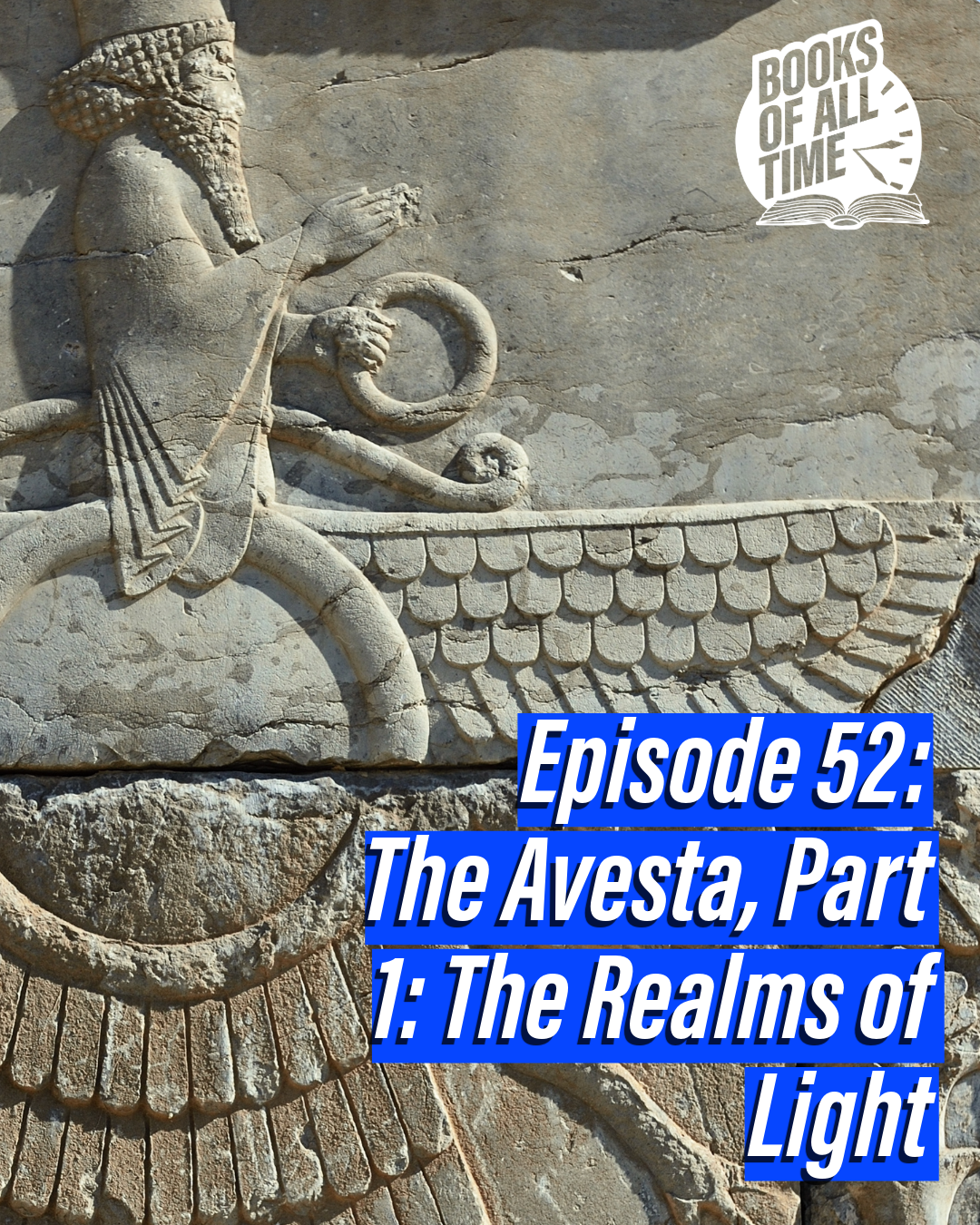
“‘Zarathustra am I:
may I be in reality, as I would wish, the bane of the wrongful one
and to the righteous a strong support.’”
- The Avesta, Yasna 43:8, translated by M.L. West (97)
Just as he was about to begin reciting his prayers, the otters appeared. The young priest stood quietly in the ankle-deep water at the edge of the river and watched them. There were two, a mother and her pup, and they were floating serenely along the slow-moving current in an embrace, to all appearances asleep. But this was only an appearance.
As soon as they drew level with him, both mother and child opened their eyes. They looked directly at the priest without a trace of fear and held his gaze. He felt the eye contact like a shock. With a deft writhing motion of her long body, the mother turned and began to make for the opposite shore, watching the priest all the while. He, in turn, did not look away from her as he set down his bowl and bundle of sticks on the gravel just behind him. Then he pushed into the river and began to swim across. He felt no shock from the cold water; it was as if there were a fire newly kindled in him, growing in his very bones.
The otter reached the opposite bank, shook herself, shifted her pup onto her back, and waited for the priest. As he waded out, she darted a little way down the bank, against the direction of the river’s flow. She looked back at him, and when he began to move toward her, she turned away with an almost human expression of satisfaction. The priest followed her as she led him on a slanting course away from the shore, into the trees beyond.
She led him through thick undergrowth and across a boulder field. Even as he stumbled, even as he began to lose a sense of where he was, the priest did not tire. The fire within him only grew higher. The otter made for the breast of a hill, where there was a clearing. As priest approached it, he could see a light—an unnatural light, as though a piece of the sun had split from the high dome of heaven and fallen into this space between the trees.
But he felt no alarm, only a sharper sense of anticipation. It was as if he was approaching the moment of some long-awaited reunion, as though every footstep brought him nearer to the one person in the world he most wanted to see. And he had an intuition that the light wanted to see him, too: it moved to and fro, as though pacing with impatience. As though it were waiting for him.
The otter vanished into the tall grass at the edge of the clearing, her duty done. The young priest, Zarathustra, did not notice her. He had eyes only for the being in the light.
I’m Rose Judson. Welcome to Books of All Time.
Intro – Overview of the Avesta, Who Was Zoroaster/Zarathustra?
Books of All Time is a podcast that’s tackling classic literature in chronological order. This is episode 52: The Avesta, Part 1: The Realms of Light. As always, if you’d like to read a transcript of this episode or see the references I used to write it, you can visit our website, booksofalltime.co.uk. There’s a link in the show notes if you need it. Let’s begin.
This month, we are taking a step out of our more-or-less chronological timeline to take a look at the Avesta, an immense collection of scriptures and hymns which form the foundation of Zoroastrianism, a religion which originated in what’s now eastern Iran and western Afghanistan no later than 590 BCE. Depending on how you date the Avesta, we could be taking that step backward or forward. Scholars believe the oldest language within the Avesta could go back as far as 1500 BCE, but the earliest extant manuscripts of it only date to about 1200 CE. Yes, the Avesta is another one of those works which, like the epic poems of Homer or the Rig Veda from India, originated in oral tradition and only came to be written down much later.
That’s not all that the Avesta has in common with the Rig Veda, either. Both seem to have sprung out of the Bronze-Age polytheistic pastoralist culture of western Asia, a group of peoples who referred to themselves as Aryans. We encountered some of the practices of these people way back in 2024, when we were looking at the Rig Veda. They kept cows and they fought in chariots. They had group rituals involving sacred fires, libations of butter and milk, and sometimes sacrifices of cows or horses. They made a sacred drink from a mountain plant that caused euphoria in those who consumed it. They believed in a group of supernatural beings who could be invoked or placated with prayers and sacrifice.
But the difference is that while the people who composed and memorized the Rig Veda worked to preserve those traditions, the people who composed and memorized the Avesta were rejecting them. Maybe “rejecting” is a bit strong, but certainly they were looking to radically reform those traditions.
Over time, the Vedic people – the Indo-Aryans, as some scholars call them – would move east into modern-day India and Pakistan, while the people of the Avesta – the Irano-Aryans – moved west into the highlands of Iran. The Vedic people’s practices were the foundation of Hinduism. The Avestan people’s faith would eventually be adopted by the Persian-speaking people of ancient Iran—the same ones whose empire would stretch into ancient Greece and Egypt, the same ones who would eventually fall to Alexander the Great in 331 BCE. It was the foundation of a faith that centered on the worship of one god, Ahura Mazda. Today we name that faith after its first prophet, Zarathustra Spitama, called Zoroaster by the ancient Greeks.
Zoroaster (as I’ll call him), may have been a real person. Scholars seem reasonably satisfied that he actually existed, but they still debate when exactly he lived. Analysis of the language of the Avesta suggests that its earliest section, known as the Gathas, could date as far back as 1200-1000 BCE. That’s a few hundred years after the oldest parts of the Rig Veda, which most scholars accept was composed beginning around 1500 BCE.
But there’s also some speculation that Zoroaster may have lived as late as 600 BCE, just before the time of Cyrus the Great, the first Persian emperor. (BBC 2004) Certainly that’s what the Ancient Greeks believed: one of Aristotle’s followers wrote that Zoroaster served Cyrus’s father, and may even have taught Pythagoras mathematics in Babylon. (West 8) That’s very unlikely, though it does tell us that by the time of Aristotle’s Lyceum in the 300s BCE, Zoroaster was known outside of ancient Iran and already becoming a legendary figure.
Later Zoroastrian stories about him also have a legendary flavor, with plenty of the usual tropes we’ve heard about significant historical figures ranging from Buddha to Cyrus the Great. For example, in a 2004 episode of the BBC’s In Our Time on Zoroastrianism, the scholar Vesta Sarkhosh Curtis describes tales about Zoroaster’s mother glowing with a supernatural light after his conception, and others which claim he was born smiling and able to speak like an adult. (BBC 2004)
The only facts we seem to have for certain are that he was a priest in a pastoralist society with a pantheon of gods similar to the one described in the Rig Veda, and that when he was about 30 years old he received a revelation that caused him to break with the tradition he’d been raised in and begin preaching a new faith: one devoted to a single god, Ahura Mazda, and one that urged men to focus less on ceremonies aimed at improving their prosperity and more on living truthful, upright lives in order to help defeat the powers of evil. As a result, Zoroastrianism is considered to be the world’s first faith based on a revelation rather than on cultural myths and traditions.
We only have these facts about Zoroaster because, amazingly, he tells us about them himself, in the Gathas. Followers of Zoroastrianism believe that the Gathas are the words of Zoroaster himself, composed by him and passed on down the ages. Scholars have doubts, but as far as my reading suggests, they do admit it is entirely possible that at least some of the Gathas faithfully transmit ideas and sayings that come directly from Zoroaster. Which is amazing. As M.L. West, who translated one version of the Gathas I read for this episode, writes, “What would Christians not give for such a collection of religious poems by Jesus?” (West 3)
We’ve had quite a few incredible stories of literary survival on this show—Aristotle’s lecture notes being rescued from a basement being just one example. The Avesta is another one of these, though the exact chain of transmission is pretty tangled. There’s a later Zoroastrian legend about how the Avesta was composed and preserved that goes like this:
Following his revelation at the riverside, Zoroaster took down the 21 books of the Avesta at the direction of the creator god, Ahura Mazda. Zoroaster then gave or dictated these books to scribes working for his first serious patron, King Vishtapa, who then had two copies of them made. One was put in the royal treasury, and another in the royal archives. Centuries later, when that dastardly Alexander of Macedon came rolling through, he and his wrecking crews copied down any bits of the Avesta which interested them—chiefly those parts that mentioned science or myths—and then destroyed both copies.
However, there were still those who had committed the words to memory. They passed the flame of Zoroaster’s revelation on from believer to believer down the centuries, until around 220 CE, when a Persian king of the Sassanid dynasty decided it was time to commit the holy books to paper again.
As far as modern scholarship can tell, only the last part of this is certainly true. There was likely no written compilation of the Avesta prior to the Sassanid period. As the scholar Jean Kellens wrote in an article for the very wonderful Columbia University resource Encyclopedia Iranica:
“The earliest transmission of the Avesta must have been oral only, since no Iranian people seem to have used writing in early times . . . Iran was a country in which written documents were conspicuously rare, so as far as the religious tradition is concerned, it faithfully carries on the old Indo-Iranian tradition which established the preeminence of a precise and careful oral textual transmission and made learning by heart of the sacred texts an essential element of an adequate cult.” (Kellens 1987)
In other words, it seems to have been the attitude of many people in ancient Iran that only soft-headed losers who lack the spiritual fire to commit the words of God to memory write things down. However, written down it eventually was, as I said, between 200–300 CE. Then it was lost a third time, following the 650 CE conquest of Iran by the Muslims. Then, around 1200, it was recompiled again, from fragments of the older manuscripts and from the memories of communities of the faithful that still existed.
These communities were both in Iran and in India, where many Zoroastrians fled in the 10th century CE, and continue to live. (Ichaporia and Peterson) Those books from the 1200s are the oldest manuscripts we have today: copies of copies, fragments of fragments. Much of the Avesta is utterly lost to us: I read parts of a 1938 history of Zoroastrianism by M.N. Dhalla which estimates that less than a quarter of the total of the Avesta has survived to the present day. (Dhalla Ch. 1) We’re lucky to have anything at all.
Further complicating the transmission of the Avesta is the fact that it was composed in an eastern Iranian language that was long dead by 200 CE. Like Vedic Sanskrit (and, indeed, like English), the language of the Avesta is an Indo-European language, but scholars aren’t sure where exactly it originated. Based on place names from some of the later parts of the Avesta, it was likely somewhere just west of the Himalayas, in what’s now Afghanistan or Tajikistan. They also don’t know what the language was called by those who spoke it—we just refer to it as “Avestan” because it is the language used in the Avesta. Like Vedic Sanskrit (or the Latin of the Roman Catholic Church), Avestan is a liturgical language, not a living one.
The structure of the Avesta is in five main parts. The first is the Yasna, which means “sacrifice”. It includes prayers and texts that were recited during the main act of worship of Zoroastrianism as well as the Gathas, the words of Zoroaster. Then comes the Visperad, which is a set of 24 additional prayers used by priests which also include some myths and rules about purity, diet, funerary customs, et cetera.
The third section is the Korda Avesta, which is a set of everyday prayers to be used by ordinary worshippers rather than priests—prayers of praise to Ahura Mazda, the one God, and to his various deputy spirits, including Mithra and Varuna; prayers to be said at various times of day or seasons of the year. Next comes the Siroza. Siroza means “thirty days” (Kellens 1987), and, appropriately, this section includes a list of the various minor spirits who rule each of the days of the month and what prayers to say to them. Finally there are the Yashts, a much later collection of hymns and myths about Ahura Mazda, Mithra, and other major figures of Zoroastrian cosmology that was probably written well into what we would call the early Middle Ages.
I’ll be honest: reading the Avesta was one of the most challenging tasks I’ve yet set myself on this show. Much of it is highly repetitive ceremonial language; many sections early in the Yasna are repeated verbatim later in the Yashts; some of it is just frankly incomprehensible without three books of commentary open at your elbow. It doesn’t help that there are almost no translations of the Avesta in English.
One of the ones that does exist, by L.H. Mills for the Oxford University Press’s series Sacred Books of the East, was completed in 1887. Another is by James Darmesteter, a French antiquarian who also wrote in English, and that was completed in 1898. I read both of those, as well as a more contemporary 2010 translation of the Gathas by M.L. West, which is called The Hymns of Zoroaster: A New Translation of the Most Ancient Sacred Texts of Iran.
I’ve done a lot of dithering and stressing out about how to approach this work—to the point that I considered quietly dropping it entirely and skipping straight to our next item on the reading list, Apollodorus of Rhodes’s telling of the Jason and the Argonauts myths. Still, I read most of Zoroastrians: Their Religious Beliefs and Practices by the scholar Mary Boyce, and she writes that, quote:
“Zoroastrianism is the oldest of the revealed world religions, and it has probably had more influence on mankind, directly and indirectly, than any other single faith. . . . some of its leading doctrines were adopted by Judaism, Christianity and Islam, as well as by a host of Gnostic faiths, while in the East it had some influence on the development of northern Buddhism.” (Boyce i)
I felt that, given all the effort I’ve made to try to get to grips with other religious texts we’ve looked at, I’d be chickening out if I left the Avesta by the wayside, even if only for another year. So I have decided to look only at the three oldest sections: the Yasna, which gives us an idea of what Zoroastrians believe about the nature of God, cosmology, and the afterlife; the Gathas, which are embedded within the Yasna and contain Zoroaster’s own words; and the Visperad, which contains more straightforward stories about Zoroastrian cosmology and demonology as well as details about things like sanitary practices, funerals, and a surprising amount of material about how to treat animals. I think that will set us up with the essentials and give us something to build from as we go hurtling towards our rendezvous with the Christian gospels sometime in 2028.
With all of that said, let’s get into it.
Part 1: The Yasna: Strength to the Forces of Truth
The Yasna, parts of which were composed at different times by different authors, consists of 72 chapters of prayers and hymns that make up the daily devotional service of Zoroastrian priests. According to an introductory note in the 19th-century edition of the Avesta translated by L.H. Mills, the Yasna ceremony is carried out in the morning, in a small space away from public worshippers, and takes about two hours to complete. It is performed by an officiant and an assistant, who mostly tends the sacred fire and ensures the officiant has everything he needs to hand. (Mills 11)
These supplies, according to an article about the Yasna by William Malanda for Encyclopedia Iranica, include water drawn from the temple well; a mortar and pestle for pounding twigs to make haoma, the Zoroastrian version of soma, the sacred euphoric drink of the Vedas; a bowl for the haoma, a bowl of goat’s milk taken from a purified goat; an offering of sacred bread (made prior to the ceremony), a bundle of twigs called the barsman which the officiant holds while reciting the prayers, a sacred fire, and a pomegranate. (Malanda 2006)
From where I sit, the Yasna strongly resembles the types of offering-ceremonies we encountered in the Rig Veda: invocations to various spiritual powers; sacred fires being lit or purified; libations of water, milk, and haoma.
There is a big difference in the form of the worship, though: no meat or animal sacrifice. And there’s an even bigger difference in the purpose of the Yasna. Where the hymns in the Rig Veda seem to have been broadly about asking the gods for protection against natural calamities like bad weather, disease, raiders, or death, the Yasna is, as M.N. Dhalla put it in his 1938 history of the faith, “a clarion call of [Zoroaster] to humanity.” (Dhalla Ch. 10).
The goal of the ritual is to strengthen humanity’s will to continue choosing morally upright conduct in order to support Ahura Mazda, the one god of all creation, in his ongoing cosmic battle with his enemy, the malevolent spirit Angra Mainyu. This is a spiritual war that, as we’ll see, is leading to a great reckoning and cataclysm, after which only the faithful and morally upright will continue to exist.
In the Yasna, all the mundane blessings men might ask for, such children, prosperity, or a long life are recast as serving this higher cause. Children can be trained to carry on the good fight. Prosperity gives one resources with which to resist temptation, or to do more good deeds. He who remains healthy and lives long can fight all the longer. Toward the end of the first chapter, after invoking and praising Ahura Mazda and other supernatural beings that support him, the priest is meant to say, quote:
“If I have offended you, whether by thought, or word, or deed, whether by act of will, or without intent or wish, I earnestly make up the deficiency of this in praise to you . . . . I would confess myself a Mazda-worshipper, of [Zoroaster’s] order, a foe to the Daevas, devoted to the lore of Ahura.” (Yasna 1.21-23, Mills 23-24)
To be a worshipper of Mazda is not just to be a follower or believer, or even a member of a community: it’s to be in direct opposition to something else, to be always choosing this and not that. To be working from one’s own free will.
In spite of all this intensity and urgency—an urgency I really don’t remember from the abridged version of the Rig Veda that we read—there are some fun bits. Chapters 9 and 10, for example, are full of quite delightful praise for the euphoric drink haoma:
“I make my claim on thee, O yellow one! for inspiration. I make my claim on thee for strength; I make my claim on thee for victory; I make my claim on thee for health and healing (when healing is my need); I make my claim on thee for progress and increased prosperity, and vigor of the entire frame, and for understanding, of each adorning kind . . . Yea, I make my claim on thee that I may overwhelm the angry hate of haters, of the Daevas and of mortals, of the sorcerers and sirens.” (Y.10:17-18, Mills 54-55)
I’m sure most of us can remember a drink that helped us overwhelm the hate of haters. After drinking the haoma at the end of chapter 11, the officiant can then move on to the heart of the Yasna.
Before that, however, it’s worth mentioning that as you read the Yasna, you meet various important divinities and spirits, although you won’t get the context for them quite yet. Obviously, Ahura Mazda is chief among them. His name means “Wise Lord”. He is the creator god, the perfect source of all goodness. Beneath him are various supernatural beings. Six of these are the Amesha Spentas, the “benevolent immortals”. They represent spiritual blessings, or perhaps different aspects of Ahura Mazda—certainly, they preside over different aspects of the material world. They are:
- Vohu Manah, the Good Mind, who watches over cattle and other animals.
- Asha Vahishta, Righteousness, associated with fire and all other light-giving things
- Kshatriya Vairya, Dominion, associated with metals and minerals
- Spenta Armaiti, or Devotion, who is the guardian of the earth
- Haurvatat, or Purity, guardian of water
- Ameretat, Long-Life or Immortality, guardian of plants (Boyce 22)
There is also Spenta Mainyu, the Creative Force, in some translations called the Holy Spirit, who watches over all humans. This Spenta is considered to be a more direct emanation of Ahura Mazda, and watches over human beings, who are the pinnacle of Ahura Mazda’s seven creations.
We also see a familiar name popping up: Mithra. In the Rig Veda, Mithra was Mitra, the god of truth, contracts, and friendship. In Zoroastrianism, he plays a similar role: he is the guardian of Asha, of Truth. He is considered a yazata, one who is worthy of veneration, and he’s mentioned from the very beginning of the Yasna liturgy, quote:
“I announce and carry out this Yasna for Mithra of wide pastures, of the thousand ears, and of the myriad eyes, the Yazad of the spoken name.” (Y.1:3, Mills 20)
There is one other carry-over from the Rig Veda: Apam Napat. In the Rig Veda, he’s God of the waters and of creation. His purpose in the Avesta and in Zoroastrianism generally is a bit less clear, but he seems to be a personification of the principle of order—he distributes all waters to the place where they are needed, whether it’s a field, a well, or the sea. (Boyce 1986) Mary Boyce, thinks Apam Napat may correspond to the Vedic god Varuna, who also had some associations with truth, loyalty, and the solemnizing of oaths. (Boyce 1979, 9-10) In spite of this somewhat vague portfolio, Apam Napat matters because he is addressed, along with Mithra and Ahura Mazda, as one of the three Ahuras, or powerful ones.
So far, so Vedic: in addition to the haoma and the other paraphernalia, we also have at least two divinities who can be connected to a time before the Indo-Iranian people went their separate ways. We even have a word, ahura, which is very close to the Vedic asura, and both words mean “powerful” or “mighty”. But by chapter 12 of the Yasna, we get a quite clean break from the Vedic tradition. Chapter 12 is called the Fravarane, or the Declaration. It is a creed, a statement of what a follower of Zoroaster does and does not believe. It begins: “I curse the Daevas.” (Livius 2017)
Now, Daeva corresponds to deva, a similar term used in the Vedic and Hindu traditions (as well as in Buddhism and Jainism). It means “the shining ones”, and is the root of Latin Deus, meaning God, and our word divinity. To the Vedic people, and to the traditions which stem from them, devas are sacred and benevolent. To the followers of Zoroaster, they are demons.
This rejection of the devas was part of why Zoroastrianism seemed so radical when it first emerged. It flipped the model of Indo-Iranian religion on its head: good was bad; the many were subordinate to the one. Mankind’s ultimate duty was transformed. It was not enough just to make good sacrifices while saying the right words in the hope of spending eternity in the pastureland of one’s ancestors. Ahura Mazda charged each person, rich, poor, male or female, to uphold moral righteousness in order to attain eternal life in the hereafter—or else risk eternal torment. Writes Mary Boyce, quote:
“Zoroaster was . . . the first to teach the doctrines of an individual judgment, Heaven and Hell, the future resurrection of the body, the general Last Judgment, and life everlasting for the reunited soul and body.” (Boyce 1979, 29)
“I profess myself a Mazda-worshipper, a Zoroastrian,” the Fravarane continues, “having vowed it and professed it. I pledge myself to the well-thought thought, I pledge myself to the well-spoken word, I pledge myself to the well-done action.” (Livius 2017) Having drunk the haoma and recited the creed, the officiant can now plunge into the heart of the Yasna: the 17 chapters known as the Gathas, first spoken by Zoroaster himself.
Part 2: The Gathas: Thus Spake Zarathustra
The Gathas make up chapters 28–53 of the Yasna. They are the filling in a prayer sandwich: after they finish, there are just a few more chapters which close out the ritual. Reciting them is the major part of the Yasna performance.
The Gathas are difficult to follow. At some point in the thousands of years of transmission they seem to have become a bit jumbled, at least to this outsider. Nevertheless, as you read (and as you refer to commentators like Mary Boyce and M.N. Dhalla, who put the main points in a more digestible order), the power and force of Zoroaster’s words—the sheer urgency and fire in them—starts to come through.
Though there is one word that stopped me in my tracks when I settled down to read M.L. West’s 2010 translation of the Gathas. It’s right at the opening, as Zoroaster prays to Vohu Manah (Good Thought) and Asha (Right) to help him approach Ahura Mazda, the Mindful One. Quote:
“I pray You all in reverence with outstretched hands for his help –
the Bounteous Will’s in first place, Mindful One, with Right –
through action
by which Thou wouldst satisfy Good Thought’s wisdom and the
cow’s soul…” (Y.28:1; West 39)
Yeah, “cow.” I gotta confess: if I were inspired to preach about the coming cosmic battle between good and evil, I would not bring the cows up right away. But that’s because I’m a person of my time. For Zoroaster, the slaughter of cows as part of the ancient Iranian religion he’d been brought up in was an unnecessary and unholy violence, a symbol of the type of unthinking evil and impurity he was trying to reform. Throughout the Gathas he will frequently speak for the cow—sometimes he’ll even speak in her voice.
In the second part of the first Gatha, for example, he has the cow express that she is afraid of being driven out of her nice green pastures by rustlers, and even more afraid of going under the knife as a sacrifice. She doesn’t understand how her violent death serves any good purpose. She cries out to Ahura Mazda, quote:
“‘For whom did Ye shape me? Who made me?
Fury and force, cruelty, violence, and aggression hold me bound.
I have no pastor but You; so show Yourselves.” (West 45)
Ahura Mazda’s reply to her makes it plain that he made her for mankind, to help feed them with her milk and the butter made from it. The fact that men decided to sacrifice her to eat her body as well is a failure on the part of men—they are choosing violence, not righteousness. He tells her that Zoroaster will speak up for her on earth, because he is the one man who listens to God. The cow isn’t impressed. Zoroaster’s a nobody, she wails. He has no power or authority to change the practices of society. Zoroaster, speaking in his own voice, agrees with this, and begs Ahura Mazda to empower him and his followers so that his message can be carried to all the corners of the earth. (West, 45–48)
Now that we’ve explained the presence of the cows, and the speeches of the cows, and the not-infrequent calls of justice for and by the cows, let’s back up. The Gathas are telling us a story about Zoroaster, woven within the words of his sermons and hymns. The story, reconstructed with help from chapters 3, 5, 7, and 8 of M.N Dhalla’s 1938 history, goes a little like this:
Zoroaster, a priest of the Iranian religion, went down to a river when he was about 30 to begin to prepare for the spring festival (almost certainly a precursor of today’s Iranian New Year, Nowruz, which takes place at the spring equinox). As he was carrying out his purification rituals, he meditated on his deep worry about the state of his faith. Writes Dhalla, quote:
“He sees with horror temples reeking with the blood of sacrificial animals. He finds that barren formalism, sanctimonious scrupulosity, meticulous ablutions, superstitious fear, and display of external holiness pass for religion. [Zoroaster] doubts the religion of his birth.” (Dhalla Ch. III)
It is at this moment that he is surrounded by light, and a divine being appears to him: Vohu Manah, the Good Mind. Vohu Manah says that Zoroaster’s devotion means he will be taken to Ahura Mazda and the truth about the world will be revealed to him. Zoroaster, brought into the holy presence, declares his devotion to Ahura Mazda and his dedication to combating the forces of darkness. Quote, from West:
“‘[Zoroaster] am I:
may I be in reality, as I would wish, the bane of the wrongful one
and to the righteous a strong support.’” (Y.43.8, West 97)
He then proceeds to do what I think any mortal would do when whisked into the presence of the creator of the universe: he asks lots of questions. These range from natural history (who made the sun and the moon? Why doesn’t the sky fall down?) to the theological and philosophical (how can we counter wickedness—through force, or through other means? Why do men seek God in the wrong places?). He also asks about the six Amesha Spentas, about the nature of the evil ones ranged against them, and how Zoroaster, a simple priest, will be able to effectively counter them without some kind of temporal authority.
This is another aspect of the Gathas which struck me as unusual, compared to other holy works we’ve read: frequently, when he is addressing Ahura Mazda or one of the Spentas, Zoroaster’s insecurity shines through. He worries he doesn’t really have the gift of prophecy. He is anxious that he’ll die before he can effectively communicate the lord’s mission. He’s frustrated with how slowly his mission of conversion is progressing.
Even with all the difficulties of the garbled translations and the fragmentation of the source material, there is a sense of a real person speaking in the Gathas. I think only parts of the Book of Job gave me that sense. But even there, the Job poet was at a slight remove: he was telling us a story. Whether he’s trying to justify his right to preach, recounting his doubts, or telling his listeners what they must do to survive in this world and the next, Zoroaster is talking to us. It’s honestly very moving to realise that the Gathas are a document—tattered and incomplete, but still true—of one man’s voice, carried from heart to heart over thousands of years.
At any rate. Zoroaster begins to preach. He tells people about Ahura Mazda, who is good and generous and loving, and can dwell in the heavens as well as in the heart. He rewards good thoughts, good words, and good deeds, but he is also engaged in a great battle that will end in a judgement of the entire earth.
The enemy is Angra Mainyu, which, rather like the word Satan, simply means “the evil one” or “the liar”. As Ahura Mazda is the source of all creation and goodness, Angra Mainyu is the source of death and wickedness. He sets himself up in perfect opposition to Ahura Mazda, even going so far as to gather six of his own Daevas to oppose the Amesha Spentas. Among these is Druj, a female demonic spirit who embodies falsehood. (Dhalla Ch. 9-10)
It is the duty of humanity to join with Ahura Mazda against these forces. This is a spiritual battle, Zoroaster explains. He tells them that to do this, they must set aside empty rituals and look within, as he has done. As Dhalla puts it, quote:
“A broken heart and a contrite spirit were the choicest sacrifices that the faithful could offer to their creator. Burning tears of a penitent heart were better than a cupful of oblations. The aim and object and end of the religion that Mazda had commissioned him to teach was righteous conduct.” (Dhalla Ch. III)
Righteous conduct is not limited to the rich or to the wise or to the brave in battle. Everyone can be righteous in his own way, and so attain heaven. Mary Boyce points out that this—the relative classlessness of Zoroaster’s message—would have been especially alarming to the people Zoroaster lived among, particularly the leaders of the group. If anyone can go to paradise, anyone can go to hell, too. Boyce also notes that, quote:
“Zoroaster’s own people evidently felt the usual scepticism towards a familiar person who claims a divine and unique revelation; and so the years he spent preaching among them were almost fruitless.” (Boyce 1979, 30)
No prophet is appreciated in his homeland, eh? Zoroaster had to leave his homeland to go look for new converts. He laments this fact in the second Gatha, quote:
“What land for refuge, where am I to go for refuge?
They set me apart from clan and tribe;
I am not pleased with the communities I consort with,
nor with the region’s wrongful masters.
How am I to please Thee, Mindful Lord?” (West, 121)
One of his cousins went with him, and they soon found a welcoming audience at the court of a neighboring province, whose king, Vishtaspa, became Zoroaster’s first serious convert. Zoroaster praises Vishtaspa throughout the last two Gathas, wishing him long life to continue witnessing for Ahura Mazda. Mary Boyce writes that, according to later sources, Vishtaspa’s conversion led to fighting with neighboring clans. It was only when Vishtaspa won that Zoroaster’s beliefs really took root in the far East of Iran. (Boyce 1979, 31)
The final Gatha (Y. 53) is Zoroaster presiding at the wedding of his daughter to Jamaspa, one of the chief officials of Vishtaspa’s court. Although he wishes the couple a happy union, he also reminds them that they need to be pious, and trust that Ahura Mazda will eventually triumph over evil.
There is one final aspect of the Gathas that is very important both in terms of understanding Zoroastrianism and in terms of understanding the influence it had on later faiths like Judaism and Christianity. Hints about this are scattered throughout the Gathas in bits, and can be hard to pick up on at first. It’s the idea of the judgement of souls at the time of death. Upon death, the spirit of the person lingers near the body for three days and nights. Then it flits off to a liminal space in the afterlife where it must cross a bridge, which later texts describe as being guarded by two four-eyed dogs.
This bridge will be wide or narrow depending on how good the person was during life. On the far side is Mithra, who holds the scales of justice and weighs the merit deceased’s thoughts, words, and deeds. After Mithra pronounces the result of the weighing, the soul is met by a personification of its conscience. This personification will vary depending on the way the scales fall: toward righteousness or wickedness. Righteous people meet a beautiful maiden and are taken up to the realms of light to live with Ahura Mazda. Wicked people meet a withered hag are dragged off to the “House of Lies”, where they are tormented forever. Those whose scales balance perfectly are taken to an afterlife similar to the one we saw in Gilgamesh: a grey, dull existence where there is neither joy nor torture. The House of Meh, basically. (Boyce 1979, 27)
So far, so familiar: we have elements we’ve seen in both the Egyptian tradition (Anubis weighing your soul; being reunited with your body or eaten by the hell-hippo and annihilated, depending on how that goes for you) and the Mesopotamian tradition (the dull, conventional afterlife; the House of Dust). What’s different is the idea that this is a) entirely based on merit rather than on the performance of specific rituals and b) liable to happen to anyone, rich, poor, male, or female.
Thus, in the Gathas, spake Zarathustra.
Part 3: The Vendidad
The Vendidad was composed several centuries later than the Gathas and the rest of the Yasna. It consists of 22 chapters or sections. The content is a little bit Genesis, a little bit Leviticus: it contains myths about Ahura Mazda, but it also describes various moral and sanitary laws. However, unlike those books, the Vendidad is written as if it’s a conversation between Zoroaster and Ahura Mazda.
In the first chapter, Ahura Mazda describes to Zoroaster how he created sixteen different lands and this led Angra Mainyu to create sixteen different plagues to vex him. It’s a little geography lesson that covers much of western and southern Asia. The first land he creates, obviously, is the land where Zoroaster lives: a place known as Airyanem Vaeja, or Eran-Vej. There’s not a strict scholarly consensus about where this place is, but one popular scholarly theory suggests it’s a region known as Khwarazm, just south of what used to be the Aral Sea in modern Uzbekistan. Angra Mainyu creates two plagues for this region: an abundance of river-dwelling snakes, and winter. Quote:
“Ten are there the winter months, two the summer months, and even then [in summer] the waters are freezing, the earth is freezing, the plants are freezing; there is the center of winter, there is the heart of winter, there winter rushes around, there (occur) most damages caused by storm.” (Vd. 1:3, Darmesteter 1898)
Each of the sixteen lands is duly described, and so are its counter-creations. These range from environmental ills like locusts to moral ones, like atheism, witchcraft, and pride. My personal favorite is the 15th land. Quote:
“The fifteenth of the good lands and countries which I, Ahura Mazda, created, was the Seven Rivers. Thereupon came Angra Mainyu, who is all death, and he counter-created abnormal issues in women, and excessive heat.” (Vd. 1:18, Darmesteter 1898)
So it was in response to the creation of the Punjab—that’s what the Seven Rivers refers to—that gave us unspecified “abnormal issues” in women. Make of that what you will.
The second part of the Vendidad has a sorta-kinda Noah story in it. Zoroaster asks Ahura Mazda whether he had revealed his truth to any other mortals before him. Ahura Mazda says yes, there was a shepherd named Yima who seemed like my kind of guy, but, quote:
“Unto him, O [Zoroaster], I, Ahura Mazda, spake, saying: ‘Well, fair Yima, son of Vivanghat, be thou the preacher and the bearer of my Religion!’ And the fair Yima, O [Zoroaster], replied unto me, saying: ‘I was not born, I was not taught to be the preacher and the bearer of thy Religion.’” (Vd. 2:3, Darmesteter 1898)
Ahura Mazda makes him a second offer: watch over all the animals and men as king of the world for me, then. Yima accepts this. Honestly, good for Yima. He refuses a promotion that he knows he’s not cut out for and then takes the one with transferable skills instead. Savvy fella. Anyway, Ahura Mazda makes him king, and Yima reigns over a growing world for a thousand years. At the end of this period Ahura Mazda tells him that a terrible winter is coming, and worse than the winter will be the flooding after the snow melts. He commands Yima to create an underground shelter—a city, really—where he must keep two of every animal, two of every bird, and two of every type of plant. He must also bring people, but he’s got to be selective about this. Quote:
“’There shall be no humpbacked, none bulged forward there; no impotent, no lunatic; no malicious, no liar; no one spiteful, none jealous; no one with decayed tooth, no leprous to be pent up, nor any of the brands wherewith Angra Mainyu stamps the bodies of mortals.” (Vd. 2:29, Darmesteter 1898)
Sorry, all you jealous, impotent hunchbacks with cavities: you get to drown.
The third chapter introduces us to some rules and regulations around the handling of dead bodies and funeral practices. Zoroaster asks Ahura Mazda about clean and unclean places on the earth. Ahura Mazda explains that homes full of faithful families, well-ordered fields of grain, and pastures full of happy cows who, quote, “yield [the] most dung” (Vd. 3:6, Darmesteter 1898) are places of joy for the earth, while burial grounds, the burrows of noxious animals like snakes and scorpions, and dakhmas bring it grief.
A dakhma is a tall circular tower with a flat open roof. It’s where Zoroastrians place human remains for excarnation—exposure to the elements and to predatory birds. For the Zoroastrians, burying a corpse pollutes the earth (and burning one pollutes fire—hence why they don’t cremate their dead). Even though Zoroastrianism requires the building of such structures, they are considered unclean, and Ahura Mazda decrees that they must be pulled down every fifty years to let the land return to its natural purity.
Dead bodies must be handled by two people. Anyone who carries one alone is basically exiled from his or her community. Anyone who buries a corpse and doesn’t dig it up within six months is to be flogged; anyone who does so and never digs it up is put to death. However, if he’s not a Mazdean when he commits this crime, he can convert and be saved. In fact, conversion is pretty much a get-out-of-jail-free card.
The next few chapters are lists of rules. The most interesting idea in chapter 4 is the idea of familial responsibility for certain types of crimes—if a man breaks a contract, all his family members to the ninth degree of relation are held liable for it to some degree, and that liability is reckoned in the hundreds of years. (Vd. 4:5-10, Darmesteter 1898) Now, this seems unworkable to me: once you’re counting ninth cousins, you’re counting tons of people. Simple arithmetic dictates that virtually everyone in a Zoroastrian community must be working off multiple types of familial sins at any time. And indeed, an online commentary I read, put together by Joseph H. Peterson on the website avesta.org, notes that this idea of liability to the ninth degree was eventually done away with.
In chapter 4, Ahura Mazda also tells Zoroaster that he’s not impressed by excessive acts of self-denial. It’s better for people to be married; better that they should eat meat; better that they should live in some degree of material comfort, because, quote:
“This man can strive against the onsets of Asto-vidhotu; he can strive against the well-darted arrow; he can strive against the winter fiend, with thinnest garment on; he can strive against the wicked tyrant and smite him on the head; he can strive against the ungodly fasting [heretics].” (Vd. 4:49, Darmesteter 1898)
“None of that Buddhist nonsense for us, lads,” Ahura Mazda is saying. “If you don’t hit your protein goals, you’ll be no good in a fight.”
Chapters 5 through 8 are very Levitical: they prescribe different punishments or atonements for specific types of impurities. Most of these are about death: how to clean a house after someone dies there, how to dispose of bodies in the winter when you can’t get to the dakhma. (Build a morgue, essentially.) Some of them are about lady problems, specifically what to do with women who deliver stillborn children. These rules involve many nights of eating ashes and washing with cow urine before moving on to good old water.
There’s a fun digression about how to become a doctor in chapter 7: you have to practice surgery on non-believers first, and you can’t get certified if three of them die. Chapters 9 through 12 contain prayers and instructions for specific purification rites: for funerals, for blessing new plots of land, and for priests preparing to perform a yasna or other ceremony.
Chapter 13 is all about dogs. Or at least, mostly dogs; there are a few animals included in this chapter that aren’t dogs. Namely, hedgehogs, tortoises, foxes, weasels, and otters. Hedgehogs are the first ones mentioned, quote:
“[Asked Zoroaster], ‘Which is the good creature among the creatures of the Good Spirit that from midnight till the sun is up goes and kills thousands of the creatures of the Evil Spirit? Ahura Mazda answered: ‘The dog with the prickly back, with the long and thin muzzle . . . this is the good creature among the creatures of the Good Spirit that from midnight till the sun is up goes and kills thousands of the creatures of the Evil Spirit. And whosoever, O Zarathushtra! shall kill the dog with the prickly back . . . kills his own soul for nine generations, nor shall he find a way over the [Arbiter’s Bridge], unless he has, while alive, atoned for his sin.” (Vd. 13:1-3, Darmesteter 1898)
(It’s also a sin to kill the otter, who are believed to be the reincarnated spirits of other dogs.) All dogs aside from tortoises and wolves, you’ll be pleased to know, are considered good boys, and there are strict instructions about caring for them, and atoning for various sins committed against them, like cruelty or feeding them bad food.
Chapters 14-18 are all about the various sins: homosexuality, murder, procuring or causing an abortion, rape, prostitution. Some of these are capital offenses (murder and prostitution); the others involve fines and periods of nine days eating the ashes and washing with the cow pee. There are also some Zoroastrian-specific sins, such as failing to wear a sacred girdle if you’re over the age of fifteen (Vd. 18). The final chapters contain tips for converting the unfaithful and healing prayers.
As with so many holy books like this, the final chapter breaks off abruptly, in the middle of a description of a purification ritual. I came away from it with a vague sense of anti-climax, but also with a firmer picture of who the early Zoroastrians were, based on what they feared and what they rewarded.
“If there is a common strand binding all the disparate material,” writes William Malandra in yet another article for the Encyclopedia Iranica, “it is maintenance of righteous living in pursuit of happiness in a world constantly threatened by pollution and chaos from the demonic powers.” (Malendra 2000)
That common strand can be found running through other faiths, too. The question is: did Zoroastrian put it there?
Part 4: Zoroastrianism’s Influence on Other Religions
The many gaps and fragments in the history of religious development—and in the development of Zoroastrianism in particular—make it difficult to understand who came up with what “first”. You can find a lot of articles online that claim Zoroastrianism is basically the root of all the monotheistic faiths practiced today. That’s actually debatable.
What isn’t is that Zoroaster was a radical innovator, particularly within the context of the Irano-Aryan culture he came up in. He seems to have been the first religious leader to create a faith based on a personal revelation, with conversion of outsiders a major goal. He also seems to have been the first whose faith was largely monotheistic, though it’s hard not to remember that the Egyptian Pharaoh Akhenaten founded the monotheistic religion of Atenism around 1350 BCE. Finally, Zoroaster seems to have been the first religious leader who posited a good-versus-evil dualism in the universe, in which a God of pure goodness faced off against a spirit of pure evil. Mary Boyce adds that, quote:
“Zoroaster was thus the first to teach the doctrines of an individual judgment, Heaven and Hell, the future resurrection of the body, the general Last Judgment, and life everlasting for the reunited soul and body.” (Boyce 1979, 29)
This last one is pretty hotly debated. There is, in the Yashts, one of the later sections of the Avesta which seems to have been written as late as 900 CE, a description of what is clearly an apocalypse, which includes a resurrection of the blessed dead. This was known as Frashokereti, the Great Remaking, a time when Ahura Mazda and the yazatas would achieve one final triumph in battle over Angra Mainyu and the daevas.
During this battle all the dead would be resurrected in new bodies like those they had on earth. There would follow a final judgement of souls, in which two of the yazatas would melt all the metal in the mountains, causing a great flow of fiery liquid over the whole surface of the earth. The living and the resurrected must walk through the river of metal. Those who are wicked will die screaming and pass into oblivion. Those who are righteous will experience a sensation similar to walking through warm milk (Boyce 28). The metal river will pour down into the subterranean home of Angra Mainyu, destroying him utterly, and the world will be returned to the state of perfection it was in immediately after creation.
This will have your ears pricked up if you’ve ever read the New Testament of the Christian Bible, particularly the Apocalypse of John. It’s entirely possible that this whole shebang originated in Zoroastrianism and was transferred to Judaism when the Israelite elite were held captive in Babylon, then passed on to Christianity.
The counterargument to this is that there’s really no allusion to the Frashokereti in the older parts of the Avesta. There’s some discussion in the Gathas of how Ahura Mazda has the power to remake the world anew if he wants to, and certainly there is discussion of individual judgement and of the righteous living in glory forever at an undefined end of time. But the rest of these particulars, the narrative with the river of metal and the resurrection of the body, comes from texts that can’t be traced back much further than 200 CE, when other faiths were also circulating those ideas and had been for at least a century, in the case of the early Christians.
There is also discussion about whether Ahura Mazda, Mithra, and Apam Napat influenced the development of the Christian trinity, or whether yazatas and daevas became angels and demons, as is sometimes claimed. Both those ideas could just as easily have come from the Vedic faith, however. For example, there is in the Rig Veda plenty of allusion to connections between Brahma the Creator, Shiva the Destroyer, and Vishnu the Preserver. (This later becomes formalized as the Trimurti in Hinduism.) The Vedic religion (and the early Iranian religion) also had legions of minor spirits and deities who were primarily good or bad in alignment.
Finally, there’s the appearance in later Zoroastrian texts of a messiah figure, the Saoshyant. This is a person of great spiritual potency who will help usher in the Frashokereti by resurrecting the dead and performing the final haoma ceremony. That term, Saoshyant, is used quite a lot throughout the Gathas, but it seems to refer in general to people of exalted spiritual status, including Zoroaster himself. (Malandra 2013) The emphasis on the idea of a Saoshyant seems to have begun around the time that the Zoroastrians were facing expulsion from their homeland by the Muslims—that is, around 700-900 CE.
All this is to say that, while Zoroastrianism certainly offers us the earliest glimpses of many religious ideas, and certainly our earliest glimpse of an evangelical reformer, does not have to have been “first” at everything to be valuable to our shared cultural history. Its persistence down the ages, through its early days as an obscure sect to its domination of the culture of successive Persian imperial dynasties to its modern diaspora, is something of a miracle in world history.
It’s a miracle we’ll discuss in greater detail—along with those Persian dynasties—in the next episode.
Wrap-Up and Outro
That’s it for this episode. I hope I was able to get across both the power of the Avesta and the difficulties trying to read it can present to an outsider. I cannot emphasize enough how frustrating I found this to read at times, and I’m hesitant to recommend reading it to you. If you can find M.L. West’s translation of the Gathas, which is published by Bloomsbury as The Hymns of Zoroaster: A New Translation of the Most Ancient Sacred Texts of Iran, you may find that pretty accessible. West puts the translated verses on one page and his explanatory notes on the facing page, so you can pick up context as you go.
Aside from West’s text, I found a quote from an article on the Encyclopedia Iranica that helped me persevere with this:
“In the end, it is pointless to try to assign a label to [Zoroaster’s] theology, for he was an inspired prophet, not a systematic theologian.” (Malandra 2009)
Inspiration doesn’t always make sense from the outside. And maybe six weeks of study on one’s own isn’t enough to begin to make sense of a work like this, especially when you’re me and you’re annoyed with yourself for having missed yet another self-imposed production deadline. The good news is that, in trying to get myself familiar enough with the Avesta to talk about it more or less respectfully, I have also had to read up on a lot of the history already. So join me next time for Episode 53: The Avesta, Part 2 – Creation, Mixture, Separation.
Books of All Time is written and produced by me, Rose Judson. The Disclaimer Voice of Doom is Ed Brown. Lluvia Arras designed our cover art and logo. Special thanks to Holly Wood, Cathy Merli, Matt Brough, John Cole and the Books of All Time Advisory Council: Ed Brown, Beck Collins, Neil Dowling, Caitlin McMullin, Hugh Parker, and Jonathan Skipp. You can support the show by subscribing and leaving a rating or review at Apple Podcasts, Spotify, or wherever you get your podcasts. You can also follow us on social media: we’re on Bluesky, Instagram and Facebook. Thanks for listening! I’ll be back soon.
References and Works Cited:
- The Avesta – Sacred Zoroastrian Texts. Translated by M.L. Mills, Delphi Publishing Ltd, 2025.
- “Avesta: The Zoroastrian Creed.” Livius, 4 Jan. 2017, www.livius.org/sources/content/avesta/avesta-the-zoroastrian-creed/.
- Bekhrad, Joobin. “The Obscure Religion That Shaped the West.” BBC Culture, BBC, 24 Feb. 2022, http://www.bbc.co.uk/culture/article/20170406-this-obscure-religion-shaped-the-west.
- Boyce, Mary. “APĄM NAPĀT.” Encyclopaedia Iranica, Columbia University, 15 Dec. 1986, www.iranicaonline.org/articles/apam-napat/.
- Boyce, Mary. “Avestan People.” Encyclopaedia Iranica, Columbia University, 15 Dec. 1987, www.iranicaonline.org/articles/avestan-people/.
- Boyce, Mary. Zoroastrians: Their Religious Beliefs and Practices. Routledge, 1979.
- Dhalla, Maneckji Nusservanji. History of Zoroastrianism (1938), Avesta.org, 1 May 2023, www.avesta.org/dhalla/dhalla1.htm.
- Gnoli, Gherardo. “Avestan Geography.” Encyclopaedia Iranica, Columbia University, 30 Apr. 2026, www.iranicaonline.org/articles/avestan-geography/.
- “In Our Time, Zoroastrianism.” BBC Radio 4, BBC, 11 Nov. 2004, www.bbc.co.uk/programmes/p005bc5v.
- Kellens, Jean. “Avesta I. Survey of the History and Contents of the Book.” Encyclopaedia Iranica, Columbia University, 12 Nov. 2025, www.iranicaonline.org/articles/avesta-holy-book/.
- Malandra, William W. “Saošyant.” Encyclopaedia Iranica, Columbia University, 23 July 2013, www.iranicaonline.org/articles/saosyant/.
- Malandra, William W. “Vendīdād I. Survey of the History and Contents of the Text.” Encyclopaedia Iranica, Columbia University, 1 Jan. 2000, www.iranicaonline.org/articles/vendidad/.
- Malandra, William W. “Yasna.” Encyclopaedia Iranica, Columbia University, 15 Aug. 2006, doi.org/10.1163/2330-4804_EIRO_COM_269.
- Malandra, William W. “Zoroaster II. General Survey.” Encyclopaedia Iranica, Columbia University, 20 July 2009, www.iranicaonline.org/articles/zoroaster-ii-general-survey/.
- Peterson, Joseph, and Pallan Ichaporia. Timeline of Zoroastrianism, Avesta.org, 28 Sept. 2023, www.avesta.org/timeline.htm.
- Shaked, Shaul. “Eschatology I. in Zoroastrianism and Zoroastrian Influence.” Encyclopaedia Iranica, Columbia University, 21 Oct. 2024, www.iranicaonline.org/articles/eschatology-i/.
- West, M. L. The Hymns of Zoroaster: A New Translation of the Most Ancient Sacred Texts of Iran. Bloomsbury Academic, 2019.


Leave a Reply