
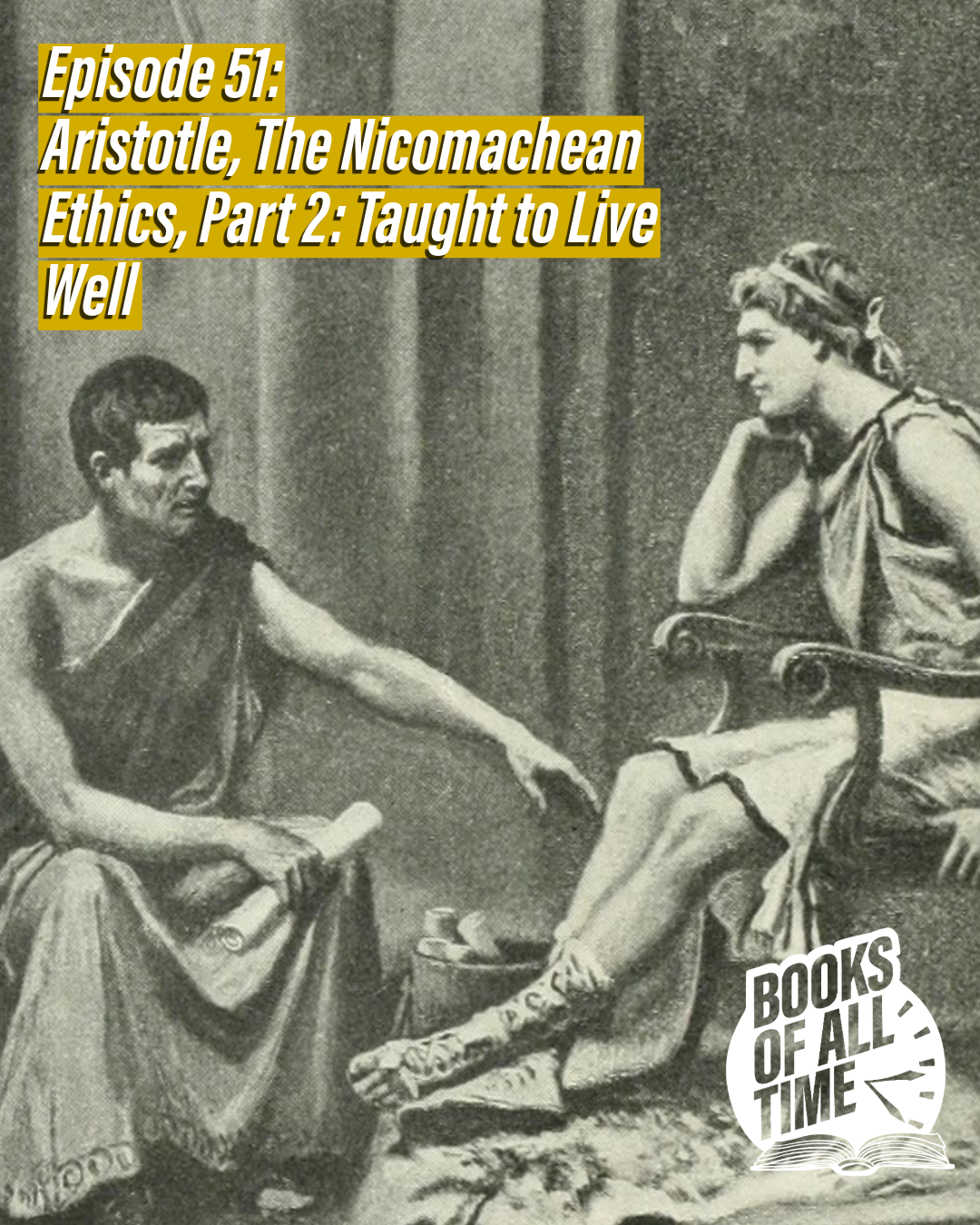
“The more completely a man possesses virtue, and the happier he is, the more he will be distressed at the thought of death . . . but that does not make him any less brave . . . because in preference to [life] he chooses a gallant end in war.”
Aristotle, The Nicomachean Ethics, translated by J.A.K. Thomson (p. 74).
The servant looked embarrassed, and Aristotle could not blame him. The poor fellow had dealt with many strange characters in his time—he had been on duty the day that gadfly Diogenes had turned up with a plucked chicken, looking for Plato. Today’s visitors had also brought a creature, but it was not destined for the pot. Aristotle left off his writing, smoothed down his clothes, and went out into the brilliant sunlight, where a crowd had already gathered around his present.
He saw a humped grey shape above the heads of the gawkers, and a snaking form of the same grey. A violent trumpet-like blast startled the onlookers, and as they stepped or leapt back—or, in at least one case, ran for the safety of a nearby porch—Aristotle beheld the elephant for the first time. Its small rolling eye, its curving tusks, the great fans of its ears: nothing he had read in the works of Cteisas or in his nephew Callisthenes’s letters had prepared him for the thrill of seeing it in the flesh before him.
A young man of noble bearing in a travel-stained cloak stepped out of the crowd and bowed to Aristotle. “Alexander of Macedon sends his greetings, master,” he said, taking a folded paper from a pouch. It was bound with fine white string and sealed with wax. As Aristotle accepted the paper eagerly the young man added, “This creature was seized from the enemies we defeated in the valleys of the Hind, far to the east. The King hopes you will learn much from studying it.”
Aristotle glanced at the seal on the letter—it was Callisthenes’s mark—and tucked it inside his clothes. For a brief moment worries welled up inside him. How would the Athenians take his reception of such an outlandish gift from the king of Macedon? How much would it cost to feed such an animal, and what would they do with its dung? But then the elephant lifted its trunk and yawned. As its keepers stood by it, gazing about them at the buildings of the Lyceum rather than paying it any attention, the elephant bent its legs and went down on its knees in order to sleep.
They do lie down to sleep! Aristotle thought, Ctesias was wrong! The philosopher’s worries vanished. He dashed inside for more paper and tablets, anxious to begin writing at once.
I’m Rose Judson. Welcome to Books of All Time.
Intro – Recap of The Nicomachean Ethics
Books of All Time is a podcast that’s tackling classic literature in chronological order. This is episode 51: Aristotle, The Nicomachean Ethics, Part 2: Taught to Live Well. As always, if you’d like to read a transcript of this episode or see the references I used to write it, you can visit our website, booksofalltime.co.uk. There’s a link in the show notes if you need it. Let’s begin.
We are back from summer hiatus. Hope yours has been wonderful; I caught some horrible illness (not COVID) on a flight to America and lost my voice, but on the plus side, my family over there has been adopted by some wild crows. Swings and roundabouts.
Last time we met, we discussed The Nicomachean Ethics, the lecture notes in which the great philosopher Aristotle laid out his thoughts on eudaimonia—the good life. Aristotle, to recap, lived from 384 BCE to 322 BCE. He was from Macedon in northern Greece, and he lived much of his life in Athens, where he studied at the Academy under Plato as a young man and then went on to found his own philosophical school after Plato’s death. Aristotle was a polymath: according to one ancient list of his back catalogue, Aristotle wrote as many as 150 significant works.
We have fewer than 50 of them, and about 15 are of questionable authorship. Of those that remain, many—including The Nicomachean Ethics, likely named for Aristotle’s son, Nicomachus, who may have edited it—are lecture notes, not publication-ready papers. In spite of this, Aristotle has become one of the most influential human beings ever to have lived. His works deeply shaped medieval philosophy and science in both the Islamic and Christian worlds, and his ideas remained central to Western thought and education until well into the eighteenth century.
In this episode, we’re going to spend a little time looking at his influence on one particular person in his own time: Alexander III of Macedon, known to history as Alexander the Great. In 343 BCE, when Aristotle was about 40 and Alexander was 13, Aristotle came to the court of Alexander’s father Philip to instruct Alexander in everything he would have learned at the Academy: poetry, the sciences, mathematics, and philosophy. We’re also going to spend quite a bit of time discussing the life of Alexander (born July 356 BCE, died June 323 BCE), whose military exploits made him into a legend in his own time—sometimes rather a dark legend. I don’t want to buy into the great-man theory of history, but it’s undeniable that the 13 years of Alexander’s career transformed the ancient world. His legacy will shape much of our next year of reading, so we’re going to spend a bit of time getting to know him.
As we’ll see, it’s debatable how deeply Aristotle’s ethical principles marked Alexander’s life, or how well his personal characteristics line up with the “magnanimous man” Aristotle described in The Nicomachean Ethics. Certainly, Alexander wasn’t what we would call magnanimous, if by magnanimous we mean generous, noble, and forgiving. However, the literal meaning of the word magnanimous was “great-souled”. I don’t think we can argue that Alexander wasn’t that, even though he left a trail of havoc in his wake.
For this episode I read a brand-new biography: Alexander: God, King, Man by Edmund Richardson. Released just this past June, Richardson’s biography draws on the latest scholarship to bring Alexander into clearer focus as a human being, often in very thrilling style. I won’t wait until the end of the show to tip my hand: I definitely recommend reading it if you like biographies or are interested in this time period.
I also read The Age of Alexander, a Penguin Classics compilation of some of the biographical sketches written by the ancient historian Plutarch, who lived from 50 CE to 120 CE, and with whom we’ll be spending time in the next 12 months in his own right. Plutarch, who was born in Greece but lived in Rome, had access to many old chronicles and documents, and as such remains one of our major sources of biographical information about Alexander, in spite of the fact that he lived nearly 400 years after Alexander had died.
Right, let us not spend more time recapping; let’s get marching back into the past.
Part 1: Child of Three Victories – The Early Life of Alexander the Great
Alexander was born in Pella, near modern Thessaloniki in northern Greece. At that time, Macedon was considered an unfashionable, rustic backwater full of savages—Richardson quotes the Athenian orator Demosthenes as saying that “you can’t even buy a decent slave from Macedon” (Richardson 24)—and Pella, its capital city, epitomised this: flat, damp, next to a river that seemed to breathe unwholesome vapours when it was not emanating unpleasant stenches.
However, Alexander’s father, Philip II, envisioned greater things for Macedon, and was in the process of willing them into existence. According to Edmund Richardson, Philip “cultivated the image of a hard-drinking buffoon, a witless brawler from the hills,” (Richardson 24) but in reality he was a shrewd and ruthless political operator. After taking the Macedonian throne by swatting aside his nephew, Philip set about building the foundation of an empire.
This involved not only amassing a large and carefully professionalised military; Philip also tried to win via soft power. He welcomed philosophers and scientists to his court from all over the ancient Mediterranean world. He presented his military exploits not as mere land-grabbing, but as preparation for a campaign of revenge against the Persians. He also created a tangled network of personal alliances with neighbouring states and important tribal leaders within Macedon by acquiring a clutch of consorts—seven in all.
This raised hackles in wider Greek society, where monogamy was not only considered a norm, but a sign of Greek superiority over other cultures. Philip’s seven brides marked him out as not merely transgressive, but barbaric. I doubt whether he minded the scorn. More likely it fit right in with the persona he was performing: if others thought him savage, that likely served his interests.
It was also possible he had so many wives because he struggled to get sons by them. It was Olympias of Epirus, his third or possibly fourth wife, who finally gave him the boy he needed. This was Alexander. Olympias was herself a character, or was at least depicted as one by Plutarch, the Roman historian.
Her people, the Molossians, were one of the northern Greek hill-tribes, with a formidable reputation for fighting and for breeding savage guard dogs. They claimed descent from Achilles, the sulky hero of the Trojan War (Philip’s family, by the way, claimed descent from Heracles—Alexander would make much of both these legendary forbears). Olympias was, per Plutarch, an initiate of a snake-worshipping cult of Dionysus. Plutarch writes that, quote:
“It was Olympias’ habit to enter into . . . states of possession and surrender herself to the inspiration of the god with even wilder abandon than the others, and she would introduce into the festal procession numbers of large snakes, hand-tamed, which terrified the male spectators as they raised their heads from the wreaths of ivy and the sacred winnowing-baskets, or twined themselves around the wands and garlands of the women.” (Plutarch 281)
Plutarch also tells us that on the eve of her marriage to Philip, Olympias supposedly dreamed that her womb was struck by a thunderbolt, and that this kindled a fire which consumed the whole world. But if there’s one thing we’ve learned over the last two years, it’s that the mothers of legendary figures often have dreams like this. Another is that ancient historians can’t help but indulge in these tropes.
For example, Plutarch goes on to say that on the day Alexander was born, his father had just sacked a city and received two other wonderful pieces of news: one of his generals had won a battle elsewhere, and one of his racehorses had taken first prize in the chariot race at the Olympic Games. “The soothsayers raised his spirits still higher,” Plutarch writes, “by assuring [Philip] that the son whose birth coincided with three victories would himself prove invincible.” (Plutarch 282)
Olympias seems not to have received the memo about invincibility. She was ambitious for Alexander and proud to be the mother of Philip’s first-born son. But Olympias was also deeply insecure, especially when Phillip brought home wife number seven. She was a young Macedonian noblewoman named Cleopatra, and had many supporters in Philip’s court. There was the possibility that a boy born to Cleopatra could be seen as more legitimate and eventually supplant Alexander in the line of succession. Olympias kept her head on a swivel—and kept pushing her son into his father’s eyeline.
Alexander was a boy after his father’s own heart. His first instructor was a military-minded man called Leonidas, whose educational philosophy revolved around, as Edmund Richardson puts it, “shivering, self-denial, and long walks.” (Richardson 25) As the boy Alexander grew, so did his father’s army—and its list of victories. By expanding his cavalry, drilling his infantry in the use of the phalanx formation, and deploying innovative siege engines, Philip consolidated his hold over Macedonia and northern Greece, subdued Thessaly, Thrace, and large chunks of Sparta, and began picking off various small city-states that were nominally under the protection of Athens. Back in Pellas, Philip’s oldest son watched all of this with unease, according to Plutarch. Quote:
“Whenever he heard that Philip had captured some famous city or won an overwhelming victory, Alexander would show no pleasure at the news, but would declare to his friends, ‘Boys, my father will forestall me in everything. There will be nothing great or spectacular for me with your help to show the world.’ He cared nothing for pleasure or wealth but only for deeds of valour and glory, and this was why he believed that the more he received from his father, the less would be left for him to conquer.” (Plutarch 283–284)
But Alexander was already demonstrating a rare talent for subduing others to his will, often using a blend of persuasion and force (at least in his personal relationships—in war he just used force). One of the most famous stories about his youth took place when he was about 10 or 11. Thessalian horse-traders came to Pellas and showed Philip a brutish, wild horse that would not allow him or his grooms to handle it. The king was on the verge of ordering the animal to be taken away when Alexander angrily cried out that they were making a mistake. Plutarch says:
“Philip kept quiet at first, but when he . . . saw that [Alexander] was upset, he asked him, ‘Are you finding fault with your elders because you think you know more than they do, or can manage a horse better?’ ‘At least I could manage this one better,’ retorted Alexander. ‘And if you cannot,’ said his father, ‘what penalty will you pay for being so impertinent?’ ‘I will pay the price of the horse,’ answered the boy. At this the whole company burst out laughing.” (Plutarch 284-85)
But Alexander had noticed that the horse was actually not vicious towards the men who were trying to control it: the problem was that it was late in the evening, and the low sun was throwing long shadows on the ground which frightened the horse. Alexander cajoled the horse into running facing the sun, and was eventually able to mount and ride him. Philip and his men were impressed. Alexander named the horse Bucephalus, which means “Ox-Head”, and they would be inseparable through many a long journey and a fierce battle.
Alexander, fast approaching adolescence, was at the risk of becoming untameable himself. Sometime around 342 BCE Philip realized that the boy would need someone to discipline his reason as Leonidas had disciplined his body. Fortunately, one of his friends knew of a renowned philosopher at a loose end—a philosopher who had studied with no less a sage than Plato. This, of course, was Aristotle.
Part 2: The Prince and the Philosopher – What We Know (and Don’t) About Alexander and Aristotle
Aristotle was about 40 years of age at this point. Plato had died in 347, and his nephew had been chosen to take over the Academy, much to the disgruntlement of Aristotle and some of Plato’s other disciples, who felt they were better qualified. In addition, Athens, under threat from Philip, was a hotbed of anti-Macedonian hatred. Since Aristotle himself had been born in Macedon—you may recall that his father had been physician to Philip’s father—he decided to leave the city.
He went to Assos, a city in what’s now western Turkey, where he’d been invited by its ruler, Hermias of Atarneus. Hermias, a former slave who was now the tyrant of Assos (remember that “tyrant” in this context just means “non-hereditary ruler”) was an important ally of Philip’s: Assos and Atarneus were right up against the edge of the Persian Empire, and had even once been part of it.
Hermias had not invited Aristotle by chance. He himself had studied with Plato in Athens years before, and had struck up a friendship with Aristotle. At his invitation, Aristotle settled in Assos, founded a school, and promptly began to meddle in Hermias’s affairs. This went better for him than it did for Plato with Dionysius of Syracuse: the philosopher convinced Hermias to loosen up some of his more despotic methods, which led to better relations with people in the region. Unfortunately Hermias was kidnapped by the Persians during a diplomatic visit to a nearby Persian governor, and taken hundreds of miles away to their capitol at Susa, deep within what is now Iran.
He was tortured, presumably to get him to reveal anything he knew about Philip’s plans for the military invasion of Persia he’d long been threatening. But he gave nothing away, and per a 1942 essay titled “Aristotle and Alexander the Great” by the classicist Michael Tierney, Hermias’s final message to his friends and loved ones was a reassurance that “he had done nothing weak or unworthy of philosophy.” (Tierney 226) He was executed by crucifixion.
Now, up to this point, Aristotle had been of a relatively open mind toward the Persians. The Academy, during Plato’s later years, had spent a great deal of time exploring Persian and Mesopotamian science and religion. They found much to admire in it. Michael Tierney writes that “Aristotle’s admiration . . . went so far as to suggest an ultimate fusion between the cultures of Persia and Greece.” (Tierney 225) This all went out the window once Hermias was killed. Aristotle wrote two poems eulogizing his patron and father-in-law, and took a white-hot hatred for Persia with him to his new assignment: teaching Prince Alexander.
Aristotle arrived at the town of Mieza, a sort of rustic royal estate near Pella, in 343 or 342 BCE. We don’t have specific details about what Aristotle taught Alexander or his other pupils, Alexander’s friends and relatives, including Ptolemy, Cassander, and Alexander’s dearest friend, a beautiful young man named Hephaestion. (Richardson 31) Tierney tries to tease out the curriculum from circumstantial evidence. (Tierney 226–227) Obviously, Homer would have been on the list—it was a set text for young boys throughout the ancient Greek world and we know from previous episodes that Alexander would carry a copy of the Iliad which Aristotle had specially made for him everywhere he went for the rest of his life, to the point of sleeping with tucked under his head.
Beyond this “moral training through the medium of mythology”, as Tierney calls it, (Tierney 226) Aristotle also likely impressed upon the young man some of the joy of scientific discovery. Plutarch tells us that Alexander enjoyed his lessons in medicine more than any other, and had a habit, for the rest of his life, of nursing his companions through illness and injury and of giving people unsolicited wellness advice.
Certainly, Alexander’s conquests greatly expanded the Hellenistic world’s understanding of geography—apparently we Americans are not the only people who learn this science through war. As hinted at in the vignette at the top of our show, Alexander seems also to have encouraged his companions to study the plants and animals they found, though the story about Aristotle’s elephant may be a legend. Also, the Macedonians probably didn’t approach making discoveries with the same systematic rigour Napoleon’s men would display nearly 2,100 years later in Egypt. (Go check out Episode 4, The Tale of Sinuhe, Part 2: Out of the Sands, a Voice, on the discovery of the Rosetta Stone, if you haven’t: we cover the army of scientists who followed Napoleon on campaign there.)
Still, exploration was a concern of theirs, even if it was backburnered. Tierney writes that, quote:
“The ceaseless pursuit of every kind of scientific knowledge under the Hellenistic monarchs, of whom the Ptolemies were the most prominent, goes back to the imprint made on Alexander’s mind [by Aristotle] . . . To this Hellenistic pursuit of science we owe a great part of our civilisation.” (Tierney 227)
Where Aristotle seems not to have influenced Alexander very much is in terms of his morals or his political ideals. Tierney at first compares Aristotle and Alexander’s relationship to that of Plato and Dionysius the Younger of Syracuse, (Tierney 222) but this seems to me to be superficial. Or at the very least, there are important distinctions between the two situations. Plato was in his 50s, close to the height of his fame and influence in Athens when he set out to make Dionysius his experiment in practical political philosophy; Aristotle was instead seizing a chance to stay employed.
Do note that Aristotle did winkle a good compensation package out of Philip: Philip had sacked Aristotle’s hometown of Stagira a few years prior and enslaved all the population. Aristotle apparently only agreed to take on the tutor job if Philip liberated and compensated the Stagirans, which he seems to have eventually done.
Regardless, there’s nothing in the historical evidence or in the later behaviour of Alexander to suggest that Aristotle had much of an influence on his ideas of how to rule. It seems to me, based on the little I’ve read, that Alexander and Aristotle overlapped before Aristotle was really focused on politics and ethics. Aristotle had just finished some scientific research in Assos and was likely working on his commentaries on Homer at the time he moved back to Macedon.
Yes, he’d studied with Plato; yes, he would certainly have been familiar with Plato’s trials and tribulations in Syracuse, but it’s possible the subject may simply have not been forefront in his mind. It’s also possible that, like so much of Aristotle’s output, there were works that were lost. The Cambridge Companion to Alexander the Great notes that two lost works of which we only have the titles, On Kingship and On Behalf of the Colonies may have been written for Alexander’s benefit. (Ogden 32) The only scrap of political education we have is an anecdote from the later historian Eratosthenes, about a letter Aristotle supposedly wrote Alexander in which he urged him to treat the barbarians as if he were their master and to treat the Greeks as if he were their leader. (Tierney 228) Alexander, as we’ll see, did not really follow this advice.
But this raises the question: did Alexander’s career influence Aristotle? Can we see traces of the philosopher’s reaction to his famous pupil’s later career in the Ethics? Probably not. Tierney notes that Aristotle’s Nicomachean Ethics and the Politics focus mostly on grappling with the ideas of Plato: refuting them, expanding on them, explaining points of confusion his students had expressed. Also, Alexander’s campaigns against Persia would drive the Greek world toward an uneasy unification, but Aristotle, as far as we know, wrote nothing about the issue of unity. (Tierney 227)
In 340, after Alexander and Aristotle had been studying together for about two and a half years, Philip went off to deal with a particularly tricky siege at Perinthus (a siege he would eventually abandon; a rare L for Philip). He named Alexander, then just 16, as his regent. Alexander left Mieza for Pellas to administer the state in his father’s absence.
Reading between the lines of both Plutarch and of Richardson’s biography, it’s possible that both Aristotle and Alexander thought this would be a temporary leave of absence; Aristotle lingered in Macedon for several years after Alexander left off his studies. However, they never met again as tutor and pupil. Alexander had now commenced his most important apprenticeship: the one that would shape him into a military strategist capable of shaking the ancient world.
Part 3: The Horned God – Alexander’s Career
Alexander didn’t only act as regent in his late teens: he also became a commander under his father’s banner. In the late 340s BCE, Philip was trying to bring the Greek city-states to heel so that he could deal with the Persians, who were starting a fresh campaign of expansion—when Aristotle and Alexander had started studying together in 342 BCE, the Persians had just invaded Egypt, sending the Pharaoh into exile.
The three most powerful city-states up to that point were Sparta, Athens, and Thebes. Philip’s campaigns, prior to him promoting his son, had mostly focused on picking off smaller states whose men and resources fed the big three (and whose resources Philip needed to feed his own ever-growing armies). In 338, he and Alexander were ready for a more direct approach. At the Battle of Chaeronea, they faced down organised resistance from Thebes and Athens. The resistance forces included the Sacred Band of Thebes—a legendary special-forces detachment made up of 150 male couples who were utterly devoted to each other. They were also seasoned killers: years before, they’d become famous for scattering the Spartans.
The Macedonians destroyed the Sacred Band to the last man. Edmund Richardson notes that, at a time when most Greek battles only had a casualty rate of about 15 percent, this would have been considered not merely a triumph but an atrocity. He also describes the state of the skeletons exhumed from the battlefield at Chaeronea: faces smashed with shields, spearheads stuck fast in pelvic cradles and spines; bodies mutilated after death. Alexander learned that victory was not enough: only total annihilation of the enemy would do. It was a lesson he would never forget. (Richardson 31–34)
Philip was assassinated by one of his own guards in 336 as he walked into a theatre. The reason for the assassination is not clear—historians ancient and modern debate whether it was a personal grudge on behalf of the murderer or a hired hit by Alexander and Olympias, who were worried about Philip’s seventh wife popping out a son who would have a solid-gold Macedonian pedigree and backup from various ambitious generals. But Alexander again swung into action: he had all but one of the possible claimants murdered. This included some of his father’s generals, but also his own half-brothers and sisters—even his stepmother Cleopatra and her infant daughter. The sole survivor was his older half-brother Arrhidaeus, who apparently had some sort of physical or intellectual disability which made him less of a threat.
Alexander inherited a throne that was deeply in debt, but he was determined not to let that stop him. A revolt by the Thebans and Athenians soon after Philip’s death gave Alexander the opportunity to show the Greek world that he was no less effective than his father: his forces attacked the city of Thebes and razed virtually every building in it to the ground, sparing only the temples and the home of its famous poet Pindar. He also had its treasury and wealthy citizens’ homes systematically looted, solving both his reputational and financial issues in one fell swoop. The rest of Greece fell back into line. Alexander promoted one of his father’s most seasoned generals to regent and marched east with 50,000 men. (Richardson 47–50)
This smash-and-grab cycle would continue for the next ten years. Alexander’s conquests strike me more as a series of hyperviolent frat parties rather than a string of glorious victories. They would march, fight, and/or pillage by day, then drink by night. Plutarch tries to justify this by claiming that it was really about the conversation for Alexander, not the wine as such. Quote:
“He sat long over his wine, as I have remarked, because of his fondness for conversation. And although at other times his society was more delightful and his manner more full of charm than any king, yet when he was drinking he would sometimes become offensively arrogant and descend to the level of a common soldier . . . When the drinking was over, it was his custom to take a bath and sleep, often until midday, and sometimes for the whole of the following day.” (Plutarch 304–305)
Aristotle, with his emphasis on moderation and temperance, would have frowned. Still, you must remember that Alexander was a very vigorous young man in his twenties. I’m sure we’ve all come across athletes who were capable of rocking up to a competition hungover—or even still slightly drunk—and performing brilliantly regardless. For the first five years of his campaigns, Alexander had this quality.
In 333, just two years after smashing Thebes, Alexander met the forces of the Persian king Darius III at the Battle of Issus. Alexander was heinously outnumbered. Darius had an immense force of Persian and Egyptian troops—mostly conscripts with no combat experience, but that was fine: he was protected by his royal guard, a 10,000-strong force known as the Immortals. Plus, he’d captured the Macedonian supply convoy. He was feeling feisty.
However, Alexander had a force made up almost entirely of seasoned campaigners, and his infantry had mastered the phalanx, a battle formation that basically involved forming a thicket of razor-sharp, 19-foot-long spears and then charging through anything in its path. (Richardson 12–15) “In 333 BCE,” writes Edmund Richardson, “there was no more reliable sign that bad things were about to happen than a Macedonian phalanx coming over the horizon.” (14)
In spite of being outnumbered two to one, Alexander’s phalanxes shredded the Persian forces, ultimately forcing Darius to flee the battlefield. The great king was in such a rush that he did not bother to collect his belongings or any of his family. Alexander’s people treated the Persian royal women with surprising grace, allowing them to keep their servants and most of their things (to say nothing of their lives). Beyond that, the Macedonians pinched every shiny object and every stick of furniture—including Darius’s bathtub, which they carried with them as they continued boring their way toward the heart of Persia itself.
He arrived there with incredible speed, given the odds against him. It helped that his atrocities escalated the further south and east he went. Damascus surrendered and escaped with a mere pillaging, but the Persian commander of Gaza was seized and gruesomely tortured. At Tyre, the cruelty reached a fever pitch. Alexander’s forces besieged the city for seven long months, and when it finally surrendered, Edmund Richardson tells us that, quote:
“Every Tyrian holding a weapon was butchered. Thirty thousand women and children were enslaved. But Alexander was still not satisfied. He had felt his power totter before the walls of Tyre, and it had petrified him . . . . Two thousand Tyrians died in agony, ‘hung from crosses’ all along the vast empty beach.” (Richardson 81)
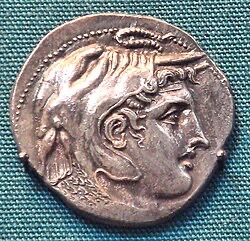
By the time Alexander arrived in Egypt in 332 BCE, he was pleased to discover that the Egyptians were perfectly prepared to surrender to him and even crown him pharaoh. He founded the city of Alexandria and then went to visit the temple of Amun at Siwa, where a priest declared Alexander the “Son of Amun”. Delighted, Pharaoh Alexander had coins struck showing his profile with ram’s horns to emulate his divine father and ordered that all the Egyptian rites which had been suppressed under the Persians should be restored. Clearly, any religion willing to treat him as a god was worth preserving.
In 331, Alexander’s gang rolled on into Mesopotamia, taking Babylon, the Persian capitol of Susa, and its treasury-city of Persepolis, which he and his men burned to the ground. He was crowned Great King of Persia in Babylon. Darius, long since gone into exile, was assassinated. Alexander had achieved what he and his father had set out to do: he had crushed and humiliated the Persians. He had given them their own back on behalf of the Greeks. He and his men had been marching for seven years and could justifiably have gone back to Macedon in a blaze of glory.
Certainly his men wanted him to. But as Aristotle would write in book two of the Nicomachean Ethics, our habits form our virtues. Alexander, by this time, was in the habit of killing and looting. He decided it was no longer enough to have broken the Persian empire to his will: he must surpass it. He would continue to push further east, until he had enlarged his territory beyond anything the world had ever seen. He would get what he wanted, but he would find that he had asked for too much.
At first, the Macedonian machine carried on much as before. He marched his men into modern-day Pakistan, Tajikistan, Afghanistan, taking fortresses thought to be impregnable and defeating armies thought to be invincible. He founded many Alexandrias. But the old spirit was not there: some of his commanders had begun to worry about his eagerness to try on foreign habits, whether it was wearing purple to signify his royalty, or having people kiss his hand or bow down to him—something Greeks reserved only for Gods. He also married foreign women: the first was Roxana, a young noblewoman from Sogdiana, an ancient civilization whose borders encompassed parts of modern Kazakhstan, Tajikistan, and Uzbekistan.
Roxana bore him a child that did not survive. Factions began to form among his men. Alexander became paranoid, for all that he was a god. One drunken night in 328 BCE, Alexander murdered his friend Cleitus, who had dared to speak out about Alexander’s strategy and his growing megalomania. Alexander wept over what he’d done, but it was a turning point. He had some of his most seasoned commanders killed, and then had their relatives and allies killed, too, in order to make sure nobody would revenge the commanders. Even Aristotle’s nephew, Callisthenes, was not safe: he was implicated in a plot and killed.
Although Alexander’s record in battle remained undefeated, some of his victories were very close-fought things indeed. If you remember episode 18 of our show (The Upanishads, Part 2 – Dionysus, Son of Indus), Alexander made it across the Indus River and not much further. He had arrived during the monsoon, he’d taken a life-threatening wound, and his beloved horse Bucephalus had died. Most importantly, the Macedonians were exhausted. In 325, Richardson writes:
“The soldiers could feel the last, fragile threads connecting them to their homes, to the people they were before the war, beginning to fray and snap. In the rain, they looked at one another and at themselves, at their strange clothes and tarnished shields, and Alexander’s enchantment began to lift.” (Richardson 288-289)
When they refused to go any further, Alexander relented. On the return journey, their smash-and-grab raids turned into the road trip from hell. First for the unfortunate Indian villagers Alexander’s forces massacred as they sailed down the Indus towards the coast of the Indian Ocean, and then for those men themselves as he marched them through the desert region that lies just to the east of the Strait of Hormuz. Two-thirds of Alexander’s men died on this journey. (Richardson 314) The remainder turned on one another as the food dwindled and the pack-animals died. Alexander held them together by walking alongside them and refusing comforts. He was always capable of making himself agreeable when it mattered.
After they arrived back at Susa, the Macedonians hoped their king would finally leave off his outlandish new customs and take them back to Greece. Instead, Alexander wrote to the Greek city-states and invited them to worship him as a god, then threw a series of increasingly lavish and desperate parties. One of these was a bizarre mass wedding, in which Alexander and nearly a hundred of his officers took local women as brides—Alexander added two Persian princesses to his collection at this ceremony. Another was an immense apology-feast: after narrowly avoiding a mutiny by soldiers who were about to be demobilized, Alexander had an enormous tent erected in which he and thousands of his veterans ate and drank together. (Richardson 337)
In the winter of 324, his best friend and general Hephaestion died. Alexander went into a frenzy of grief. He had a colossal pyre built for his friend in Babylon. But this was not enough. Over the next several months he ordered his entire domain to mourn for Hephaestion as much as he did. This culminated in funeral games in late May of 323. Alexander attended a party held by his friend Medius one night, and wound up drinking himself into a stupor after a drinking competition—sources, according to Edmund Richardson, report that the king drank twenty cups of wine. (Richardson 340–358)
The excruciating hangover turned into a dangerous, lingering fever. Severe abdominal pain appeared, along with intense thirst. Alexander entered a terminal decline. Historians, then and now, differ about what it was that eventually killed Alexander on June 11, 323 BCE. Ancient historians tended toward poisoning. Later and modern ones point to more mundane explanations based on Alexander’s hard living and the types of diseases that were more common prior to vaccination and antibiotics. Cirrhosis of the liver and appendicitis are possibilities, along with pancreatitis or complications from malaria and typhoid.
Whatever it was, it had done the one thing that hundreds of thousands of soldiers commanded by rich and powerful men had not been able to do: it defeated Alexander of Macedon. In less than fifteen years he had re-ordered vast swathes of Europe and Asia. Richardson quotes estimates Alexander’s campaigns led to the deaths of 1% of the global population. (Richardson 8)
If you were going to pull that off now, you’d have to kill 83,000,000 people—which God forbid, obviously. He was a brigand and a terror in his time. As we’ll see in a few months, it would take the Romans to make him “Great”.
Alexander’s campaigns also led to Hellenization: the spread of Greek culture, practices, and art. We’ve discussed how Indian art in the areas where Alexander’s armies passed acquired a very Greek tinge beginning in the 330s BCE—this was also happening in Egypt and Lebanon and Turkey. The city of Alexandria, with its famous library, was one important consequence of this Hellenization. And even though that library would eventually be destroyed, its mission to gather all known literature led to the preservation and spread of many works which might otherwise have been lost—including Aristotle’s works.
We will never, as Jonathan Barnes put it in his Aristotle: A Very Short Introduction, “see through the fog of legend [to] determine how far Aristotle influenced his ambitious and unlovely charge.” (Barnes 10) But it is just possible that without Alexander, nobody else would have been influenced by Aristotle, either.
Wrap-Up and Outro
That’s it for this episode. I hope you enjoyed this look at Alexander. He’ll be popping up again as we continue our journey together. Quite apart from the histories we’re going to read which mention him, he’s also the first-known subject of prose fiction in Europe. That’s right: Alexander’s legend was so big it founded an entire genre of literature, though it may be a while before we get to the Alexander Romances themselves.
As to the books I read for this episode, I’ve already recommended Edmund Richardson’s biography to you. That title again is Alexander: God, King, Man, and it just came out at the start of the summer. Well worth your time; he works in lots of poetry and legends from the cultures Alexander cut a swathe through and he has access to some recently translated writings from Mesopotamia and Egypt that help add some new details to Alexander’s story.
I’d also tell you to read Plutarch, but he’s on our list for early 2028. Though I suppose you could get a head start if you don’t want to wait: like Herodotus, he’s very gossipy even though his biographies are meant to have a moral benefit for the reader.
As to what’s on our list next? Well. We’ve talked about the Persians many times, but we’ve never actually read anything from them. We’ll take care of that next time by looking at the Avesta, a collection of hymns and scriptures that is the foundational teaching of Zoroastrianism. Join me later this month for Episode 52: The Avesta, Part 1 – The Realms of Light.
Books of All Time is written and produced by me, Rose Judson. The Disclaimer Voice of Doom is Ed Brown. Lluvia Arras designed our cover art and logo. Special thanks to Holly Wood, Cathy Merli, Matt Brough, John Cole and the Books of All Time Advisory Council: Ed Brown, Beck Collins, Neil Dowling, Caitlin McMullin, Hugh Parker, and Jonathan Skipp. You can support the show by subscribing and leaving a rating or review at Apple Podcasts, Spotify, or wherever you get your podcasts. You can also follow us on social media: we’re on Bluesky, Instagram and Facebook. Thanks for listening! I’ll be back soon.
References and Works Cited:
- Aristotle, and D’Arcy Wentworth Thompson. The History of Animals, Book II. University of Chicago. https://penelope.uchicago.edu/aristotle/histanimals2.html.
- Aristotle, and Adam Beresford. Nicomachean Ethics. Penguin Books, 2020.
- Aristotle, et al. The Nicomachean Ethics. Penguin Books, 2004.
- Barnes, Jonathan. Aristotle: A Very Short Introduction (Very Short Introductions Book 32). Oxford University Press, 2000.
- Bigwood, J. M. “Aristotle and the Elephant Again.” The American Journal of Philology, vol. 114, no. 4, 1993, pp. 537–55. JSTOR, https://doi.org/10.2307/295424.
- Bragg, Melvyn. “In Our Time.” In Our Time: Aristotle’s Nicomachean Ethics, BBC Radio 4, 2 Nov. 2003.
- Ogden, Daniel, editor. The Cambridge Companion to Alexander the Great. Cambridge: Cambridge University Press, 2024. Print. Cambridge Companions to the Ancient World.
- Plutarch, and Ian-Scott Kilvert and Timothy E. Duff. The Age of Alexander: Ten Greek Lives by Plutarch. Penguin Classics, 2011.
- Richardson, Edmund. Alexander: God, King, Man. Bloomsbury Press, 2026.
- Romm, James S. “Aristotle’s Elephant and the Myth of Alexander’s Scientific Patronage.” The American Journal of Philology, vol. 110, no. 4, 1989, pp. 566–75. JSTOR, https://doi.org/10.2307/295280.
- Tierney, Michael. “Aristotle and Alexander the Great.” Studies: An Irish Quarterly Review, vol. 31, no. 122, 1942, pp. 221–28. JSTOR, http://www.jstor.org/stable/30098049.


Leave a Reply