
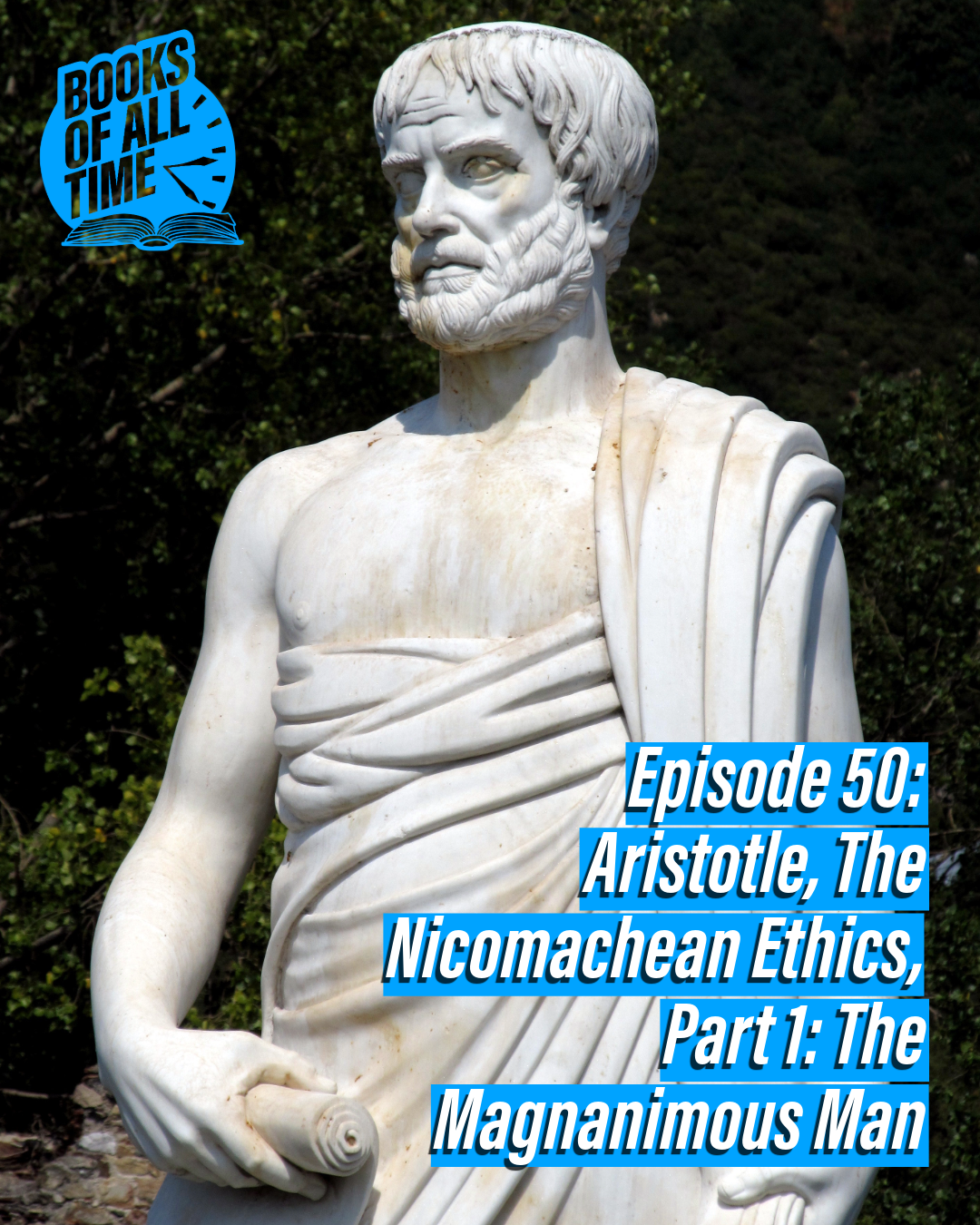
“Someone who exercises their intellect and cultivates their intellect is surely in the best possible condition [any person can be in], and is the most beloved by the gods.”
Aristotle, The Nicomachean Ethics, translated by Adam Beresford, 2020 (p. 262).
Nicomachus waited until he heard Theophrastus shut the door before he allowed himself to sigh. He looked over the stacks of wax tablets with dread rising in his heart. He knew they would be covered with his father’s tiny, crabbed handwriting—where Nicomachus might get a few score words down, his father would fit a few hundred. He also knew that the wax had sat in this upper room all through the summer, and might have run in places to the point of being illegible. He would have to guess what his father had meant, and though Nicomachus was no fool, he was also not a patch on his father for analytical thinking. Nor was he capable of emulating his style.
He wished his father were here to guide him through the copying—the hours and hours of weary copying—that Theophrastus had asked him to do. But father had fled the city after the end of the wars with the King of Macedon. Though Nicomachus was an Athenian true-born, thanks to his mother, his father was an alien—one the citizens of Athens saw as tainted by his Macedonian connections. Or at least, that had been his father’s conviction, and his paranoia had driven him to leave Athens for good. Nicomachus wasn’t so certain the danger was all that great: his father, after all, had taught and encouraged two generations of the very best Athenians in rhetoric and philosophy and statecraft. His lectures were events not to be missed.
His lectures had been events not to be missed. He would not be speaking again, anywhere. He had died hundreds of miles away in Chalcis. Nicomachus had only lately returned from presiding at his funeral, where he had seen to it that the mortal remains of his father were properly cared for. Now he would try to see to it that the remains of his life’s work survived a little longer.
He gazed again at the tablets before him, feeling utterly adrift. From several places on the dusty wax the word eudaimonia—blessedness—leapt out at him. He read one passage:
[Eudaimonia] is our ultimate goal. It means living a life that meets all our needs. It’s the goal of everything we do. (Beresford 11)
Nicomachus smiled bitterly. He did not know when he would himself reach eudaimonia. But that, his father would have said, was part of the point: blessedness was to be found in striving toward a good life as much as it was in the achievement of it. He smoothed out the first few inches of his papyrus scroll, inked his pen, and began to write.
I’m Rose Judson. Welcome to Books of All Time.
Intro – Who Was Aristotle? Overview of His Life, Intro to The Nicomachean Ethics
Books of All Time is a podcast that’s tackling classic literature in chronological order. This is episode 50: Aristotle, The Nicomachean Ethics, Part 1: The Magnanimous Man. As always, if you’d like to read a transcript of this episode or see the references I used to write it, you can visit our website, booksofalltime.co.uk. There’s a link in the show notes if you need it. Let’s begin.
After our sojourn in China exploring the mysticism of the Tao Te Ching, we return to Ancient Greece to engage with one of the great works of Western Philosophy. Our last book in this category was Plato’s Republic. You may recall that this was a series of philosophical treatises on the nature of reality, the ideal society, and what it means to live a just or virtuous life thinly disguised as the story of a long post-dinner party discussion with Socrates. This time we are turning to Plato’s most famous pupil, Aristotle, to get to grips with a work known as The Nicomachean Ethics. It takes a very different approach to thinking through problems than Plato did. We’ll talk more about that in a moment—and we’ll unpack that curious title, too. First, let’s orient ourselves in time and space.
Aristotle was born in 384 BCE in Stagira, a small town in northern Greece. His father, Nicomachus, was the royal physician to King Amyntas of Macedon. We don’t know much about Aristotle’s early life, other than that his parents died while he was still a boy, which led to him being brought up by a guardian. He becomes more visible around the age of 17 or 18, when he moves to Athens to study at Plato’s Academy. He quickly distinguished himself as a researcher and lecturer, became close to Plato, and was eventually put in charge of the Academy’s library.
The scholar Jonathan Barnes, writing in Aristotle: A Very Short Introduction for the Oxford University Press in 2000, gives an amusing picture of what Aristotle reportedly looked like:
“He was allegedly a dandy, wearing rings on his fingers and cutting his hair fashionably short. He suffered from poor digestion, and is said to have been spindle-shanked.” (Barnes 2000, 1)
Skinny legs, a try-hard hairdo, and a dark sense of humour: are we sure Aristotle wasn’t a film student in the late 1990s? I swear I was surrounded by those guys.
When Aristotle was about 37, Plato died. The Macedonian empire under Phillip II was, at that point, going on a rampage throughout Greece, and there was a lot of anti-Macedonian sentiment running through the city. Without Plato to protect him, Aristotle felt anxious. He left Athens, spending the next five years roaming around Greece indulging his first love: biology and the ways of various animals. In 343 BCE he received a summons from Philip II: come and teach my son, Alexander. We’ll go into what’s known about this relationship in our next episode, but the direct teacher-student period of Aristotle and Alexander’s acquaintance only lasted a few years.
By 335, Aristotle was back in Athens. The prestige (or notoriety) his role as a royal tutor had given him, as well as his earlier association with Plato, made it possible for him to set up his own institution, the Lyceum. Note, however, that because he wasn’t an Athenian, he never owned the property: he just rented it.
Barnes cautions us not to think of the Lyceum as anything like a modern university, with set class times and degrees. The way he describes it, it sounds more like a public debating club with a gym attached. Aristotle would conduct research, write about his findings, and deliver lectures to both chosen students (all male, naturally) and to the general public (also all male). (Barnes 2000, p. 7)
He lectured on all kinds of topics. He was a true polymath. “Choose a field of research, and Aristotle laboured in it,” writes Jonathan Barnes. “Pick an area of human endeavour, and Aristotle discoursed upon it.” (Barnes 2000, p. 4). Indeed, Aristotle, it turns out, was much more than a philosopher and the developer of formal logic: he was Ancient Greece’s one-man answer to Time-Life Books. Botany, astronomy, zoology, physics, sports, rhetoric, psychology, law, poetry, economics, politics—you name it, Aristotle was there to break it down for you. One ancient librarian’s list of works by Aristotle ran to more than 150 titles. (Barnes 2000, p. 3)
We have almost none of them: one list I consulted had about 45 titles, 15 of which were listed as probably not authentic. So just 30 of his works remain, and of those that do, only two are pieces intended for publication. The rest seem to be lecture notes.
Yes, I know: the collected extant works of one of the most influential figures in Western science and philosophy are basically the equivalent of PowerPoint slide decks. Some of these notes include detailed discussion of topics. Others are little more than bullet points or sentence fragments. Still other notes are confusing even to experts to this day—it is possible that some of the notes in this third category could be inside jokes between Aristotle and his audience: the Simpsons memes of his day.
And look: these are the slide decks of a true genius, but it’s hard not to think about what we’ve missed out on by having so little finished product from him. In his time, Aristotle was praised for his elegant prose style. Virtually no examples of that have survived. Picking up the thread of his biography, we can see why: when Aristotle’s estranged pupil Alexander the Great died in 323 BCE, there was a fresh upwelling of anti-Macedonian violence in Athens. Aristotle, by this time in his sixties, leaves the Lyceum behind and retires to the city of Chalcis on the island of Euboea, where his mother’s family came from. He died there, depressed and isolated, in 322 BCE.
Aristotle’s executors included his chief pupil Theophrastus, who had taken over directing the Lyceum (and the associated group of philosophers, known as the Peripatetic school) after Aristotle’s retirement. According to tradition, Theophrastus arranged to have some of Aristotle’s lecture notes copied out—possibly by his chief pupil Nicomachus, the son of Aristotle, which is what I imagined for the opening vignette at the top of the show.
When Theophrastus died in 287 BCE, this little library of works was given to his successor, a guy named Neleus. Neleus took the library with him when he left Athens for Scepsis, a town in what is now Turkey, where he hid everything in a cellar to prevent the local authorities coming and confiscating it for their library. The works of Aristotle stayed in that cellar for two centuries, the papyrus fibers slowly degrading, until they were discovered by a wealthy Athenian and taken back to Greece in the middle of the first century BCE. This is the story as reported by the Roman writer Plutarch (coming soon to a podcast near you) and other ancient sources. It may just be a story.
Regardless of how the works were transmitted, two very important ones survived: The Nicomachean Ethics and the Politics. These were linked pieces: the Ethics is meant to lead into the Politics. Aristotle did not call the first of these works the “Nicomachean Ethics”; he just called it “Ta Ethike”, which means “On the Subject of Character.” Its current title is meant to differentiate it from an earlier version of the lectures on ethics edited by another Aristotelian disciple, Eudemus.
None of the sources I read really seem to know when it began to be called The Nicomachean Ethics, though in a 2023 episode of In Our Time, the scholar Angie Hobbs says it didn’t get that name possibly until as late as 175 CE. What is generally agreed upon is that Nicomachean refers to Aristotle’s son, who likely edited a later, completer and more mature version of the lectures.
The Ethics is divided into 10 sections, each of which try to contribute to an understanding of what it means to live our lives well. We should stop here to clarify the term “ethics”. One of the delights of covering another philosopher is that I got to dive back into Bertrand Russell’s A History of Western Philosophy, which contains a chapter on Aristotle’s Ethics. That Pearl of an Earl explains that we need to guard ourselves against reading The Nicomachean Ethics with a lens ground to a Christian-influenced prescription. Quote:
“As a result of Christian dogma, the distinction between moral and other merits has become much sharper than it was in Greek times. It is a merit in a man to be a great poet or composer or painter, but not a moral merit; we do not consider him the more virtuous for possessing such aptitudes, or the more likely to go to heaven. Moral merit is concerned solely with acts of will, i.e. with choosing rightly among possible courses of action. I am not to blame for not composing an opera, because I don’t know how to do it.” (Russell 172-173)
Aristotle’s ideas of morality are skewed slightly differently than ours: the unethical and what we would consider the undesirable overlap for him in ways that they don’t for us. Aristotle also assumes that an educated man would naturally be more moral than an uneducated one. We still make this error, but we don’t take it as an iron-clad truth anymore.
It was educated men Aristotle was addressing. On the most practical, immediate level, the lectures that form the Nicomachean Ethics were aimed at helping the Athenian elite understand how their personal conduct and thought could feed into their civic lives and so influence society—that’s why Aristotle considered the Ethics to be connected to the Politics. On a broader level, we find Aristotle trying, in his scientific way, to understand what a human life is for. He has an answer—sort of. It’s a very interesting one. Let’s get into it.
Part 1: Books 1-3 – The Function of a Person; Eudaimonia; the Virtues
Aristotle begins by asking a simple question: what is the point of a human life? All other areas of human activity have a point, he argues: the point of medical practice is to restore or preserve health. The point of military leadership is to achieve victory. The point of economic activity is to increase wealth, and so on. Being alive is the universal condition or activity of all humans; it stands to reason there must be a point to all of this, too.
He proposes that the point of a human life is to achieve eudaimonia. This is a term that historically has been translated as “happiness”, but multiple scholars say this is probably not the right term to use today. I read two different Penguin Classics editions of The Nicomachean Ethics for this episode—you’re welcome, I definitely felt my brain leaking out my nostrils at times. The first was the 2003 edition of a 1959 translation by J.A.K. Thomson, introduced by Jonathan Barnes. The second was a new 2020 translation by Adam Beresford.
Beresford’s edition is interestingly chatty—it reads as if Aristotle is addressing you from his lectern—and it contains a useful essay at the end about the word eudaimonia, and why translating it as “happiness” probably doesn’t quite capture the nuance of what Aristotle was discussing. Nowadays we tend to think of happiness as a mood or an emotional state. To the Greeks, eudaimonia is more of a state of well-being, an overall condition of flourishing or blessedness. Beresford elaborates:
“[Aristotle] does not think the goal of life is just to be happy (i.e. content, satisfied, pleased with life; tranquil; enjoying a steady and stable sense of well-being). He thinks the goal of life is to live a genuinely desirable, worthwhile life; one that really does have all the greatest blessings in it (whether you feel that way about it or not). Further, his own distinctive view of eudaimonia is that you will attain such a life if you exercise the best human virtues to the full; if you live a life of action, of achievement and accomplishment.” (Beresford 271)
It is perfectly possible to have a life that meets the qualities of eudaimonia and not feel particularly happy. If you and your wife are on the outs, or you suffer from chronic pain, or you’re just kind of a grouch, but otherwise you are living up to your full potential? That’s eudaimonia, friend. It is, Aristotle goes on, “a virtuous activity of the soul” (Thomson 15) which continues over the course of a lifetime. Quote:
“One swallow does not make a summer; neither does one day. Similarly, neither can one day, or a brief space of time, make a man blessed and happy.” (Thomson 16)
This eudaimonia is actualized within ourselves, but it also extends outward to the society around us—humans, like ants and bees, are social animals that need community to work together. The science or process by which we order that community is known as politics, Aristotle explains, and that is a lens through which we’ll examine the question of what makes a good life.
Though not just yet. Now that we have a rough understanding of what the purpose of a human being is, says Aristotle, we must accept that we will only ever have a rough understanding—there is not a precise way to prove the things we’re going to talk about the way there would be in a mathematical proof. For instance, people don’t really agree about what eudaimonia looks like. Aristotle walks the audience through some possible examples.
First, he says, people tend to define eudaimonia based on their own experiences. Sometimes that’s a negative definition—a person who’s sick is likely to define eudaimonia, at least in part,as the absence of sickness. Sometimes it’s a positive: a person who loves his wife and children will likely include the presence of warm family bonds within eudaimonia. Aristotle wants to work with broader categories, though. He defines three: a pleasure-seeking life, a prestige-seeking life, and the contemplative life.
No guesses as to which the philosopher thinks is superior here (though to be fair, he did warn us that people tend to define eudaimonia based on their own circumstances). Still, he ticks off the pros and cons of each type of life. Bodily pleasures and comforts matter—you can’t really pursue your highest potential if you’re debilitated by illness or crushed by poverty—but as an end in themselves they lead to a “slavish” or “bovine” existence. (Beresford 4)
Wanting to be renowned and respected (Aristotle thinks only of statesmen here, not actors or artists) can lead to overreliance on the opinions of others or to an endless chasing after money, which is sort of a sub-category of trying to please or dominate others. Eudaimonia really should be something more self-contained than that. As for the contemplative life—well, says Aristotle coyly, we’ll look at that later.
In the meantime, he turns to kicking the legs out from under Plato’s idea of universal forms. He apologizes for doing this—the people behind this idea are very wise and clever and dear to me, he says, but still: what practical use is the ordinary person supposed to make of “the good in itself” or of any of the universal forms, such as a “universal bed”? Quote:
“I can’t for the life of me see how a tailor or carpenter is going to get any help exercising his craft if he does know about this ‘Good in itself’, or how anyone is going to be a better doctor or general because they’ve ‘beheld the Form itself’. I mean, doctors don’t even seem to investigate health that way. They investigate human health, or really just the health of this person in front of me. Right? Because you practise medicine on particular people.” (Beresford 9–10)
One of the things I like about Aristotle—at least as he is here in the Ethics—is that he is for the most part very practical. Is an idea worth spending time on if you can’t apply it in your daily life somehow, or if it’s not a stepping-stone to an idea you can apply? Probably not. Throughout part one he repeats over and over again that eudaimonia can look like many things, but one common feature it has is action. This is a work that wants to get the audience thinking about what they can do. After all, thinking about what you can do and then doing it—using reason (or, I would argue, the creative imagination) to make changes—is a uniquely human quality. Surely a quality so unique is tied up with our ultimate purpose.
So eudaimonia is activity. But it’s driven by the soul. What is that? While he doesn’t agree with Plato about the Form of the Good, Aristotle does buy into the idea of a three-part soul: appetites, spirit, reason. Appetites keep us alive, spirit inspires us to action, reason plans those actions and exercises our self-control. There are also virtues, and these can be divided into two categories: moral virtues (or virtues of character) and intellectual virtues. What are these, and how are they developed?
Intellectual virtues are those that can be taught to us by another person. Moral virtues require habituation through life experience. Everyone is different, and will be “primed” (Beresford 27) to be more disposed toward some virtues than others. Because virtues are something you do or live out, it’s hard to give strict definitions or rules; these are practical matters, and circumstances change the conditions in which each person will practice their virtues. However, there’s a sort of metaphorical rule of thumb you can use to gauge whether or not your behaviour is virtuous: the doctrine of the mean.
The doctrine of the mean basically says that activities are virtuous when you do them at the right time, for the right reason, and in the right degree. A wealthy person who gives an ample amount of money to relieve starving widows and orphans is generous. A wealthy person who gives them the change he found down the back of his sofa is stingy; a person in debt who gives them the money he owes his creditors—or gives that same money to a friend who doesn’t really need it—is a spendthrift. Likewise a soldier who runs from battle is a coward while one who eagerly endangers himself and his comrades is reckless.
Aristotle spends quite a lot of time on the doctrine of the mean (it’s in book two), giving examples of how different virtues like bravery and temperance—moderation in eating, drinking, and sex—and kindness can go too far, or not far enough. He seems to be doing this to show how subjective every person’s individual situation would be, and because he is a scientifically minded person who likes precision, you also get the sense that having to point out all these fuzzy boundaries and edge cases makes him a bit itchy.
It turns out that Aristotle did not invent this concept of the doctrine of the mean—it was an idea floating around in the zeitgeist of the time. Jonathan Barnes, in his introduction to the 2003 edition of the Ethics, suggests Aristotle may have been mentioning it more or less because he feels he has to—because his audience would have expected him to address it. Barnes is quite certain that if there had been a later edition of The Ethics, Aristotle would have removed the doctrine entirely. (Thomson xxv)
Still, it’s there, and it will pop up some more throughout the remaining books. Book three covers the sticky issue of whether all bad behaviour is unethical, or if there are exceptions. Aristotle’s conclusion is that to count as unethical (or as ethical), our actions must be both deliberate and wilful. That is, you have to choose to act unethically while knowing that you’re acting unethically.
Throwing out some rubbish you find in the street, and then later discovering it contained someone’s lost wallet, is unfortunate, possibly even careless, but not unethical. Deliberately clearing a homeless encampment that contains people’s only copies of their identity documents, or prescriptions, or their last photos of loved ones so that you can be perceived as tough on crime by your voters is unethical.
Likewise, a boxer who takes a bribe to throw a fight is acting unethically. A boxer who throws the fight because the mob threatens to kill his children if he doesn’t is not. Under compulsion he chooses the least unethical path. This, argues Aristotle, does not make him unethical.
So, in the first few books we have our groundwork: the goal of life, the moral virtues that help us aim for it, and a yardstick (the doctrine of the mean) for understanding whether our own behaviour is up to the mark. What does that look like in one person? Enter the magnanimous man.
Part 2: Books 4-7 – The Magnanimous Man, Justice vs. Equity, and Pleasure
The Magnanimous Man (who is, depending on the translation, also called the Magnificent Man, or the Great-Souled Man) appears in book four, and is often presented as Aristotle’s portrait of someone who in theory combines all the qualities needed to attain eudaimonia. It’s kind of a confusing portrait. Throughout the first three books you get a feeling that Aristotle is aiming to produce people who engage in self-reflection, prize education and logic, and aim at a kind of enlightened moderation in all things. The Magnanimous Man is . . . not exactly that.
He seems to be more of a portrait of the ideal kind of civic leader, or the big man about town. He is brave, completes his military service with honour, and does not gossip. He has an appropriate amount of pride about his appearance and his abilities. He shows everyone deference or disdain according to their station in relation to his—in Aristotle’s day, it was perfectly acceptable to be rude to the waiter. He has a beautiful home, speaks in a well-modulated voice and walks slowly—in short, he lives his life as if it were a well-funded stage production in which he is the main character. Says Aristotle:
“Such, then, is the magnanimous man; the man who falls short of him is unduly humble, and the man who goes beyond him is vain.” (Aristotle, quoted in Russell 171)
Bertrand Russell, the British philosopher, found the Magnanimous Man difficult to stomach. “One shudders to think what a vain man would be like,” he quips. (Russell 171) He observes that, quote:
“The virtues of the magnanimous man largely depend upon his having an exceptional social position. Aristotle considers ethics a branch of politics, and it is not surprising, after his praise of pride, to find that he considers monarchy the best form of government, and aristocracy the next best. Monarchs and aristocrats can be ‘magnanimous’, but ordinary citizens would be laughable if they attempted to live up to such a pattern.” (Russell 171)
Every now and then, when reading Aristotle, you get slapped about the chops with a reminder that you are confronting a mind from a world that is very alien to ours in many respects. The magnanimous man is one of those times. Book five is another: it discusses justice, equity, and righteousness. Righteousness is the most important moral virtue: a righteous person neither violates laws and social norms nor takes advantage of others (or takes more than his share). This promotes social harmony.
In society, you have distributive justice—how wealth or honours are shared out among a group, ideally according to merit—and you have corrective justice, which repairs relationships among equals after someone is wronged. Note that Aristotle is concerned with equity—in which remedies for injustice fit an individual’s social status and circumstances, not equality, in which everyone is treated the same. Russell writes:
“We think that human beings, at least in ethical theory, all have equal rights, and that justice involves equality; Aristotle thinks that justice involves, not equality, but right proportion, which is only sometimes equality.” (Russell 169)
If you hurt another citizen, you owe them reparations. If you hurt your slave or your child (while they’re still a minor, at least), it is like harming your own property. You’re not subject to corrective justice in those instances because all you’ve done is harm your inferiors. This also applies to a limited degree between husbands and wives, though a wife, because she also has a father or other male protectors who have an interest in her well-being, can’t be treated quite as your own property.
Of Aristotle’s concepts of justice, Russell concludes:
“This brings up a question which is half ethical, half political. Can we regard as morally satisfactory a community which, by its essential constitution, confines the best things to a few, and requires the majority to be content with the second-best? Plato and Aristotle say yes . . . . The Aristotelian view, that the highest virtue is for the few, is logically connected with the subordination of ethics to politics.” (Russell 171-172)
Moving on to book six, we get insight into the intellectual virtues. These support the moral virtues because, without them, we would not be able to reason about how to act. We reason about our desires to make choices that allow us to do well—a process which Aristotle, again, notes as distinguishing us from the lower animals. (Beresford 138) The virtues which help us through this process are: (Beresford 138-139)
- Technical skill or art: The ability to create or do something guided by reason and experience.
- Scientific knowledge: Anything understood via analysis from first principles or proofs—he means logical proofs, and calls out his earlier work, the Analytics, as helping the listener to understand proofs. Good cross-promotion, Aristotle!
- Practical judgement: Understanding of right or wrong actions, which can manifest as personal prudence (governing yourself or your home) or as political practice. This is developed over time and through life experience.
- Cognition or intellect: An ability to perceive the truth of a situation, determine its most important aspects, and identify appropriately ethical courses of action. This is also developed through experience over time, which is odd, because I thought Aristotle said the intellectual virtues could be taught.
- Wisdom: Philosophical wisdom, a very lofty form of understanding the higher things in life. Aristotle explains this as being a higher echo of practical judgement. They are related to one another in the way that the science of medicine is related to health: one is a method for developing the other. Practical judgement builds one’s wisdom. (Thomson 166)
Belief and opinion don’t count; these are often false. Cleverness—the capacity to carry out actions that result in the achievement of a goal—is tricky; it can be good or bad depending on what your goal is.
In book seven, Aristotle investigates the stumbling-blocks that prevent us from acting virtuously. (He also tries to reconcile them with Socrates’s notion that nobody who knows better would act badly—I’m not sure he does this successfully, but he does seem to at least question Socrates and Plato’s idea that knowledge and virtue are the same.)
The stumbling blocks are vice, incontinence, and brutishness. (Thomson 167) Vice is the opposite of virtue: deliberately choosing wicked or bad actions—gambling, sleeping with your best friend’s husband, etc. Incontinence is lack of willpower: knowing what you ought to do to be virtuous but not having the self-discipline necessary to do it. Procrastination, laziness, gluttony—these are often signs of incontinence. Brutishness is the extreme of violence or depravity—cannibalism, rape, or murder—usually caused by equally extreme situations.
Aristotle mostly focuses on incontinence, because that is the most common type of impediment to virtuous behaviour: being weak of will. Sometimes there are extenuating circumstances that lead to this weakness: you’re drunk or tired, for instance. The problem, he explains, arises from our experiences of pleasure and pain. It is pleasant to lie in bed longer than you should even though you know it will cause you pain (of a sort) when you arrive at work later. Overeating is pleasant until you wind up with indigestion or a wardrobe that no longer fits.
Not being able to resist the short-term pleasure for the long-term pain is a pretty decent summary of incontinence. It has two sub-categories: impetuous action—you don’t think, you just go after what you want—and weakness, when you do think about what you’re doing, but aren’t strong enough to make the right choice in the moment.
Occasional lapses in willpower are normal. If you let incontinence become a habit, however, you become an intemperate person who’s always chasing their pleasures. Pleasure isn’t bad in and of itself, but it’s not the highest good. Plus, as you develop your self-discipline, you get to experience new forms of pleasure, such as being smug about your workout routine.
Part 3: Books 8-10 – Friendship and Contemplation
In books eight and nine, Aristotle moves on to the subject of friendship. These are some of my favourite sections of the Nicomachean Ethics. He says:
“Friendship . . . is a kind of virtue, or implies virtue, and it is also most necessary for living. Nobody would choose to live without friends even if he had all the other good things.” (Thomson 200)
Rich, poor; young, old—everybody needs friends to enjoy the good times and weather the bad times. Friendship, or something like it, underlies the social order, which means it is necessary for life. In book eight, Aristotle contemplates whether bad men can have friends and lays out three categories of friendship.
Friendship based on utility is the first, least enduring sort of friendship. In this, two people are able to derive some material benefit from one another. These are often found in business relationships and in relationships between older people and younger people—the older person, Aristotle assumes, is usually relying on the younger person for help with errands and such. Once circumstances change, however, and one party is no longer useful to the other, the friendship based on such grounds is likely to break.
Next comes friendship based on pleasure. Aristotle classifies this as a friendship of youth, or as one that is based on people with similar tastes in wine or literature or entertainment or other delights. As people age and tastes change, these friendships are liable to dissolving. But they can last for quite a while.
The most enduring friendship is that based on virtue—that is, between two people who have similarly good characters. These are friends who want what’s best for one another. The friendship stems from a harmony within their two characters. It may resemble utility- or pleasure-based friendship at a superficial level, and there may also be utility and pleasure within it, but it rests on this foundation. “Their relationship is based on something about them,” writes Aristotle, “not something incidental. So, their friendship lasts as long as they remain good people. And goodness is something durable.” (Beresford 192)
Friends in this category will also encourage each other to pursue what’s best for them and help each other become more ethical people. Their love for each other should reflect how they feel about themselves—treating oneself with respect is a key dimension of eudaimonia, and it’s good practice for learning to be a friend to others. No matter how self-sufficient you think you are, your friends matter as you strive toward the ethical life.
Friendship is harder to come by if you are older, Aristotle asserts, or inclined to be a grouch. You are unlikely to have many friendships based on virtue—those are rare. You actually need several friends of all types. Friendships end for many reasons, including one person outpacing the other in terms of emotional maturity as they age; someone else’s values changing sharply, or when they do something downright evil. Unless the friendship ends due to this latter category, it is important to continue to show respect to former friends out of gratitude for what they once meant to you.
Friendships need to be among equals, too. (This requirement for equality explains how horrible people can have friends: they must be equally awful and “get a kick out of each other’s horribleness.” (Beresford 201)) Equality extends into the family in Ancient Greece: if you’re a man, you may feel affection toward your wife and kids, but the bond you have with them is not true friendship.
(Hard disagree here, as you would expect given how marriage means something totally different two thousand years on. Spouses absolutely must be good friends to make a go of building a life together nowadays, and, based on my own experience with my parents, it is possible to be friends with your kids once they get into their late teens and are more or less safely launched—prior to that you are the friendly, loving caretaker, but not a “friend”.)
Anyway, Aristotle also looks at the problems that rulers and the very rich have when it comes to forming friendships: who are their equals? A friend from a lower station in life would need some extraordinary attribute the wealthy or powerful man lacks—wisdom, virtue—in order to make up for the discrepancy in their material situations. More often than not, rulers are going to attract flunkies. Hopefully they will be wise enough to avoid them.
Here’s another one of those alien-world moments: Aristotle asserts that love between friends must also be proportional to their respective social standing. The inferior person (by class, citizenship, sex, or whatever) must demonstrate greater love for the superior person. This, to the 21st-century western mind, sounds repugnant. But you see it all the time. People are happy to make themselves small to be loved by indifferent people.
Aristotle then ties friendship into politics as he moves into book nine. The relationships among individuals can be mapped onto society at large. You’d think, given the fact that he says friendships based on similarity of character are the strongest and most enduring, that he would favour some form of democratic or republican government. You’d be wrong. He thinks republicanism is the worst. Aristocracy is slightly better; monarchy is best. A king loves his subjects like a father, guarding their interests. The aristocracy see the lower classes as providing things for their benefit and are interested in the welfare of those classes so far as it protects and improves their own. Democratic societies are more cut-throat—more like friendships based on utility.
Regardless of what form a government takes, a sort of universal friendship—goodwill among men—is the glue that keeps societies together. Goodwill is a benevolent vibe. Aristotle says:
“It’s impossible for people to be friends if they haven’t come to feel goodwill towards one another; but they can have mutual goodwill without yet being friends. People want the best for the objects of their goodwill, that’s all. That doesn’t mean they’d do anything to help them or go to any trouble over them. You could call goodwill lazy friendship, metaphorically speaking.” (Beresford 225)
He finishes by saying that friends are necessary to the pursuit of eudaimonia because they offer us opportunities to think about our own behaviours in relation to others, and because they also offer us opportunities to do right by other people.
In the final book, Aristotle returns to the topic of pleasure before he sums up. He wants to address the polarized views around pleasure: some say it’s indulgent or corrupting and must be avoided; others say it is the one good life offers us. He notes that it has to be somewhere in the middle because, among other things “people educate the young by steering them with pleasure and pain.” (Beresford 240) After poking holes in the two extreme arguments—pleasure is always bad vs. pleasure can only be good—he determines that pleasure “perfects the activities, and so perfects life, to which all are drawn . . . it perfects life for each individual, and life is a thing to choose.” (Thomson 264) He concludes by threading the needle: pleasure is good when it is experienced by good people doing good things. Seems a bit of a dodge, Aristotle, but you’re the genius.
At the very end he throws in a curveball: of all the virtuous activities you can pursue—courage, art, temperance, magnanimity—it turns out the one which leads to eudaimonia most reliably is one he hasn’t even mentioned yet: contemplation. He justifies this assertion by appealing to the gods with the quote from the top of the show:
“The man who exercises his intellect and cultivates it seems likely to . . . be most loved by the gods. For if, as is generally supposed, the gods have some concern for human affairs, it would be reasonable to believe also that they take pleasure in that part of us which is best and most closely related to themselves (this being the intellect).” (Thomson 266)
What a surprise that a philosopher would recommend such a thing.
Wrap-Up and Outro
That’s it for this episode. I admit I approached Aristotle in a defensive crouch, mentally speaking: I really struggled to slog through Plato, as worthwhile as I think that ultimately was for me. I thought Aristotle would be the same way, and I’m pleased that he wasn’t. He’s much more practical, much more down-to-earth, and much more willing to entertain the idea that he might be wrong. You don’t get that in Plato—or at least, not from Plato’s Socrates. The lecture-note format also helps, I think; I kind of resented Plato disguising his opinions as someone else’s, and the fact that he used his dead teacher as a puppet for all his best ideas. Aristotle just tells you what he thinks.
Also, in spite of the fact that Aristotle holds conventional social attitudes for his time, he is not on board with getting rid of poetry, or sauces at mealtimes, or re-ordering society so that reproduction is controlled by eugenicist sex-lotteries. He gets off into the weeds with his logic sometimes, but he stays firmly on planet earth. And I do like his conception of blessedness as something one constantly strives toward through positive action, not just through the avoidance of sin. I think that allows us to be humans even as we work to be better humans who do less harm.
So, should you read it? Maybe. I think Adam Beresford’s 2020 translation for Penguin Classics is the more approachable one—the 2003 one, translated by J.A.K. Thomson, had helpful summary headers at the start of each chapter, but the language is very much from the late 1950s. And I think you’d struggle to find it now outside of a used bookshop anyway. You can also get a good summary of it from Bertrand Russell’s A History of Western Philosophy, though he is kind of down on the Ethics. He sees it broadly as a propaganda piece for elite respectability that preserves inequities and isn’t really useful to a person of deep feeling. But you’d expect that of a guy who served time for anti-war activities more than once in his life.
Next week, the meta-episode, in which we look at the life of Aristotle’s most famous pupil, Alexander the Great. Join me next time for Episode 51: Aristotle, Nicomachean Ethics, Part 2 – Taught to Live Well.
Books of All Time is written and produced by me, Rose Judson. The Disclaimer Voice of Doom is Ed Brown. Lluvia Arras designed our cover art and logo. Special thanks to Holly Wood, Cathy Merli, Matt Brough, John Cole and the Books of All Time Advisory Council: Ed Brown, Beck Collins, Neil Dowling, Caitlin McMullin, Hugh Parker, and Jonathan Skipp. You can support the show by subscribing and leaving a rating or review at Apple Podcasts, Spotify, or wherever you get your podcasts. You can also follow us on social media: we’re on Bluesky, Instagram and Facebook. Thanks for listening! I’ll be back soon.
References and Works Cited:
- Aristotle, and Adam Beresford. Nicomachean Ethics. Penguin Books, 2020.
- Aristotle, et al. The Nicomachean Ethics. Penguin Books, 2004.
- Barnes, Jonathan. Aristotle: A Very Short Introduction. Oxford University Press, 2022.
- Bragg, Melvyn. “In Our Time.” In Our Time: Aristotle’s Nicomachean Ethics, BBC Radio 4, 2 Nov. 2003.
- Russell, Bertrand. History of Western Philosophy Bertrand Russell. Routledge, 2015.


 Books Of All Time
Leave a comment