
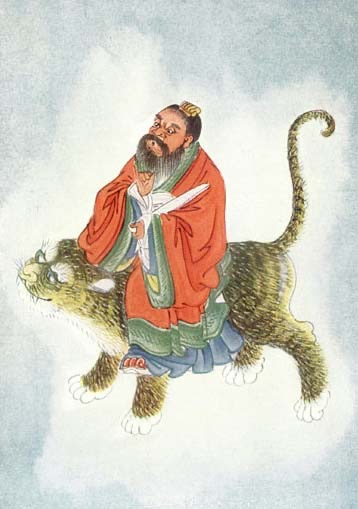
“Alert as a warrior in enemy territory.
Courteous as a guest.
Fluid as melting ice.
Shapeable as a block of wood.” (Lao-Tzu in Mitchell, Verse 15)
The alchemist stretched and flexed his hand. The scars left behind by the burns were hideous: puckered like rotten leather, mottled red and brown. While he no longer felt the pain of the injury he supposed the circulation had been affected; any sustained bout of writing would cause his hand to swell and throb. When it did, he would have to wait an hour or more for the fluids to recede. If he tried to push through it, his whole arm would become heavy and hot, and—worst of all—his writing would become shaky and smeared.
He had considered taking on an apprentice who could write for him, but the alchemist did not think he would be good at dictating his ideas. Writing had to come first: it was how he untangled the bird’s nest of his thoughts. And this nest was very tangled indeed. He touched his writing hand with the other one. It was cool and the pulse barely perceptible. He took up his brush again.
“I relate a dangerous recipe,” he wrote. “In seeking to create a medicine for longevity I have instead discovered huo yao, fire medicine. This I created by drawing on the works of ancient masters, who had experimented with heating saltpeter to create the purple flame.”
He paused to dip and blot his brush. He shivered as an overwhelming memory broke over him: the caustic smell of the mixture in the moment before it burst. “With the saltpeter I combined sulfur and charcoal, and bound the whole together with honey. Smoke and flames resulted, erupting with such violent force that my hands and face were burned badly, and much of my equipment destroyed. He who attempts to create such a mixture will not extend life, but extinguish it.”
It was the goal of any good Taoist to achieve longevity. The alchemist had hoped to create an elixir that would make him immortal. In a way, he had. He had described gunpowder to the world for the first time.
I’m Rose Judson. Welcome to Books of All Time.
Intro – Recap; The Many Lives of Taoism
Books of All Time is a podcast that’s tackling classic literature in chronological order. This is episode 49, Lao-Tzu, the Tao Te Ching, Part 2: As Fluid as Melting Ice. As always, if you’d like to read a transcript of this episode or see the references I used to write it, you can visit our website, booksofalltime.co.uk. There’s a link in the show notes if you need it. Let’s begin.
Hello again. We return to our exploration of the Tao Te Ching, an ancient Chinese book of proverbs and poems from about 350 BCE that has long been attributed to the sage Lao Tzu. If you missed the previous episode, which summarized what’s in the Tao Te Ching and some of its major themes, do go back and have a listen. In this episode, we’re going to have a bit of a “picky tea” that covers lots of aspects of the legacy of the Tao Te Ching. We’ll get a brisk overview of the history of Taoism in China, look at how the West has turned it into a kind of new-age self-help framework that can apply to any area of life, and then end on a fun note by talking about how Taoism found its way into Star Wars and Ursula K. Le Guin’snovels.
First, a brief recap. The Tao Te Ching describes the tao, or the way, which is part philosophy, part practical life advice. The philosophy part sees the tao as a disembodied, cosmic force which penetrates, creates, and changes the universe. It’s described as something which flows and moves through all things. It’s not something any one person can control, appeal to, or direct: instead, people can either align themselves with it or do things which work against it. Those who work against it by constant struggle to dominate wind up thwarted. Those who are aligned, passive, and receptive to the Tao can tap into its energy and achieve long, peaceful lives—or, if they happen to be in charge of a country, become a kind of magnet for peace and prosperity.
In spite of the fact that it’s attributed to a sage called Lao Tzu who lived around the same time as Confucius—in the sixth century BCE—historical evidence suggests that he is probably an invention. The Tao Te Ching, instead, is likely to be a compendium of poems and folk proverbs drawn from centuries of prior tradition by an unknown editor or editors. It was likely compiled into something like its final form around 350 BCE, though this is not when Taoism got started as an actual religion. That would come later.
The origins of the ideas in the Tao Te Ching are murky, but material evidence suggests the roots may reach deep into the past. You may recall from a previous episode—Episode 25, The Book of Isaiah, Part 2: Wizards that Peep and Mutter—that ancient Chinese diviners would heat ox bones or turtle shells in a fire, interpret the cracks that occurred, and then write prophecies on them. Well, there are oracle bones, some as early as 1400 BCE, which have strongly Tao-ish—though not yet Tao-ist—writing on them. These bones mention “the way” and other concepts.
The inclusion of proto-Taoist terminology on these objects shows us how deeply woven into Chinese culture Taoist ideas are: they were in circulation as early as the late bronze age, when the dominant spiritual practice was a form of shamanism. Shamanism is a belief system which centers around quasi-magical practices, such as the creation of powerful objects or substances, or priests entering altered states to commune with the world of the spirits. As the vignette about the Taoist alchemist at the top of our show suggests—totally true, by the way: Taoist alchemists accidentally invented gunpowder while trying to invent an immortality potion around 850 CE—Taoism never fully separated from some of those older, shamanistic ideas.
In fact, that’s one of the remarkable things about Taoism: how it constantly evolves. The image of flowing water which takes the shape of any container is prevalent throughout the Tao Te Ching, and that is a very apt description of the philosophy itself. Wherever it goes, it absorbs and adapts. The scholar Isabelle Robinet once wrote that Taoism, quote:
“has reabsorbed and digested, regathered and amalgamated, and preserved and organized various strands of Chinese culture…all without ever abandoning its own identity and coherence. It has thus become a constantly operating force coordinating and synthesizing Chinese traditions…[and] has impregnated all of Chinese civilization, penetrating ways of thinking in China in all kinds of ways.” (Isabelle Robinet, quoted in Clarke)
As we’ll see, Taoism has digested aspects of the world outside of China, too—and been digested by the world in turn.
But first, we should talk about how that slender book of poetry, with its talk of uncarved blocks and empty spaces and yielding to the universe, snowballed into something that inspired alchemists to blow themselves up in their labs.
Part 1: Five Pecks of Rice and “Church” Taoism
I found an excellent 1966 book, Taoism: The Parting of the Way, by the scholar Holmes Welch. Welch, who lived from 1924–1981, is best known for his work on Chinese Buddhism. He was a research fellow and instructor at both Harvard and Yale and spent significant chunks of his career posted to Hong Kong with the U.S. Foreign Service during the chilliest years of the Cold War. One paper I read referred to Welch as being “spy-adjacent” (Ritzinger 422) rather than an out-and-out spy, but it was fun to spend a few minutes think of him as a kind of American counterpart to George Smiley, the fictional English spymaster who started out as a German literature student.
While Welch’s book is several decades old and seems to be outdated on several key details, what reading around I’ve done suggests it is still in line with today’s scholarship when it comes to the broad strokes of the history of Taoism. Plus, he writes with a pleasing clarity and a decent helping of dry wit. By way of introducing Taoism to his audience, Welch writes that, quote:
“It is a very curious religion. It is not based on faith, but on direct experience of God. It has no place for ritual or priests or church. It promises no response to prayer while we are in this world, and as to the next world, that does not exist . . . . It vigorously attacks morality and government—two institutions that religion generally supports. And most curious of all, the mystical experience it offers is not ecstatic, but dark, neutral, and uncertain.
“For these reasons Taoism as a religion was no success at all. Or rather, the highly successful religion which came to be called Taoism has almost nothing to do with the Tao Te Ching.” (Welch 87)
Instead, Welch points out, the religious movement known as Taoism came to incorporate a wide range of practices and beliefs drawn from many older Chinese traditions, with the philosophy expressed in the Tao Te Ching occasionally brought in as an afterthought, if at all. He describes four “streams” which would eventually combine to form Taoism many centuries after the Tao Te Ching was compiled.
The first of these streams was philosophical Taoism, which incorporated the works of Lao Tzu and his most popular descendants, Chaung Tzu and Lieh Tzu—Chaung Tzu’s book, an engaging and often funny collection of stories with a point, will be a focus of this show later this year. The second was a sort of ancient Chinese wellness movement. This involved attaining extreme longevity, or possibly even physical immortality, through meditation practices, exercises, and sexual control. (Depending on who you asked and when you asked them, “sexual control” could mean either total abstinence, a Chinese tantric-style practice that involved delayed orgasm, or straight-up sacred orgies.)
The third stream focused on the search for some legendary islands where a mushroom grew that conferred immortality, and the fourth was alchemy: the proto-pseudo-science of experimenting with various substances to create riches or, again, an immortality potion. (Welch 88-90)
Three of these four streams, Welch points out, have immortality or extreme longevity as their end goal. He describes some of the wilder practices these pursuits took, especially on the wellness side. For example, there is some ancient Chinese writing which exactly prefigures an American group known as the Breatharians. They, like certain proto-Taoist Chinese sages, believe that all food created impurities in the body, and that fully evolved humans can exist on air alone. This has, historically, not worked out well for them. (Welch 110)
All these streams meet with a rush in 142 CE—fully seven hundred years after Lao Tzu is believed to have lived. In that year, an imperial magistrate named Zhang Daoling claimed he had received a startling revelation. The sage Lao Tzu, in a sanctified and superhuman form, appeared to him on a mountainside in Sichuan and charged him with destroying the demons who were soon to come down and annihilate most of the world’s population. The only way to destroy these demons was to reform the religious practices of the day.
If we take a hard materialist view of Zhang’s story, we might suppose he’d had a nervous breakdown, or eaten something which resulted in hallucinations. I choose to view him from a more generous angle. Maybe this is just a guy who’s reinventing himself in midlife, like all those lawyers or doctors who leave their professions to write thrillers, or like when Madonna got really into yoga in the late 90s.
Regardless of why he took this hard pivot away from a steady government job, Zhang Daoling soon set himself up as The Celestial Master and organized what can loosely be termed a church. While this church claimed its legitimacy from Lao Tzu and began to be referred to as Taoist, it did not really use the Tao Te Ching as the basis for any of its practice. Instead, it provided what we might call Spirituality as a Service (SaaS). Anyone who paid Zhang Daoling and his followers an annual subscription of five pecks of rice (roughly 55 pounds or 25 kilograms) could have access to the services of specially ordained local priests, who could provide medical care, hear confessions of sins, cast out demons, and bury the dead.
Outsiders began to call this group the Way of the Five Pecks of Rice or, when they were feeling catty, The Rice Bandits. But the Celestial Masters forged ahead: Zhang Daoling’s descendants took up his mantle, expanding the operation and gaining influence throughout the region. People liked the medical care, even if it came with preaching from a class of clerics known as Libationers. Celestial Master Taoism also presented a more ecstatic and earthy alternative to the rigid, elitist world of the Confucians.
Then a local lord gave the Taoists a small army to play with. This introduced a paramilitary strain into the faith. Welch notes that priests became warlords, and new converts to the religion became “demon soldiers”. (Welch 116)
The Celestial Master Taoists began to involve themselves in regional conflicts, finding it a convenient way to ingratiate themselves with allied politicians and spread their beliefs. These beliefs again expanded to include bans on animal sacrifice and alcohol, a regime of mandatory quarantine with confessions for the sick, and a network of no-cost inns on the roads, because why not. (Welch 116) Also throughout this time the Taoists were continuously producing new texts—everything from transcripts of prophetic trances to commentaries on the Tao Te Ching, which I imagine were mostly full of excuses as to why the Celestial Masters completely ignored the Tao Te Ching. We are a long way from wu wei and Lao Tzu’s ideal leader, who doesn’t dominate events.
Naturally, the armed Taoists eventually went too far: a splinter group who wore yellow cloths on their heads rose up and rebelled against the regional secular leadership. This did not result in a single violent overthrow of the government, but instead in a decade-long running battle between the so-called Yellow Turbans and the local lords. Eventually, the Yellow Turbans’ leader surrendered, and Celestial Master Taoism lay down its arms to renew its focus on faith healing and weird sex rituals. (Welch 117-119)
If you are so inclined, you can go look up Holmes Welch’s book on the Internet Archive—there’s a link at the bottom of the transcript for this episode—and turn to pages 120 and 121, where there is a description of a group practice known as the Union of Breaths, supposedly performed at new moons. The best way I can describe it is that it’s like sexual square dancing, in which partners are exchanged. I’m going to risk a quote here. If you are listening with young or sensitive people nearby and you haven’t already hit the fast-forward, do so riiiight… now. Quote:
“At the moment of ejaculation the adept, heaving a great breath and ‘grinding his teeth,’ presses the urethra with the two middle fingers of the left hand at a point between the scrotum and the anus. This forces semen up the spinal column to the . . . head, and is immensely restorative.” (Welch 121)
I imagine that’s the kind of thing you can learn nowadays if you pay the likes of Andrew Tate a lot of money.
Moving ever so swiftly on. Just because the Taoists stopped being militant didn’t mean they stopped being competitive. As the first millennium CE wore on, they began seeking influence among the powerful again—this time through philosophical discussion rather than armed insurrection. They also offered their services as alchemists. (It turns out that many an absolute ruler is keenly interested in transmuting ordinary substances into gold and in the prospect of potions that could make him live forever.)
Of course, there was already a quasi-religious philosophical system that had a stranglehold on China’s upper class. That was Confucianism. Its practices informed the entire elite education system and underpinned the bureaucracy, rather the way the Catholic Church would come to do in Europe. The Confucians of the time appreciated the Tao Te Ching and the Chuang Tzu as excellent examples of Chinese literature and even admitted that they contained some philosophical ideas that Confucius would have endorsed. (Helle 79-80).
However, they dismissed the rest of popular Taoist practice—the exorcisms, the prophetic trances, and the sex parties—as vulgar and superstitious. The Confucians did not have much luck convincing their own local rulers of this—again, the alchemy was a major Taoist USP as far as the nobility was concerned—but they did manage to sell visitors to the court on the idea. Particularly the Jesuits, once there were Jesuits around. (Helle 80)
The most serious competitors for the Taoists were the Buddhists. Buddhism had arrived in China only about a hundred to a hundred and fifty years before Zhang Daoling came down from the mountainside. Scholars believe that the two traditions were influencing one another from early on, largely because they were initially fishing for followers in the same pool. While both schools of thought had their lofty sides—well-read men discussing the finer points of philosophy—they were also focused on decreasing the suffering of ordinary people in one way or another. Buddhism presented itself as offering a purer salvation than the Taoists: we don’t see demons around every corner, went the pitch; we can guide you to liberation from the cycle of death and rebirth, and we won’t ask you to give us a wheelbarrow full of rice to do it. (Helle 80)
Taoism, for its part, picked up a few interesting ideas from Buddhism: namely, the idea of that various esoteric practices like fasting and meditation could help you achieve a higher state—though the Taoists saw this higher state as physical preservation rather than liberation from the cycle of death and rebirth. They also began to build temples and stock them with monks who focused on producing, preserving, and commenting on the ever-increasing body of Taoist texts, while the local Taoist priests (and the sons they trained to follow them) continued chasing off demons and conducting more mundane daily rituals, such as burials. (Helle 80-81)
“In all these varieties of [Taoist] life,” writes Helle, “there seems to have been the goal to contact persons in the beyond in the shamanistic tradition . . . However, the most immediate purpose of employing the services of a priest have been and still are to achieve tangible effects in this world.” (Helle 81)
Those goals are not what we might consider spiritual: wealth, good health, and extreme longevity. And they are certainly not the goals we might imagine the readers of verses like, oh, chapter 10 of the Tao Te Ching to have. Quote:
“Giving birth and nourishing,
having without possessing,
acting with no expectations,
leading and not trying to control:
this is the supreme virtue.” (Mitchell, verse 10)
But Taoism is a human system, and humans are irrational, preoccupied with their appetites, and able to adapt their actions to their present circumstances while simultaneously declaring they’re following ancient traditions. Taoism flowed like water through the centuries of Chinese history, briefly supplanting Confucianism at the court of the Tang emperors from about 600-900 CE, when it spread to Japan and Taiwan.
It continued to thrive in villages, with temples all over the Chinese mainland until the 20th Century, when many of them were converted to schools during the brief republican period of China (Bragg et. al., 40:00-41:30), and then completely suppressed immediately after the declaration of the People’s Republic of China in 1949. (Strickmann)
The 63rd Celestial Master, Zhang Enbu, fled to Taiwan in that year, (Strickmann) and it is largely thanks to its continued popularity in Taiwan that the popular form of Taoism survives. It’s a form that is very different from anything Lao Tzu might have imagined—while the sacred sex aspect is gone, it has picked up feng shui, a form of geomancy that involves siting buildings (or objects inside them) to align with auspicious features in the sky or landscape. Today it’s mainly used by anxious suburbanites who want to believe they can decorate their way to wealth, love, or health.
If a sacred text’s principles can become so distorted in practice within its native country, it should probably come as no surprise that we in the west also got pretty weird about it, once we picked it up.
Part 2: The Way of Commodification – Taoism as Adapted by the West
The first translation of the Tao Te Ching in English hit shelves in 1868. Hundreds have followed, and it’s likely that a significant chunk of these were produced by people like the poet Stephen Mitchell and the science fiction novelist Ursula K. Le Guin: people who do not know any Chinese.
Even for people who do know Chinese, translating the Tao Te Ching is fiendishly difficult. That’s because the archaic Chinese in which the oldest copies of it are written is nearly impossible to read in a way that leads to a clear, straightforward meaning, and that’s setting aside the ambiguity of the actual poems themselves.Our friend Holmes Welch sums it up like this:
“Archaic Chinese . . . has no active or passive, no singular or plural, no case, no person, no tense, no mood. Almost any word can be used as almost any part of speech. I have seen ‘manure’, for instance, used as an adverb.” (Welch 9)
He goes on to note that anything that seems vaguely like a rule has dozens of exceptions, and that, because there is no extant original manuscript of the Tao Te Ching, translators working with very old copies of it have to second-guess not only their own working knowledge of the language and the intentions of the author, but also the intentions of (and possible errors or alterations introduced by) the copyists. There is also the fact that many ancient Chinese writers liked to drop allusions to other works, or to current events, or to events in the life of the writer into their works without explaining them–they assumed their audience would get the message. (Welch 12)
In spite of all this, Holmes Welch does not sound like a man in the throes of despair or in the grip of a stress-related drinking problem. He sounds quietly excited about plunging into the thicket:
“With most of Chinese poetry and much of Chinese prose, we have to decide for ourselves what is meant, within more or less broad limits set by the text. To read is an act of creation.” (Welch 12)
And people say humanities scholars lack grit.
Western translators and readers have indulged in some pretty dazzling acts of creation with their readings of the Tao Te Ching. Classic, ancient books—books of all time, you might say—have a tendency to be picked up by successive generations, buffed to a high shine, and then held up to reveal a reflection of whomever decided to do the buffing.
As we embark on our third year together, I have to say one of the things I’ve learned doing this show—other than that I need to get a better handle on my day job and my red blood cell count in order to keep doing it—is that it is impossible to avoid getting a bit appropriate-y when reading across cultures. We always try to make things about us. This is just as true of Taoism as it is about anything else.
“The global propagation of Taoism outside Chinese communities,” writes the scholar Jose Bizerril, “has a clear relation to a certain orientalist atmosphere: namely, a western worldview that opposes a modern (and postmodern) West and a mythical East. This imagined East becomes a repository for alternative lifestyles, worldviews, and practices.” (Bizerril 2015)
There are tons of books that purport to adapt the principles of Taoism for western audiences. If you pop over to Goodreads (which, if you don’t know, is a place where people can post reading lists or book reviews), you’ll find a list called “The Tao of [Insert Topic Here]”. It lists as many books as the compiler could find that have titles beginning with those three words.
There are 106 items on the list. A few of my favorites:
- The Tao of Physics
- The Tao of Architecture
- The Tao of Twin Peaks
- The Tao of Elvis
- The How and the Tao of Old-Time Banjo
- The Tao of Willie: A Guide to the Happiness in Your Heart
That last one is by Willie Nelson. I would say that roughly a third of the titles on this list are about making money or becoming influential, and another third are about making yourself feel better about your life (the other third is everything else—science, pop culture figures, and cats).
We are going to look at two of the most popular western adaptations of the Tao from each of those main categories. One is The Tao of Leadership by John Heider, and the other is The Tao of Pooh by Benjamin Hoff. Since you’re listening to me talk and not reading this, let me clarify: “Pooh” in this context means “Winnie-the-Pooh,” the charmingly dim-witted bear from A.A. Milne’s classic books for children.
Heider first. John Heider, who lived from 1944–2010, was an American psychologist associated with the mid-20th century Human Potential Movement. One of its major centers is the Esalen Institute in Big Sur on the coast of California. Esalen was founded by a couple of Stanford graduates in the 1960s.
One of its founders, Dick Price, developed Gestalt practice, a modified form of mindfulness meditation which involves two or more people working together to observe, comment on, and discuss what they are experiencing at the present moment. Aldous Huxley, Ken Kesey, and Deepak Chopra have all been guest teachers at the institute. It offers workshops on everything from massage therapy and ceramics to therapeutic journaling and “human empowerment in the AI age.”
I tell you all of this so you understand what kind of place this is. Not bad or even foolish, per se, but a very American sort of place that picks and chooses from all kinds of traditions and tries to apply or repackage them to help people live fuller lives—but often winds up helping people live more “optimized” lives instead.
Heider published The Tao of Leadership in 1985. It is structured to be similar to the Tao Te Ching: 81 short chapters on different topics. In his introduction, he says that he first applied the lessons of the Tao Te Ching to his work when he was teaching training courses for other psychotherapists and educators. All well and good. Then he summarizes the lesson of the Tao Te Ching as “our work is our path” (Heider xi). Less good. Then he says, quote:
“I do not read Chinese, however; I made this adaptation by comparing many different translations until their apparent contradictions were reconciled and made sense to me.” (xii)
[Heavy, drawn-out sigh.] Look, I don’t want to—and I’m not capable of—turning this section of the show into an episode of If Books Could Kill. But here in the introduction we already have him admitting to a fatal flaw in his project. Heider’s basically saying that this “adaptation” of Lao Tzu (who, again, probably didn’t exist) is him wrapping up his own ideas in Chinese robes. He seems like he was a lovely, intelligent, professionally accomplished human being who really wanted to help others, but my teeth were already gritted even before I got to the pages with Arabic numerals on them.
Listener, I did not unclench my jaw. You recall the opening of the Tao Te Ching? “The Tao that can be told/ Is not the eternal Tao;/ The name that can be named/ is not the eternal name?” Heider dilutes this chewy little nugget into New Age soup:
“Tao means how: how things happen, how things work. Tao is the single principle underlying all creation. Tao is God. . . . If you can define a principle, it is not Tao. Tao is a principle.” (Heider 1)
Is it, though? He goes on to say in later in the first chapter that everything boils down to “principle and process, how and what.” And then concludes that “By knowing Tao, I know how things happen.”
First, shouldn’t that be “principle and process, what and how,” or even “why and how”? Second: there is no one, overriding point to the Tao Te Ching—it’s a collection of loosely related poems and proverbs that probably weren’t all written by the same person at the same time, after all—but surely one of them is: you as a human never actually know how things happen and you can never control them. Life is a mystery; everyone must stand alone, or something.
I would like to be generous. But reading through The Tao of Management and comparing it side-by-side to the Tao Te Ching is crazy-making. There are some nuggets of good advice sprinkled throughout for leaders that do apply Taoist ideas. In chapter 14, “Knowing What Is Happening,” for instance, Heider suggests that leaders who lose sight of what is happening in their groups or what members of the group are trying to say should not strive harder to understand, or try to force things into a prescribed framework. They need to step back and pay attention to what is happening now and be receptive to it. (Heider 27)
Then, a few pages later, you get to Chapter 19, “Self-Improvement,” which says: “No teacher can make you be happy, prosperous, healthy, or powerful. No rules or techniques can enforce these qualities. If you wish to improve yourself, try silence or some other cleansing discipline.” (37)
So in other words, forget those techniques: try this technique, or others like it. I can’t tell whether Heider is unintentionally contradicting himself or trying to sound like the Tao Te Ching by deliberately introducing contradictions because he feels that’s necessary for writing a profound text. Neither option makes me able to settle into the book at all.
Maybe my problem is the presentation: maybe if he had written a straightforward prose work with case studies and other bits of research included, then pulled in verses from the Tao to illustrate his points, I could live with it. It’s the way he’s kind of aping the “simple, yet profound” language and the “inscrutability” that Westerners often ascribe to Asian esoteric thought that gets my back up.
Laying aside the cultural appropriation aspect, Heider, to me, just winds up coming across as if he’s trying to speak to a seminar room full of business leaders who all have head injuries. He uses a quiet tone and simple language, but occasionally throws in jargony words and phrases like “capitalize” or “Gestalt formation,” (63) then caps chapters off with what’s probably meant to be a gnomic little observation that bears pondering upon. Here’s the end of Chapter 20, “Traditional Wisdom”:
“What is common is universal. What is natural is close to the source of creation. This is traditional wisdom.” (Heider 39)
No, Dr. Heider, I’m pretty sure those are tautologies.
I take it back, I am going to go If Books Could Kill for a second here: I bet this hits so hard when you’re stupid.
We now move on to the Tao of Pooh, and I have a confession to make: I owned this book when I was a teenager. It was a gift from my very first serious boyfriend, and I cherished it. It was proof that he loved me, because I like books and he gave me a book, awwww! In my defense, we’re all kind of idiots when we’re 16 and in love.
The Tao of Pooh was published in 1982. Its subtitle is: The Principles of Taoism Demonstrated by Winnie-the-Pooh. I read the 2025 edition published by Farshore for this episode, and I note that on the cover, right underneath the name of the author, Benjamin Hoff, it says, “Inspired by the original works of A.A. Milne and E.H. Shepard”. I get that the publishers had to include this for copyright reasons—Hoff quotes extensively from Milne’s books and uses many of Shepard’s original illustrations—but it is odd that a work with “Tao” prominent in the title doesn’t also mention it’s inspired by Lao Tzu.
Anyway. Benjamin Hoff is still alive and living in Oregon. In 2021, he published his own version of the Tao Te Ching, which I’ve not read and can’t pass comment on. However, I will say that unlike other translators and popular authors who aren’t practicing academics, his bio on his website suggests he has demonstrated serious dedication to studying East Asian cultural practices, including Taoism, throughout his life. And in spite of the fact that The Tao of Pooh seems like it should be fluffy and silly on the surface, the relative depth of his reading compared to someone like Heider is evident.
Before we get to that, though, let me observe that The Tao of Pooh was basically tailor-made to be a best-seller. It combines a bunch of elements publishers and people love. You’ve got an approachable explanation of an ancient philosophy—something lots of stressed, jaded Westerners are always ready to hear about. You’ve got the sugar-rush nostalgia hit of a wildly popular children’s book series—and even if people had never read the original Pooh books or any of Milne’s other work, they’re likely to have encountered the characters through the Disney adaptations.
And, from Hoff himself, you have an authorial voice that’s a bit snarky and contrarian about the Current State of the World. The Tao of Pooh makes complex things seem simple and simple things seem complex. It presents the old and familiar in a new way. It’s an insanely clever idea.
Which is what makes it so weird that Hoff takes numerous pot-shots at “cleverness” throughout the course of his book. In among all the amusing and often thought-provoking relationships he draws between the personalities or situations in Pooh and how they can relate to concepts in Taoism(wu wei, for instance, becomes the Pooh Way), there’s a persistent refrain of very un-Taoist contempt for academics, business, organised religion, fast food, rock music, and plastic surgery.
While I’m broadly sympathetic to Hoff’s feelings about several of those things—for instance, I am sure we both deplore the current vogue for enormous false eyelashes—they take me out of whatever else he’s trying to say. It’s like listening to windchimes on a breezy day, but every now and then someone in the next garden over triggers an air horn. You can never quite relax into the moment.
It also doesn’t help that about two-thirds of the way into the book, Hoff begins to steer it toward self-help cliches. There’s a bit where he talks about a man at the end of his rope—an alcoholic who’d lost his daughter, bankrupted his business, and tanked his reputation—and then reveals him to be, voila! The architect Buckminster Fuller. There’s another where he relates with apparent sincerity the story of Li Ching-Yuen, a Chinese herbalist who died in 1933—and claimed he had been born in 1677. He had extended his life via perfect alignment with the Tao. Hoff writes:
“In the mountains of China, [Li] learned . . . some of the secrets of the earth’s medicine. In addition to using various rejuvenative herbs daily, he practiced Taoist exercises, believing that exercise which strains and tires the body shortens life. . . . He advised those who wanted strong health to ‘sit like a turtle, walk like a pigeon, and sleep like a dog.’” (Hoff 122-123)
This reads like a more grammatically correct version of the kind of stuff that washes up in my spam folder, promising miracles from a supplement that will only set you back $79.95 a for a bottle of 30. I know we hear a lot about supercentenarians, but so many of those claims about reaching extremely old age just turns out not to be true.
Apologies for bringing up If Books Could Kill yet again, but the hosts of that show went on the wellness podcast Maintenance Phase to debunk claims about the so-called Blue Zones, like the Japanese island of Okinawa, where people reportedly live hale and hearty lives well into their 110s. A close read of the evidence shows that most of those reports are either record-keeping errors, misunderstandings, or just plain false. For example, the demographer Saul Justin Newman of University College London showed that a lot of people who claimed to be living incredibly long lives actually turned out to be impersonating their own parents or grandparents in order to commit some good, old-fashioned pension fraud.
Also, I looked up Li Ching-Yuen on Wikipedia. In addition to claiming he was over 250 years old, he also claimed to be seven feet tall. Mmhm.
I guess my point here is that The Tao of Pooh could have been—and at times is—a fun way to help Westerners grasp Taoist concepts. But like Heider’s book, it eventually focuses more on contrasting the pure, noble, ancient Tao with our fallen, materialist, competitive western world. It becomes less about the Way and more about Hoff’s way. Which is disappointing, to say the least. Apparently, the companion book, the Te of Piglet, is even more of a drag in this regard: it seems Hoff goes off on a tangent about how awful feminism is.
Ugh. Enough about this. Let’s talk about Star Wars.
Part 3: Building Worlds with the Tao – Star Wars and Earthsea
A long time ago, in a galaxy far, far, away, a guy named George Lucas made a little film called Star Wars that drew on a ton of ideas from Asian culture. George had spent time with Buddhist monks in India (Johnson); he’d been fascinated by the samurai films of Akira Kurosawa—in particular, The Hidden Fortress (1958).
In creating the universe for Star Wars, he’d drawn heavily on these Asian influences as well as on Arthurian legends, the original Flash Gordon serials, and the scholar Joseph Campbell’s books on story and myths. Lucas cites Campbell’s The Hero with a Thousand Faces as being formative to his sense of story. Just about anyone who’s ever taken a screenwriting class will have had to read that book, and that is thanks largely to Lucas: he’s the one who foisted all that on us, simply because Star Wars was such a runaway success.
Anyway, along with plot points, the Asian influence on Star Wars is evident in its visual design elements, too. I read a paper from the year 2000 by Kevin J. Wetmore called “The Tao of Star Wars, Or, Cultural Appropriation in a Galaxy Far, Far Away” which picked out a lot of details that seem obvious in hindsight: you’ve got the Jedi, who fight with swords and wear robes, like samurai. Darth Vader’s armor is also very influenced by medieval-era samurai gear, and then, in 1999’s The Phantom Menace, you’ve got Queen Amidala and her crew who have a vibe that’s part Geisha, part imperial China. (93)
Wetmore also calls out the fact that, in spite of Lucas’s interest in Buddhism, quote, “the language the various characters use to describe the Force suggests Taoism . . . the theology and cosmology of Star Wars constructs an ultimate reality much closer to Taoism than to any Western religious philosophy.” (94) And this is true: most Western religions are about belief in a personified higher power. Buddhism is mostly about moral balance and about transcending a world of suffering. Taoism is super into the interplay of opposites like “light” and “dark” and ultimately all about that cosmic, uh, force.
Westmore further draws two major parallels between Taoist philosophy and the Jedi. The first regards the emphasis on flow: both the Tao Te Ching and the Jedi stress that to control the force you’ve got to be open, receptive, yielding. Think of how Obi-Wan Kenobi (again, a very Asian-sounding name) tells Luke that the force controls actions but can also obey commands. In The Empire Strikes Back, Yoda mentions flow and flowing several times while he’s training Luke in the swamps of Dagobah. The Force can’t be tapped into if you come at it from an intellectualizing or analytical mindset. At some point, you’ve got to stretch out with your feelings, switch off your targeting computer, and fire the torpedoes trusting that you’ll save the galaxy. (Wetmore 95)
The second Taoist parallel is in how the Jedi—in the first two films, at least—present themselves as very humble. Neither Obi-Wan nor Yoda immediately strike Luke or the viewer as likely to be skilled warriors. One is an elderly gentleman with a suspiciously neat beard; the other is a little green imp who enjoys rooting through Luke’s belongings and whacking his robot with a stick. Wetmore pulls an appropriate quotation from the Tao Te Ching to illustrate this point, quote: “One who excels as a warrior. One who excels in fighting is never aroused in anger.” (Wetmore 96)
Well, quite. Yoda spells this out in The Phantom Menace when describing how people turn to the Dark Side: “Fear leads to anger; anger leads to hate, hate leads to suffering.” This notion of a dark side as negative and evil is where the Western influence reasserts itself. Taoism, at least before Zhang Daoling showed up promising exorcisms for everyone, didn’t recognize this kind of polarity—one rooted in enmity. Instead, you had the opposites constantly blending into one another, becoming one another. Although, to be fair, there’s quite a bit of that in Star Wars, too, particularly in 1983’s Return of the Jedi. Russell P. Johnson of the University of Chicago’s School of Divinity laid this out in a 2023 blog post called “This Is the Way: Daoist Themes in Star Wars”.
He notes that at the start of Return of the Jedi, Luke Skywalker is becoming very much like his father, Darth Vader. He dresses in black. He’s got a mechanical hand. At one point he uses a force choke, which is Vader’s preferred HR management technique. This flirtation with the Dark Side is a result, Johnson argues, of Luke’s fear of becoming like his father—of straining to control himself and avoid the Dark Side. Control is what the Emperor tries to do. It’s only when Luke realizes that trying to control anything is futile that he finally understands what he has to do: turn off his lightsaber and yield. Johnson pulls out a line from verse 69 of the Tao Te Ching which illustrates the lesson: “There’s nothing worse than attacking what yields. To attack what yields is to throw away the prize.”
And that prize? A jam session with the Ewoks, attended by your dad’s Force Ghost. Sure, it may seem cringe to us now, but just imagine: it could have ended with a Celestial Masters-style Union of the Breaths instead.
Anyhow, by happy coincidence, Russell Johnson’s article links to an edition of the Tao Te Ching produced by another science fiction legend—although not one as well-known as George Lucas. Ursula K. Le Guin, who lived from 1929–2018, was the author of more than 20 novels and dozens of short stories, along with countless essays and reviews. From a very early age she was familiar with the Tao Te Ching: her father had a well-loved 1898 edition of it in their home. This was by the scholar Paul Carus, whose version presented the Chinese characters on one side, and an English transliteration—a representation of the sounds of the Chinese word—and a translation of the meaning on the other side.
Very early in life, Le Guin began to work on her own version of the Tao Te Ching, which she called a “rendition” as a nod to the fact that she did not know Chinese. It took her decades to complete. In the intervening years she produced the works for which she would become famous—works which drew heavily on Taoist philosophy. Her 1971 novel The Lathe of Heaven took its title from one of the translations of the Tao Te Ching she read. (Le Guin 1998, 101) Her breakthrough novel, 1969’s The Left Hand of Darkness, is set in a world where one of the religious systems is explicitly Taoist. They have a song that sounds very Tao Te Ching-ish, quote:
“Light is the left hand of darkness,
And darkness the right hand of light.
Two are one, life and death, lying
Together like lovers.” (Le Guin 1980, 64)
The themes of balance are also prevalent in Le Guin’s work, particularly in the magic system she invented for the Earthsea fantasy novels. I read a 2021 paper, “Aspects of Worldbuilding: Taoism as Foundational in Ursula K. Le Guin’s Earthsea Saga” by Dennis Friedrichsen. It walks through all the many Taoist influences visible in Le Guin’s series. Magic in Earthsea is a bit like the Force, yes, but the main issue for Le Guin is the idea of a balance, of aligning with natural rhythms. “The issue of balance is visible early,” writes Friedrichsen, “with clear complementary opposites in the form of silence and the world, dark and the light, and dying and life.”
Another confession: I have bounced hard off Ursula K. Le Guin’s fiction over the years. It’s just not my thing. But I have read and re-read many of her essay collections and speeches. I really love her as a thinker, as a person who is awake in the world. And I really enjoyed her rendition of the Tao Te Ching. In her notes for it, and in interviews she gave around the time of its eventual publication, in 1998, she explained her motivation for persevering with the project over a nearly sixty-year period.
Her goal, she wrote in the introduction, was to create a version of the Tao Te Ching that speaks less to rulers and to sages than it does to, in her words, “an unwise, unpowerful, and perhaps unmale reader.” As a dedicated non-theist, she admired the Tao Te Ching’s, quote, “morality without a deity to validated it, and spirituality of which man is not the measure.” (Le Guin 1998, 20)
She was irritated by the idea that people need to believe in a god—or in anything—in order to behave morally. “A belief,” she wrote, “starts with a genuine spiritual yearning, and it often ends up in a kind of silly, frivolous self-reassurance, with lots of trappings.” (Le Guin, quoted in Slaughter) (I’m going to pretend she used the word “trappings” deliberately, as a nod towards all those ancient Chinese Taoists who held in their semen.)
She also hoped to rescue Lao Tzu from the other translators of recent years, whose work, to her mind, was sort of soggy with New Age “dullness and vagueness”. (Le Guin, 1998, 103) These translators misrepresent the Tao Te Ching by amping up the mysticism even when they shouldn’t, Le Guin argues. Quote:
“Lao Tzu is tough-minded. He is tender-minded. He is never, under any circumstances, squashy-minded. By confusing mysticism with imprecision, [other translators] betray the spirit of the book and its marvellously pungent, beautiful, laconic language.” (Le Guin 1998, 103)
There are more than 80 English translations of the Tao Te Ching out there, the majority of which are not by people who actually know Chinese. Our friend Holmes Welch had this to say about the mania for translations of the Tao Te Ching, quote:
“Why have there been so many translations? Certainly one reason is that the book is short. Its brevity appeals not only to the translator, but also to the reader with broad interests who cannot resist an important slender volume reasonably priced, tempting him by its very slenderness to do a little serious reading.” (Welch 5)
Welch also points to the fact that the Tao Te Ching’s ambiguity and obscurity is part of its appeal. “It is a famous puzzle which everyone would like to feel he had solved.” (Welch 7) In the six weeks it’s taken me to finish up this episode, I’ve read or re-read six translations of the Tao Te Ching, and Le Guin’s is my favorite of the non-specialists’ editions. She largely tries to stay out of the text’s way, and she largely succeeds. I think she comes closest to solving the puzzle because she understands it can’t be solved. I’ll leave you with this quote from her footnote to verse 55, which compares the perfect Taoist to a baby:
“As a model for the Taoist, the baby is in many ways ideal: totally unaltruistic, not interested in politics, business, or the proprieties, weak, soft, and able to scream for hours without wearing itself out . . . . As a metaphor of the Tao, the baby embodies the eternal beginning, the ever-springing source. . . . No Peter Pan-ish refusal to grow up is involved, no hunt for the fountain of youth. What is eternal is forever young, never grows old. But we are not eternal . . . . The Way is more than the cycle of any individual life. We rise, flourish, fail. The Way never fails. We are waves. It is the sea.” (Le Guin 1998, 66)
Wrap-Up and Outro
That’s it for this episode. I feel like it is both very annoying and very appropriate that the ideas in the Tao Te Ching have been the launching point for everything from longevity-seeking sex-and-alchemy cults in ancient China to a multibillion-dollar franchise about space wizards. Annoying, because it would be interesting to see what a religion based only on the ideas of unforced action and attention to natural forces could actually look like. Appropriate, because, as “a puzzle everyone wants to believe he has solved,” Taoism was never not going to be picked up by anyone and everyone and bent into all kinds of shapes.
You may well say to me: but Rose, misinterpretation and reinvention are the fate of many other big ideas humans create, from capitalism to Christianity! And I would agree with you. But the Tao Te Ching seems to be unusually flexible—like the mercury the alchemists believed would lead to immortality. Like the water that flows off melting ice. In following its principles, you can gain inner peace and arrange your furniture. Not even Hinduism has that kind of range.
I mentioned lots of books in this. If you are interested in the history of Taoism do pick up Welch’s book, either at the Internet Archive or by shopping around for a used copy online—I saw several on eBay in the US, for instance. I don’t recommend either of the books discussed in the middle section of the show, but I do recommend Ursula K. Le Guin’s edition of the Tao Te Ching if you want a non-specialist rendition that has some very fine poetry in it, and some very sharp, often funny notes.
What next, you ask? Why, it’s only Ari-bloody-stotle, the philosopher to kings. We’ll discuss just one of his books (actually a collection of lecture notes) and then spend the meta episode talking about his relationship with his most famous student, Alexander the Great. Join me next time for Episode 50: Aristotle, Nicomachean Ethics, Part 1 – The Magnanimous Man.
Books of All Time is written and produced by me, Rose Judson. The Disclaimer Voice of Doom is Ed Brown. Lluvia Arras designed our cover art and logo. Special thanks to Holly Wood, Cathy Merli, Matt Brough, John Cole and the Books of All Time Advisory Council: Ed Brown, Beck Collins, Neil Dowling, Caitlin McMullin, Hugh Parker, and Jonathan Skipp. You can support the show by subscribing and leaving a rating or review at Apple Podcasts, Spotify, or wherever you get your podcasts. You can also follow us on social media: we’re on Bluesky, Instagram and Facebook. Thanks for listening! I’ll be back soon.
References and Works Cited:
- Amaker, Tyler, et al. “Gunpowder in Medieval China.” Science Technology and Society a Student Led Exploration, 29 July 2020, opentextbooks.clemson.edu/sciencetechnologyandsociety/chapter/gunpowder-in-medieval-china/.
- Bizerril, Jose. “Taoism and New Age.” SpringerLink, Springer International Publishing, 13 Oct. 2015, link.springer.com/rwe/10.1007/978-3-319-08956-0_86-2#citeas.
- Clarke, J. J. The Tao of the West: Western Transformations of Taoist Thought. Routledge, 2006.
- Heider, John. The Tao of Leadership: Lao Tzu’s Tao Te Ching Adapted for a New Age. Green Dragon Books, 2015.
- Helle, Horst J. “Daoism: China’s Native Religion.” Brill, 2017, pp. 71–81. A Comparison of Cultures, http://www.jstor.org/stable/10.1163/j.ctt1w8h29s.12. Accessed 30 May 2026.
- Hoff, Benjamin, and Ernest H. Shepard. The Tao of Pooh: The Principles of Taoism Demonstrated by Winnie-the-Pooh. Farshore, 2025.
- Hoff, Benjamin. “The Official Website of Benjamin Hoff, Author.” The Official Website of Benjamin Hoff, Author, http://www.benjaminhoffauthor.com/. Accessed 16 June 2026.
- Johnson, Russell P. “This Is the Way: Daoist Themes in Star Wars.” The University of Chicago Divinity School, divinity.uchicago.edu/sightings/articles/way-daoist-themes-star-wars. Accessed 31 May 2026.
- Kerr, Breena. “A Week with Breatharians, the People Who Think Air Is Food.” GQ, 7 Sept. 2017, http://www.gq.com/story/breatharians-the-people-who-think-air-is-food.
- Laozi. Tao Te Ching: A Book about the Way and the Power of the Way. Translated by Ursula K. Le Guin, Shambhala, 2019.
- Mark, Emily. “Taoism.” World History Encyclopedia, https://www.worldhistory.org#organization, 22 Feb. 2016, http://www.worldhistory.org/Taoism/.
- “Religions – Taoism: The Origins of Taoism.” BBC, BBC, 12 Nov. 2009, http://www.bbc.co.uk/religion/religions/taoism/history/history.shtml.
- Ritzinger, Justin R. “Tinker, Tailor, Scholar, Spy: Holmes Welch, Buddhism, and the Cold War.” The Open Buddhist University, The Journal of Global Buddhism, 24 Apr. 2021, buddhistuniversity.net/content/articles/tinker-tailor-scholar-spy_ritzinger-justin-r.
- Slaughter, Jane. “Lao Tzu: Tao Te Ching: A Book about the Way and the Power of the Way.” Detroit Metro Times, 27 May 1988, http://www.metrotimes.com/arts/lao-tzu-tao-te-ching-a-book-about-the-waw-and-the-power-of-the-way-2282158/.
- Strickmann, Michel. “Taoism.” Britannica.Com, Encyclopedia Britannica, 22 May 2026, http://www.britannica.com/topic/Taoism/Influence.
- Welch, Holmes. Taoism: The Parting of the Way. Beacon Press, 1966. Via the Internet Archive: https://archive.org/details/taoismpartingofw0000holm/
- Wetmore, Kevin J. “The Tao of ‘Star Wars’, Or, Cultural Appropriation in a Galaxy Far, Far Away.” Studies in Popular Culture, vol. 23, no. 1, 2000, pp. 91–106, http://www.jstor.org/stable/23414569.


Leave a comment