
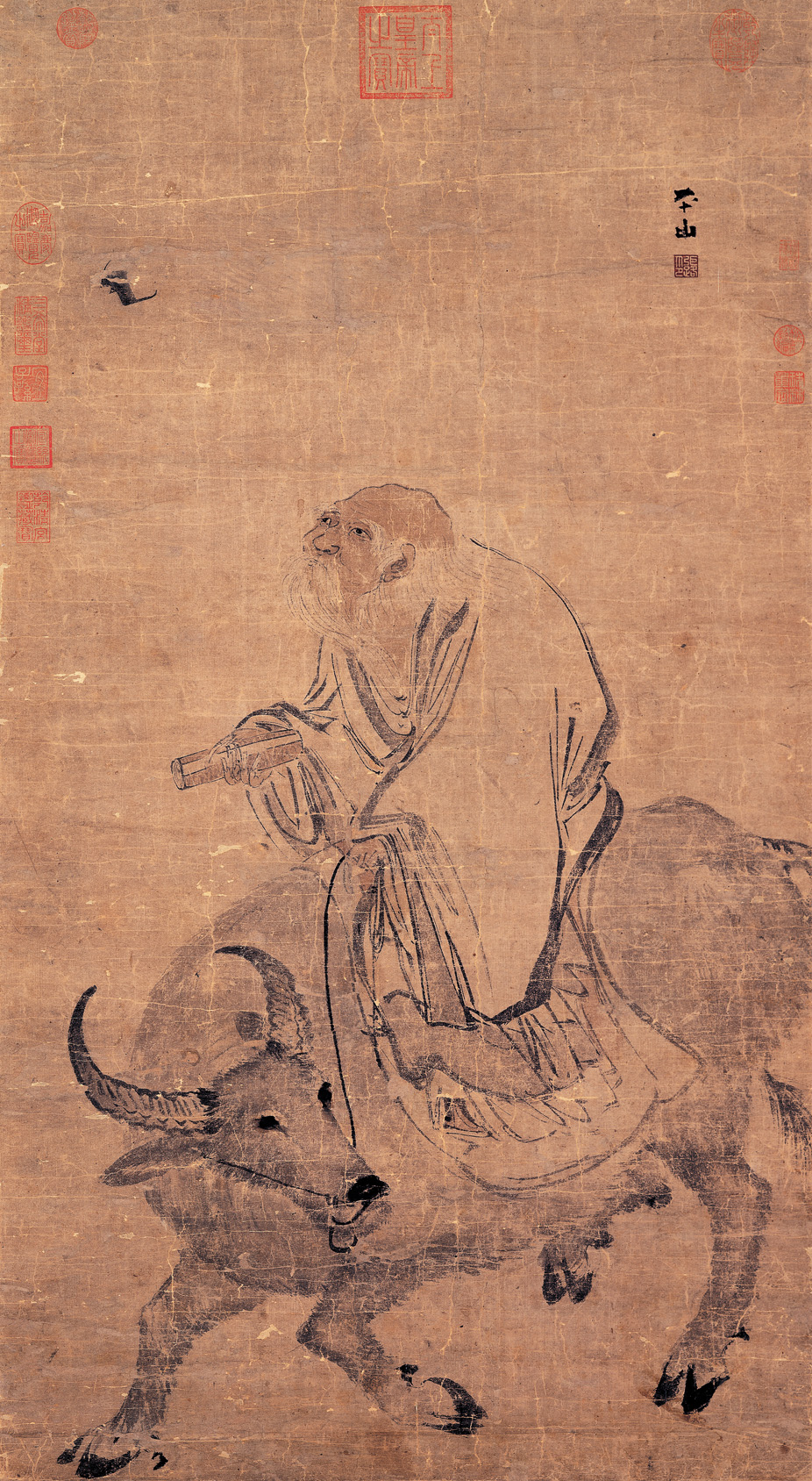
“The giant pine tree
grows from a tiny sprout.
The journey of a thousand miles
starts from beneath your feet.” (Lao-Tzu in Mitchell, Verse 64)
The legends say that the old man approached the border crossing in the mountains on a cold night. They don’t say whether he had any attendants with him—given his honourable position and his long service at the court, it would have been unusual if he had none. But the old man was going into voluntary exile, so perhaps he made the journey alone after all.
The court the old man served was the Duke of Ch’u’s court. Ch’u, now lost, covered vast areas of central China, including what is today Hubei province. The capital of modern Hubei is Wuhan, a city of more than 13 million people which sits on the Yangtze River and is perhaps best known to people where I live as the place in which COVID-19 was first identified.
On the night we are speaking of, two and a half thousand years ago, things were much quieter. There were no paved motorways, no skyscrapers, no airplanes grinding across the sky. The only lights the old man would have seen were torches posted either side of a gate in the mountains, and perhaps a flickering lamp or a brazier in the hut occupied by the border guards.
One of the guards—the historian Sima Qian tells us his name was Yin Hsi—approached the traveler holding a torch aloft.
“I know you,” he said to the old man. “You’re Lao-Tzu, the duke’s historian. What brings you into the mountains at night?”
“I am retiring into the west,” said Lao-Tzu. “I am weary of the corruption at the court and the endless wars. I have tried to help my masters rule wisely by showing them their history, but it seems we live in an age where force in pursuit of gain is the only law men recognize.”
“That’s so,” Yin Hsi replied. “Is there another law we ought to recognize, master? I know you have instructed great scholars—even that Confucius fellow, who has so many disciples hanging on his every word now, sought you out. I would be grateful for anything you could teach me.”
“I can write some things for you,” Lao-Tzu said. Yin Hsi, who was a courteous man, if not a cultured one, led the sage to a rock near the brazier where he could sit. He furnished the old man with writing materials, then busied himself with keeping the fire warm and bright for his guest. Lao-Tzu wrote through the night, producing a work that was five thousand characters long and divided into two parts. After dawn, he handed what he had written to the gatekeeper.
“Here is everything you need to know,” he said. Yin Hsi accepted the master’s book with gratitude, then opened the western gate. Beyond there was cold mist, not yet touched by the rising sun. Lao-Tzu walked slowly into it. Very soon, he was out of sight.
I’m Rose Judson. Welcome to Books of All Time.
Intro – What Is the Tao Te Ching? Who Wrote It, and When?
Books of All Time is a podcast that’s tackling classic literature in chronological order. This is episode 48, Lao-Tzu, the Tao Te Ching, Part 1: Darkness Within Darkness. As always, if you’d like to read a transcript of this episode or see the references I used to write it, you can visit our website, booksofalltime.co.uk. There’s a link in the show notes if you need it. Let’s begin.
This week we are returning to China to engage with a slim volume of poetry that is considered both a masterpiece of Chinese philosophy and the cornerstone of Taoism, China’s major native religion. This book of poetry is the Tao Te Ching, attributed for centuries to a scholar known as Lao-Tzu. For us westerners, the Tao Te Ching has become one of the most popular Chinese works of literature we know. You’re familiar with it even if you don’t think you are.
The Tao Te Ching has been translated into English many times. Sometimes these translations are by scholars with actual knowledge of classical Chinese. Others are by poets and writers who piggyback on the work of these scholars—for instance, the late science fiction novelist Ursula K. Le Guin produced her own edition in 1997. The Tao Te Ching has been appropriated by businessmen, by martial arts teachers, mental health counselors, scientists, travel writers, one American president, and Willie Nelson.
The scholar D.C. Lau, in the introduction to his translation of the Tao Te Ching for Penguin Classics, writes that, quote:
“It cannot be said that [the Tao Te Ching] has been best served by its numerous translators, as the nature of the work attracted many whose enthusiasm for Eastern mysticism far outstripped their acquaintance with Chinese thought or even with the Chinese language.” (Lau vii)
The Tao Te Ching is one of China’s great contributions to world culture, but it has become a sort of woo-woo self-help ideology for many people, totally divorced from the time and place where it was written.
Which is understandable, given that scholars are really not at all sure where it was written, or by whom. The Tao Te Ching, like its legendary author, is lost in the mist.
First, it’s entirely possible that there was no such person as Lao-Tzu. The first clue is that the name “Lao-Tzu” isn’t a given name; it’s more of a title, meaning roughly “Old Master.” The next clue is that the first known source which mentions him was written hundreds of years after he is supposed to have lived. The vignette at the start of our show draws on a story passed on by Sima Qian, who was the author of the Shiji, usually known in English as Records of the Grand Historian. He lived from roughly 145 to 86 BCE, and he believed that Lao-Tzu lived at the same time as—though was somewhat older than—Confucius. Confucius, you may recall, lived from about 550 BCE to about 479 BCE—about the same time as our crusty pal Hesiod.
However, Sima Qian wasn’t completely sure about Lao-Tzu’s dates. He relates at least two other stories about his origins, one of which also suggests that Lao-Tzu somehow lived to be nearly two hundred years old. This is not so much a biography as it is a record of the of stories that were in circulation about Lao-Tzu at the time Sima Qian was writing.
D.C. Lau has an entire appendix dedicated to this issue of whether Lao-Tzu existed at the back of the Penguin Classics edition of the Tao Te Ching. He combs through several important philosophical works to see whether those writers discuss Lao-Tzu or Taoism. None of them do—at least, not until the 200s BCE. Even the Chuang-Tzu, which was composed around 300 BCE and is considered the other major Taoist text, doesn’t mention Lao-Tzu or any kind of school of thought created by him. (Lau 98) In fact, the Tao Te Ching itself doesn’t mention Lao-Tzu or any other specific person.
Based on the evidence, Lao Tzu was almost certainly not a real person, but instead a kind of back-formation by later writers—a character they invented who could be venerated as the founder of their tradition. The stories told about him—his trip into the mountains, a meeting in which he gives a testy clap-back to a question Confucius asks—are typical examples of a genre of stories about wise sages doing wise, sage things. (Lau 100) “That [the Tao Te Ching] is attributed to Lao Tzu is purely a matter of tradition,” Lau concludes. (Lau 104)
So if there wasn’t one author of the Tao Te Ching, how did it come to be written? The answer is most likely that it’s an anthology—a collection of 81 poems and proverbs from many authors and many different time periods. These 81 verses are strung loosely on a common thread: the concept of the Tao or the way—what it is, how it behaves, and how people can apply it in their lives. Probably there have been many Tao Te Chings over the centuries, with changing configurations of verses as different editors or copyists handled the work according to their different agendas.
Dating the work is equally tricky: like the Upanishads or the Rig Veda, it almost certainly includes sections that were written centuries apart. Some of the Tao Te Ching is probably as old as the writings of Confucius—that is, around the end of the sixth century BCE—while other parts were written 200 or more years later. I read a 1981 paper by David C. Yu, “The Creation Myth and Its Symbolism in Classical Taoism”, which suggests the Tao Te Ching was compiled in more or less its final form between 350 and 275 BCE. (Yu 485) The oldest known physical copy of it—written on a series of bamboo slips excavated from a Chinese tomb in 1993—dates from around 300 BCE, so that’s where I’ve put it in our order.
As usual, I want to emphasize that I’m not mentioning all this uncertainty around the Tao Te Ching to try to discredit its philosophy or as a slight against anyone who believes the traditional origin stories about it. I’m just trying to present what I’ve learned from the quote-unquote neutral scholars about it.
I also think underlining the uncertainty around its authorship and origins is a useful way to build up to the issue of how I approached summarizing this often very abstract and obscure work. Usually, I try to do summary episodes chronologically—start at the beginning, walk you through to the end. That’s not possible here. Unlike the Analects of Confucius, the Tao Te Ching isn’t organized into sections by theme—it really is kind of a mixed box of chocolates. “The most sensible way of giving an account of it,” writes D.C. Lau, “is to deal with the various key concepts, and to relate them wherever possible.” (Lau xiv)
I can’t argue with that. Let’s walk through three of the main preoccupations of the Tao Te Ching: what the Tao is and how it works on a cosmic level, how individuals can apply the Tao in their lives, and how the Tao works—or doesn’t—in politics.
Part 1: The Cosmology of Taoism: Cosmic Forces, Wu Wei, and Yin and Yang
So, like: what is the Tao? Good luck getting a straight answer on that. The literal word means a way, a road, or a path. The figurative concept is trickier. The American poet Stephen Mitchell opens his translation of the Tao Te Ching like this:
“The Tao that can be told
is not the eternal Tao.
The name that can be named
is not the eternal name.” (Mitchell, verse 1)
D.C. Lau opens his like this:
“The way that can be spoken of
Is not the constant way;
The name that can be named
Is not the constant name.” (Lau 5)
And then there’s Ursula K. Le Guin’s rendition, which goes like this:
“The way you can go
isn’t the real way.
The name you can say
isn’t the real name.” (Le Guin, quoted in Popova 2016)
Cool. So we’re dealing with something that seems to be both a force and a practice. But, as subsequent verses will show, it’s impossible to accurately describe the force or perfectly follow the practice. The Tao is bigger than human minds are capable of conceiving: our practice of naming things immediately imposes limits, and the Tao is limitless. It’s universal, so if you attempt to give it a specific name or even try to define a specific set of qualities, you’ve failed to explain it. (As an aside: you can imagine this sending Plato, with his notion of the Forms and the Form of the Good, into fits.)
Verse 14 says in part, quote:
“Look, and it can’t be seen.
Listen, and it can’t be heard.
Reach, and it can’t be grasped. . . .
Approach it and there is no beginning;
Follow it and there is no end.
You can’t know it, but you can be it,
At ease in your own life.” (Mitchell, verse 14)
So we have a bit of a dilemma: we can never truly understand the Tao. However, if we want to live in harmony with the Tao—and the Tao Te Ching makes clear this is your one purpose as a human—we still have to try to understand it to the best of our limited capabilities.
Here’s where my limited capabilities have gotten me so far: The Tao is a cosmic force, a kind of benevolent chaos that contains the unformed potential of all things. It is not the original source of creation—the Tao, per the end of verse 1, apparently has its own origins in a kind of void that Mitchell translates as, quote, “darkness within darkness.” The Tao is also not a personal intelligence. It is not a spirit or a god—not like Yahweh in the Hebrew Bible; nor is it like the Brahman, the primordial Self of the Upanishads.
This lack of personality is found in other ancient Chinese traditions, such as the idea of the Way of Heaven, which we’ve come across in passing in both Confucius and Sun-Tzu’s Art of War . The Way of Heaven is a sort of divine mandate which requires people to behave according to moral principles. (Lau xiii) The Tao is divine-ish, but it doesn’t really have a moral code attached to it. The Tao is more like gravity: a constant cyclical flowing and ebbing of energy out of which arise worlds and the life those worlds sustain.
I’m recording this on May the Fourth, by the way, and it’s hard not to notice the parallels between the Tao and the Force as Obi-Wan Kenobi describes it in the first Star Wars film: “It’s an energy field created by all living things. It surrounds us and penetrates us. It binds the galaxy together.” George Lucas was deliberately drawing on the concept of the Tao, as we’ll discuss in the next episode.
Since the Tao is like gravity, it isn’t actively trying to achieve anything when it creates something. It just is. It just does. Through its potential, things happen without effort. Verse 42 says:
“The way begets one; one begets two; two begets three; three begets the myriad creatures.
The myriad creatures carry on their backs the yin and embrace in their arms the yang and are the blending of the generative forces of the two.” (Lau 49)
You’ve very likely seen the yin-yang emblem: a circle in which two shapes, one light and one dark, coil around each other like fish or drops of water. Each shape contains a little spot of its opposite within it. This is a concept which grew out of the Tao Te Ching: the notion of opposites blending to create something new. Pairs of opposites appear frequently in the Tao Te Ching. Here’s one example from verse 41:
“The path into the light seems dark,
the path forward seems to go back,
the direct path seems long,
true power seems weak,
true purity seems tarnished,
true steadfastness seems changeable.” (Mitchell, Verse 41)
And another from verse 2:
“Thus Something and Nothing produce each other;
The difficult and the easy complement each other;
The long and the short offset each other;
The high and the low incline towards each other;
Note and sound harmonize with each other;
Before and after follow each other.” (Lau 6)
There is no policy at work here, no grand design that aims to combine these opposites to a specific purpose. There is a sense of something cyclical, but unlike Vedic or Buddhist or even Greek philosophy and metaphysics, there is no sense of a need to transcend this cycle. The Tao is not doing anything; it is more like it is happening. And many of the contributors to the Tao Te Ching want to impress upon us the fact that something is happening rather than nothing, and that we get to witness and participate in the something, is worthy of our awe and gratitude. Verse 34:
“The great Tao flows everywhere.
All things are born from it,
Yet it doesn’t create them.
It pours itself into its work,
Yet it makes no claim . . .
Since all things vanish into it
And it alone endures,
It can be called great.
It isn’t aware of its greatness;
Thus it is truly great.” (Mitchell, Verse 34)
And from this primordial soup, this effortless merging and unmerging of opposites and elements, the Tao Te Ching suggests there is a model for people to follow. The Tao is not something you do or strive toward—it is something you accept. Which is, of course, easier said than done.
Part 2: Self-Mastery Through the Tao
So we have a concept of how the Tao works in nature and in the cosmos. What does a person who wants to live a life that is aligned with this concept need to do? As you can probably expect: not much. At least on the surface.
Self-mastery matters in Taoism, but it looks very different from what we might think of as self-mastery today—especially in the west, where we’re all awash in a self-improvement culture that demands we constantly work to enhance every aspect of our lives. Your looks, your diet and exercise practices, your career achievements, your romantic conquests, your home decorating choices and your family life are all parameters you need to be quote-unquote optimizing in order to achieve your best life. Strive. Grind. Rise above. Work the room.
Taoism looks at all this and says, “nah.” Struggling to control your external circumstances is pointless. Fighting to grab at more, more, more—even when you’re only fighting with yourself—is to put yourself out of alignment with the Tao, which is fundamentally a force of limitless potential. Verse 9 says:
“Fill your bowl to the brim
and it will spill.
Keep sharpening your knife
and it will be blunt.
Chase after money and security
and your heart will never unclench.
Care about people’s approval
and you will be their prisoner.
Do your work, then step back.
The only path to serenity.” (Mitchell, Verse 9)
That last bit sounds rather like the Bhagavad Gita, doesn’t it? Act without any attachment to the result of your action. The Tao Te Ching literally raises the idea of detachment to a virtue. In fact, that’s what the word te means in the title: virtue. One of the ways to achieve virtue is through the practice of wu wei, which means “non-action”. This is not about being apathetic or inert. It is about not trying to control things.
Verse 29 begins:
“Do you want to improve the world?
I don’t think it can be done.
The world is sacred.
It can’t be improved.
If you tamper with it, you’ll ruin it.
If you treat it like an object, you’ll lose it.” (Mitchell, Verse 29)
You, even if you are rich, powerful, or unusually gifted in some way, are a very small part of creation. Trying to force your will on a situation is futile. Doing so is trying to swim against the current of the Tao, which is doomed to end in disappointment, suffering, or even violence. Cultivate humility: remember that you a creature with limited perception and that you have no way of understanding everything going on around you. How is it possible for you to take control of a situation you can never fully understand?
You must submit to the Tao and flow around events and obstacles like water. There is quite a lot of water imagery in the Tao Te Ching, actually. Verse 8, for instance. Quote:
“Highest good is like water. Because water excels in benefiting the myriad creatures without contending with them and settles where none would like to be, it comes close to the way.” (Lau 12)
Put a bit more plainly, water flows into empty spaces and fills them up. It gives creatures something to drink without shoving itself at them. Flexibility, suppleness, a willingness to yield—this is the essential quality of virtue. D.C. Lau sums this up in his introduction:
“The Taoist sees that water is submissive and weak yet it can wear down the hardest of things, that the baby is supple and weak yet no one wishes to harm it, that the female is meek and submissive yet she is able to get the better of the male, that the body is supple when alive and rigid when dead, and from these isolated observations he gains the intuitive insight that in the nature of the universe it is the submissive that survives and triumphs in the end.” (Lau xl)
Don’t mistake submissiveness for indulgence, however. Verse 46 says, in part:
“There is no crime greater than having too many desires;
There is no disaster greater than not being content;
There is no misfortune greater than being covetous.
Hence in being content, one will always have enough.” (Lau 53)
Also don’t mistake detachment for indifference to others. Multiple verses of the Tao Te Ching explain a person’s duty to others within the context of that detachment—you view everyone as equally worthy and almost always, to put it in Christian terms, turn the other cheek. Here’s verse 49:
“She is good to people who are good.
She is also good to people who aren’t good.
This is true goodness.
She trusts people who are trustworthy.
She also trusts people who aren’t trustworthy.
This is true trust.” (Mitchell, Verse 49)
(That’s a quote from the Mitchell edition, by the way—he often plays around with the pronouns; Lau’s translation uses “I” in that verse rather than a third-person perspective.)
You could sum up the Taoist approach to self-mastery as a gradual stripping away of the illusion that you can control outside circumstances. Verse 33 explains that this is the way not just to virtue, but to long life:
“He who knows others is clever;
He who knows himself has discernment.
He who overcomes others has force;
He who overcomes himself is strong.
He who knows contentment is rich;
He who perseveres is a man of purpose;
He who does not lose his station will endure;
He who lives out his days has had a long life.” (Lau 38)
Now. What happens to a person who does find him- or herself in a position of power? How to best apply the Tao then? It turns out that the Tao Te Ching actually has a lot to say about that: in spite of its emphasis on detachment and self-mastery, fully half of the 81 verses talk about politics and society, and how they’d be improved if only rulers would follow the Way.
Part 3: The Tao of Politics
If you read the Tao Te Ching as a mystical self-help manual and just sort of let it wash over you, you run the risk of forgetting that it was written by specific people during a specific time period. The verses about politics and society offer a way out of this, especially if you read the Penguin Classics edition (or any other scholarly edition). Those verses act like a hook you can use to pull yourself out of the incense-scented self-improvement cloud many editions of the Tao Te Ching seem to want you to drift around in. They help reconnect you to a real culture and a real history. Or, as D.C. Lau writes, quote:
“Both in China and in the West, there have been attempts to put undue emphasis on the mysterious elements in the [Tao Te Ching]. So far we have seen only a rather down-to-earth philosophy aimed at the mundane purpose of personal survival and political order.” (Lau xxxviii)
As I mentioned earlier, the current consensus about when the compilation of the Tao Te Ching happened has settled on a window between about 350 BCE and about 275 BCE. That’s toward the end of what historians call the Warring States Period of China, which lasted from 475 to 221 BCE. The clue about what that period was like is right there in the name: there were many states—seven or more of them—and they were constantly at war with each other.
There was also a battle of ideas going on at this time. The Warring States period overlapped with the emergence of what’s known as the Hundred Schools of Thought, which includes Confucianism as well as Taoism and some other isms we won’t get into. These schools of thought weren’t just debating each other at dinner parties or in the marketplace a la ancient Greece. They were jostling for official patronage from various noble courts, and working their way into the bureaucracy of those courts. As we’ve seen, Confucianism would wind up the ultimate winner of this period, even if Confucius himself died in relative obscurity.
The Tao Te Ching contains echoes of both of these conflicts. There are complaints about a decline in morality. There are chippy little comments that are clearly meant to knock Confucianism. And there are grand, sweeping prescriptions about how rulers can rule in accordance with the way and so usher in a new era of prosperity and peace and what have you. All of this comes with a Taoist twist.
A personal favourite verse of mine is verse 53, part of which goes:
“The court is corrupt,
The fields are overgrown with weeds,
The granaries are empty;
Yet there are those dressed in fineries,
With swords at their sides,
Filled with food and drink,
And possessed of too much wealth.
This is known as taking the lead in robbery.
Far indeed is this from the way.” (Lau 60)
The more things change, eh? On the other hand, there’s verse 61:
“A great nation is like a great man;
When he makes a mistake, he realizes it.
Having realized it, he admits it.
Having admitted it, he corrects it.
He considers those who point out his faults
as his most benevolent teachers.
He thinks of his enemy
as the shadow that he himself casts.” (Mitchell, Verse 61)
I am quite certain such a ruler has never existed. I am also sure some warlord in China at some point had this verse read to him and thought he was that ruler—after all, he’d only exiled one of the advisors who criticized his battle plans. Today we’d be lucky to find a single leader who could even admit the possibility of their being able to make a mistake.
Anyway. Verse 3 contains a couple of what you might call sub-tweets of Confucianism. One of these is a little funny; the other’s more disturbing. The funny one first. The verse begins,
“Not to honor men of worth will keep the people from contention.” (Lau 7)
In Mohism and Confucianism, it was considered very important to have regular public displays of loyalty and reverence toward famous sages or heroes, living or dead. Taoism argues that these kinds of displays inspire people to the sort of competition that is contrary to the Tao, and so leads to disaster. I imagine the writer of this verse was also just annoyed at how popular the Confucianists were, with their special little hats and their exams and so on.
The second part of that verse is less amusing: it basically argues that Confucianism’s emphasis on increasing access to education is misguided. A proper Taoist ruler’s job to keep people in as simple a state of ignorance as possible. Knowledge breeds desire; desire breeds striving; striving eventually leads to social disorder. Verse 3 says:
“Therefore in governing the people, the sage empties their minds but fills their bellies, weakens their wills but strengthens their bones. He always keeps them innocent of knowledge and free from desire, and ensures that the clever never dare to act.” (Lau 7)
Can’t really vibe with keeping people dumb even if they’re happy, sorry. But I understand why someone writing in the Warring States period would come to that conclusion. When you’ve had literal centuries of strife and destruction, you probably want to go to any lengths to ensure some tranquillity. To be fair to the Tao Te Ching, though, there is also a warning to rulers that if you oppress the people too hard, they stop fearing death and therefore you. That’s in verse 74, quote:
“When the people are not afraid of death, wherefore frighten them with death? Were the people always afraid of death, and were I able to arrest and put to death those who innovate, then who would dare?” (Lau 81)
Moderation really matters in Taoism, even when it comes to terrorizing your population.
Sometimes, with the best will in the world, you do have to go to war. When that happens, Verse 30 advises you wrap it up as quickly as possible, without boasting, arrogance, or otherwise antagonising your enemy. (Lau 35) Verse 69 (nice) adds that it’s usually better to be the party that’s transgressed against:
“Of two sides raising arms against each other, it is the one that is sorrow-stricken that wins.” (Lau 76)
With its emphasis on not-doing, you can imagine that the ideal Taoist government would also be a very small one. This is crystallized in verse 60, quote:
“Governing a large country
Is like frying a small fish.
You spoil it with too much poking.
Center your country in the Tao
and evil will have no power. . . .
Give evil nothing to oppose
and it will disappear by itself.” (Mitchell, verse 60)
Isn’t it pretty to think so?
Wrap-Up and Outro
That’s it for this episode. I hope you’ve enjoyed this introduction to the Tao Te Ching. I read it once a long, long time ago, when I was a “spiritual but not religious” teenager, and I’m glad to revisit it now as an adult, and to have looked at it in a more grounded way that takes into account the time and place where it likely came from. I think when I was young I expected some kind of mystical revelation from it. Today, I’m able to take it as it comes and let what grabs me grabs me—which just shows how far I’ve progressed in the Way, no?
Should you read it? Sure, why not. Choose your translation based on what you’re looking to get from it, though. D.C. Lau’s Penguin Classics edition is my preference, but I’m a person with a really weird hobby that involves trying to read as much world literature as possible and then talk to my computer about it. The more scholarly bent of that translation works for me.
If you are looking for something more personal development-focused, you want either Stephen Mitchell’s edition, which comes as a pretty little palm-sized book with beautiful Chinese artwork throughout, or Ursula K. Le Guin’s 1997 Tao Te Ching: A Book about the Way and the Power of the Way, which includes her thoughts and commentary on the text.We’ll talk more about Le Guin’s take on the Tao Te Ching in the next episode.
Speaking of which, our next episode will go a bit more into how Taoism developed after the Tao Te Ching—priests! Temples! Feng Shui!—and how it’s been appropriated by (mostly) western audiences who have tried to use it as world-building tool for their sci-fi epics, reinterpret it as a guide to business success, improve their martial arts practice, or re-present its philosophy using characters from a children’s book. Join me later this month for Episode 49: Lao-Tzu, The Tao Te Ching, Part 2 – Fluid As Melting Ice.
Books of All Time is written and produced by me, Rose Judson. The Disclaimer Voice of Doom is Ed Brown. Lluvia Arras designed our cover art and logo. Special thanks to Holly Wood, Cathy Merli, Matt Brough, John Cole and the Books of All Time Advisory Council: Ed Brown, Beck Collins, Neil Dowling, Caitlin McMullin, Hugh Parker, and Jonathan Skipp. You can support the show by subscribing and leaving a rating or review at Apple Podcasts, Spotify, or wherever you get your podcasts. You can also follow us on social media: we’re on Bluesky, Instagram and Facebook. Thanks for listening! I’ll be back soon.
References and Works Cited:
- Girardot, N. J. “Myth and Meaning in the ‘Tao Te Ching’: Chapters 25 and 42.” History of Religions, vol. 16, no. 4, 1977, pp. 294–328, http://www.jstor.org/stable/1062633.
- Johnson, Russell P. “This Is the Way: Daoist Themes in Star Wars.” The University of Chicago Divinity School, 3 May 2023, www.divinity.uchicago.edu/sightings/articles/way-daoist-themes-star-wars.
- Laozi, and D. C. Lau. Tao Te Ching. Penguin Books, 1985.
- Laozi, and Stephen Mitchell. Tao Te Ching. Frances Lincoln Ltd, 2015.
- Littrell, Zachary. “Let’s Talk about Ursula K. Le Guin, Oscar Wilde, and Taoism.” BOOK RIOT, 7 Feb. 2018, www.bookriot.com/lets-talk-about-ursula-k-le-guin-oscar-wilde-and-taoism/.
- Popova, Maria. “A Small Dark Light: Ursula K. Le Guin on the Legacy of the Tao Te Ching and What It Continues to Teach Us about Personal and Political Power 2,500 Years Later.” The Marginalian, 29 June 2021, www.themarginalian.org/2016/10/21/lao-tzu-tao-te-ching-ursula-k-le-guin/.
- Yu, David C. “The Creation Myth and Its Symbolism in Classical Taoism.” Philosophy East and West, vol. 31, no. 4, 1981, pp. 479–500, https://doi.org/10.2307/1398794.


Leave a comment