
“Look, to the east I go, and He is not there,
to the west, and I do not discern Him,
To the north where He acts, and behold Him not,
He veils the south, and I do not see Him.
For He knows the way with me,
tests me—I come out as gold.” (Job 23:8–10 in Alter 154)
From the armchair in the corner of the hotel room, Felice watched her fiancé. He was on the bed, wearing one of his better suits. He sat upright, hands resting lightly on his knees. His eyes were fixed on the floor. His expression was utterly blank. It was as if he were not in the room at all, but rather on the tram, riding to or from the office. Her sister Else was speaking, but Felice was not listening. She only looked steadily at Franz, trying to guess what was in his mind.
That was a tall order. Franz was a writer—possibly a great one, as Max, who’d introduced them, had tried to impress upon her. And Franz had lived up to that, by writing and writing and writing to Felice. Over the two years of their unusual courtship, he had sent her hundreds of letters. These letters were not, her friends and sisters explained to her, typical love letters from a beau. They sounded less like passionate declarations and more like tormented confessions. “Felice,” he wrote once,
“… beware of thinking of life as commonplace, if by commonplace you mean monotonous, simple, petty. Life is merely terrible; I feel it as few others do. Often—and in my inmost self, perhaps all the time—I doubt whether I am a human being.” (Kafka xiii)
Just what every girl wants to hear. But scattered through the prevailing gloom of Franz’s letters were glittering instances of affection and joy. One can imagine Felice clinging to these, clutching them to her heart to keep her warm, like many a young woman in love with an emotionally stunted or ambivalent man has felt she had to do.
Felice was ready to let go. In the weeks since the formal engagement ceremony, at which Franz had seemed dazed and haunted, Felice’s sister and her best friend, Grete, had successfully convinced her that Franz Kafka would be a terrible husband.
Now, in a Berlin hotel room, she and he had come together with their advocates to discuss whether their marriage should still take place. Kafka’s friend—Felice couldn’t remember his name, but it hardly mattered—had offered only hesitant or limp objections to the arguments Else and Grete laid out. Franz had not spoken a word.
Felice was still watching him when she noticed the others had stopped speaking. She looked up at her sister, and realized they were waiting for her to speak. “What do you think, Felice? Surely this can’t continue,” Grete said.
“No,” Felice said. “No, we can’t go on with this.”
When she looked back at Franz, his face had changed its expression at last. He looked defiant. And more than a little relieved.
I’m Rose Judson. Welcome to Books of All Time.
Intro – Recap; Three Reactions to Job
Books of All Time is a podcast that’s tackling classic literature in chronological order. This is episode 47, The Book of Job, Part 2: I Come Out as Gold. As always, if you’d like to read a transcript of this episode or see the references I used to write it, you can visit our website, booksofalltime.co.uk. There’s a link in the show notes if you need it. Let’s begin.
This is the second part of our exploration of The Book of Job from the Hebrew Bible, which seems to have been written or compiled sometime in the fourth century BCE. Our first episode was the usual overview. We discussed what the evidence suggests about who wrote the Book of Job. Unlike other books of the Bible we’ve engaged with, the bulk of it seems to have been composed by one unusually gifted poet, with some pushy editors inserting less skillful passages at the last minute.
We also walked through the sub-genre of scripture Job belongs to, namely theodicy, which grapples with how a world ruled by a just and loving god can have evil in it. And we walked through the book itself, in which Satan bets God that he can get the pious, godly Job to abandon his faith if he suffers enough. (Hat tip, by the way, to one of our listeners who goes by “Macchu Pikachu” on Bluesky, for joking that the Book of Job is brought to you by “DraftKingofKings”.)
You’ll recall that Job spends the entire book insisting that he is being punished unjustly, and demanding that God come and explain himself to Job. You may also recall that when God finally does turn up, he basically sidesteps Job’s grievances and shows off how powerful he is. Then God praises Job for never abandoning his faith before restoring him to former wealth and security. It’s a fairly inconclusive conclusion, and that lack of closure has given readers of Job the fidgets for the better part of two thousand years. Job is, for many people, a book which raises more questions than it answers.
In this episode, we’re going to look at how three different men reacted to Job over the centuries. One is the English poet, printmaker, and mystic William Blake, who created artwork based on Job repeatedly from the 1780s into the 1820s. Another is Franz Kafka, the Czech novelist most famous for his story The Metamorphosis. Almost since Kafka first appeared in print, critics have been drawing parallels between his writing and various themes from Job, especially in his posthumous 1925 novel, The Trial, which he began writing in 1914, just after the end of his first—yes, his first—engagement to Felice Bauer.
The third—the one we’ll begin with today—is the Swiss psychologist Carl Gustav Jung. Toward the end of his life, Jung produced a slim but dense book called Answer to Job, which distilled all of his ideas about human and social development into a psychological profile of one of the trickiest characters of all: God.
Part 1: Carl Jung’s Answer to Job: Psychologically Profiling God
Carl Jung appeared in passing in last summer’s episode on Freud and the Oedipus Complex (that was episode 34, The Soil Your Father Sowed, for those keeping track at home). Let’s quickly get acquainted with him in his own right.
Jung was born in Switzerland in 1875. He came from a family of Swiss Reformed Church clergymen—his father and several of his uncles were men of the cloth. His mother suffered from depression and had a bit of a mystical or occult streak. Jung himself was a very imaginative boy, prone to intense introversion. From an early age, he conceived of himself as having two personalities—one was his external self, Carl the schoolboy; the other was his subconscious, an adult of indeterminate age who thought deep thoughts about the world. Many of these thoughts, even in childhood, involved questioning the faith into which he’d been born.
Some of these thoughts were, well, unusual. When Jung was about 10 or 11 he was sent to a school in Basel, which is a cathedral town. One sunny day he came out of class into the cathedral square, he stood taking in the blue sky and the view, and imagined God sitting on a golden throne far up in the sky, overlooking the lovely city scene.
He felt an intrusive, blasphemous thought bubbling up. He suppressed it. For several days and nights little Carl wrestled with the fact of this wicked thought—what did it mean that he would even begin to picture such a thing? Was he bad? Was God testing him? He supposed that was it, that God wanted to, quote, “test my obedience by imposing on me the unusual task of doing something against my own moral judgment and against the teachings of my religion.” (Jung, quoted in Mehrtens)
But if God was testing him, Jung reasoned, he would have to obey the urge to think the thought. So he did, and it was this: He imagined the Basel Cathedral square in all its sunshine and glory again, and God and the golden throne. He also imagined, in the words of his autobiography “Memories, Dreams, Reflections”, “an enormous turd” falling from the bottom of the throne and smashing into the cathedral, destroying it. (Jung, quoted in Mehrtens)
To me, this sounds like a Terry Gilliam animation that didn’t make it into an episode of Monty Python’s Flying Circus. To Jung, it was a revelation. Once he let himself picture the holy poo toppling from the celestial throne, he claimed that he felt a great rush of relief. As one would, after holding something like that in for several days. Quote:
“I wept for happiness and gratitude. This wisdom and goodness of God had been revealed to me now that I had yielded to his inexorable command. It was as though I had experienced an illumination . . . . that God could be something terrible.” (Jung, quoted in Mehrtens)
I think it illuminates much more about the minds of young boys than it does about the wisdom and goodness of God, but then, I am just some lady, not a giant of western psychology. This dual nature of God—as something destructive and dangerous as well as creative and good—tormented Jung for his entire life. He maintained his faith, but abandoned religious orthodoxy. He went on to study medicine, then psychiatry.
In the first decade of his career he fell in with Sigmund Freud, and then very decisively out with Sigmund Freud. He founded his own branch of psychology, analytical psychiatry, which seems, from my quick read of Jung: A Very Short Introduction by the Oxford University Press, to incorporate ideas about the unconscious, mythology, and symbols as well as more empirical psychological observations. (Jung, you may recall, broke with Freud because he was squicked out by—or at least doubted the primacy of—Freud’s insistence that sexual and erotic drives were the at the core of personal development.)
As Jung grew older and witnessed the horrors of the world wars, the issue of the dual nature of God pressed on him ever more urgently, and clergy with whom he corresponded wrote him ever more frequently to explain his views. In 1951, after an illness, he produced Answer to Job in what was, by all accounts, a burst of tremendous effort. It is a brief book—my edition comes to a mere 172 pages, including the introductions—but it is a passionate argument in favour of the idea that God has a psyche, complete with a light and dark side, just as much as we do. After all, we are made in his image.
Answer begins like this:
“The Book of Job is a landmark in the long historical development of a divine drama. At the time the book was written, there were already many testimonies which had given a contradictory picture of Yahweh—the picture of a God who knew no moderation in his emotions and suffered precisely from this lack of moderation. He himself admitted that he was eaten up with rage and jealousy and that this knowledge was painful to him. Insight existed along with obtuseness, loving-kindness along with cruelty, creative power along with destructiveness . . . . A condition of this sort can only be described as amoral.” (Jung 16)
So God, as depicted in the early books of the Bible, is amoral. Strong stuff. Jung says he hopes with this book to “give expression to the shattering emotion which the unvarnished spectacle of divine savagery and ruthlessness produces in us.” (Jung 16)
He explains that the problem with Yahweh, at least as The Book of Job opens, is that he is, in fact, omnipotent, omniscient, and omnipresent. By his very nature, God cannot help but be all things in one: good and evil, persecutor and helper. (Jung 21) Jung also states that Yahweh is interested in man and wants man to continually assure him of his greatness and justice, while also regretting having created them, quote, “although in his omniscience he must have known all along what would happen to them.” (Jung 25)
Jung deals with the actual events of the Book of Job in just a few brisk pages. He connects God’s decision to test Job with God’s behaviour towards Adam and Eve:
“It is amazing to see how easily Yahweh, quite without reason, had let himself be . . . made unsure of Job’s faithfulness . . .the mere possibility of doubt was enough to infuriate him and induce that peculiar double-faced behaviour of which he had already given proof in the Garden of Eden, when he pointed out the tree to the First Parents and at the same time forbade them to eat of it. . . . Similarly, his faithful servant Job is now to be exposed to a rigorous moral test, quite gratuitously and to no purpose.” (Jung 28–29)
At least, no purpose for Job. The purpose of Job’s trials, in Jung’s reckoning, turn out to be not a test of his faith, but a test of God’s ability to understand his own nature. “The tormented though guiltless Job had secretly been lifted up to a superior knowledge of God which God himself did not possess,” Jung writes. (Jung 31) And what is this knowledge? That God is not merely a benevolent force, but an antimony—the sum total of all that is created, good and bad. By insisting that God allow him his day in court, Job also forces God to confront what he has done. However, as you’ll recall from the end of Job, God never actually engages with the substance of Job’s complaint. He just asks Job what right he thinks he has to complain at all.
I think Jung’s summary of God’s speech from the whirlwind is excellent. Quote:
“For seventy-one verses he proclaims his world-creating power to his miserable victim, who sits in ashes and scratches his sores with potsherds, and who by now has had more than enough of superhuman violence. . . . Altogether, he pays so little attention to Job’s real situation that one suspects him of having an ulterior motive which is more important to him: Job is no more than the outward occasion for an inward process of dialectic in God. His thunderings at Job so completely miss the point that one cannot help but see how much he is occupied with himself.” (Jung 33)
Job, through his blamelessness and forthrightness, has exposed something about God’s nature to God: that he is both the light and the dark, justice and its absence. (Jung 43) “Whoever knows God,” Jung writes, “has an effect on him. The failure of the attempt to corrupt Job has changed Yahweh’s nature.” (Jung 51)
Jung walks through the earlier books of the Bible, picking out evidence to show that Yahweh has been obsessed with—even distracted by—his creative power. This explains why he boasts to Job about creating Behemoth and Leviathan instead of addressing the fact that he let Satan, you know, murder Job’s children. But after restoring Job, God broods. He begins to consult his omniscience, as Jung puts it. He speaks less to the “children of Israel” and more about the “the children of men”. (Jung 66–67)
To fully integrate the impact of this encounter with Job—to understand the suffering he inflicts on man, God must himself become a man. And so God manifests himself on earth as Christ, is betrayed, and endures the ordeal of the crucifixion, crying out in his despair. Jung writes, quote:
“Here his human nature attains divinity; at that moment God experiences what it means to be a mortal man and drinks to the dregs what he made his faithful servant Job suffer. Here is given the answer to Job, and, clearly, this supreme moment is as divine as it is human.” (Jung 73)
In that moment, God finally allows himself to understand Job. There is more to Answer to Job than this—Jung tries to propose, for example, that what we conceive of as a trinity—Father, Son, and Holy Spirit—is better pictured as a quaternity: Father, Son, Holy Spirit, and Shadow or Satan. How else can we come to live with the fact that God would only allow the world to be redeemed via the brutal human sacrifice of his own son? (Jung 104) Why else would God allow Satan to continue to exist, if he were not part of him? (Jung 107)
He also argues that the Virgin Mary can be said to represent the feminine qualities of God. These of course mirror the shadow—the qualities of the self that we try to repress or reject—and Jung’s theory of the animus/anima: that is, that every person contains psychological elements of the opposite gender within them. Mary, or the goddess of Wisdom, is the anima in this theory. Jung seems to be trying to fit God into the Jungian worldview, in other words.
Many people found this hideously offensive at the time, of course. Others, like me, simply disagreed. Still, Jung’s speculation bothers me less than the various declarations of Freud, even though Freud never did anything so brazen as to put God on the couch. I think that is because Jung is very up front about the fact that he knows this is a subjective and emotional book, and because of the general air of anxiety which permeates it. It is less a book in which a man explains a theory to us then it is a book in which a man walks us through his fears about modern life and shows us how he tries to cope with them. Other people might try to cope through, say, hobbies, or substance abuse (which I guess also counts as a hobby). Jung, however, engages in a close reading of scripture to try to understand the psychology of God.
Towards the end of the book, as he meditates on the Book of Revelation, Jung frets about how mankind will handle the new and terrible powers it has attained via the atom bomb.
“Something empirically demonstrable comes to our aid from the depths of our unconscious nature. It is the task of the conscious mind to understand these hints. . . The only thing that really matters now is whether man can climb up to a higher moral level, to a higher plane of consciousness, in order to be equal to the superhuman powers which the fallen angels have played into his hands.” (Jung 145)
In other words, the greater our ability to destroy one another, the greater our responsibility to one another becomes. Sobering thought, for those of us alive in this, the third week of April 2026.
Part 2: Franz Kafka’s The Trial: The Whirlwind of the State
Now that we’ve walked through the apocalyptic anxieties of Carl Jung, how about a nice, cheerful palate cleanser? Just kidding, we’re going to talk about Franz Kafka. Kafka was born in Prague in 1883, to a nice middle-class Jewish family. Prague was then part of the Kingdom of Bohemia in the Austro-Hungarian Empire. The Austro-Hungarian Empire would break up within Kafka’s lifetime, so it is perhaps appropriate that so much of his work has a sense of things falling apart, or of a kind of sourceless bureaucratic menace where nobody knows exactly who’s calling the shots—just that they have to be fired.
Kafka trained as a lawyer and spent most of his very short life working for insurance companies evaluating injury claims from workers who’d suffered gruesome accidents in factories. He invested in an asbestos factory with his brother-in-law, but for the most part he was dedicated to his writing. Educated in German and Czech, he developed an interest in Yiddish literature and language in his later twenties. He began to probe his Jewish spiritual and cultural heritage, though he seems not to have been particularly religiously observant.
In August 1912, Kafka met a woman, Felice Bauer, at a dinner party. In his diary, he judged her as having a, quote, “bony, empty face that wore its emptiness openly,” but in truth, he was obsessed. (Kafka v) Felice lived in Berlin—about 215 miles or 350 kilometers away—but Kafka began to write to her. The imaginary relationship he began to develop with her fired his artistic imagination, too.
Over the following months he wrote the short story The Judgement—drafting it allin one night—along with six chapters of the novel that would be published after his death as Amerika. He also wrote The Metamorphosis, his most famous work, about a man who wakes up one morning and finds that he has been turned into a giant insect. (Perhaps the most relatable aspect of that story for us today is the fact that the protagonist is still expected to come into the office in spite of his transformation.)
In among this flood of productivity, he wrote sheaves of letters to Felice. These are not, as the vignette at the top of the show suggests, typical love letters. As the translator Idris Parry puts it in his introduction to the Penguin Modern Classics edition of The Trial I read for this episode, quote:
“Almost every page reflects the tension in Kafka’s mind as he is torn between hope and despair, conviction and doubt, attraction and fearful hesitation. Uncertainty is his way of life.” (Kafka xi)
Kafka was tormented by duelling desires: for companionship and marriage on the one hand, and for his desire to produce great work, which required solitude, on the other. The relationship went on at a distance for years, with occasional meetings in person. In 1914 Kafka asked Felice to marry him. When she accepted, he dithered. A mutual friend acted as intercessor, ultimately convincing Kafka to come to Berlin in late May 1914 for the customary formal engagement ceremony, which involved witnesses and officials.
Kafka . . . did not enjoy this. Quote:
“Had they sat me down in a corner bound in real chains, placed policemen in front of me, and let me look on simply like that, it could not have been worse. And that was my engagement; everybody made an effort to bring me to life, and when they couldn’t, to put up with me as I was.” (Kafka xiv)
Just six weeks later, he would be back in Berlin to break the engagement off. He didn’t do this himself—rather, he so annoyed Felice with his continued foot-dragging that she summoned him to a meeting where she, her sister, and their mutual friend told him the engagement had to end. By August of 1914, as other men in Prague were mobilizing for the war, Kafka was writing what would become The Trial.
The Trial is similar to The Metamorphosis in that it involves an ordinary man whose world abruptly changes in terrible, inexplicable ways (and also in that he’s expected to show up at the office regardless). Josef K.—almost invariably called K. throughout the story—is a senior bank clerk who lives in a boarding house. He wakes on the morning of his 30th birthday to discover that the usual maid has not brought his breakfast. Instead, men he’s never seen before enters and tell Josef he is under arrest. When Josef asks what for, one of them says,
“‘It’s not our job to tell you that. Go into your room and wait. The proceedings have now been started, and you will learn everything in good time. I am exceeding my instructions by talking to you in such a friendly way.” (Kafka 2)
They then suggest he could bribe them to get better treatment, but he refuses. Before he’s escorted to his office by three of his junior colleagues, K. is told that he can go about his life as usual, but to expect a summons from the court.
K.’s life then becomes a weird half-life—one in which he largely continues to carry out his usual functions with escalating intrusions from the unaccountable, unfathomable legal process he is subject to—strange people bob up in places where it seems they shouldn’t be; he is sent to weird, dreamlike locations to pursue his elusive justice.
Some days after his arrest, he’s summoned to attend a hearing. When he arrives at the address, he finds that he hasn’t been sent to an austere courthouse, but to a run-down, bustling tenement building. He has to go searching from apartment to apartment, ultimately finding the court assembled in a large hall at the back of a washer-woman’s apartment on the fifth floor.
K., as he will do frequently throughout the story, narrates his arrest to the crowd, depicting himself as a Job-like victim unjustly accused. Quote:
“There is no doubt that behind all the utterances of this court, and therefore behind my arrest and today’s examination, there stands a great organization. . . . And the purpose of this great organization, gentlemen? To arrest innocent persons and start proceedings against them which are pointless and mostly, as in my case, inconclusive.” (Kafka, 36–37)
However, K. realizes that the crowd he has been trying to turn in his favour are all wearing badges on their lapels, and that the magistrates also have these badges. K. leaves the assembly, shouting about corruption as the men in the crowd grab at him.
A subsequent visit to the tenement leads to K. discovering the offices of the court in a labyrinthine attic. K. is aghast that he should be subject to the justice of an organization housed in such a filthy place, with dim passages dotted with other defendants. These are all defeated husks of people, incapable of understanding what K. says to them, or to explain why they are there. He is, like Job, unable to find his accuser, unable to lay out his case before him.
Also like Job, K. receives the worst advice from people around him. Among these is K.’s uncle, arriving from the country with concerns about the family’s reputation now that he hears K. has been arrested. He takes K. to see a sickly but influential lawyer called Huld, who receives them in his bedroom and agrees to take K.’s case.
K. nearly ruins his relationship with Huld by hooking up with Huld’s pretty nurse. She’s got a thing for accused men, and seems to know all about his case. In the middle of a make-out session she too advises him. Quote:
“Get rid of your failings. You can’t defend yourself against this court; you have to acknowledge your guilt. Acknowledge your guilt at the first opportunity. Only then are you given the possibility of escape, only then.” (Kafka 86)
But K. insists he is innocent, in spite of the fact that Kafka’s narration has been showing us how K. is unable to rise above the shabby, selfish aspects of his personality. He browbeats or uses the women around him—quite early in the story, he sexually harasses a young woman who lives in the boarding house, Fraülein Blücher, with whom he is sort of ambivalently obsessed (rather like Kafka and Felice Bauer). He waits up for her while she’s out on a date, then accosts her when she comes home and pulls her into a rough, non-consensual embrace.
He maintains an attitude of superiority toward others and refuses to take responsibility for any of his actions. For instance, there’s a surreal interlude where K. finds the officers who arrested him being beaten with a cane in a supply closet at the bank where he works. K. tries to pay off the man doing the whipping to get him to stop. When that doesn’t work, K. goes through a series of micro-rationalizations which ultimately lead to him slamming the door and fleeing the scene, insisting to himself there was nothing he could have done.
K., continuing to work with Huld, wants to lodge a deposition or a written statement with the court. Huld warns him that this risks, quote, “attracting the particular attention of a bureaucracy which was always vengeful.” (Kafka 96) Nobody, not even Huld, has a view of the entire judicial system. K. is again advised to submit and accept the circumstances, but he can’t.
On a tip from a client at the bank, K. goes to see the court painter Titorelli, who lives in an even more hellish tenement than the first. Titorelli explains that there are only three good outcomes possible: actual acquittal, which never happens even for the innocent, indefinite postponement of his process, or an apparent acquittal, which can result in re-arrest at any time. In spite of Titorelli’s advice that he seek indefinite postponement, K. is convinced he can achieve an actual acquittal, and he fires Huld.
Some days later, K.’s manager asks him to meet an influential Italian client at the city’s cathedral and show him around the town. At the cathedral, the Italian is a no-show. Instead, K. is given a sermon by a priest who reveals himself to be the prison chaplain. He warns K. that his case isn’t going well. He tells K. a very confusing parable about a man who waits years for a doorkeeper to admit him through a door to “the law”. When he’s on the brink of death, the doorkeeper tells the man the door was meant for him alone, then shuts it.
The priest then tries to explain various scholarly interpretations of this parable to K., which just confuses him further. It seems, to me, like a parody of the kind of academic commentary Jewish scholars make on scripture, or the kind of explanations Job’s friends give him when trying to convince him of his guilt. “One does not have to believe everything is true,” the priest tells K. “One only has to believe it is necessary.” “Depressing thought,” K. replies. “It makes the lie fundamental to the world order.” (Kafka 176)
There is no redemption for K. the way there is for Job. The night before his 31st birthday, some men in top hats who strike K. as “clapped-out old actors,” (Kafka 178) come to his building and escort him through the town, holding him firmly by the arms. He tries to break free of them until he catches a glimpse of Fräulein Bürster crossing the square, he gives up, telling himself:
“The only thing I can do now is preserve my logical understanding to the end. I always wanted to grab at life, and not with the best of intentions either. That was not right; and am I to show now that not even these proceedings lasting a whole year could teach me anything?” (Kafka 180)
K. is led at length to a quarry with a house overlooking it. The men strip him to the waist and prop him against a boulder, brandishing a knife which they expect him to take from them and stab himself with. At the last moment, K. sees a figure in a window of the house. It seems to be reaching for him. He stretches out his hands, hoping for a last-minute reprieve which does not come. The executioners drive the knife into his heart. “Like a dog!” K. cries, as he dies. (Kafka 180)
Interestingly, Kafka never intended for The Trial to see the light of day. He had instructed his literary executor, Max Brod, to destroy all his writings after his death. Brod did not—luckily for us. The Trial wasassembled from an unfinished manuscript, rather similar to the way ancient scrolls are pieced together. It came out the year after Kafka’s early death from tuberculosis. Almost immediately commentators and critics latched onto its parallels with Job: the unjust accusation, the baffling, baroque workings of a justice that was beyond reach or understanding, the many people advising K. to admit his guilt and submit to the will of the court.
But there were also differences: while Josef K. may be innocent of a statutory crime, he is not innocent in his attitudes towards others. Throughout the story we see him engaging in lechery, refusing to acknowledge that he has any responsibility toward others, demonstrating a lack of gratitude toward his uncle; privately reveling in a sense of superiority over the people around him. There’s also his feeble, abortive attempt to intervene on behalf of the men being whipped in the supply closet.
He is not upright and perfect: he is a career man who, as he puts it in that moment of clarity ahead of his death, “wanted to grab at life.” And he never learns how to stop doing that. When confronted with the awful majesty of the law and the inexorable arrival of death, Josef K. cannot admit defeat, nor can he admit his own failings. The very last words of the novel are, “It was as if the shame would outlive him.” (Kafka 180)
Speaking of outliving: Felice Bauer, as mentioned earlier, did give Kafka one more kick at the matrimonial can, but they split for good in 1917, when it was clear he had tuberculosis. (Kafka would then go on to have three other fianceés, even moving in with one of them, but none of the marriages took.) Felice married a banker and had two children. When Hitler came to power, she and her family fled Germany for Switzerland, then emigrated to the United States, settling in Westchester County, New York. She kept Kafka’s letters with her through all danger and all the changes of residence, and sold all 500 of them to a publisher shortly before she died in 1960.
Part 3: William Blake’s Job Illustrations: The Betrayal of Friends
Now we come to one of my favourite creators in all of history: William Blake. Born in 1757 during the Seven Years’ War, Blake was alive during one of the most momentous 50 years in European history. He would live through the American and French revolutions, the rise and fall of Napoleon, the waning of the European Enlightenment, and the rise of the Romantic Age. Even though Blake never attained fame or wealth in his time—and even though he spent all but three of his sixty-nine years in London—he still overlapped with some of the great radicals of the age. His voice and his visions, as expressed in his art, have survived, however. In that so-called Age of Reason, Blake was a fiery advocate for justice—but also for the spirit and the imagination.
Blake grew up in the household of a modestly prosperous hosier in Soho. He was taught mainly at home, and mainly out of the Bible, though his parents also bought books of classical artworks and the writings of Edmund Spenser and Ben Jonson for their children. From an early age, Blake reported visions: he met supernatural beings on the stairs or in haystacks. While rambling on Peckham Rye, a green space south of the Thames, little William looked up and spotted a tree full of angels. (Vernon)
His parents understood William’s singular character and his passion for drawing. They decided not to send him to a traditional school, but to art school. When they could no longer afford the fees, young Blake was apprenticed to James Basire, an engraver for the Royal Academy. Blake learned the craft of engraving, a painstaking process that involved etching designs onto a copper plate.
He was a naturally quarrelsome, forthright personality, and evidently, arguments between him and his fellow apprentices inspired his master to send him out on excursions to Westminster Abbey. There he made drawings of figures and elements of the architecture, and also got into fights with boys from the Westminster School, who were getting in his way.
After he left his apprenticeship, Blake joined the Royal Academy as a painting student. The prevailing tastes of the time were for history paintings, usually executed in oils. Blake found these tedious. He struck out as an engraver instead. For the early part of his career, Blake mostly operated out of the shop of Joseph Johnson, a radical printer whose clients included the feminist author Mary Wollstonecraft and Thomas Paine, the pamphleteer and author of pro-American Revolution tracts such as Common Sense. By the 1780s, Blake himself was firmly established as a radical: pro-abolition, anti-monarchist, and—most daringly—anti-church.
He was also beginning to create his illustrations for The Book of Job at this time. He would return to Job again and again over the next 40 years. Across the decades, Blake approached his Job illustrations through a variety of media, including ink-wash drawings, classic intaglio printing techniques, watercolor paints, and relief etching, a method he pioneered. Relief etching involved painting or drawing directly onto a metal plate with an acidproof solution, then dipping the plate in acid. The unpainted sections would be eaten away, leaving the design standing out. This allowed for the creation of more fluid images—and let Blake pull prints of his work with less ink.
He had two key patrons for his Job works, according to the William Blake Archive website. The first was Thomas Butts, who supported Blake in the 1790s. He commissioned 19 watercolor paintings of the Job story from Blake between 1799 and 1806. These later became the basis for a second set in 1821, commissioned by Blake’s other great patron, John Linell (no, They Might Be Giants fans, not that John Linnell). Blake and Linell borrowed the original watercolors so they could be traced and re-painted, and additional designs added, bringing the total to 21 sets. Finally, Linell decided he wanted engravings of the illustrations, which Blake created between 1823–1825. Art historians consider this final set of engravings to be Blake’s finest illustrative works. (Moskal 16)
In addition to financial precarcity and marginalization because of his political views, Blake seems to have identified with Job as a figure who is made to suffer unjustly. For example, Blake had a run-in with the law in 1803, when he allegedly said, “Damn the King, the soldiers are all slaves,” while having an argument with a soldier. (Whittaker) He was eventually acquitted, but as this little scrape came at the height of the Napoleonic Wars, the penalties for a conviction could have been severe—and, indeed, the incident led some friends and patrons to drop him. He had one exhibition of his works in 1810, and it was a flop. According to an article by Kelly Grovier for BBC Culture, a reviewer of the time wrote that Blake was, quote, “an unfortunate lunatic whose personal inoffensiveness secures him from confinement.” (Grovier) Finally, his favourite brother Robert died after a lingering, painful illness.
However, the sea of troubles is not the only aspect of Job which drew Blake to work and rework his pictures for it. Rather, for him, it seems that The Book of Job was, at least in part, a story about how your friends can betray you in the midst of your grief or affliction, and whether you can forgive them for it. I found an excellent 1990 paper, Friendship and Forgiveness in Blake’s Illustrations to Job, by the scholar Jeanne Moskal of the University of North Carolina, Chapel Hill, which lays out this view.
First, we’ll examine Moskal’s view Blake’s overall interpretation of the story of Job. Blake was opposed to organized religion, but he believed fervently in God and in Christ. Like many believers then and now, he saw the Bible as a coherent story which began with the creation and led to Christ’s incarnation, death and resurrection, a theory of interpreting the bible known as typology. (Aside: it’s pretty clear, reading Answer to Job, that Carl Jung also subscribed to typology on some level; he talks about the Bible as if it is one continuous narrative.)
Because Blake believed that the works of the Old Testament foreshadowed the coming of Christ, he saw Job as one chapter in that story. (Moskal 16) Job himself prefigures Christ, and his three companions, Eliphaz, Bildad, and Zophar, prefigure the various people in Christ’s life who would betray, deny, or mock him. In his designs for the last set of engravings for Job, Blake wrote all kinds of quotations around the margins of the illustrations. These included text from Job and text from the New Testament, too. Moskal explains that several scholars believe Blake chose these pairings deliberately, to show how Job connects to the Gospels and the writings of the Apostles. (Moskal 16)
Blake also has a different take on what we could call Job’s overall character arc. While most believers see The Book of Job as a story about a man who maintains and defends his righteousness without losing his faith in God, Blake shows how Job follows, quote, “a progression from mere observance of the obligations of the law to a religion of imaginative fullness.” (Moskal 16)
For Moskal, this is demonstrated by Blake’s choice to include the text “The Letter Killeth, The Spirit Giveth Life” on the first illustration. It is also symbolically embedded through the imagery—in the first illustration, for example, there are musical instruments hanging in the trees near Job and his (first, pre-murdered) family. In the last, he and his new family are playing the instruments. They have moved from passively displaying their faith to actively performing it. (Moskal 16-17)
But the main thrust of Moskal’s paper is about friendships. Quote:
“Blake’s treatment of the three friends can fruitfully be seen in the light of his lifelong concern with mutual forgiveness, by which I mean the ethical problem of human beings forgiving each other, as contrasted with the theological problem of God forgiving human beings.” (Moskal 16–17)
Blake, given his temper, his capacity for holding a grudge, and his overall oddness, did struggle to make and keep friends throughout his life. One of his most calamitous friendships was with the then best-selling poet William Hayley, who’s largely forgotten today. In 1800, Hayley invited Blake to move out to Sussex to live near him in a cottage. In exchange, Hayley would ensure that Blake had plenty of engraving work to do, which would solve his money problems and let him dedicate more time to his own art.
What actually transpired was that Hayley condescendingly gave Blake poorly paid busy-work. The need to take as many commissions as possible left Blake with no time to create his own art. Blake eventually felt compelled to leave—especially after the incident with the soldier, which took place while he was working for Hayley. Blake wrote, “Thy friendship oft has made my heart to ake / Do be my Enemy for Friendships sake.” (Blake, quoted in Moskal 17)
Blake also had to endure the humiliation of having his ideas for some pictures for Chaucer’s Canterbury Tales stolen by a former friend, Thomas Stothard, apparently because Stothard thought that Blake would be too crazy and unreliable to carry the commission out. Moskal demonstrates how Blake’s poetry is full of betrayals by friends and derogatory remarks about friendship, such as “Half Friendship is the bitterest Enmity.” (Moskal 18) Blake also frequently expressed, let us say, a resistance to letting bygones be bygones. Moskal points out Blake’s derogatory notes next to a passage in a book he owned, a passage that was about the joy of forgiving others, (Moskal 18) and draws out further hostility toward unconditional forgiveness in his poem The Marriage of Heaven and Hell. (Moskal 18–19)
By the time he was creating the final set of Job engravings for John Linell, however, Blake had been luckier in his friends. Linell believed in Blake as an artist, did not think him mad, and took pains to introduce him to people who were of like mind or who might be able to promote him further. Moskal argues that during the final decade of his life, Blake seemed to be softening his previous views about the perils of friendship and the folly of forgiving too quickly.
Half of Blake’s Job illustrations include the three companions. They first appear in illustration 7 to comfort Job in his affliction. Their faces are turned toward the sky in lament, their arms are raised in supplication. However, notes Moskal, they are all stepping forward with their left, or sinister, feet—a sign that they are not necessarily aligned with poor Job. (Moskal 21)
Blake also invents an entirely new scene in illustration 10, in which Job’s three friends point mockingly at him as he kneels on the ground in misery, gazing up to heaven for relief. Moskal sees this as Blake riffing on chapter 12, verse 4: “The just upright man is laughed to scorn,” and, you know, I’m no expert, but I don’t think she’s likely to be way off there, given that Blake has written those words in immense letters in the lower border. She also reckons that Blake’s design for this illustration is at least partially motivated by his typological view of the Bible, and that the companions are meant to pre-figure the Romans who mocked Christ after he was condemned to be crucified. (Moskal 21)
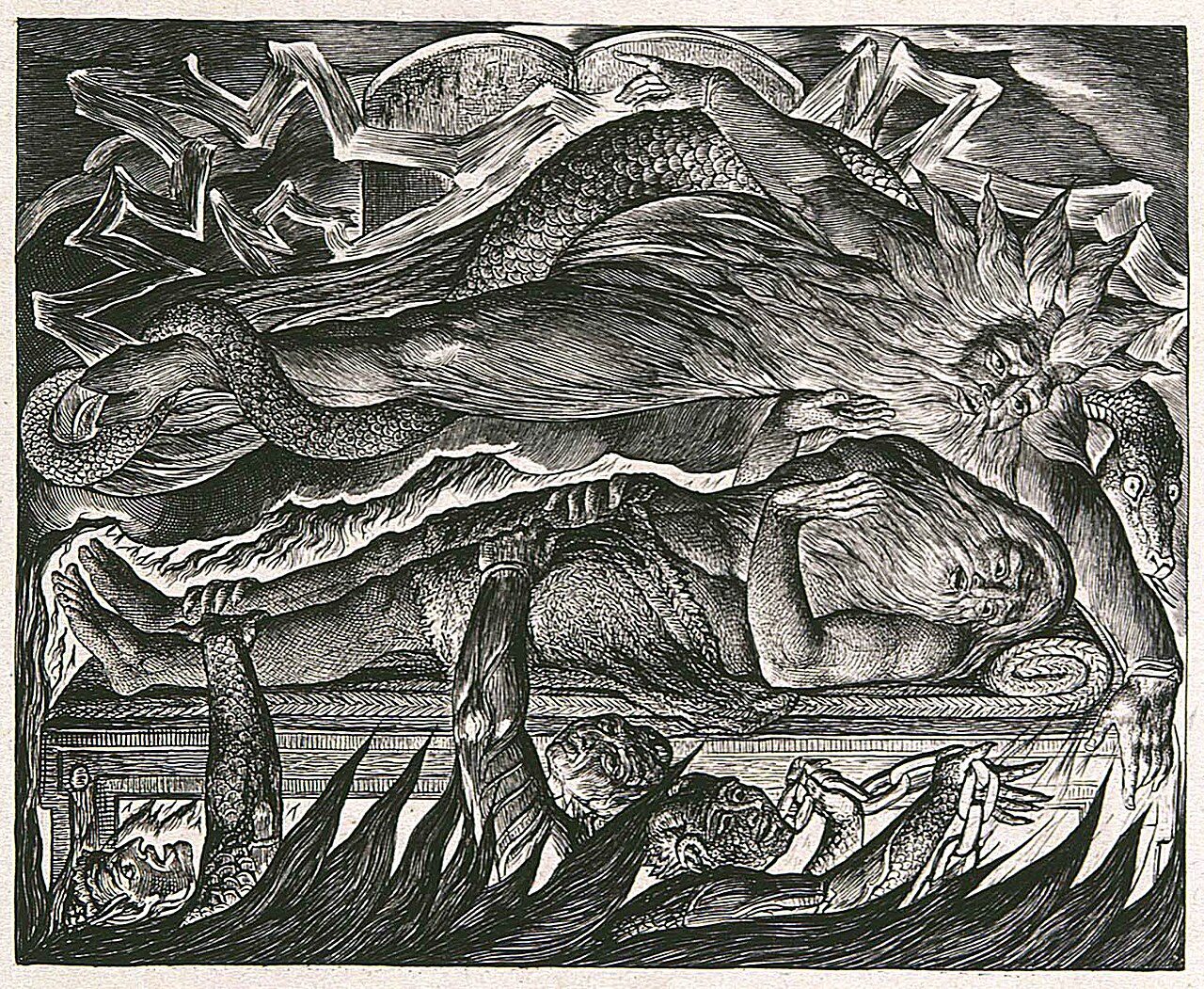
Illustration 11, which is the cover image I picked for this episode, shows Job lying on his bed as a formidable and frankly demonic-looking God looms over him. Below him, emerging from flames, are his three friends, who are likewise demonic to the point of being unrecognizable: beards burned away, dark, scaly skin, and claws. But even though God is right up in Job’s face, it’s his friends he is looking at, as if their betrayal shocks him more. There is a nice scene of solidarity between Job and his friends in illustration 12, though. As Elihu, the fourth companion who was obviously added to the Book of Job by a later, less talented writer drones on and on, Job and his friends look on in obvious boredom.
When God speaks to Job out of the whirlwind in illustrations 13 through 17, we see a shift in the power balance between Job and his companions. The friends have loomed over Job in the prior illustrations, but now Blake shows them gradually sinking down to his level. They huddle and hide their faces from the visions God shows while Job looks on openly. Finally, in illustration 18, they kneel in supplication as Job, standing upright at last, prays for them before a flaming altar. In the border decorations for illustration 18, Blake has included a Bible open to a verse which begins, “Love your enemies.”
For Blake, writes Moskal, “the poignancy of Job’s story . . . lies in the friends’ betrayal of their past loyalty to Job. In job, the archetype of the suffering righteous person, Blake suggests a deeper capacity for human forgiveness . . . hence, his Job suggests a similarly deeper capacity for friendship. Revising the tradition of the suffering Job, Blake makes Job the archetypal friend as well.” (Moskal 28)
The illustrations for The Book of Job were the last complete work William Blake ever did. He had just begun a new set of works based on Dante’s Inferno when he fell ill with an unspecified malady that was likely the result of long exposure to the caustic chemicals that he worked with every day. (Blake Archive Biography) A witness to his final hours wrote that Blake, quote, “died in a most glorious manner. “He said He was going to that Country he had all His life wished to see & expressed Himself Happy hoping for Salvation through Jesus Christ—Just before he died His Countenance became fair—His eyes brighten’d and He burst out in Singing of the things he Saw in Heaven.” (Bentley, Blake Records 346-47, quoted in Blake Archive Biography)
Wrap-Up and Outro
So that is it for this episode, which, I admit, probably hasn’t been the cheeriest one. But that’s because the Book of Job isn’t, either. It’s a weird, weird story. Throughout the whole narrative, the main character makes the case for why he is innocent in spite of the fact that he is being punished. But then, at the very moment when it looks like the justice he has been pleading for will arrive, he is instead subjected to a flashy show of force before which he must humble himself, in spite of the fact that he’s already been plenty humbled.
Both in what it says about Job’s cause and about the nature of God, The Book of Job is troubling and contradictory. Whether one identifies with it, like Blake, or is haunted by it, like Kafka, or feels compelled to refute it, like Jung, it is impossible not to have some sort of reaction to The Book of Job.
As to the works covered in this episode, I absolutely recommend you visit the William Blake Archive to look at the various iterations of the Job illustrations. I’ve put a link in the show notes that will take you directly to the final set of the Linell engravings, but there’s a ton of other material there, too. It’s a really wonderful digital resource. As for Kafka’s The Trial, it’s worth having a go. One friend, upon hearing that I would be covering it for the show, described it as “suffocating,” with which I agree. He didn’t mean it as a compliment, but I do. I usually struggle with narratives in which the protagonist is an unsympathetic man, but Kafka’s ability to evoke the waking nightmare K. finds himself in—and the fact that he is occasionally surprisingly funny—kept me in there. And, you know, it’s short. Not even 200 pages.
Jung’s Answer to Job is also short, but I really only recommend that to people who are already interested in Jung, or who might be Christians interested in going deeper into this very singular take on scripture (it is, in spite of Jung’s gradual lapse in religious observance over the course of his life, a very Christian-centric work.) Again, he’s nowhere near as maddening to me as Freud was, but neither is, like, the manual for my tumble dryer.
Next time, we are going back to China to explore the way. Join me for Episode 48: Lao-Tzu, The Tao Te Ching Part 1 – Darkness Within Darkness.
Books of All Time is written and produced by me, Rose Judson. The Disclaimer Voice of Doom is Ed Brown. Lluvia Arras designed our cover art and logo. Special thanks to Holly Wood, Cathy Merli, Matt Brough, John Cole and the Books of All Time Advisory Council: Ed Brown, Beck Collins, Neil Dowling, Caitlin McMullin, Hugh Parker, and Jonathan Skipp. You can support the show by subscribing and leaving a rating or review at Apple Podcasts, Spotify, or wherever you get your podcasts. You can also follow us on social media: we’re on Bluesky, Instagram and Facebook. Thanks for listening! I’ll be back soon.
References and Works Cited:
- Alter, Robert. The Wisdom Books: Job, Proverbs, and Ecclesiastes: A Translation with Commentary. W.W. Norton & Company, 2011.
- Altizer, Thomas J. “The Revolutionary Vision of William Blake.” The Journal of Religious Ethics, vol. 37, no. 1, 2009, pp. 33–38, http://www.jstor.org/stable/40378032.
- “Biography.” The William Blake Archive, blakearchive.org/exhibit/biography.
- Greenstein, Edward L. Job: A New Translation. Yale University Press, 2019.
- Grovier, Kelly. “William Blake: The Greatest Visionary in 200 Years.” BBC Culture, BBC, 24 Feb. 2022, http://www.bbc.co.uk/culture/article/20190910-william-blake-the-visionary-relevant-200-years-on.
- “ILLUSTRATIONS OF THE BOOK OF JOB (COMPOSED 1823-26).” The William Blake Archive, blakearchive.org/work/bb421.
- Jones, Josh. “William Blake’s Masterpiece Illustrations of The Book of Job (1793–1827).” Open Culture, http://www.openculture.com/2016/09/william-blakes-masterpiece-illustrations-of-the-book-of-job-1793-1827.html.
- Jung, C. G. Answer to Job. Princeton University Press, 2011.
- Kafka, Franz. The Trial. Penguin Books, 2015.
- King James Bible: 400th Anniversary Edition of the Book That Changed the World. HarperCollins Publishers, 2011.
- Macris, Anthony. “Punishment in Search of a Crime – Franz Kafka’s the Trial at 100.” The Conversation, 27 Jan. 2026, theconversation.com/punishment-in-search-of-a-crime-franz-kafkas-the-trial-at-100-247230.
- Mcquail, Josephine A. “Passion and Mysticism in William Blake.” Modern Language Studies, vol. 30, no. 1, 2000, pp. 121–134, https://doi.org/10.2307/3195433.
- Nastasi, Alison. “The Radical Sex and Spiritual Life of William Blake.” Flavorwire, 30 Nov. 2015, web.archive.org/web/20190702105154/flavorwire.com/549274/the-radical-sex-and-spiritual-life-of-william-blake/2.
- Nicholson, Eric. “William Blake’s Vision of The Book of Job.” The Culturium, 28 Nov. 2022, http://www.theculturium.com/eric-nicholson-william-blakes-vision-of-the-book-of-job/.
- Sedgwick, David. “Answer to Job Revisited: Jung on the Problem of Evil.” The Jung Page, 3 Nov. 2014, jungpage.org/learn/articles/book-reviews/727-answer-to-job-revisited-jung-on-the-problem-of-evil.
- Whittaker, Jason. “The Radical Visions of William Blake.” Tribune, tribunemag.co.uk/2022/11/the-radical-visions-of-william-blake.


Leave a Reply