
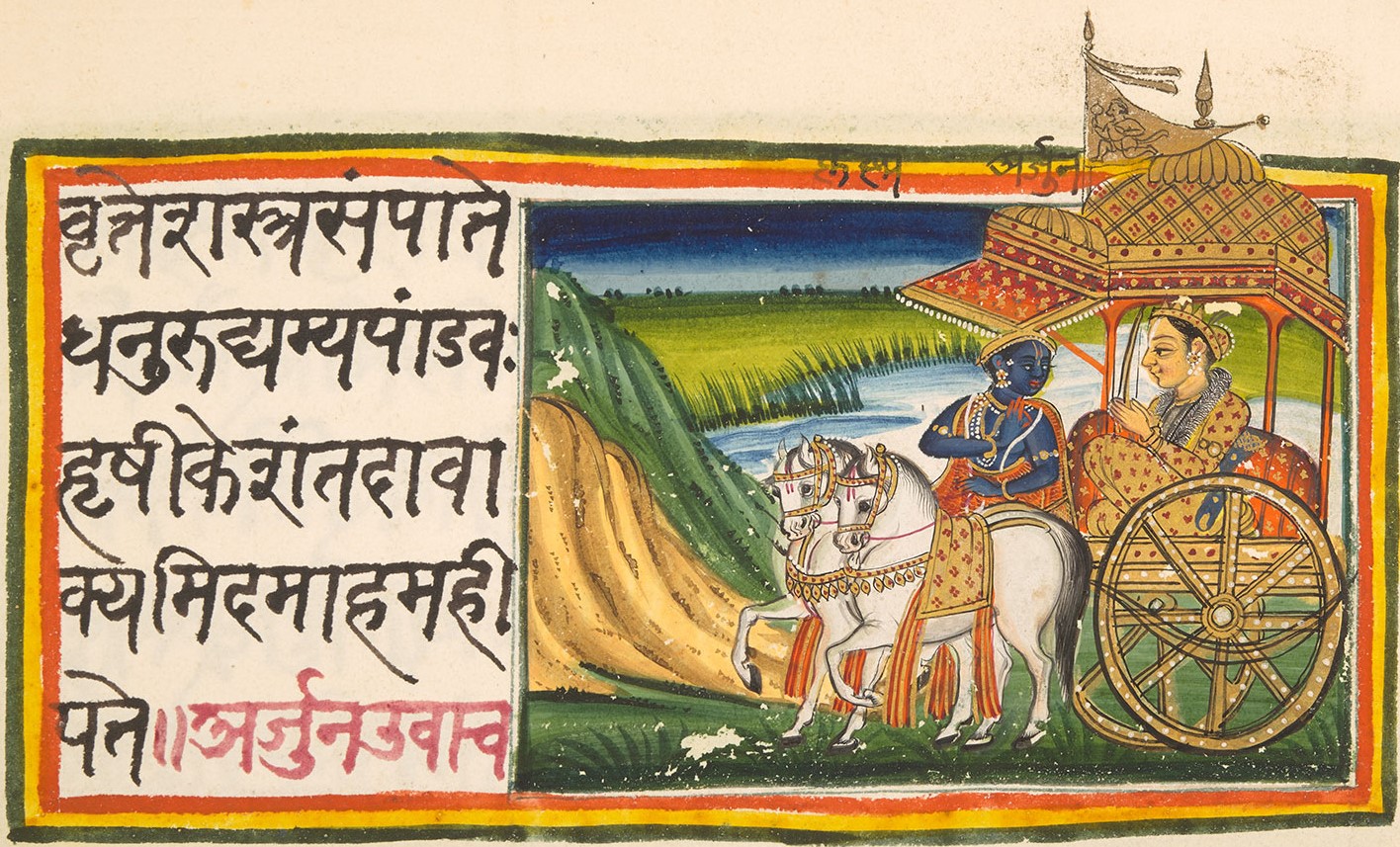
“Arjuna, I know those beings who have crossed over, as well as those who exist, and the ones yet to be. But no one knows me.” (The Bhagavad Gita, Translated by Laurie Patton, p. 91)
One of the most profound spiritual awakenings of Mohandas Karamchand Gandhi’s life came about because he made friends at a vegetarian restaurant in London. In 1888, then just 19 years old, Gandhi had moved from India to Britain to complete his legal education. As a Hindu, he kept to a vegetarian diet, and vegetarian catering was very hard to come by in Victorian Britain.
Well-meaning English friends tried to pressure him into eating meat, even though Gandhi insisted that he had promised his mother he would not. The woman who ran his lodging house, while trying to oblige him, produced food that was, he would write in his autobiography, “tasteless and insipid.” (Gandhi 1929)
Unhappy, usually hungry, and feeling completely out of his element, the young Gandhi began to take long walks through the city. On one of these, he happened across a vegetarian restaurant in Farringdon Road, not too far from Smithfield Market. The restaurant was run by the London Vegetarian Society—the LVS. Just inside the door they were selling copies of a slim book called A Plea for Vegetarianism, by the social reformer Henry S. Salt.
Gandhi bought the book and began to read it while eating his first hearty meal in ages. He was grateful for the food, but more importantly, he was moved by Henry Salt’s book. Much later, on a visit to London in 1931, he would say that:
“Mr. Salt’s book . . . showed me why, apart from a hereditary habit, and apart from my adherence to a vow administered to me by my mother, it was right to be a vegetarian. He showed me why it was a moral duty incumbent on vegetarians not to live upon fellow animals . . . . I found that a selfish basis would not serve the purpose of taking a man higher and higher along the paths of evolution. What was required was an altruistic purpose.” (Gandhi 1931)
In spite of his shy, reserved nature and general social awkwardness, Gandhi soon became a member of the executive committee of the LVS. He was eventually introduced to two members of the society who also happened to be Theosophists—members of the occult movement founded by a mystic named Helena Blavatasky that blended ideas from various traditions, including Hinduism. Gandhi’s Theosophist friends were just then puzzling over Sir Edwin Arnold’s The Song Celestial—an English verse translation of the Bhagavad Gita. They hoped that Gandhi could help them make sense of it.
It turned out that he had never read it. “I felt ashamed,” wrote Gandhi in his autobiography. (Gandhi 1929) But he decided to study the Gita alongside his Theosophical friends. It helped to fan the fire of his soul.
“The book struck me as one of priceless worth. The impression has ever since been growing on me with the result that I regard it today as the book par excellence for the knowledge of Truth. It has afforded me invaluable help in my moments of gloom.” (Gandhi 1929)
Gandhi would return again and again to the Bhagavad Gita, carrying a worn copy of it with him wherever he went. He read it while imprisoned in Johannesburg. (Majmudar) Once he had founded his ashram, he spent most of 1926 translating it into Guajarati. He wrote a commentary on it, and then, when friends complained the commentary was too obscure, he wrote another one, some of which was composed during another stint in prison.
But the Gita was not just a long-standing scholarly obsession to Gandhi—he would write in a letter to a friend, for example, that “mere bookish souls can never attain moksha.” (Gandhi 1914, quoted in Nagappa)
Gandhi regarded the Gita as both an ideal to strive for and a practical guide for conducting its life. Its teachings were the north star he constantly steered by as he pursued his legal cases, carried out his earliest campaigns of social justice, and, eventually, helped liberate his nation from the British Raj. For him, the primary teaching of the Gita was one of complete devotion to one’s duty—and complete detachment from any ego-rewards that duty may or may not offer. In the English-language edition of his commentary on the Gita, Gandhi wrote:
“The Gita does not decide for us. But if, whenever faced with a moral problem, you give up attachment to the ego and then decide what you should do, you will come to no harm. This is the substance of the argument.” (Gandhi 1960)
Gandhi was a scholar and a seeker after truth. He read many books beyond the Gita, but seems to have resonated with those that contained echoes of its wisdom: Christ’s Sermon on the Mount was one of these, as were Henry David Thoreau’s Civil Disobedience and Leo Tolstoy’s The Kingdom of God Is Within You. It is possible that Gandhi would have become the leader he was without ever having encountered the Bhagavad Gita. But it would have been a different kind of leadership—and we would live in a different kind of world.
I’m Rose Judson. Welcome to Books of All Time.
Intro – Background to the Bhagavad Gita
Books of All Time is a podcast that’s tackling classic literature in chronological order. This is episode 45: The Mahabharata, Part 2 – The Bhagavad Gita. If you’d like to read the transcript for this episode or see the list of references I used to write it, you can visit our website, booksofalltime.co.uk. There’s a link in the show notes if you need it. Let’s begin.
This is our second episode on the ancient Indian epic the Mahabharata, the tale of a tragic war that snowballed, over the course of centuries, into a compendium of folklore, scientific observations, and spiritual knowledge. In our last episode, we covered the main plot of the story—the rivalry between the Kauravas and Pandavas, two sets of semi-divine cousins whose rival claims to a throne led to an apocalyptic war.
In this episode, we’re focusing on a work within that work—700 verses from the sixth book which are known to us today as the Bhagavad Gita. Sometimes called “The Sermon of the Blessed Lord Krishna,” the title means “Song of the God,” very similar to the title of the English-language edition through which Mahatma Gandhi discovered the work. It is, you may recall from our previous episode, a dialogue between the warrior Arjuna—an ambidextrous archer whose father was Indra—and his friend Krishna, a prince from an allied kingdom who is acting as Arjuna’s charioteer. Krishna is actually the eighth incarnation on earth of the god Vishnu, and he talks Arjuna through his last-minute jitters about the battle.
More about that in a moment. The Mahabharata, as we’ve said, is a compendium of various tales that grew over time. While the core of the epic is likely very old—at least as old as the poetry of Homer in Greece—much of the work includes later material. One thing scholars have never settled on definitively is whether the Gita is one of these later additions, though what I’ve read suggests most think it probably is.
Laurie Patton, in her introduction to the standalone Penguin Classics edition of the Bhagavad Gita, notes that the consensus as of 2008, when she was writing, was that the Gita was added to the Mahabharata between the second century BCE and the second century CE. (Patton xxxix) That’s a four hundred-year range, but I guess that counts as narrowing things down in ancient literature. (And a side note: I’ll be working mainly from Patton’s translation of the Gita in this episode, with some dips into the Edwin Arnold version and the prose edition of the Mahabharata, translated by John D. Smith.)
However, if it was written down about 100 or so years later than the main plot of the Mahabharata—say somewhere between 250-150 BCE—that might explain why a lot of it seems to be aimed at synthesizing or refuting some Buddhist principles. This would have been during or just after the reign of Ashoka the Great, emperor of Magadha, who was an immensely important patron of Buddhism, and helped kick-start its spread across Asia. (Ashoka’s version of the Buddhist Wheel of Dharma is that symbol you see in the center of the Indian flag.)
Similar questions swirl around authorship. I was getting a bit tangled up in various text sources about this, so I went to my old friend, BBC’s In Our Time, and dug around in their archive until I found their show about the Bhagavad Gita from 2011. In it, the scholar Jessica Frasier gives a simple distillation of the debate around which group the Gita’s author or authors belonged to. There are two major candidates. First, you have the brahmans, the Vedic priests, who are trying to update Vedantic philosophy for a world that has:
- Moved on from a pastoral way of living to an urban one that, among other things, doesn’t lend itself to regular animal sacrifice
- Suddenly sprouted several new competitor religious traditions that involve renouncing society, like Buddhism and Jainism
The Brahmans would be principally interested in trying to find an expression of Vedantic philosophy that encourages people to live out their dharma within the established social order instead of leaving home to live in the forest. The second option as to authorship is the Kshatriyas, the kingly/warrior caste. If they were responsible, the Gita can be seen as a rationalization of their warrior code which gives them a moral justification for the violence they often have to carry out.
It’s possible (and likely) that many hands from many different traditions shaped the Gita, and that different sections are attributable to editors or compilers from very different backgrounds, with very different concerns. I read a paper from 1961 called “Social and Economic Aspects of the Bhagavad Gita” by D.D. Kosambi which tries to tease out evidence for who wrote the Gita and when based on the kinds of people and material culture it talks about.
Kosambi decides that the writers were Brahmins commissioned by Kshatriya warlords who wanted to help sell lower-class people (and reluctant members of their caste) on the idea of righteous war. (He also reckons the Gita was written around 100 CE or so.) He writes, quote:
“The utility of the Gita derives from its peculiar fundamental defect, namely dexterity in seeming to reconcile the irreconcilable. The high god repeatedly emphasizes the great virtue of non-killing (ahimsa), yet the entire discourse is an incentive to war.” (Kosambi 206)
He also notes that “Practically anything can be read into the Gita by a determined person.” (204) I agree with that—those 700 verses somehow manage to be many things to many people. Well, let’s see what we come up with, shall we?
Part 1: Setting the Scene; Chapters 1-6
The Bhagavad Gita begins in the sixth book of the Mahabharata. The old blind king Dhristrarashtra—he’s the father, you’ll recall, of Duryodhana and his 99 brothers who all came out of the jars of ghee—ancient IVF, basically—asks his advisor Sanjaya to describe what Is happening on the field of Kuru as the armies meet. Sanjaya describes all the fighters on their side, and the fighters on the enemy side—the side of the sons of Pandu, who died after having sex he’d been told explicitly not to have.
Then Sanjaya says he sees one of the Pandava princes, Arjuna, riding out in his chariot. We move away from Sanjaya’s narration and go straight into the driver’s seat. Arjuna asks Krishna to drive him out into the center of the field so he can see the faces of the men he is about to fight. They are his cousins and erstwhile friends; teachers and uncles he reveres and loves.
Arjuna begins to have what some of the natives of this island call a bit of a menty B. Quote:
“Krishna, I long
neither for victory,
nor kingship
nor pleasures.
Lord of the Cows,
what is kingship to us,
what are delights,
or life itself?
“The ones
on whose behalf
we long for kingship,
delights, and pleasures –
these are the very ones
drawn up in battle.” (Patton 11-12)
He does not want to kill these men, he declares. There would be no joy in it, not even in victory—evil would follow him and his brothers wherever he goes for the rest of his life. Moreover, destroying his family would destroy its dharma, and they would all be sent to hell. Surely the correct action here is to turn the chariot round, not to fight his own kinsmen to the death. How must he act? The dilemma is impossible; all his options seem terrible.
He drops his bow and arrow and sits down on the floor of the chariot. Krishna scolds him: this isn’t like you! Stand up and fight like you always do! Arjuna protests: any other time he’s fought, he hasn’t been setting out to murder his own family members.
At this, Krishna laughs. Quote:
“You speak as if
with words of wisdom,
[but] you have mourned
that which is
not to be mourned.
Wise men mourn neither
those whose life-breath is gone,
nor those whose breath remains.
I have never
not existed;
nor have you, nor have
these lords of men.
Nor will we
cease to exist,
all of us,
from now onwards.” (Patton 19)
He then gives Arjuna an overview of two out of the three main arguments he is going to make over the course of the Gita. The first is a philosophical (or metaphysical) justification based on the nature of reality. Krishna reminds Arjuna of the existence of the atman, which we discussed in our episodes on the Upanishads way back in 2024.
The atman isthe imperishable true self within and beyond the body, the eternal essence that can neither be created nor destroyed. The atman is itself part of the Brahman Human bodies are like old robes that can be exchanged for new ones at death. Since the death of those bodies is as inevitable as the wearing out of a robe, Arjuna should not grieve.
The second argument is an appeal to Arjuna’s class and his dharma as a warrior. Turning away from a battle not only harms him spiritually: it will also bring shame to his family. Nobody is going to believe that the great Arjuna suddenly renounced violence for spiritual reasons; they’ll just think he’s a coward.
Krishna then introduces the term yoga. He is not talking about stretching into downward-facing dog here. He is talking about spiritual discipline—the Sanksrit roots of the word “yoga” are related to the word for a “yoke” or a harness—something you use to link something to something else, or use to control something else. Jessica Frasier, in that In Our Time episode, explains yoga as, quote, “an internal ritual, a discipline that you do with your mind and your body, where you can, in a sense, link mind and body to a higher purpose, a higher reality.”
Krishna explains to Arjuna that he does not need to renounce the world to become a yogi. There are many different flavours of yoga which can help one cultivate an attitude of detachment from the world—for instance, he describes his discussion of the atman and brahman as Samkhya yoga, the Yoga of Knowledge, which involves understanding that human bodies are simply perishable manifestations of something eternal.
Mastering yoga and developing the correct attitude toward will give Arjuna the ability to maintain equanimity in the face of any overwhelming situation, whether it’s caused by events, extreme emotion, pain, or bodily exertion—even by overwhelming joy. A major step toward achieving this internal attitude is the ability to let go of concern about, or desire for, a particular outcome of an action one takes. Carrying out these various types of yoga and achieving this detachment will help Arjuna continue to live in the world—and live up to his dharma—even when it makes painfully contradictory demands of him.
Krishna gives an overview of all of this in the last half of the second “chapter” of the Gita. Gandhi, according to the foreword to a 2009 edition of the Bhagavad Gita published by the SUNY Press, memorized the final 19 verses of this chapter and recited them daily. (Smith xxviii) That makes sense when you read through that section and encounter verses like this one:
“The person who
casts away all desires,
who moves away from clinging,
who has no idea
of ‘mine’,
and who has no idea
of ‘I’,
that one comes to peace.” (Patton 35)
Arjuna is going to need more convincing than this, however. “If this attitude is more important than action,” he asks Krishna, “why are you telling me I still need to act? Why do I need to follow through with killing my family members? I don’t understand.”
Krishna explains again that Arjuna is not the one doing the acting. The eternal God is working through him. If Arjuna tries to pervert God’s purpose by acting with a specific personal goal in mind—for instance, abstaining from fighting to avoid having to kill his old teacher Drona—he will accumulate karmic debt. This karmic debt will bind him to the outcome of his choice and delay his attainment of moksha—liberation from the cycle of death and rebirth.
This is Karma Yoga, the Yoga of Action. Throughout this section, theological language begins to creep in—Krishna is starting to drop hints to Arjuna about his true nature. Quote:
“When you have entrusted
all actions to me,
with thought
on the highest self,
when you have become
free from desire,
free from the idea of ‘mine’,
then fight, with grief gone.” (Patton 44)
Arjuna is still confused. If all action comes from God, how can people’s actions do harm? Krishna explains that desire, anger, and passion lead people to cling to the outcomes of their actions. They choose to act against God, or to carry out their ordained actions from a place of selfishness, and this causes harm.
Krishna then takes another step toward revealing his true nature to Arjuna: he tells him that he, Krishna, taught this Yoga of Action to the ancient sages long ago. “Surely that’s not possible,” Arjuna says. “You’re barely even older than me.”
Krishna tells him that he has had many births and deaths, and that Arjuna has, too. The difference between them is that Krishna can remember all of his past lives, and that Krishna only comes into the world when it is necessary. Quote:
“Although I am unborn and imperishable, although I am lord of all beings, I assume my own nature and take on existence through my illusory power, for whenever dharma lapses and adharma increases, heir of Bharata, I create myself; to protect the virtuous, destroy the wicked and restore dharma I take on existence in age after age.” (Smith 358)
People who master their desires can act according to their dharma without doubt, and offer their actions as sacrifices to God, renouncing the outcomes. They can thus attain moksha through Krishna. Next, Krishna discusses the importance of meditation as a tool to help attain this mastery:
“Making outside sensation
truly outside,
focusing the eye
between the eyebrows,
making equal
the ingoing breath
and the outgoing breath,
moving in the nose,
the sage whose highest path
is release,
whose sense, mind
and insight
are controlled,
whose anger, fear and longing
have disappeared,
is always released.” (Patton 68-69)
“Well, okay,” Arjuna says. “But meditation and renunciation that sounds like what the monks who’ve renounced their lives do. Is that what I should do? Is that the kind of renunciation you’re looking for? I’m still not clear about that.”
Krishna tells him that being a monk is all well and good—love me some monks—but it’s not necessary to starve yourself or give up performing sacrifices to attain renunciation. The internal path Krishna has been trying to explain, the one which sees dharma as a form of service, combined with the inward renunciation of all rewards or punishments, is better still. It leads to the truest form of self-awareness: one which allows a person to know and acknowledges the divine force behind the world—Brahman—even in the midst of mundane duties.
A person who attains this level of self-awareness will have a recognizable personality: one which sees the divine in all persons and situations and is capable of perfect equanimity. Quote:
“That person is distinguished
who sits apart from friend,
associate and enemy,
who stands with even insight
among the hated
and the loved,
among the righteous,
and the evildoers.” (Patton 72)
“This all sounds about as easy as holding back the wind,” sighs Arjuna. Bro, same. Krishna is patient, however. He has been sitting on his third argument. It’s time to lay it out.
Part 2: The True Form of Krishna
Krishna explains that those who strive toward truth—who understand that there is an imperishable essence beyond the visible world, and who act without attachment to the outcomes—also know Krishna himself. He, too, has a nature beyond the material. From Edwin Arnold’s The Song Celestial, we have this marvellous declaration:
“I am that womb:
I make and I unmake this Universe:
Than me there is no other Master, Prince!
No other Maker! All these hang on me
As hangs a row of pearls upon its string.
I am the fresh taste of the water; I
The silver of the moon, the gold o’ the sun.” (Arnold VII)
Those capable of discerning this truth about the universe—that it comes from an eternal source, which is the one God, currently appearing to Arjuna as Krishna. He reiterates his all-knowingness, declaiming the words I quoted at the top of the show:
“Arjuna,
I know those beings
who have crossed over,
as well as those
who exist,
and the ones yet to be.
But no one
knows me.” (Patton 91)
This is a lot for Arjuna to take in. All this time he thought he was talking to his brother-in-law, and it turns out that no: he is looking up from the floor of his chariot at the source of all creation.
Krishna continues, reiterating that evil is the result of people being attached to impermanent things categorized as Maya. Duryodhana, for instance, is completely in thrall to maya in his pursuit of total domination over the Kuru lands. But there could be hope even for him, if he were to detach himself from the goals of actions and recognize the eternal oneness of the universe—that is, if he were to recognize Krishna. Even Duryodhana could attain moksha and rejoin Krishna, the imperishable source of all.
Krishna explains that people can combine the two prior paths he has described—the path of knowledge and the path of selfless action—with a third: the path of devotion to and reliance on Krishna, on the eternal Brahman within all things. Thinking of Krishna at the moment of death will help such a person achieve liberation. He again recommends meditation, including recitation of the sacred syllable om, as a tool to help achieve this threefold understanding.
Krishna moves on to explain how this seemingly contradictory existence is possible—how can he be here talking to Arjuna, but also the creator of all things? For that matter, how is it apparently separate beings are all unified within Krishna? Quote:
“As a great wind,
moving
in all places,
dwells eternally
in the sky,
so all beings
dwell in me.
Think of this.” (Patton 102)
He is the receiver of all sacrifices, no matter how humble. He is the one for whom all people yearn, even if they think they are worshipping a different god, or an ancestor, or a ghost. This is because he is the source of all gods.
Arjuna is beginning to believe this. He asks for more detail about Krishna’s different forms. Krishna says they are limitless, then begins to list all the different heroes, gods, and kings Arjuna may ever have heard of—he is all of them. He is every fig tree, he is the thunderbolt, he is “the wish-granting cow” (Patton 118), the river Ganges, and he is Yama, god of death.
“If you say it’s so, my Lord, it’s so,” Arjuna tells him. But then he can’t help asking: “Could you show me your many forms?”
And Krishna does. He gives to Arjuna a gift of true sight, one which reveals all the incarnations of the Brahman—the absolute reality—all at once. Poetically, this is one of the places where the Gita reaches a peak. From Laurie Patton’s translation, we learn that the divine form of Krishna:
“had many
mouths and eyes;
many wondrous
aspects to behold;
many divine ornaments;
many divine weapons
of war,
raised high.
Bearing divine
garlands and garments,
divine scents
and oils,
the god held
every wonder –
facing everywhere,
without end.” (Patton 125-126)
Edwin Arnold becomes even more fulsome. Quote:
“Crowned with garlands of star-clusters,
Robed in garb of woven lustres,
Breathing from His perfect Presence
Breaths of every subtle essence
Of all heavenly odours; shedding
Blinding brilliance; overspreading–
Boundless, beautiful–all spaces
With His all-regarding faces;
So He showed! If there should rise
Suddenly within the skies
Sunburst of a thousand suns
Flooding earth with beams undeemed-of,
Then might be that Holy One’s
Majesty and radiance dreamed of!” (Arnold XI)
Arjuna is overcome—and who wouldn’t be, if their brother-in-law suddenly revealed himself as the wearer of a thousand thousand faces and the wielder of a thousand thousand mighty weapons? I can’t imagine what kind of state I would be in if…
…You know what, with at least one of my brothers-in-law, I can actually imagine being in this situation. Hi Jeremy, hope you’re well.
Anyway. Krishna stands before Arjuna, who is overcome with awe. He assumes a kneeling position, tears rolling down his cheeks, and he prays aloud. I believe, Arjuna says. I believe you are the Lord of the Universe. But he also sees terrible visions of his family members—enemy or ally—crushed in the jaws of the Lord’s most fearsome aspects.
“The heroes
of the mortal world
enter your flaming mouths,
as so many
currents of water
in a river
might run
towards the ocean.
As moths
that fly
to their full
will rush to death
in the blazing fire,
so, too, worlds
rush to death
in your mouths.” (Patton 130-131)
Arjuna begs Krishna to explain why he can see this, and that is when Krishna explains that he is not only a creator and a nurturer, but also a force of destruction: “I am Time, the destroyer of worlds,” he explains. (Smith 363) All that is happening on the field of Kurukshetra was meant to happen, has to happen, will happen—whether Arjuna takes up his weapons or not.
Part 3: Freedom Through Devotion
Arjuna, shaken, begs Krishna’s pardon if he was ever disrespectful to him before. He is embarrassed that he was blind to his friend’s true nature. Quote:
“If, thinking you a friend, I have spoken to strongly through heedlessness or affection – ‘Hey, Krishna Yadava, my friend!’ – not knowing of this your greatness, or if in jest I have done you dishonour, invincible one . . . then I beg your forgiveness.” (Smith 364)
Krishna says that there is nothing to forgive, and he resumes his normal human form. You’d think that would be enough to get Arjuna up and moving again. Instead, Krishna continues his teaching, presumably under the impression that Arjuna is much more likely to believe him now that he’s seen him eating entire worlds in his many ferocious mouths.
The way to liberation, he explains, is different for all. Some get there by knowledge of the true nature of reality. Others ascend through unselfish action aligned with their dharma. Still others renounce the world. But there is another way: personal faith and love of God. The scholar Hutton Smith describes it in the foreword to the SUNY Press edition of the Gita like this, quote:
“The spiritual journey is difficult—it is like crossing mountain ranges. . . but if one is impatient to complete the journey . . . there is a shortcut, a tunnel that cuts through the base of the mountain. This shortcut is called the Way of Devotion. Before one enters this tunnel, the wayfarer must have faith that there will be light at its end.” (Smith 2009 xvi)
Taking refuge in, and being personally devoted to, God—what is now known in Hinduism as bhakti— is a familiar concept to many Westerners, or anyone from a monotheistic religion. But at this time in India, this was a fairly new proposition. The scholars talking to Melvyn Bragg in that In Our Time episode described this divine, personal love as a departure from the older Vedantic ways of relating to god.
Indeed, if you go back to the Rig Veda, while there was genuine awe and respect for the gods in the hymns, there was not this yearning, personalized love for them—instead, you used rituals to summon the Gods when you needed them, like supernatural tradespersons. Or, if you thought they were mad at you, tried to calm them down—again, via rituals. Bhakti, this more intimate relationship with the divine was an innovation.
The scholar Wendy Doniger writes, in her book The Hindus: An Alternative History that:
“One way in which bhakti modifies moksha is by introducing into the Upanishadic formula that you are brahman (the divine substance of the universe) a god with qualities . . . who allows you to love the god without qualities. By acting with devotion to Krishna, Arjuna is freed from the hellish consequences of his actions.” (Doniger 283)
In addition to providing, quote “a kind of moral Teflon” (that’s Doniger again), bhakti also gives devotees access to an approachable aspect of the limitless, often terrifying divine they can wrap their minds around and love—that’s what Doniger means by being allowed to love the god without qualities. And that love, Krishna says, can eventually turn into knowledge, and the ability to work without detachment.
Krishna also spends a lot of time in the latter third of the Gita going over finer points of the metaphysics behind the truth he is revealing. He describes the differences between the physical body and the immutable self. He lays out three tendencies (gunas, or qualities) in human personalities and the actions or thoughts they have. These are sattva (truthfulness), rajas (energy or passion) and tamas (darkness or, on the more positive side, stability).
For someone who just wants to absorb the main message of the Gita, these latter discussions can come across as a cascade of Sanskrit vocabulary words, and—to me, at least—they all seem tend toward a similar conclusion: there are many paths to enlightenment, and many different obstacles along that path which will depend on your personal circumstances. Striving to maintain your equanimity, doing your duty with detachment, understanding that you and all around you are part of the great cosmic whole—these things will keep you on your path in spite of any obstacles.
And when your human will fails—which it will—you must set aside pride and egotism, turn to your faith in your personal God, and accept their teachings to attain the renewed strength you need to continue along the road this life has set you on. Krishna says to Arjuna at the last:
“[M]y thought is this:
one who learns
and recites
this conversation of ours
so filled with dharma
would sacrifice to me
with the sacrifice
of knowledge.
And also
one who would hear
without sneering,
full of trust,
would be freed,
and would reach
those happy worlds
where actions are pure.” (Patton 203)
“All my doubts are gone,” Arjuna says to Krishna. “I will do as you say. I will fight.”
It is one of the great ironies of the Mahabharata—a story that is, as Wendy Doniger puts it “passionately against war, vividly aware of the tragedy of war” (Doniger 283) should have at its heart this conversation: one in which a man whose whole spirit revolts at the idea of violence is convinced it is his sacred duty to kill members of his own family.
How on earth did Mahatma Gandhi turn it into an argument for peace?
Part 4: Influence of the Gita on Gandhi
When I was first outlining this episode, I knew I needed to talk about Gandhi’s approach to the Gita. I was surprised to learn that he had never encountered it until he was already a young man, and that it was actually introduced to him by English occultists, rather than fellow Hindus.
It turns out that for quite a long time the Gita was not particularly influential as a devotional work in India, other than as a foundational text for the worship of Krishna. There is no evidence of scholarly commentary on the Gita for several hundred years after it’s likely to have been composed—the oldest, by Adi Shankara, was written in the late 8th century CE, (Patton xxxix) prior to what we’d call the early middle ages. (For context, the 8th century CE is when the Vikings started to invade Britain.)
After that, the commentaries didn’t stop, mainly because none of the commentators could agree with one another about what the Gita means. The argument didn’t spread to Europe until the 18th century—specifically, 1785, when an East India Company printer—and amateur scholar—named Charles Wilkins translated it into English. The Gita is, as a result, one of the most studied texts in world literature (Chapple, preface to Smith 2009 xix). Christopher Chapple, who edited the 2009 SUNY Press edition, writes that:
“Few of the scholars … seem to agree on the meaning of the text, yet none of them can be said to be incorrect.” (Chapple preface to Smith 2009 xxiv)
So that’s helpful, I guess, in that it lets us understand Gandhi’s interpretation of the Gita as an endorsement of non-violence within a a long, rich historical tradition of people finding in it whatever they need it to say. I don’t mean to be flip—the Gita is wise and beautiful, but it is quite a remarkable feat of spiritual gymnastics to ignore the ultimate object of the conversation between Krishna and Arjuna within the context of the story: here’s why you should pick your bow back up and kill your cousins, bro.
There’s a chapter of a 2011 book by Nagappa K. Gowda called The Bhagavad Gita in the Nationalist Discourse which looks at Gandhi’s writings about the Gita to help understand how he came to use it to refine and expand his idea of the concept of ahimsa – non-violence – and satyagraha – civil disobedience.
First, Gandhi engaged very seriously with scholarly commentary as well as with the text itself. According to Gowda, Gandhi “felt that ‘it was difficult to be pleased with any [commentaries]’ because ‘they were all literary interpretations.’” (Gowda ch. 5) A focus on philology, poetic metre, the specific shades of meaning of a given word—these, for Gandhi, leached the spiritual content from the Gita, and the Gita had functioned for centuries first and foremost as a spiritual guide. Ignoring this function made commentators prone to missing the point.
He was also wary of interpretations that were influenced by European commentators or European philosophy. He didn’t dismiss them out of hand—after all, he retained an admiration for Edwin Arnold’s translation of the Gita to the end of his life—but he felt that these interpretations did not, quote:
“…[understand] the age-old spirit of India . . . her soul, and that is the reason why the nation has come to this pass.” (Gandhi 1918, quoted in Gowda)
In spite of his dissatisfaction with most other commentaries on the Gita, Gandhi was willing to admit that the Gita’s language left it open to a wide range of interpretations which could all contain some form of truth. The Gita, like many of the greatest works of literature, reflects back whatever a person brings to it when they read it. Gandhi, for example, first came to it as a nervous young man who was unsure of his place in the world. Contemplating it and re-contemplating it helped him understand that he must find a way to act on behalf of others. As he grew older and more committed to social justice, it helped remind him of, quote: “This one truth . . . We can follow truth only in the measure that we shed our attachment to the ego.” (Gandhi 1960)
He was not terribly interested in historical facts or textual discoveries about the composition of the Gita—or, more accurately, he did not see them as relevant to its message. He considered it a great spiritual allegory. Quote:
“When I first became acquainted with the Gita, I felt that it was not a historical work, but that, under the guise of physical warfare, it described the duel that perpetually went on in the hearts of mankind, and that physical warfare was brought in merely to make the description of the internal duel more alluring.” (Gandhi 1948, quoted in Gowda ch. 5)
Gandhi points out that if the authors of the Mahabharata more broadly had wanted to write a military history, they would have done so. Instead, they gave posterity a work that constantly grapples with morality, duty, and the nature of reality—with dharma, in other words.
The ultimate message of the Gita is one of self-realization—realizing one’s connection to the universal self, that is, and all that implies about one’s relation to the world and other beings. The ultimate path toward that realization is renunciation of desire for reward from one’s actions. This is how Gandhi arrives at the belief that the Gita ultimately compels one to a life of non-violence. In his 1946 book Gita the Mother, he wrote:
“I have felt that in trying to enforce in one’s life the central teaching of the Gita, one is bound to follow Truth [sic] and Ahimsa. When there is no desire for fruit, there is no temptation for untruth or Himsa. Take any instance of untruth or violence, and it will be found that at its back was a desire to attain the cherished end. Where there is possessiveness, there is violence.” (Gandhi 1946, 19)
He also notes that the Gita is not doctrinal: it can be applied to anyone’s life regardless of their culture or place in time. “The seeker is at liberty to extract from this treasure any meaning he likes so as to enable him to enforce in his life the central teaching.” (Gandhi 1946, 20)
The Gita is ultimately about a man faced with a terrible decision. For Gandhi, and for millions of others, it is also a guide to how to make the best of those terrible decisions—how to conduct oneself righteously in the world.
“I lost my earthly mother who gave me birth long ago,” Gandhi wrote, “but this eternal mother [the Gita] has completely filled her place by my side ever since. She has never changed, she has never failed. When I am in difficulty or distress, I seek refuge in her bosom.” (Gandhi 1946, 4)
Wrap-Up and Outro
That’s it for this episode. I hope it inspires you to pick up a copy of the Bhagavad Gita and read it –or re-read it. I had read it long ago in a world religions survey class and failed to get it. Now that I’ve read it within the larger context of the Mahabharata, it has more weight and resonance. I also feel that it is an excellent read for turbulent times—not that any of us knows what those are like. Its message of releasing worry about outcomes is, at least for me, a very welcome one. Maybe it will be for you, too. I recommend reading it as a separate work if you really want to dig into it. Laurie Patton’s edition for Penguin Classics has some good introductory matter, and the verse is clean and spare. If you are a Victorian poetry head—I know you’re out there—go find Edwin Arnold’s translation on Project Gutenberg or another site that hosts public domain works. You’ll be able to thrill to the same rhymes that first inspired a young Gandhi.
We move on now from the Indian epics and head back to the Middle East, to ancient Israel. We are again looking at part of the Hebrew Bible—and part of the Old Testament, if you’re a Christian. We are going to linger over the story of a man who becomes the unwitting subject of a bet between divine powers. Join me next time for episode 46: The Book of Job, Part 1—That Man Was Upright and Perfect.
Books of All Time is written and produced by me, Rose Judson. The Disclaimer Voice of Doom is Ed Brown. Lluvia Arras designed our cover art and logo. Special thanks to Holly Wood, Cathy Merli, Matt Brough, John Cole and the Books of All Time Advisory Council: Ed Brown, Beck Collins, Neil Dowling, Caitlin McMullin, Hugh Parker, and Jonathan Skipp. You can support the show by subscribing and leaving a rating or review at Apple Podcasts, Spotify, or wherever you get your podcasts. You can also follow us on social media: we’re on Bluesky, Instagram and Facebook. Thanks for listening! I’ll be back soon.
References and Works Cited:
- The Bhagavad Gita. Translated by Laurie L. Patton, Penguin Classics, 2014.
- Bragg, Melvyn, and Simon Tillotson. “The Bhagavad Gita.” In Our Time, BBC Radio 4, 31 Mar. 2011.
- Cope, Stephen. “Gandhi and the Gita: The Making of a Hero.” Yoga International, Yoga International, 1 Oct. 2014, yogainternational.com/article/view/gandhi-and-the-gita-the-making-of-a-hero/.
- Doniger, Wendy. The Hindus: An Alternative History. Oxford University Press, 2010.
- Fowler, Jeaneane D. The Bhagavad Gita: A Text and Commentary for Students. Sussex Academic Press, 2012.
- Gandhi, Mohandas K. “The Moral Basis of Vegetarianism” (1931). Southern Cross Review, southerncrossreview.org/22/gandhi2.html.
- Gandhi, Mohandas K. “Gita the Mother” (1946). Internet Archive, archive.org/details/in.ernet.dli.2015.90464/page/n31/mode/2up.
- Gandhi, Mohandas K. “Discourses on the Gita” (1930). Gandhi Research Foundation, http://www.mkgandhi.org/discoursesonthegita/discoursesonthegita.php. Accessed 2 Mar. 2026.
- Kosambi, D. D. “Social and Economic Aspects of the Bhagavad Gītā.” Journal of the Economic and Social History of the Orient, vol. 4, no. 2, 1961, pp. 198–224, https://doi.org/10.2307/3596050.
- Majmudar, Uma. “Mahatma Gandhi and the Bhagavad Gita.” MK Gandhi, http://www.mkgandhi.org/articles/Mahatma-Gandhi-and-the-Bhagavad-Gita.html.
- Nagappa Gowda, K. “Nasaktiyoga and the Nationalist Imagination: Gandhi’s Interpretation of the Gita.” The Bhagavadgita in the Nationalist Discourse, Oxford University Press, New Delhi, 2011.
- Sargeant, Winthrop, and Christopher Key Chapple. The Bhagavad Gita. State University of New York Press, 2009.
- Smith, John D. The Mahābhārata: An Abridged Translation. Penguin Books, 2009.
- “The Song Celestial; or, Bhagavad-Gîtâ (from the Mahâbhârata) Being a Discourse between Arjuna, Prince of India, and the Supreme Being under the Form of Krishna.” Translated by Edwin Arnold, Project Gutenberg, http://www.gutenberg.org/cache/epub/2388/pg2388-images.html.


Leave a Reply