
“It moves—yet it does not move/ It’s far away—yet it is near at hand!/ It is within this whole world—yet/ It’s also outside this whole world. When a man sees all beings/ within his very self,/ and his self within all beings, It will not seek to hide from him.” (Isha Upanishad, 5-6)
May 30, 1845, Concord, Massachusetts. A man writes a letter to a friend, steel nib scratching paper. He is just past 40, with the sideswept hair and impressive sideburns fashionable among men of the middle 19th-Century. (We won’t call him a “Victorian”, to be referred to by the name of a British Queen would offend his patriotism – he is an American). Our letter-writer pours forth his mind onto the page – his mind, the “mind of America” (Bloom), was an unquenchable fountain. Just now he is telling his friend what he wants to read next.
“There is a book which I very much want of which this is the title. ‘The Bhagavat Geeta, or Dialogues of Kreeshna & Arjoon; in eighteen lectures; with notes.’ Translated from the original in Sanskreet, or ancient language of the Brahmins, by Charles Wilkins; London: C. Nourse; 1835.” (Emerson, quoted in Riepe, 121)
This was not the writer’s first flowering of interest in the scripture and wisdom of India. Indeed, his own father, who’d died when the writer was just a boy, had eagerly bought and read the new English translations of “Hindoo” scriptures which had begun flowing across the Atlantic in the early part of the 19th Century. There was a vogue for this type of study, particularly in the area around Boston. Former president John Adams, for example, spent five years of his retirement gobbling up whatever Indian books he could get his hands on.
As an undergraduate at Harvard University, our letter-writer began reading Indian spiritual and philosophical works in earnest. On the website for The Pluralism Project, an initiative of Harvard, we learn that our letter writer “was especially attracted to the teachings of the Upanishads . . . which speak of the unity of spirit linking the human soul and the Transcendent, the ‘unbounded, unboundable empire.’”
The Transcendent. Throughout his life, Ralph Waldo Emerson was driven to seek the transcendent – he would found an entire movement on it, one that would help launch the careers of both Walt Whitman and Henry David Thoreau. We Americans think of Emerson as “our” great philosopher – and he is – but we often ignore the fact that his writings are suffused with ideas drawn from India.
But Emerson was never shy about this influence. In his book American Veda, Philip Goldberg describes Emerson as “the first public thinker to openly embrace Eastern religious and philosophical precepts, which he blended with a range of other sources . . . to produce an unrivalled body of work whose influence pervades the culture to this day.” (Goldberg 43)
What were those ideas? There was the idea of the fundamental oneness of the universe, of which each human person is an emanation – Emerson would later call this “the Over-Soul”, but he described it in an 1837 journal entry this way:
“I grow in God. I am only a form of him. He is the soul of me . . . a certain wandering light comes to me which I instantly perceive to be the Cause of Causes. . . In certain moments I have known that I existed directly from God and am, as it were, his organ. And in my ultimate consciousness Am He.” (Emerson, quoted in Goldberg 53)
There was also Emerson’s theory of compensation, which sounds a whole lot like karma. “You cannot do wrong without suffering wrong. Treat men as pawns and ninepins, and you shall suffer as well as they.” (Emerson, quoted in Goldberg 52)
And finally, there was the idea of reincarnation, of the eternal transmigration of souls. In his poem “Brahma”, Emerson writes:
“If the red slayer thinks he slays
Or if the slain think he is slain
They know not well the subtle ways
I keep, and pass, and turn again.” (Emerson, quoted in Goldberg 52-53)
The unity of creation, the law of cosmic justice, birth and rebirth – all of these ancient ideas found a new flowering in Emerson. And all of them appear in writing for the first time in The Upanishads.
I’m Rose Judson. Welcome to Books of All Time.
Books of All Time is a podcast that’s tackling classic literature in chronological order. This is episode 17: The Upanishads, Part 1: By Wisdom and By Toil. As always, if you want to read the transcript of this episode or see the references I used to write it, you can visit our website, www.booksofalltime.co.uk. There’s a link in the show notes if you need it. Let’s begin.
So here we are, back in ancient India, walking around the immense palace of sacred writing that forms the foundation of the Hindu faith. This week’s episode looks at The Upanishads, which contain revolutionary spiritual ideas that went on to shape not only Hinduism—which is, I remind you, the world’s oldest continuously practiced religious faith—but also Buddhism, Jainism, and the Beatles. Well, George, at least.
I’ll try not to be too flip. These are sacred writings for many millions of people. And what are they, the Upanishads? According to Kim Knott, in Hinduism: a Very Short Introduction, they are a collection of at least 108 poems, stories, and mantras which comment on the earlier Vedas. 10 to 12 of these Upanishads are considered the most ancient and most significant—they’re what you’ll be reading when you pick up a paperback copy of “The Upanishads.” I’ll be summarizing four of them for you during this episode.
Before we go there, however, some more background. Let me take a moment to clarify what I mean when I say “the Vedas.” In the intervening years since The Rig Veda first began to be written down, there have been three more sets of Vedic scripture written: the Yajur Veda, Sama Veda, and the Atharva Veda.
The Brahmins – the priestly class that emerged from Vedic culture – have been custodians of the Vedas for all these centuries, and they’ve written detailed commentaries on them explaining the correct way to chant hymns, perform sacrifices, and understand the stories of the gods. These are known as the Brahmanas. The Upanishads are a commentary on these commentaries; each one is paired back to one of the four Vedas.
I found a useful allegory about how the Upanishads fit into Hinduism’s spiritual lineage on a website maintained by the Indian Government – the Vedic Heritage Portal. In his opening essay on the Upanishads, Professor Shashi Tiwari describes the Vedas as a great tree. “The Brahmanas are its flowers,” he explains, “and the Upanishads are its ripe fruits.”
What makes the Upanishads so fruitful, so revolutionary, is the fact that they are concerned with spiritual and metaphysical ideas, not cultural religious practices – they are esoteric, about belief and knowledge, rather than exoteric, about the rituals and symbols. Patrick Olivelle, who translated the edition of the Upanishads that I read for this episode, says that the Upanishads “document the transition from the archaic ritualism of the Veda into new religious ideas and institutions . . . Upanishads are the vedic scriptures par excellence of Hinduism.” (Olivelle xxiii)
From The Upanishads we get ideas about Brahman – the universal spirit or animating force, the stuff of creation; the Ātman, which is the essential self within each person, divorced from ego, an emanation of Brahman. We also get a new idea of karma, a word which previously meant “action” or “good works”, and now means “morally charged action, good or bad”, as Wendy Doniger describes it (169). We also get numerous descriptions of and meditations on the cycle of reincarnation fed by karma, along with the possibility of escaping that cycle through renunciation of the illusions and material wants of this world – the spiritual self-discipline, grounded in meditation, known as yoga. There are so many other ideas, but those four are the ones which repeat throughout.
The word “Upanishad” was translated as “secret teaching” for a long time in the West. This isn’t exactly accurate: a better meaning would be “sitting beside” or “placed in relation to.” It’s a double- or triple-entendre: the Upanishads exist in relation to the Vedas and Brahmanas, drawing on them and commenting on them; teachers and students sit beside one another in discussion of the heady ideas within the Upanishads.
And when were these heady ideas ripening, you may ask? The Rig Veda began to be written down around 1500 BCE. While the chronology of the composition of most early Indian scripture is muddy and uncertain – Olivelle says “any dating of these documents that attempts a precision closer than a few centuries is as stable as a house of cards” (xxxvi) – we can say that by the time of the Upanishads, things have moved on a bit from the Rig Veda. Most scholars place the earliest Upanishads in a window between about 600 to 400 BCE, with some possibly being composed as late as 200 BCE.
That’s a big window, but it still lines up roughly with the period during which the Ancient Greeks are flourishing – Hesiod writing his burn letter to his brother, Athenians competitively reciting Homer at each other, Plato writing dialogues for Socrates. It also covers the conquest of Judah and Israel by the Babylonians, which helped drive the writing of Genesis and Exodus. And – although we won’t encounter him for a while yet – the Buddha is alive during this window, being influenced by ideas present in the Upanishads and also possibly influencing them. So this is quite the fertile time for big ideas in spirituality. And the Upanishads also come out of a very fertile place.
According to chapter seven of Wendy Doniger’s The Hindus: An Alternative History, at the time the Upanishads begin to be written, society in northern India has evolved from the pastoral, horse-sacrificing nomads of the Rig Veda. This makes complete sense: it’s been 700 years between the two, after all, and times change. Over the centuries, those tribal groups have multiplied, discovered agriculture, settled into villages, and are now beginning to urbanize. There are many kingdoms in the region now, and they are connected by trading links to one another and to the broader world beyond.
“Where there’s trade,” says Doniger, “new ideas spread quickly and circulate freely.” (165) In addition to trade, part of why ideas about spirituality and religion were so fluid during this time is because the Vedas were not a “closed canon.” (Doniger 165) There are lots of priests involved with writing and editing these scriptures, but there’s no equivalent of a pope or a central church dictating what is and isn’t holy writ. The anonymous authors of the Upanishads writ, by the way, in Sanskrit, but it is a very different type of Sanskrit to that found in the Rig Veda. If the language of The Rig Veda is like Chaucer’s English, Doniger explains, the Upanishads sound like Shakespeare’s.
My version of The Upanishads isn’t Shakespearean; it is lovely clean prose or poetry, depending on which Upanishad you’re reading. I’m working from the 2008 Oxford World Classics edition of The Upanishads, translated in the late 90s by, as I mentioned, Patrick Olivelle. He is Professor of Sanskrit and Indian Religions at the University of Texas at Austin. (I wonder how you say “hook ‘em” in Sanskrit.)
His edition of the Upanishads covers 12 principal Upanishads, and does so in roughly chronological order. That’s the order in which I’ll summarize them for you, too. We’ll cover the Brihadaranyaka Upanishad, the Katha Upanishad, the Isha Upanishad and the Mandukya Upanishad.
Away we go.
The Briahadaranyaka Upanishad contains the oldest writing in the Upanishads. It’s also one of the longest, divided into six chapters. Each of these chapters are structured a bit differently: you’ve got myths, some poetry, some dialogues between scholars and their pupils, or, in one case, a king and scholar. At the end, you’ve also got some rituals and spells, including one for the begetting of a male child. All the main ideas that people have taken away from the Upanishads are introduced here.
The first chapter relates several different myths about the creation of the universe. These hit many of the same beats we covered in our last episode on comparative mythology: in some of the myths, something comes from nothing; some feature a divine couple whose many children go to war with one another; in others, there is a universal person – bit like Purusa in the Rig Veda – who divides or dismembers himself into all the various forms of creation.
In the opening part of this chapter, creation is compared allegorically to the sacrificial horse: “Its bones are the stars, its flesh is the clouds, its stomach contents are the sand; its intestines are the rivers,” and so on. (Olivelle 7) This seems to be introducing us to the idea of the oneness of all things.
The next section is another creation myth which introduces the idea of the cycle of rebirth, describing how in the beginning there was only Death, accompanied by hunger, “for what is hunger but death?” (7) Death wants a body and chants prayers for one. When the body appears (out of foam on the water: hello, Aphrodite), he quickly divides it into the sun, the sky, and the wind. He wants another body, so he fathers one himself, then eats it; he wants yet another body – this cycle of Death devouring bodies continues until at last the body which emerges is a horse, and Death sacrifices himself to himself.
Another section gives us a battle between gods and demons. The gods try to drive out the demons by asking each of the senses to chant a hymn for them, but the demons continually thwart the singing, creating bad smells, bad sounds, and disagreeable speech in the process. At last, the breath “in the mouth” successfully completes the chant and defeats the demons, and there follows a long explanation of how this breath, called the Ayasya, the great breath of life, is the essence of all creation. This section is quite insistent on this point:
“This breath is Ayasya . . . for it is the essence of the bodily parts. Now, the essence of the bodily parts is breath – for it is very clear, the essence of the bodily parts is breath. Therefore, any part of the body from which breath departs is sure to wither, for it is the very essence of the bodily parts.” (Olivelle 11)
Got that? Here again we have repetition, which in writing this ancient usually signals that the passage is a throwback to oral tradition – or perhaps to the fact that sages and priests would read passages of scripture aloud to others – you’ve got to really, really hammer a point home in that case.
At any rate: breath, the Ayasya, is also the foundation of speech, which allows human beings to sing and chant. Then we get an example of such a chant:
From the unreal
Lead me to the real!
From the darkness
Lead me to the light!
From death
Lead me to immortality! (Olivelle 12-13)
The sage explains that all three parts of this verse are asking for the same thing: unreality is death, reality is immortality; darkness is death, light is immortality.
Then we get one last creation myth, describing how the first person, the Ātman, created all other living beings from his own essence, and how this essence exists in each person, “like a razor within a case or a termite within a termite-hill.” (15)
The ātman is your inner reality, the sage goes on, and departing from life without working to understand and venerate your ātman is just as threatening to your spiritual welfare as not doing sacrifices or saying prayers – even more so. What’s more, venerating the ātman in you helps create a better reality for others:
“Now, this ātman is a world for all beings. So, when he makes offerings and sacrifices, he becomes thereby a world for the gods. When he recites the Vedas, he becomes thereby a world for the seers. When he offers libations to his ancestors and seeks to father offspring, he becomes thereby a world for his ancestors… When creatures, from wild animals and birds down to the very ants, find shelter in his houses, he becomes thereby a world for them.” (Olivelle 17)
So all things spring from the same divine source and re-emerge from it endlessly, and venerating that divinity within yourself leads you to righteous living; to compassion for others.
Chapters two and three are in the form of dialogues with sages. In chapter two, the sage Gargya and the king Ajatasatru have a lively spiritual discussion. Gargya is so impressed with (and humbled by) Ajatasatru’s snappy rejoinders to his declarations of truth that he asks to become Ajatasatru’s pupil.
“Huh!” Ajatasatru says, “That’s not the way things usually go – I’m just a warrior-king, you’re a Brahmin, you’re supposed to explain Brahman to me! But sure, let’s go for a walk.”
They see a sleeping man. Ajatasatru wakes the man up. The man gets up and goes away, presumably irritated at being woken, but Ajatasatru isn’t interested in that. “When this man was asleep here, where was the person consisting of perception? And from where did he return?” (Olivelle 25)
Gargya doesn’t know. Ajatasatru explains that when one is asleep, the ātman – the essential self – draws in the powers of the senses from where they reside in the body and uses them to create dreams. When the person wakes, the ātman releases the senses so they can resume their duties. Ajatasatru describes the ātman as “’the real behind the real,’ for the real consists of the vital functions, and the self is the real behind the vital functions.”
The chapter then moves on to a discussion between a different sage, Yajñavalka, and his wife Maitreyi. They discuss the nature of love: when you love something, Yajñavalka explains, what you really love is the ātman of the other person – the ātman which is part of the brahman, which is also part of you. Loving and understanding your ātman will lead you to an understanding of the whole world.
Yajñavalka further explains that everything which can be perceived in creation is the “honey” – the outflow, the result – of the “radiant and immortal person” (31) who underpins all creation and resides in the physical body of all beings. All inorganic nature – fire, water, sun; lightning, thunder, moon – is also an emanation of this “radiant and immortal person”:
“This very self (ātman) is the lord and king of all beings. As all the spokes are fastened to the hub and the rim of a wheel, so to one’s self (ātman) are fastened all beings, all the gods, all the worlds, all the breaths, and all these bodies.” (Olivelle 32)
In the third chapter, Yajñavalka enters into a dialogue with several other sages who pepper him with questions, the way students will do to Socrates in Plato. Also like Socrates, Yajñavalka tends to have the last word in these exchanges. The questions dive into the utility of prayers and hymns, the origins of the bodily senses, and the nature of the ātman. It’s in this last that we hear the first call for renunciation: since the ātman is beyond hunger and thirst and emotion, the only way to really know and honor the ātman is by living a life free from desires like hunger and thirst or a lusting after riches. This includes the desire to show off how smart and wise you are:
“A Brahmin should stop being a pundit and try to live like a child. When he has stopped living like a child or a pundit, he becomes a sage.” (Olivelle 39)
You hear that, everyone who’s ever had a hot take on the internet? Being a pundit imperils your understanding of the ātman. But Yajñavalka goes further – you really can’t describe your ātman or brahman, he explains, because it’s ineffable. You can only say it’s not this, or not that – not your ego, not your desires, not your thoughts, not this statue of a god on your home altar. You must be silent, meditate, and observe to understand it.
Chapter four goes into the nature of what happens after death, with an explanation of how actions in this world determine a person’s next incarnation:
“What a man turns out to be depends on how he acts and on how he conducts himself . . . a man resolves in accordance with his desire, acts in accordance with his resolve, and turns out to be in accordance with his action.” (Olivelle 65)
That, right there, is karma.
Chapters five and six are kind of a grab-bag of sayings, ideas, and even some rituals. There’s some, uh, contraceptive breathwork you can try, as well as some bits of herbal magic for becoming famous or wealthy – this seems like a holdover from older times, given the deep metaphysical discussions we’ve waded through in the earlier part of this Upanishad. But that’s the nature of these kinds of writings: you’ll often have these jarring juxtapositions of the spiritual and the earthy. It’s possibly down to the fact that the earthy sections are so old and well-beloved that the people who compiled the writings thought it would be an offense against tradition to throw them out.
I’m totally going to try the spell for attaining greatness, though. Just have to collect every type of herb and fruit in a fig-wood bowl.
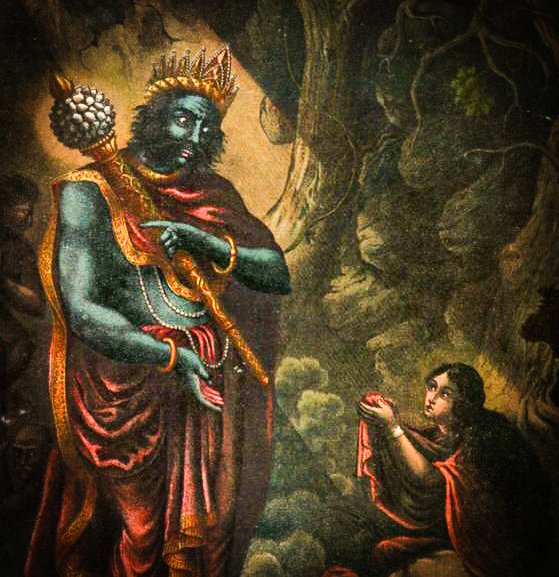
Next, the Katha Upanishad. This Upanishad is a poem about a conversation between Nachiketas, a little boy and Yama, the god of death. Nachiketas is watching his father send some cows off as a sacred donation. He realizes that the cows are not fresh, healthy young cows. They’re what the British might call “knackered”. They’ve been milked dry, they’re barren and bony. Like many sensitive small boys, this leads him to wonder if his father will donate him to charity when he’s worn out, and to whom.
He pesters his dad with the question: “Father, to whom will you give me?” After the third time Nachiketas asks him this, his father snaps back: “I’ll give you to Death!” (Olivelle 232)
Nachiketas, being an obedient boy, decides to go to Death himself. He travels to Death’s house, saying:
“I go as the very first of many.
I go as the middlemost of many.
What’s it that Yama must do,
That he will do with me today?” (232)
However, because he’s arrived unannounced, there’s nobody to receive him. Nachiketas sits in Yama’s waiting room for three days without anything to eat or drink. When Yama does show up, he’s mortified. “I’m so sorry there was nobody to look after you,” Yama tells Nachiketas. “Let me grant you three wishes in return.”
The first thing Nachiketas asks is that his father be in a kind mood when Yama sees fit to send him back to the land of the living.
“Oh, no worries. He’ll be delighted to see you,” Yama says.
Nachiketas’s second wish is to have Yama show him how to properly build a fire altar for sacrifices. This Yama does.
Nachiketas’s third wish is to know whether there is an existence after death. Yama says,
“As to this, even the gods of old had doubts,
for it’s hard to understand, it’s a subtle doctrine.
Make, Nachiketas, another wish.
Do not press me! Release me from this.” (Olivelle 235)
But Nachiketas insists. Who better to explain it to him, after all, than Death himself? Yama tries to put him off – offers him power, girls, elephants, gold, wealth – but no. Nachiketas just wants to know whether there’s any existence after death.
Yama is impressed that the boy is able to resist the material gratification he’s offered in preference for understanding truth. So Yama agrees to his request. That’s mainly what the rest of this poem is about: the deathlessness of the ātman, and the unity of all creation as part of brahman. You can’t die because your soul is immortal; you are never alone because you are part of everything there is.
Yama explains how people who don’t come to understand this truth, clinging instead to material wants, wind up falling into Yama’s power again and again as they are reborn and reborn and reborn.
A wise man, on the other hand,
“The wise one—
He is not born, he does not die;
He has not come from anywhere;
He has not become anyone.
He is unborn and eternal, primeval and everlasting.
And he is not killed, when the body is killed.” (238)
The way to work towards this understanding of the ātman and the brahman is not through study or rituals or sacrifices, but through meditation, particularly contemplation of the sacred syllable OM.
“For this alone is the syllable that’s brahman!
For this alone is the syllable that’s supreme!
When, indeed, one knows this syllable,
he obtains his every wish.” (237)
Spiritual discipline extends beyond meditation: it also includes exercising self-restraint in speech, and in avoiding simple gratification of desires. This spiritual discipline is the root of what was becoming known as Yoga philosophy: releasing oneself from attachments, engaging in meditation on the eternal oneness of the universe.
Yama warns Nachiketas that this is not as easy as it sounds:
“Arise! Awake! Pay attention,
When you’ve obtained your wishes.
A razor’s sharp edge is hard to cross—
That, poets say, is the difficulty of the path.” (240)
Yama then continues describing the nature of the ātman and the brahman to ensure Nachiketas understands the teaching: When you can rein in your senses and base desires enough to understand that there is no “you;” when you can see that you and everything else are one, and that you are perfect in the here and now, you will break free from the cycle of death.
Om.
The Isha Upanishad is next. It’s very short, but very, very dense – I quoted two stanzas of it at the top of the show.
The teaching in the Isha Upanishad is about the tension between the fact that while worldly pursuits like chasing wealth – or even rituals, good deeds, and prayers – are useless for obtaining immortality, they may be necessary discipline for some people. They may have to do these things and become disillusioned with them in order to finally understand that they don’t need them.
The opening stanza of the Isha Upanishad is among the most commented upon. Olivelle gives it like this:
“This whole world is to be dwelt in by the Lord,
whatever living being there is in the world.
So you should eat what has been abandoned;
and do not covet anyone’s wealth.” (249)
Another translator, Ralph Griffith, casts the verse this way:
“Enveloped by the Lord must be This All — each thing that moves on earth. With that renounced, enjoy thyself. Covet no wealth of any man.”
The message is very simple: you are part of eternity already; there’s no need to grasp and struggle. Feed yourself with what comes; understand that wealth ultimately comes to nothing. But simple things aren’t easy. It’s hard not to strain towards understanding of the oneness of all creation instead of relaxing into it. It’s a constant struggle to release the attachment to creature comforts, or to people you love and have lost.
No less a person than Mahatma Gandhi said that “If all the Upanishads and all the other scriptures happened all of a sudden to be reduced to ashes, and if only the first verse in the Isha Upanishad were left in the memory of the Hindus, Hinduism would live forever.”
It is very profound. But of course, we have more of it than that. This dual practice – this sort of spiritual cognitive dissonance – of accepting and renouncing, knowing and not-knowing, being and not-being, has the power to free people from fear, sorrow, and even death itself.
“Knowledge and ignorance—
A man who knows them both together,
Passes beyond death by ignorance,
And by knowledge attains immortality.” (250)
The Isha Upanishad closes with triumphant stanzas of praise:
“O, Pusan, sole seer!
Yama! Sun! Son of Prajapati!
Spread out your rays!
Draw in your light!
I see your fairest form.
That person up there,
I am he!” (250)
I am he – I am one with everything.
Finally we come to the Mundaka Upanishad. This is another widely translated one, because it beautifully recapitulates much of what has been taught in the earlier Upanishads, with a few key additions. The Mundaka Upanishad is also presented as a dialogue between a wealthy man and a sage.
Saunaka, the rich man, asks Angiras the sage if there’s any knowledge which can unlock an understanding of the entire world.
“Well,” Angiras replies, “there are two types of knowledge.” He explains that there’s the lower knowledge – reading and memorizing the Vedas, venerating gods, performing oblations and sacrifices, learning astronomy and grammar and mathematics and so on. By contrast, the higher knowledge, which involves meditating and coming to understand one’s essential self, unlocks an understanding of everything.
“What cannot be seen, what cannot be grasped;
Without color, without sight or hearing,
Without hands or feet;
What is eternal and all-pervading,
Extremely minute, present everywhere—
That is the immutable,
Which the wise fully perceive.
“As a spider spins out threads, then draws them into itself;
As plants sprout out from the earth;
As head and body hair grows from a living man;
So from the imperishable all things here spring.” (Olivelle 268)
Angiras goes on (the sages always do) to explain that the lower kind of knowledge doesn’t just fail to help you understand the nature of the world. It will actually entrap you in the cycle of death and rebirth. He is quite scathing about it:
“Deeming sacrifices and gifts as the best,
The imbeciles know nothing better,
When they have enjoyed their good work,
atop the firmament,
They return again to this abject world.” (Olivelle 270)
It’s the yogis who live in the wilderness, begging their food, living penitent lives who really understand the true nature of creation. “Through the sun’s door they go, spotless, to where that immortal Person is, that immutable self.” (270)
Brahman is the root of everything, Angiras explains: all forms of creation emerge from it like sparks from a fire. To know it is to know everything, and scripture and meditation allow the seeker to reach it and merge with it:
“Take, my friend, this bow,
this great weapon of Upanishad,
Place veneration on it
as the whetted arrow;
Stretch it with the thought fixed on the nature of that;
That very imperishable is the target, my friend.
Strike it!
“The bow is OM, the arrow’s the self
the target is brahman, they say.
One must strike that undistracted,
he will then be lodged in that.
Like the arrow in the target.” (Olivelle 272-273)
The sage continues, describing the precepts of a virtuous life: dedication to the truth, austerity, and chastity – the elements of asceticism, which would take hold not just in Hindu yogis but also in Buddhism and Jainism. Renunciation of desires and worldly things purifies, Angiras insists: only by leaving behind all desires can we be truly free.
“As the rivers flow on and enter into the ocean
giving up their names and appearances;
So the knower, freed from name and appearance,
reaches the heavenly Person, beyond the very highest.” (Olivelle 276)
How’s that, eh? Feeling at one with the nature of all creation? You can understand why the verses and ideas of the Upanishads hit so hard with the likes of Ralph Waldo Emerson – even though the Unitarianism he practiced isn’t anywhere near as brittle and angry as the Puritanism that underpinned New England’s culture, there is a real lack of light and warmth there.
It must have been nice to contemplate the idea that people were not miserable sinners steeped in depravity, waiting for the judgement of a furious God, but instead pure souls liable to distraction by the illusions of this world, who need self-discipline, not punishment. Heck, it’s nice for me, and I haven’t been a practicing Catholic since I was a teenager.
I enjoyed reading the Upanishads, but in particular the four I summarized here. I feel like they not only bring me to a better understanding of concepts which underpin Hinduism and other Indian religions; they really do bring me to a better understanding of myself. I don’t think I’ll be renouncing all possessions anytime soon – I wouldn’t be able to finish this podcast if I did that – but I am reframing how I think about annoyances like the dishes, or tedious paperwork, or fears for the future. It’s all brahman, man. As another seeker of Indian wisdom once said, “I am he as you are he as you are me / And we are all together.”
That’s this week’s episode. For part two of our investigation of the Upanishads, I’m going to take a look at what we know about connections between the ancient Greek world and the ancient Indian world. This episode will take us a little bit beyond the time period we’re in right now – perhaps as late as Alexander the Great – but there are some really fascinating connections between the two civilizations that are awfully exciting – at least to me! Hopefully to you, too. Join me on Thursday, October 23 for “Episode 18: The Upanishads, Part 2 – Dionysus, Son of Indus.”
Books of All Time is written and produced by me, Rose Judson. The Disclaimer Voice of Doom is Ed Brown. Lluvia Arras designed our cover art and logo. Special thanks to Yelena Shapiro, Cathy Merli, Matt Brough and the Books of All Time Advisory Council: Ed Brown, Beck Collins, Neil Dowling, Caitlin McMullin, Hugh Parker, and Jonathan Skipp. You can support the show by subscribing and leaving a rating or review at Apple Podcasts, Spotify, or wherever you get your podcasts. You can also follow us on social media: we’re on Bluesky, Instagram, Facebook, and also on X, formerly known as Twitter. Thanks for listening! I’ll be back in two weeks.
References and Works Cited:
Doniger, Wendy. The Hindus: An Alternative History. Tantor Media, Inc, 2021.
Goldberg, Philip. American Veda: From Emerson and the Beatles to Yoga and Meditation–How Indian Spirituality Changed the West. Three Rivers Press, 2013.
Goodman, Russell B. “East-West Philosophy in Nineteenth-Century America: Emerson and Hinduism.” Journal of the History of Ideas, vol. 51, no. 4, 1990, pp. 625–645, https://doi.org/10.2307/2709649.
Knott, Kim. Hinduism: A Very Short Introduction. Oxford University Press, 2016.
Olivelle, Patrick. Upaniṣads. Oxford University Press, 2008.
Riepe, Dale. “Emerson and Indian Philosophy.” Journal of the History of Ideas, vol. 28, no. 1, 1967, pp. 115–122, https://doi.org/10.2307/2708485.
Shashi Tiwari. “Upanishads.” Vedic Heritage Portal, vedicheritage.gov.in/upanishads/. Accessed 1 Oct. 2024.
“Trade and Transcendentalism.” The Pluralism Project, Harvard University, pluralism.org/trade-and-transcendentalism. Accessed 1 Oct. 2024.
“The Vedas: The Once and Future Scriptless Texts.” Humanities Division, http://www.humanities.ox.ac.uk/vedas-once-and-future-scriptless-texts. Accessed 28 Sept. 2024.


Leave a comment