
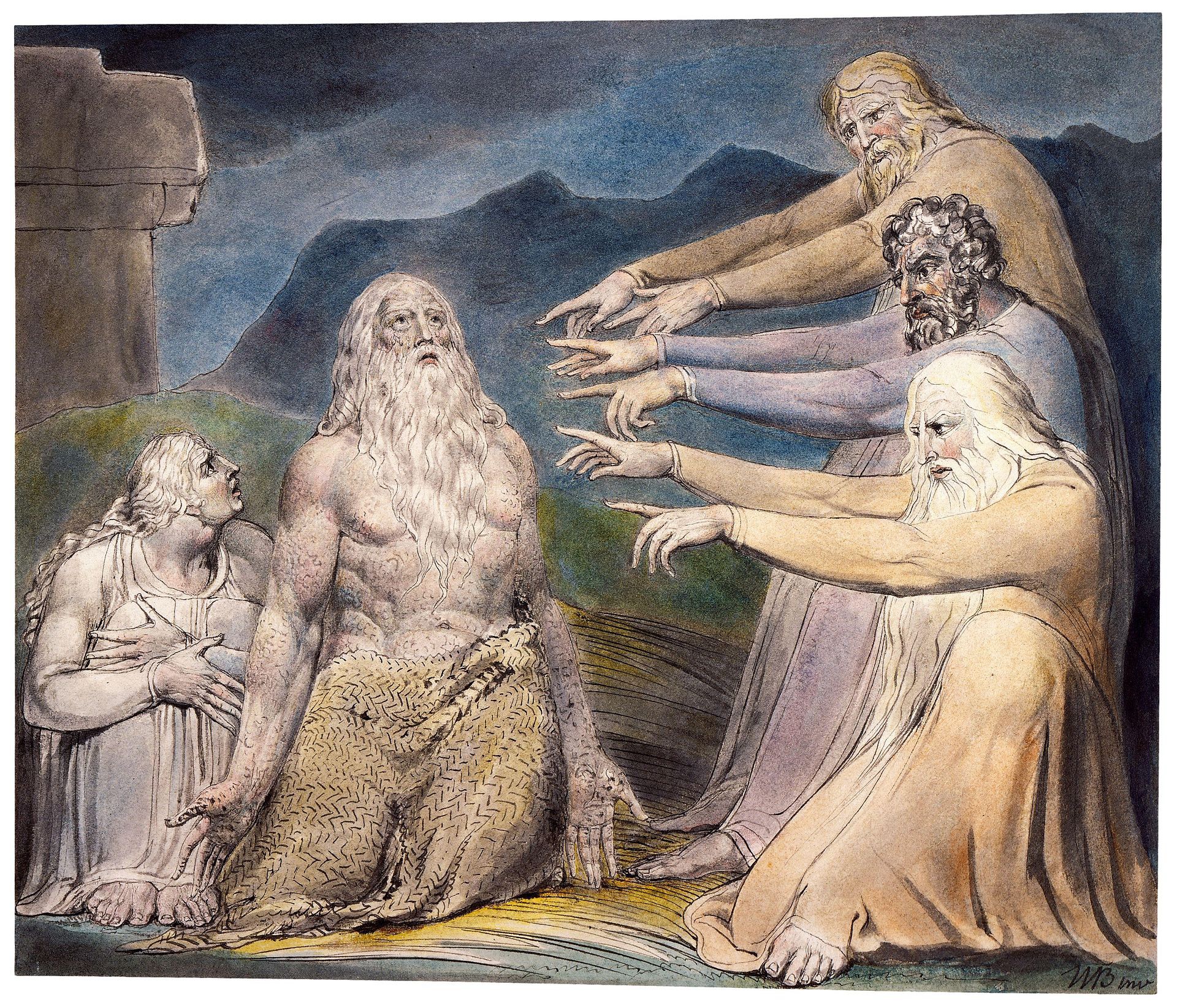
“Would, then, that my words were written,
that they were inscribed in a book,
with an iron pen and lead
to be hewn in rock forever.
But I know my redeemer lives,
and in the end he will stand up on earth,
and after they flay my skin,
from my flesh I shall behold God. (Job 19:23-26, in Alter 132)
Sometime in 1783 or 1784, Benjamin Franklin wrote a parody of the first chapters of the Book of Job. He was, at the time, serving as the United States Minister to France. He’d been living large in a donated chateau in Passy, near Paris, making regular visits to Louis XIV. In the course of his mission to secure a French alliance (and French financing) for the American Revolutionaries, he’d outwitted British spies, hobnobbed in salons, romanced widows, and dealt with the prissy Puritanism of his colleague John Adams.
With the 1783 Treaty of Paris which ended the war safely signed—or with it as good as signed—Big Ben felt like he could relax enough to indulge in one of his favourite pastimes from his printing days: spoofing the Bible. As was usual with Franklin, the spoof had a satirical point to make. In it, he presents God as an earthly king. God is holding a leveé at his palace, where all his various aristocrats can mingle, suck up to him, and present him with petitions. He spots Satan, one of his favourite courtiers. Quote:
“And God said to Satan, You have been some time absent; where was you? And Satan answered, I have been at my country-seat, and in different places visiting my friends. And God said, Well, what think you of Lord Job? You see he is my best friend, a perfectly honest man, full of respect for me, and avoiding every thing that might offend me. And Satan answered, Does your Majesty imagine that his good conduct is the effect of mere personal attachment and affection? Try him; only withdraw your favor, turn him out of his places, and with-hold his pensions; and you will soon find him in the opposition.” (Franklin, after 1782)
So far, so literal. But Franklin explained (I love him, but he was always prone to over-explaining his jokes) that the leveé illustrates the danger of having all power reside in one person. That powerful person, no matter how benevolent and wise, can be influenced to do terrible things.
The whispering of a conniving advisor. The twittering of a bleach-blonde morning news anchor. The increasingly feeble and erratic electronic pulses between neurons in a rapidly shrinking frontal lobe: when one person is in the driver’s seat, it’s things as simple as this which can blight the futures of millions of people. God destroyed Job because Satan convinced him to. Wrote Franklin:
“Trust not a single person with the government of your state. For if the Deity himself, being the monarch, may for a time give way to calumny, and suffer it to operate the destruction of the best of subjects; what mischief may you not expect from such power in a mere man, though the best of men . . . And be cautious in trusting him even with limited powers, lest sooner or later he sap and destroy those limits, and render himself absolute.” (Franklin, November 1784)
Now, obviously, when most people read The Book of Job, they take it as a story that tries to explain how bad things can still happen to good people, or how suffering can exist without reward. They don’t take it as a cautionary tale about the dangers of authoritarian monarchy. But maybe more of them should.
I’m Rose Judson. Welcome to Books of All Time.
Intro – Background to the Book of Job: Dating, Authorship
Books of All Time is a podcast that’s tackling classic literature in chronological order. This is episode 46, The Book of Job, Part 1: That Man Was Upright and Perfect. As always, if you’d like to read a transcript of this episode or see the references I used to write it, visit our website, booksofalltime.co.uk. There’s a link in the show notes if you need it. Let’s begin.
This week, we take our third and final dip into the Hebrew Bible, which Christians include within what they call the Old Testament. Biblical scholars divide the various books of the Bible into three types of literature: history, prophecy, and wisdom. We’ve covered history with our episodes on Genesis and Exodus. We’ve covered prophecy with our look at the Book of Isaiah. Now we’re covering wisdom.
“Wisdom literature” is a genre of writing that was common throughout the ancient Near East—in Egypt and Mesopotamia as well as in Judea. In wisdom literature, sages or wise people share stories or ideas about virtue and the nature of the divine. There are three wisdom books: Proverbs, Ecclesiastes (or Qohelet) and Job, and they each offer a different take on wisdom literature.
Proverbs offers advice for living virtuously and prosperously in day-to-day life. Ecclesiastes takes a negative approach to wisdom, reminding people that death comes when you least expect it, so don’t get too attached to your accomplishments and just try to enjoy your life. Then there’s Job, which illustrates the relationship between God and humankind: specifically, the sticky problem of how a just God can allow righteous or innocent people to suffer.
This is known as theodicy, and it was especially popular in Mesopotamian writings. Theodicy aims to offer justifications for the suffering which help reconcile the two apparently opposed parts of this problem—a just God, an unjust world.
When I was selecting which of these books to cover, I dismissed Proverbs right away, because it’s . . . just a list of proverbs. Its structure makes it difficult to discuss on a show like this. Ecclesiastes is interesting, and not just because it gave us the lyrics to that Byrds tune, but it suffers from a similar problem as Proverbs.
Job is more our speed: it’s a story about a person, and a strange story at that. Its portrayal of God as the kind of easily swayed tyrant Benjamin Franklin warned us about has puzzled and confused readers and scholars for millennia. Its poetry—the bulk of which appears to have been written by one very talented author—has dazzled them. Job grapples with the problem all people of faith, or even just of good will, must confront in their life: the problem of how a just, loving God can let the innocent suffer. And it does it with serious panache, provided you can ignore two sections which appear to have been added later. More about that in a moment.
I read three translations for this episode. The first is the King James Bible version, because I’m a sucker for that early modern English. The second is by the scholar Robert Alter of the University of Berkeley, which can be found in his 2011 book The Wisdom Books: Job, Proverbs, and Ecclesiastes. The third is by Edward Greenstein, in his Job: A New Translation from 2019.
Alter treats Job as a story about surrendering to the will of God which also treats human. Greenstein sees it slightly differently: he reads Job as an account of one man, with justice on his side, speaking truth to power—the ultimate power. We will take each of these approaches on in turn as we walk through the story.
Let’s talk about dates. As with so much ancient literature, there aren’t precise dates for when Job was written. Typically, scholars can conduct close analysis of the language used in the work to determine a rough bucket of time into which it might fall. Robert Alter explains in his introduction that the structure of Job makes this tricky. (Alter 20)
It’s a frame story, where you have God doing terrible things to Job at the start of the tale, then having a confrontation about it with Job at the end. In the middle, the Job poet has inserted a series of debates between Job and the three friends who try and fail to help him make sense of the calamities that have befallen him (and a fourth friend who pops up out of nowhere, yells at Job for several chapters, then vanishes again—that’s one of the later additions I mentioned).
The frame story uses a very archaic Hebrew of the kind that was common during the First Temple Period—so as old as 1000 BCE. The bulk of Job includes a lot of Aramaic words, however, and Judeans didn’t begin to speak Aramaic regularly until sometime after 500 BCE. (Alter 20-21) Alter writes that:
“The author of the Book of Job . . . has either reworked an old text or formulated his own text on the basis of oral tradition, using archaizing language. There is an obvious effort in the frame-story to evoke the patriarchal age, though in a foreign land with non-Israelites.” (Alter 22)
Edward Greenstein, in the introduction to his translation, states that Job was written (or developed or compiled) between 540 and 330 BCE. (Greenstein xxvii) Alter agrees that a “fourth-century setting” can’t be ruled out (Alter 21), so I am parking it in our list around 330 BCE—the latest possible date for it.
Judea in the fourth century BCE was a few generations out from the end of the Babylonian exile. Jerusalem was once again home to a Judean elite, who were exposed to many types of learning and poetry. The single poet who wrote the bulk of the Book of Job appears to have been one of these. Greenstein writes:
“The poet appears to be a polymath whose knowledge of language, literature, and realia (animals, plants, law, astronomy, anatomy) is impressive . . . he draws on numerous sources, and he dazzles like Shakespeare with unrivaled vocabulary and a penchant for linguistic innovation.” (Greenstein xxvii)
Even for a non-specialist like me, there is a sense in this, more than just about anywhere else in the Bible, of a mind at work: someone who had the fire of this story in his soul for whatever reason, and who was able to transfer that fire through writing of exceptional richness and power. Greenstein suggests that the Book of Job would originally have had a very narrow audience—manuscript copies would have circulated among a small circle of similarly educated elites.
When it eventually began to attract a wider audience, and less-skilled, less linguistically flexible copyists began to reproduce it, the Book of Job’s complexity worked against it somewhat. they often messed it up, especially if they were translating it out of Hebrew in the process. (Greenstein xxxii-xxxiv) There is an obvious break in the text, some of the speeches are clearly attributed to the wrong character, and there are, as I’ve said, two sections which were clearly added later by inferior writers.
One of these is a section in chapter 28 called the Hymn to Wisdom. This section is similar to an earlier Babylonian poem known as The Poem of the Righteous Sufferer or “I Will Praise the Lord of Wisdom”, depending on the source you consult. Back in our episodes on Genesis and Exodus we discussed some of the stories and themes which are found in both the Hebrew Bible and earlier Babylonian sources—to say nothing of the Flood narrative in Gilgamesh. Chapter 28 of Job appears to be another example of this kind of cross-pollination.
The second, most annoying one, is a long speech by a character called Elihu which Alter describes as “bombastic, repetitious, and highly stereotypical poetry [that] . . . is vastly inferior to anything written by the Job poet.” (Alter 22) It’s not clear to me from what I read whether anyone has a good explanation for when or why this section was added to the book, but they all tend to agree it was an insertion, because Elihu isn’t mentioned in the earlier part of the story or after he stops talking. Moreover, none of the other characters are shown reacting to what Elihu says. Alter calls it a “lapse in judgement by an ancient editor.” (Alter 23)
In spite of being somewhat knocked about, as it were, in transit, The Book of Job is still a treasure. To quote Robert Alter again, Job “reaches deep into the chaotic sea, up to the stars where celestial beings dwell, and down into the kingdom of death.” (Alter 28) Let’s dig into that treasure now.
Part 1: Losing a Bet He Didn’t Make
The Book of Job opens a bit like a fairy tale: long ago and far away. Chapter one, verse one from the King James Version:
“There was a man in the land of Uz, whose name was Job; and that man was perfect and upright, and one that feared God, and eschewed evil.” (Job 1:1, KJV)
Job is a prosperous patriarch living outside of Israel and Judea, somewhere east of the Jordan River. He has seven sons and three daughters, many heads of sheep, cattle, and camels, and so forth. He is considered one of the great men of the region for his piety as well as his wealth. He frequently prays for and offers up sacrifices on behalf of his children, just in case they have partied a little too hard during their birthday parties and, quote, “cursed God in their hearts.” (Job 1:5 KJV)
All well and good. Until we cut to heaven, where God is receiving his angels—including “the Satan,” with a definite article. In a footnote, Alter explains that the Hebrew word is hasatan. “The word satan,” he writes, “is a person, thing, or set of circumstances that constitutes an obstacle or frustrates one’s purposes.” (Alter 33) He refers to Satan as the Adversary throughout his translation to differentiate him from the later characterization of Satan as a demonic presence. Reading further through Alter and Greenstein’s footnotes, it becomes clear that some scholars seem to think Satan is a job title, not a proper name.
Moving on. God says to Satan, “Haven’t seen you in a while; where’ve you come from?”
“Hither and yon,” Satan replies.
“Don’t suppose you crossed paths with my bestie Job?” God says. “So perfect, so upright. He fears me and avoids every type of sin. There’s nobody like him on earth.”
None of the translations I read explicitly say that Satan rolled his eyes at this, but I think it’s implied. Quote:
“And the Adversary answered the LORD and said, “Does Job fear God for nothing? Have You not hedged him about and his household and all that he has all around? The work of his hands You have blessed, and his flocks have spread over the land. And yet, reach out Your hand, pray, and strike all he has. Will he not curse You to Your face?” (Job 1:9-11 in Alter 31-32)
God seems to find this compelling. He tells Satan he’ll take that bet. “Do whatever you like with him short of killing him,” he says. And Satan flits off, cracking his knuckles—again, that’s my inference—and thinking about how he can do Job dirty.
Back to Job, who is at home when a messenger comes to him and says that Sabeans—people from modern Yemen or Saudi Arabia—raided his cattle herds, seizing all the cows and donkeys and killing the herdsmen. The messenger has hardly finished this tale when a second one rushes in to tell Job that a meteor or other type of heavenly fire has struck Job’s sheepfolds, killing all the animals and the shepherds. The second messenger is swiftly followed by a third, who breaks it to Job that his camels have also been stolen—this time by Chaldeans from what’s now Iraq—and all of their keepers have been slain as well.
Finally, the fourth messenger arrives with the most grievous news of all. Job’s 10 children were gathered at the home of his eldest son, enjoying a birthday feast, when a sudden windstorm destroyed the house. All of his children are dead.
Job, in shock and distress, tears his clothes and his hair. He falls to the ground, crying:
“Naked came I out of my mother’s womb, and naked shall I return thither: the Lord gave, and the Lord hath taken away; blessed be the name of the Lord.” (Job 1:21 KJV)
Satan appears to have lost his bet. We return with him to the heavenly court, where God is smug:
“Have you set your mind on my servant Job,
that there is none like him on earth—
a man whole (in heart) and straight (of path), fearing of Elohim and turning from evil;
and he still holds-fast to his wholesomeness;
so that you have tempted me to devour him for nothing?” (Job 2:3 in Greenstein 39-40)
Hmm, yes, how dare you tempt Him, Satan. Poor omnipotent God, being swayed by wily advisors.
Satan brushes off God’s gloating. “Yes, we took his property and his children, but I know that if you harmed him physically, he’d curse you to your face.”
“Bet,” says God, and away goes Satan again, this time to cover Job in hot, inflamed boils from head to foot.
Job hobbles painfully to an ash-heap, where he sits and scratches himself with a piece of a broken clay pot—a detail that manages to be both disgusting and pathetic. His wife berates him for continuing to keep his piety: “Curse God, and die!” she says. (An aside: I am interested in the characterization of Job’s wife as angry with him for what they’ve suffered. They were her children, too. Is she really so hard of heart about losing them? Anyway.)
Job replies sharply to her that she speaks foolishly. “What, shall we receive good at the hand of God, and shall we not receive evil?” (Job 2:10, KJV) He continues to sit in the ashes, head shaven, heart devastated, scraping away at his afflicted skin.
Three of Job’s friends arrive to visit him in his grief. These men come from various corners East of the River Jordan, though the modern-day locations are unclear. There’s Eliphaz the Temanite, Bildad the Shuhite, and Zophar the Naamathite. They are shocked and horrified at the change in Job’s appearance, and at the scale of his losses. In solidarity with their friend, they tear their garments, sprinkle dust on their heads, and sit in silence with him for seven days and seven nights.
It’s Job who breaks this silence. He begins to speak passionately, cursing not God, but himself. He wishes that the day of his birth—the night of his conception, even—would be annulled; wiped utterly from the record of time. This speech makes up all of chapter three and is the beginning of the Serious Business poetry section of Job. If you’re having a tough time in life right now—I mean really going through it—reading chapter three of Job could be pretty cathartic, I reckon. A taste:
“Why did I not die from the womb,
from the belly come out, breathe my last?
Why did knees welcome me,
and why breasts, that I should suck?
For now I would lie and be still,
would sleep and know repose
with kings and the councilors of earth,
who build ruins for themselves,
or with princes, possessors of gold,
who fill their houses with silver.
Or like a buried stillborn I’d be,
like babes who never saw light.” (Job 3:11-16, in Alter 43)
I have been in grief; I have sat with grieving loved ones. I am not sure how I would reply to someone who expressed this depth of despair, so I imagine Job’s friends weren’t, either. But bless them, they’re sure going to try.
Part 2: With Friends Like These
We now enter the main dialogue section of the story. It’s structured as three rounds of speeches in which Job and his friends argue about whether or not he is being punished for sins or is actually blameless.
Eliphaz bats first. He begins hesitantly: “If speech were tried against you, could you stand it?” he asks. (Job 4:2 KJV) Basically he’s saying, “I don’t know if you’ll want to hear this, but here goes.”
Eliphaz points out to Job that calamities like these are visited on people for their sins. Job is in general a good man, obviously—in fact, he’s been known to encourage other sinners to turn their lives around—but God does not mete out punishment unprovoked. All Job has to do is accept the discipline of God, and all the paraphernalia of a righteous life, like children and property, will be restored to him. God may inflict a wound on you, but he will also heal you.
The next part of Eliphaz’s speech contains a story about a spirit appearing to the speaker in the night, whispering that mortal men can never be completely redeemed, except by God. Edward Greenstein argues that he—and other scholars—think this part of the speech was actually originally assigned to Job, and has been misplaced within the narrative. Further along in the text, there’s evidence that this is true, because Job’s friends accuse him of lying about having this dream, not Eliphaz.
It also makes sense to me that Job is the one who describes this dream given how despondent the tone of voice is, especially in contrast with the preceding lines’ reassurance that Job can get his cows back.
Quote:
“Yet to me did a word come in stealth,
And my ear grasped a hint of it;
In shudders from visions in the night,
When slumber falls upon people.
Fear overcame me, and trembling;
As shivers set my bones to shaking.
For a spirit passed across my face;
It set the hair of my flesh on end.
It stood still, but I could not discern its demeanour,
(Nor) the form in front of my eyes.
A moaning and voice did I hear.” (Job 4:16 in Greenstein, 49)
Still, regardless of who’s meant to be saying it, this half of the speech is a chilling reminder of mortality: God finds fault even in his angels, whispers the spirit, what hope do “those who dwell in clay houses”—that is, in human bodies—have? (Job 4:19 in Greenstein, 49)
Anyway, Eliphaz has spoken: if you repent, God will set everything right, don’t worry. It is not made explicit in the text that Job gives Eliphaz side-eye before rebutting his arguments, but again, I think it’s heavily implied.
Job says that it’s insulting to call his torments “discipline”. The tribulations he is suffering are sapping his will to live, and he’s not a young man. Even if he had sinned, and did repent, he is convinced he would not live long enough to be restored to the state he was in before. All the effort of his life has been wasted; all the blessings he received trampled to pulp. Quote:
“Thus I was heir to futile moons,
and wretched nights were allotted to me.
Lying down, I thought, When shall I rise?—
Each evening, I was sated with tossing till dawn.
“My flesh was clothed with worms and earth-clods,
my skin rippled with running sores.
My days are swifter than the weaver’s shuttle.
They snap off without any hope.” (Job 7:3-6 in Alter, 65)
He then challenges God directly: what have I ever done to You? Will you let me die in this state of agony? Why are you interested in the lives of men at all?
Bildad speaks up. He also tries to be comforting. And he fails epically: instead of suggesting that it’s Job who’s being punished for his sins, he says, well, what if it was your kids who sinned instead, and that’s why they’re dead, and you, who are righteous, remains alive? That would keep God on the right side of things.
He also reproves Job for daring to make demands of God. Bad things happen to blasphemers, he points out. Quote:
“Thus is the fate of all who reject El;
The hope of the blasphemer vanishes.
His stronghold is gossamer,
And his trust a spider’s house.
When he leans on his house, it will not stand up;
He will hold onto it, but it will not stand firm.” (Job 8:13-15, in Greenstein 71)
I love that: his trust a spider’s house. You, listener, are not allowed to steal that phrase for the title of your literary fiction novel; I’m already outlining one.
As you can imagine, Job does not accept this argument. He states again that he believes God has treated him unjustly, and that if he could, he would take God to court. But God refuses to accept human challenges—he is too great and lofty. Warming to his theme, Job begins to question how God can make men capable of sin and then punish them when they do what he created them to do. Quote:
“Thine hands have made me and fashioned me together round about; yet thou dost destroy me. Remember, I beseech thee, that thou hast made me as the clay; and wilt thou bring me into dust again? Hast thou not poured me out as milk, and curdled me like cheese? Thou hast clothed me with skin and flesh, and hast fenced me with bones and sinews. Thou hast granted me life and favour, and thy visitation hath preserved my spirit.” (Job 10:8-12 KJV)
Another note to you the listener: I also forbid you from using “poured me out as milk and curdled me like cheese” for the title of your historical erotica set on a windswept dairy farm in 18th-century Ireland: I’m outlining that, too.
Now it’s Zophar’s turn. He also believes that God is just, and that Job probably is in the wrong. But he has a more sympathetic explanation for it: Job just somehow forgot what it was he did wrong, possibly as a result of divine intervention. He sincerely hopes that God will reveal to Job the nature of his forgotten transgression, but that’s unlikely. Clearly Job should just repent and be rehabilitated. Sort of a plea deal.
Job is annoyed now. He does not want to hear these platitudes and conventional wisdom. He sarcastically recites a bunch of proverbs to them, showing that he doesn’t need this kind of instruction from them. He repeats his desire to demand God account for himself, this time with more fire:
“Your pronouncements are like maxims of dust;
Your responses—like lumps of clay.
Keep silent before me, so that I may speak—
Whatever may come upon me!
I will take my flesh in my teeth,
And I will place my life-breath in my hand.
Though he slay me, I will no longer wait—
I will accuse him of his ways to his face!” (Job 13:12-15, in Greenstein 92-93)
This is too much for Job’s friends. In the second round of dialogue they spend most of their time upbraiding him for accusing God of injustice. Eliphaz says Job shouldn’t mock the wisdom they’re trying to share with him, and he certainly shouldn’t try to make demands of God. Bildad rattles off several more proverbs, which are aimed at proving God must be just because he punishes the wicked. Zophar adds to this that wicked people may appear to be prosperous, for a time, but that this prosperity is an illusion, gotten by shady means, which God soon takes away.
Job initially tries to empathize with his friends. He understands that it is hard for faithful men to accept that God may have acted unjustly, and that they are trying to balance their desire to comfort their friend with an equally strong desire to maintain their worldview (and avoid blasphemy).
I have—and I’m sure we all have—experienced this when turning to friends in times of distress: instead of understanding, your friends wind up offering advice that is aimed as much at their sense of anxiety as it is about your grief. That is, they are worried on some level that whatever happened to you could happen to them, so they try to find a means of explaining it away which makes it unique to your situation, keeping them quote-unquote safe. Or, if they’re the person who hurt you, they’re trying to rationalize your genuine pain with their need to continue to see themselves as a good person.
To resume. Job points out to his friends that, good or wicked, all men come to the same end: dead in the dust being eaten by maggots. (Job 21:23-26 KJV) God is clearly too remote from the affairs of men to know or care how they suffer. Job’s friends have had enough: they are convinced that he’s done something to deserve this. For the final round of discourse, the gloves are off.
Part 3: The Voice from the Whirlwind
We’re back to the top of the order with Eliphaz. He rebukes Job for claiming that he knows how or where God judges humankind from—and after all, even if God is remote, all the better to see what everyone is up to. Furthermore, what benefit is it to God whether a man is just or pious? He only punishes those who do wrong. Job has been punished; he is therefore in the wrong. Eliphaz then pleads with Job one last time to repent:
“Acquaint now thyself with him, and be at peace: thereby good shall come unto thee. Receive, I pray thee, the law from his mouth, and lay up his words in thine heart. If thou return to the Almighty, thou shalt be built up, thou shalt put away iniquity far from thy tabernacles. Then shalt thou lay up gold as dust, and the gold of Ophir as the stones of the brooks.” (Job 22:21-24 KJV)
Bildad cites God’s power over all of creation as he again accuses Job of being ridiculous for wanting to face him, as it were, in court. Quote:
“He encloses the face of the new moon,
He spreads over it his clouds.
He draws a border round the face of the water,
At the limit where light meets darkness.
The pillars supporting the sky shudder,
Stunned by the blast of his rebuke.” (Job 26:9-10 in Greenstein 160)
Job replies bitterly that if he were truly sunk in sin, he wouldn’t have the gall to call God to account. He laments the loss of his former estate, and claims that God, in marking Job as he has done, has actually done more than just harm one man (and his family, and his servants, and countless animals). God has cut off Job’s ability to do good to his neighbours, as he used to do when he was wealthy and respected. He rattles off his many acts of charity, from giving poor men clothing made from his sheep’s wool to fostering orphans and respecting the rights of the enslaved.
He vows, one final time, that he is innocent:
“If my land cry against me, or that the furrows likewise thereof complain; If I have eaten the fruits thereof without money, or have caused the owners thereof to lose their life: Let thistles grow instead of wheat, and cockle instead of barley. The words of Job are ended.” (Job 31:38-40 KJV)
And you would expect, after that mic drop, for the next voice to be that of God.
But no, it’s Elihu, a young man who is, we are told “the son of Berak-El the Buzite”. Elihu is irritated with Job for demanding justice from God and with the others for not being able to effectively knock sense into Job. Through four long-winded discourses, he basically tells Job that suffering builds character, so Job should be grateful God has done what he’s done. I won’t trouble you with Elihu much, but I will share one quote which I think sums up his sections nicely. It’s from just after he introduces himself:
“I, too, will speak out my part,
I will speak my mind, I, too.
For I am full up with words,
the wind in my belly constrains me.
Look, my belly is like unopened wine,
like new wineskins it bursts.” (Job 32:17-19 in Alter 201)
He’s basically comparing his speech to a fart he’s been holding in for a while. Like I said, that sums him up.
Elihu exits as mysteriously as he arrived. Enter God, in a whirlwind. He speaks to Job in a mocking tone, asking how it is such a mortal can dare to question him, the creator of the universe. He has some questions for Job, too:
“Hast thou perceived the breadth of the earth? declare if thou knowest it all. Where is the way where light dwelleth? and as for darkness, where is the place thereof, that thou shouldest take it to the bound thereof, and that thou shouldest know the paths to the house thereof? Knowest thou it, because thou wast then born? or because the number of thy days is great?” (Job 38:18-21 KJV)
Robert Alter points out in footnotes to this section that God’s speech serves as a counterbalance to Job’s death wish. It teems with life, sweeping from the stars, which God sets in their patterns, to the depths of the ocean, where he sets the boundaries of the waves. It crosses the mountains and fields where the wild animals thrive and multiply under his bounty. He reminds Job that he made the horse and the hawk, and beasts even more wondrous than these. He describes Behemoth—probably some kind of divinely jacked-up hippopotamus. Quote:
“Behold now Behemoth,
Which like you I created!
Like large cattle he eats grass.
Behold now the strength in his loins!
The power in his belly’s muscles!
He drops his penis like a cedar;
The sinews of his testes intertwine.
His limbs are pipes of bronze,
His bones like an iron rod.” (Job 40:15-18 in Greenstein 231)
Listener, please feel free to use whatever phrases take your fancy from that passage for whatever kind of writing your twisted little mind is plotting. I’m making no claims there.
The next fantastical beast is Leviathan—very likely inspired by the crocodile. God challenges Job to try to tame one, just try. Quote:
“Could you draw Leviathan with a hook,
and with a cord press down his tongue?
Could you put a lead line in his nose,
and with a fishhook pierce his cheek?
Would he urgently entreat you,
would he speak to you gentle words?
Would he seal a pact with you,
that you take him as lifelong slave?” (Job 40:25-28 in Alter, 250-251)
Job replies to God in what appears to be simple, humble terms: I know you can do anything; I am awed at your presence; I repent in dust and ashes.
Or does he?
Edward Greenstein argues that this little speech is actually sarcastic. Job is really saying God is exactly as he supposed him to be: a remote bully who doesn’t care about the people he’s created. “I repent in dust and ashes” is the wrong reading; instead it should be “I’m fed up, and I pity dust and ashes”—that is, I pity my fellow humans, as we’ve been saddled with this unfeeling creator.
Whether he’s genuinely repentant or being sassy, Job’s tortures are ended. God restores him to health, then rounds on his three friends (note that in the text God only names three of them: Elihu isn’t mentioned, which pretty much settles the hash on whether or not he was added later). God tells them he is angry with them: Job has spoken honestly about God, but they have not. God doesn’t elaborate on why he feels the three visitors are dishonest, but Greenstein takes a stab at it:
“The companions . . . warrant their claims by appealing to traditional wisdom, sometimes in the form of pithy sayings. Knowledge for them is second hand—what they have learned through the chain of tradition. Job . . . gets his insights from experience—from the implications he draws from the fact that he, a righteous man, sorely suffers; from a revelation, a particular experience, he receives from a rogue spirit; and from the perennial sticking point that the wicked prosper. Job’s companions seek to deny these claims, but Job perseveres in reiterating them.” (Greenstein 22)
At any rate, God tells the companions he won’t smite them for Job’s sake. He has them make burnt offerings and accept Job’s blessing. Then he repays Job for all of his losses: double the number of animals and servants, and another ten children. The narrative ends in the Biblical “happily-ever-after” register. Quote:
“After this lived Job an hundred and forty years, and saw his sons, and his sons’ sons, even four generations. So Job died, being old and full of days.” (Job 42:16-17 KJV)
Wrap-Up and Outro
So that is it for this episode. I agree with Robert Alter that the Book of Job seems like the most mysterious part of the Bible. The rest of that compilation is in praise of God. It’s full of stories which illustrate the justice of God or trace the fate of the Israelites, the people of God’s covenant. Job does not fit into any of these categories.
Even if you don’t think that Job ends his encounter with God in a state of defiance against him as Edward Greenstein suggests—for myself, I’m not sure that I do, but I’m just some lady, not a translator or philologist—the Book of Job is a radical departure from other scripture. It shows God behaving callously toward an innocent man just because he can. It offers a vision of creation in which humans are more or less another creature in the great cosmic menagerie God whipped up for himself—creatures nowhere as cool as Leviathan or Behemoth, at that.
And I think that, even though Job ultimately gets all his stuff back, it leaves open the question of whether or not God is just. Certainly the God depicted in Job is powerful, but is he acting with integrity? His rebuttal to Job’s complaints is that, well, He’s God. He and his motives are beyond the comprehension of human minds. The damage, though—that’s very, very comprehensible. You can hardly blame Job for demanding that his case be heard.
Now, should you read this? Absolutely. Even if you’re a devoted secularist, the writing in Job is spiritually expansive, and you’ll stumble across a lot of phrases that you may not have realized originated in (or were at least popularized by) Job.
If you just want to read Job by itself, grab Edward Greenstein’s Job: A New Translation. The notes are good, the verse is interestingly rendered, and his take on the story is worth mulling over. Robert Alter’s translation is part of a larger work, as mentioned. If you want more than just Job, pick up that. Again, it’s called The Wisdom Books: Job, Proverbs, and Ecclesiastes. His verse is somewhat prettier to my mind, and if you’ve not read Ecclesiastes before, you are in for a treat there, as well.
Next time we meet, we’ll take a look at the lives of three very different men who produced works in reaction to, or in conversation with the Book of Job: the Swiss psychiatrist Carl Jung, the Czech novelist Franz Kafka, and the English mystic, poet, printer and artist William Blake. Join me in a couple of weeks for Episode 47: The Book of Job, Part 2 – With an Iron Pen.
Books of All Time is written and produced by me, Rose Judson. The Disclaimer Voice of Doom is Ed Brown. Lluvia Arras designed our cover art and logo. Special thanks to Holly Wood, Cathy Merli, Matt Brough, John Cole and the Books of All Time Advisory Council: Ed Brown, Beck Collins, Neil Dowling, Caitlin McMullin, Hugh Parker, and Jonathan Skipp. You can support the show by subscribing and leaving a rating or review at Apple Podcasts, Spotify, or wherever you get your podcasts. You can also follow us on social media: we’re on Bluesky, Instagram and Facebook. Thanks for listening! I’ll be back soon.
References and Works Cited:
- Alter, Robert. The Wisdom Books: Job, Proverbs, and Ecclesiastes: A Translation with Commentary. W.W. Norton & Company, 2011.
- Ekstrom, Laura W. “Theodicies.” Stanford Encyclopedia of Philosophy, Stanford University, 8 Aug. 2024, plato.stanford.edu/entries/theodicies/.
- Franklin, Benjamin. “Founders Online: Franklin: Proposed New Version of the Bible, [1782 or After].” Founders Online, U.S. National Archives, founders.archives.gov/documents/Franklin/01-38-02-0388. Accessed 18 Mar. 2026.
- Franklin, Benjamin. “The Leveé [Before 6 November 1784].” Founders Online, U.S. National Archives, founders.archives.gov/documents/Franklin/01-38-02-0153. Accessed 18 Mar. 2026.
- Greenstein, Edward L. Job: A New Translation. Yale University Press, 2019.
- King James Bible: 400th Anniversary Edition of the Book That Changed the World. HarperCollins Publishers, 2011.


 Books Of All Time
Leave a comment