
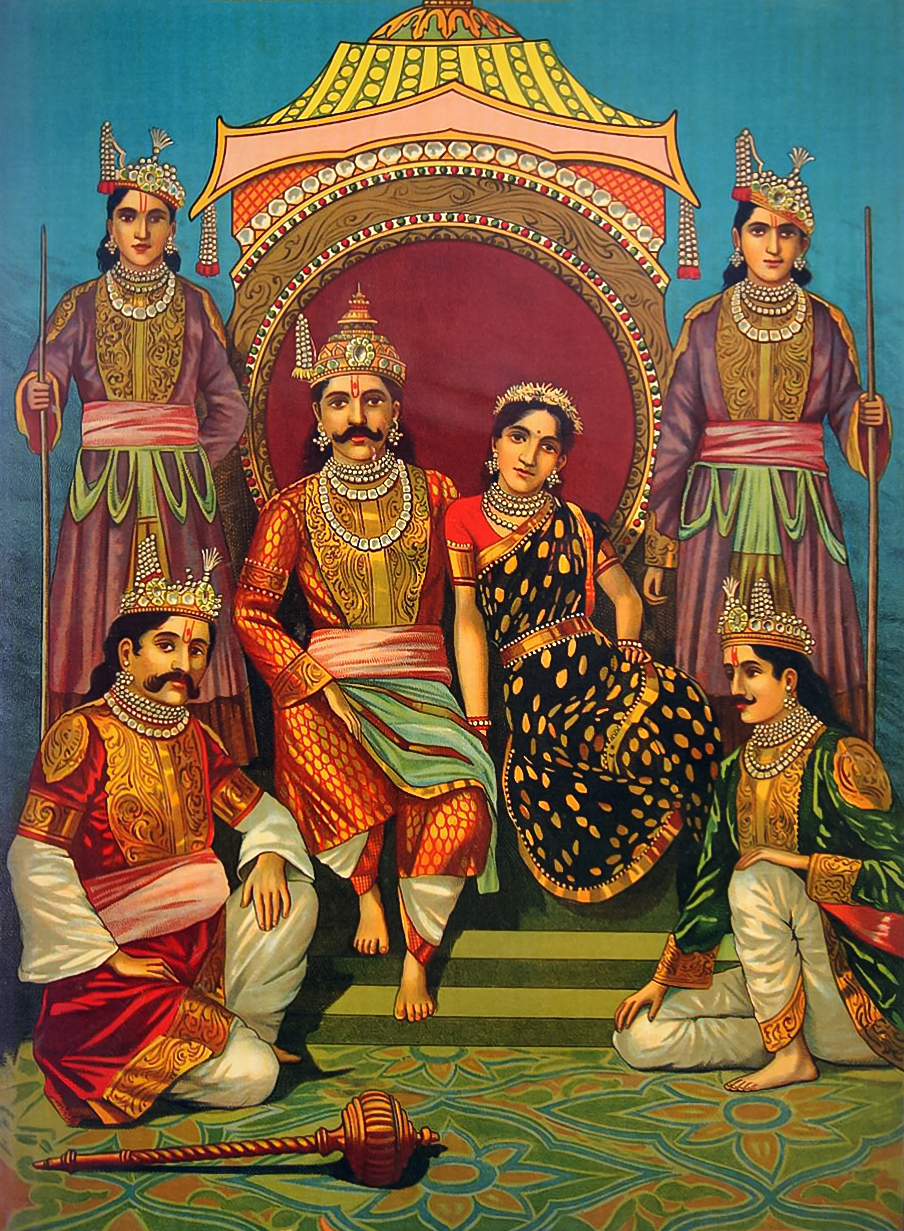
“People tell this tale now; others shall tell it in times to come; through it, sons become obedient and servants well-behaved; the man who hears this is freed at once from every sin of body, speech, and mind.” – (The Mahabharata, Smith 12)
It was past midnight when the young Englishman looked up from his paper and noted, with distaste, that there was not a surface within the entire office of the Civil and Military Gazette that was not dewy or splashed or running with some liquid or another. The rain had stopped hours ago—or at least was falling so softly that he could not hear. Still the walls and floors glistened, dampened by the August air that pushed and squashed through the windows like so much wet sponge. Beads of sweat ran down his scalp onto the lenses of his glasses, oozed out from under his arms, and slid down his flanks, pasting his thin vest top to his skin. And everywhere on his working surface—on his hands and trousers, too—there were black speckles of ink.
He sighed and wiped his pen, wishing he were away from Lahore and back at Simla, where even in June fresh, cool air flowed down from the mountain snows—where one could always breathe. He shifted in his seat, unsticking his legs from the leather upholstery and stretched his arms. When he looked back down at the desk, he realized that his paper was blotted with sweat, and that some lines would be completely illegible for the clerk who did the type-writing. He debated laying the smeared pages aside to start on a fresher, fairer copy now. He decided to finish the draft first: best not to lose momentum.
He drew a large volume across the desk. Train-ticket stubs, scraps of odd paper, and a blue editing pencil marked places of interest. He opened the book at the pencil and turned over a limp, damp page. He re-read a passage just to get the wheels of his thought turning again. Then he looked for the last unfinished sentence on his paper, and continued writing from the word monstrous:
“Monstrous, painted in all the crude colours that a barbaric hand can apply; moved by machinery that would be colossal were it not absurd, and placed in all their doings beyond the remotest pale of human sympathy.” (Kipling 1886, quoted in Smith lv)
This was the young man’s response to the sixth book of the first translation, in English prose, of the Mahabharata. Other men had assured him that the great Indian epic was the equal of Homer. He saw nothing there to admire, and, with the certainty, chauvinism, and contrarianism common to many a brilliant young man of twenty, was happy to say so in the starkest terms. But the stories India tells have a way of working into one’s bone marrow—and never was that more true than for this writer, Rudyard Kipling.
I’m Rose Judson. Welcome to Books of All Time.
Intro – Background to the Mahabharata
Books of All Time is a podcast that’s tackling classic literature in chronological order. This is episode 44: The Mahabharata, Part 1 – Sacred and Marvelous Tales. If you’d like to read the transcript for this episode or see the list of references I used to write it, you can visit our website, booksofalltime.co.uk. There’s a link in the show notes if you need it. Let’s begin.
A very belated happy new year—a belated Groundhog Day, even—to you all. I have been, as mentioned in past episodes, working my way through a pretty wicked case of anemia since late August or so, and taking some downtime in January became necessary if I was going to finally turn the corner. Apologies again for another prolonged absence.
This episode sees us continuing our journey through the great epics of Ancient India. Last month, we got to know the Ramayana, the story of Rama, an avatar of the Vedic god Vishnu who came to earth to defeat a demon and lost his wife in the process. We also caught up with the development of religion in Ancient India up to the time that the Ramayana was being compiled—important background context for the world of the characters, especially when it comes to the concept of dharma.
Now we move on to a bigger, even more epic story that revisits and enlarges on some of these themes: the Mahabharata. Like the Ramayana, the Mahabharata was composed in Sanskrit. It is the work of many authors, though it’s traditionally attributed to one—in this case, Vyasa. Like Valmiki, the author tradition assigns to the Ramayana, Vyasa may or may not have existed. Similar to Valmiki, Vyasa also appears as a character within the story—more about that shortly. The Mahabharata largely uses the same poetic meter as the Ramyana, and it appears to have also originated in oral tradition before beginning to be written down around 300 BCE—though parts of it are significantly less old, with some probably being added to the main body of the work as late as 400 CE.
And oh boy, does the Mahabharata ever have a body. It consists of 100,000 verses divided into 18 books. It is more than twice as long as the Ramayana and eight times longer than both the Iliad and the Odyssey added together. If you owned a complete translation of the work, it would come as a set of 12 or more quite chunky volumes. In our opening vignette, Rudyard Kipling was reviewing part of the first prose translation in English, which was translated by Kisari Mohan Ganguli and published in Calcutta between 1883 and 1896. It came to 18 volumes—one for each of the “books” ancient scholars divided the work into.
I read two abridged editions (yes, even though I said a while back that I would only read one). The first is the 2009 Penguin Classics prose edition translated by John Smith, and the other is another 1898 verse translation by Romesh C. Dutt—the same scholar who produced the poetic version of the Ramayana I read. Dutt’s edition is available from Macmillan Classics, or completely for free on Project Gutenberg.
I was able to read both of these versions because, as it turns out, the main narrative of the Mahabharata only makes up about 25 per cent of the total length of the book. The rest of it is a compendium of mythology, lore, sermons, doctrine, and even geography that was grafted on to the central story over time. For ordinary readers like you and me, it’s possible to skip past most of the digressions and focus on that 25 per cent. That’s what I’ve done for this first summary episode.
Note that it’s also possible many of us have already read one very important section of the Mahabharata which comes from one of these digressions—namely, the Bhagavad Gita, an incredibly influential work of spirituality and ethical philosophy that is also considered one of the scriptural treasures of Hinduism. And if you’re not familiar with the Bhagavad Gita, it’s likely you’ve heard at least one well-known line from it,famously quoted by J. Robert Oppenheimer, the nuclear scientist who led the effort to build the atomic bomb: “Now I am become Death, destroyer of worlds.” The Bhagavad Gita consists of about 1,000 verses—just 1 per cent of the total length of the Mahabharata—but is by far the most influential section of the work.We’ll be exploring the Bhagavad Gita in depth in our next episode.
For now, let’s start with the main plot, and with some scene-setting. The Mahabharata takes place in the same general area as the Ramayana—in what is today the northern Indian state of Uttar Pradesh. This area is just south of the Himalayas on the border with Nepal. Ayodhya, the city Rama ruled, is in Uttar Pradesh, as is the Taj Mahal.
When it comes to time period, the Mahabharata is set rather a long time after the events of the Ramayana. It doesn’t feel all that different when you read it, though. The main narrative was probably developed during the same period of religious and cultural ferment that informed the Ramayana, so we get many similar scenarios. For example, there are again people renouncing society to live in the forest while the elites are still performing Vedic-style animal sacrifices.
The story concerns the fate of the kingdom of Hastinapura and its ruling dynasty, the Kuru family. The narrative traces the enmity that develops between two branches of this family—two sets of cousins. One set is known as the Kauravas. They are led by Prince Duryodhana. The other set is the Pandavas, led by Prince Yudhishthir. The cousins’ struggle over the right to rule Hastinapura leads to betrayals, attempted murder, and exile. It then culminates in an insanely destructive 18-day war that not only destroys one branch of this family—it also marks the transition to a new, degraded cosmic age: the Kali Yuga.
If you thought the end of the Ramayana was emotionally shattering, well. That was just a warm-up compared to what’s to come in the Mahabharata.
Dharma, and the moral quandaries into which it places us, is also a major theme in this work, as it was in the Ramayana. The scholar Arshia Sattar describes the Mahabharata’s treatment of dharma in the introduction to Dutt’s poetic translation like this, quote:
“The moral dilemmas [the Mahabharata] confronts make us stop and think about ourselves in our own time and place – dilemmas of duty to others and responsibility to oneself, the conflict between righteousness and justice, the relationship between war and other kinds of sanctioned violence, the desire for power and the quest for truth – these are questions that we still ask, answers that we still seek, no matter who we are or where we might be in the world.” (Vyasa 3-4)
Right, that’s our bird’s-eye view of the story. Let’s hitch up our chariot and get rolling; we’ve a lot of ground to cover.
Part 1: The Older Generations
The Mahabharata begins, like the Ramayana, with a group of sages in a forest telling stories to one another. One of these, Urgrasravas, tells the others that he recently attended a snake sacrifice held by a local king, where he was able to hear a seer called Vaisampayana tell the story of the Mahabharata.
Urgrasravas is prevailed upon to tell the story in full to the group, and he does—this is our framing story: holy men in the forest hearing the tale at third hand. Urgrasravas learned the story from Vaisampayana, who learned it from Vyasa, the original composer. Indian epics do enjoy structuring their tales in this way, sort of the REO Speedwagon approach: heard it from a friend who, heard it from a friend who, heard it from another who was actually there.
Anyway, Urgrasravas relates that not only is this a good story, it is, in fact, a holy one which confers wisdom and spiritual purity on those who learn to recite it, or even hear it. He repeats the words of Vaisampayana’s introductory address to the king at the snake sacrifice, quote:
“What is found here concerning dharma, the making of wealth, pleasure, and final release is to be found elsewhere, too . . . but what is not found here is to be found nowhere.” (Smith 12)
He also relates that, quote, “Any evil that a man may do in error as he goes about his daily tasks melts away as soon as he hears the Mahabharata tale.” (Smith 12) So we’ve got that going for us, which is nice. After some extended throat-clearing and scene-setting, we are given the background.
King Shantanu of the Kurus, ruler of Hastinapura, is looking to remarry after the death of his first wife. His new wife’s father-in-law refuses to let his daughter marry the king unless he has an assurance that her children will inherit the throne. Shantanu’s son from his first marriage, Bhishma—a young and vigorous warrior—recognizes that that he has a duty to secure his father’s happiness, even at the expense of his own power.
He takes a vow of celibacy and dedicates himself to serving his father’s new children. When his younger half-brother is grown, Bhishma secures two sisters as brides for him—a third, Amba, is thwarted in her marriage goals and blames Bhishma for this, vowing to kill him in her next life. Make a mental note of Amba and her vendetta, please.
Bhishma’s younger brother dies without fathering children. The line is at risk of dying out. In spite of that, Bhishma refuses to break his vow of celibacy. So, his stepmother Satyavari calls an audible: she summons a brahman, a holy priest, to step in where Bhishma won’t. This type of surrogate fathering was apparently a custom in some places in India. The Brahman she summons is her son from a past liaison: the seer Vyasa, the traditional author of the Mahabharata.
Vyasa sleeps with the first widowed princess. Now, remember: he is an ascetic who’s been living in the woods. He doesn’t bother to wash up before doing his dynastic duty: this sort of act is not supposed to be enjoyed by any of the parties, and Vyasa is determined to lean into that. The princess can’t stand to look at his matted hair, tangled beard, and weathered face. She shuts her eyes during the act. Vyasa prophecies that the child of this union, who will be called Dhritrarashtra, will, quote:
“…have the vigour of ten thousand elephants; he will be learned, a true royal seer; he will be a man of great fortune, great courage, and great wisdom; he will have a hundred mighty sons. But because of his mother’s fault, he will be completely blind.” (Smith 38)
The second princess fares slightly better: she merely turns pale with disgust when Vyasa approaches her. Her son, Pandu, is born sort of pale and feeble as a result—possibly jaundiced, according to John Smith’s introduction. Still, a slightly feeble prince is preferable to a blind one, and Pandu inherits the throne of Hastinapura ahead of his elder half-brother.
These two boys will be the fathers of the ill-fated cousins who will meet on the field of Kurukshetra. (An aside: There is also a third son born as a result of Vyasa’s designated hitting. His name is Vidura, but his mother is a servant-woman and so he is destined to become a seer rather than a prince. Onward.)
One day, Pandu is hunting in the forest. He comes across two deer mating. He shoots the male, but is then horrified as the deer transform into humans: a powerful seer and his wife, who apparently were indulging in some next-level erotic role play via shapeshifting. The seer, with his dying breaths, curses Pandu: if the prince ever engages in a sexual act himself, he will die. This is unlucky for Pandu, as he’s just married two wives. Since he can’t procreate, he resigns the throne and retires to the forest. Blind Dhritrarashtra assumes the kingship instead.
Dhritrarashtra is married to a very strong-minded woman named Gandhari who blindfolds herself in order to share in her husband’s affliction. She conceives, but the embryo grows within her for an inordinately long time.
Meanwhile, in the forest, Pandu’s senior wife Kunti has obtained some boons for good deeds and for performing various physical and spiritual austerities. These boons allow her to invoke any god to father children on her. She chooses three: the god Dharma, who gives her her eldest son, Yudhishthira; Vayu, the wind-god, whose son is Bhima; and finally, Indra, the thunder-god, whose child by Kunti is Arjuna.
Kunti transfers one of her boons to her co-wife, Madri. Madri gets busy with the Ashvins, twin gods of medicine and healing. She bear s twins called Nakula and Sahadeva. These five boys will be known as the Pandavas, after Pandu, their adoptive father.
Back in Hastinapura, Gandhari has been pregnant for over a year when she hears of Pandu’s divine adopted sons. This causes her to finally stop sitting on the egg, figuratively speaking. She gives birth to—uh, well. Quote:
“Gandhari with a mighty effort caused the embryo to fall from her womb, for she was overcome with misery. Then there emerged a dense mass of flesh like a ball of iron, and though she had carried it in her womb for two years, she prepared to cast it away.” (Smith 44)
Yikes. But Vyasa counsels her to prepare a hundred pots full of ghee—that’s clarified butter—and then to sprinkle the ball with cold water. It separates into a hundred embryos, which are planted in the ghee. Vyasa trots off to the Himalayas to perform austerities and prayers, and the hundred butter babies are soon born—each of them boys. The eldest of these is Duryodhana. When Dhritrarashtra asks Vyasa what kind of man Duryodhana will be, out of the literal sky come the shrieks of jackals and the harsh calls of carrion birds.
Dhritrarashtra is advised to abandon this son, who will result in the end of his line, but he refuses. These hundred children are known as the Kauravas—the second faction who will face off on the battlefield one day. I would prefer to call them something catchier—the Ghee Gang, the Butter Boys, Team Cream—but we will stick with tradition. Kauravas and Pandavas it is.
Part 2: Rivalry, Dice Game, the Pandavas in Exile
All the boys grow up, guided in one way or another by their great-uncle Bhishma. The Pandavas are taught the ways of war by a hale old warrior called Drona. Arjuna, the third child, is especially gifted in this department: he’s an ambidextrous bowman, and, like Rama, is able to obtain celestial mantras for battle through his training.
When the boys are older, Drona suggests to King Dhritrarashtra that a tournament would be appropriate. This section has strong Arthurian legend vibes for me: we get a mock-battle with teams of fighters in chariots and on elephants. Arjuna seems like he is cleaning up at this tournament, especially in the target-shooting. Quote:
“Now the voices of the people died away and all was still,
Arjun to his proud preceptor showed his might and matchless skill.
Towering high or lowly bending, on the turf or on his car,
With his bow and glist’ning arrows Arjun waged the mimic war.
Targets on the wide arena, mighty tough or wondrous small,
With his arrows still unfailing, Arjun pierced them one and all!” (Dutt, 22)
Duryodhana is not enjoying being shown up like this. But then—again, like something out of Arthur—an unaffiliated mystery warrior turns up. He too is an amazing fighter, and he soon tops every one of Arjuna’s tricks. Duryodhana immediately befriends the ringer. His name is Karna.
Unbeknownst to everyone there, he was fathered by Surya the Sun god and Kunti, mother of the three eldest Pandavas, prior to her marriage—so he’s actually the Pandavas’ half-brother. Duryodhana recruits Karna into his entourage, and the seeds of rivalry between Arjuna and Karna are sown.
Not long after the tournament, Pandu gives into a fatal temptation to sleep with his junior wife, Madri. He accordingly dies of his curse, and she dies by suicide immediately afterward. The Pandavas and Kunti return to the palace at Hastinapura, where the people—along with Dhritrarashtra and his counselors—are immediately struck by the poise and righteous conduct of Yudhishthira. This is not surprising, given he is literally the son of Dharma.
Dhritrarashtra’s counselors point out that Yudhisthira was the first-born of all the cousins, and that his temperament would make him a much better crown prince than the angry and jealous Duryodhana. This conversation makes Duryodhana, well, angry and jealous. Instead of an outright confrontation, however, Duryodhana decides to play nice while plotting his cousins’ downfall. He makes a show of having a beautiful house built for the Pandavas. But it is secretly a death trap, as Duryodhana orders the builder to, quote:
“Make the builders use whatever materials are inflammable – hemp and resin and so forth – and make them plaster the walls with a clay mixed with ghee, oil, and plenty of lac. Then place all over that house hemp, bamboo, ghee, wood, and every other such contrivance.” (Smith 59-60)
Murder via building code violations! The perfect crime. The Pandavas move into the house. Yudhishthira already suspects something is fishy, and his suspicions are confirmed when his uncle Vidura tips him off about Duryodhana’s plans to burn the house up with them in it. The Pandavas have a tunnel dug under the house, and when Duryodhana sends goons to set fire to the house, they are able to escape to safety.
But everyone in Hastinapura assumes they perished in the fire. They go into hiding for a time, posing as a family of Brahmans and peregrinating around the forests near the Himalayas, meeting sages and hearing various legends. Not long after settling in a potter’s house, where they live on alms as per Brahman tradition, they learn of a swyamvara taking place in a nearby kingdom. A swyamvara is a competition among suitors for the hand of a princess of the kshatriya caste, or warrior caste. The lads are excited to watch the sport, so they leave their mother in the place where they’re staying and go to observe the festivities, heavily disguised as priests.
The princess at stake is the Princess Draupadi of Pancala. Among the competitors is Duryodhana, naturally. He’s brought Karna along with him. Another competitor is Prince Krishna of the Vrishni clan. His father, Vasudeva, is brother to the Pandavas’ mother Kunti, so he’s also a cousin—though not one in line for the throne of Hastinapura. Krishna is famous as a skilled charioteer and warrior. But he is hiding his true identity: he is the eighth incarnation of the great god Vishnu (Rama, you may recall, was the seventh). He is not there to win a wife. He is there to watch out for Arjuna.
Brahmans are barred from participating in the competition, which is (you guessed it) an archery challenge. Hanging from the high ceiling of the palace is a suspended target that moves – in the prose version, the target is in the shape of a fish, though Dutt describes it as a “discus” in the verse edition. The suitors must use a specific giant bow, look at the target in a reflecting pool at their feet, and then hit the eye of the fish (or a spot on the discus) five times.
Karna, the mystery knight, steps forward to have his go. He’s able to bend and string the bow, but as he is setting up to shoot:
“Uprose Karna, peerless archer, proudest of the archers he,
And he went and strung the weapon, fixed the arrows gallantly,
Stood like SURYA in his splendour and like AGNI in his flame,—
Pandu’s sons in terror whispered, Karna sure must hit the aim!
But in proud and queenly accents Drupad’s queenly daughter said:
“Monarch’s daughter, born a Kshatra, Suta’s son I will not wed.” (Dutt 41)
Karna, you see, is believed to be the child of laborers, so he isn’t a member of the right caste to marry a princess. The poor guy slinks away ashamed. Then Arjuna volunteers. He’s wearing a helmet on his head to conceal his face—masterful gambit, sir—and he is, as you’d expect, able to handle the bow and hit the target. But this causes even more of an uproar due to the fact that he is, to all appearances, a priest. Fortunately, Krishna steps in:
“Krishna rose amidst the monarchs, strove the tumult to appease,
And unto the angry suitors spake in words of righteous peace,
Monarchs bowed to Krishna’s mandate, left Panchala’s festive land,
Arjun took the beauteous princess, gently led her by the hand.” (Dutt 47)
The Pandavas go back to the potter’s house. Kunti is inside meditating when the boys arrive. “Mom,” Arjun says, “I won something amazing!” Without looking around, Kunti replies, “Well, make sure you share it with your brothers.” And this, amazingly, is not treated as an unintentionally funny remark, but a serious, binding command. Princess Drupadi becomes the wife of all five Pandava brothers (though she is most attached to Yudhishtira, as Arjuna and Bhima have already got, or will get, wives elsewhere—Arjuna, for example, marries Krishna’s sister).
After marrying the princess and striking up an alliance with her father, Drupad, the Pandava Polycule is now too powerful to be kept away from court at Hastinapura. They return, and Dhritrarashtra decrees a split succession. Duryodhana will inherit the eastern half of the kingdom—the half that contains the city of Hastinapura and the rich lands along the Ganges—while the Pandavas will have the western half, sited on the river Jumna. This part of the kingdom is wild, intractable forest.
It’s meant as a slight, but the Pandavas are nothing if not industrious. They clear a section of the forest and build a city there, Indraprastha. (The ruins of Indraprastha are visible near modern Delhi.) The demon Maya, who owes Arjuna a favor—Arjuna rescued him during one of his adventures—decides he will use his skills as a master craftsman to create a splendid palace for the brothers and their wife. This one, naturally, won’t be a tinderbox. Instead, it is made of precious metals and gems, quote:
“Its brilliance seemed to outshine the splendor of the sun as it blazed forth with a divine radiance. It stood obscuring the sky, like a mountain or a cloud, long and broad and smooth, dispelling sin and weariness.” (Smith 83)
Yudhisthira, having become a new power in the west of the kingdom, decides to hold a sacrifice to consecrate the hall. Duryodhana is invited to attend. He cannot help but be impressed by the new building. He also cannot help but be insulted when he mistakes an indoor pool for a very shiny floor and steps into it, getting soaked to the skin. As he drags himself out of the water, the laughter of his cousins ringing in his ears, he vows revenge.
But again, this sneaky so-and-so can’t bring himself to start a straight fight. Instead, Duryodhana decides to take advantage of the pious and righteous Yudhisthira’s single flaw: his love of gambling. He, along with his uncle Sakuni, who owns a set of loaded dice, coaxes Yudhishthira into making bet after bet. He can’t bring himself to stop, and soon he has wagered his palace, his wealth, his birthright—even his wife—and lost them all.
According to the terms of the final bet, Yudhisthira and his brothers are to live in exile in the forest for 12 years. In the 13th year, they must return to society, but they must do so in disguise. If they’re recognized during that year, back to the forest they go. If they’re not, they get their half of the kingdom back. This is definitely the kind of weird bet you make when you have a serious gambling problem.
Poor Draupadi, as a result of this dice game, is condemned to live as a slave to the Kauravanas. One of Duryodhana’s younger brothers, Duhsasan (emphasis on the duh) grabs her by the hair—an insanely offensive thing to do to any woman in this culture, but especially a royal, married woman—and drags her into the presence of Duryodhana and Dhritrarashtra. She bravely calls them out for their dishonorable behavior towards her, and Dhritrarashtra allows her to be banished with her husbands to the forest.
Part 3: Exile, Return, and the Council of War
The Pandavas’ 12 years in the forest is, like Rama’s and Sita’s, a long period where not a whole lot happens. They meet many people, including demons and helpful and are visited by friends like Krishna and Vidura. They hear many legends, including a condensed version of the Ramayana. For Arjuna, the main thing that happens to him during his exile is that he spends five years in isolation working on his archery and his spiritual practices. He then impresses a hunter in the woods—a hunter who turns out to be the god Shiva in disguise. Shiva bestows upon him various celestial weapons which will come in handy later.
For Bhima, the Pandava brother who’s the son of the wind god, the main thing that happens is that he is attacked by wild animals while out on a mission in the mountains to collect flowers for either Drupadi or his own wife—versions vary.
Bhima uses his mighty voice and barbarian-like strength to subdue and kill the animals, but the racket he makes in doing so annoys another resident of the mountains: Hanuman, the monkey-god. Hanuman, disguised as a sick and feeble monkey, humbles Bhima by challenging to lift his tail with his supposedly superhuman strength. When Bhima can’t do it, Hanuman reveals himself.
This celebrity encounter delights Bhima. After apologizing to Hanuman for the noise, he begs him to assume the giant form he took when he leapt across the ocean between India and Lanka. Hanuman initially demurs: this is the wrong age of the world for that, he tells Bhima. The Kali Yuga is nigh.
Unlike the Greeks, who talk about finite gold, silver, bronze, and lead ages, the ancient Indians (and Hindus today) talk about a cycle of four ages, each one progressively shorter and nastier than the next. The Kali Yuga is the shortest and nastiest of all—it is a degenerate and violent age full of sin and misery.
It will not surprise you to know that we are in the Kali Yuga right now. It will also not surprise you to know that “short” is a relative term when we’re talking about cosmic ages: our current Kali Yuga is not set to end until the year 428,899 CE. So, you know, adjust your expectations accordingly.
Anyway, Bhima and Hanuman banter back and forth for a bit, and they are pleased to discover that they are, in fact, half-brothers via their father the wind god. Hanuman tells Bhima he can foresee that he and the other Pandavas will be in a terrible war, and that this war is actually necessary to usher in the Kali Yuga.
Hanuman cannot come to help them in person, but he tells Bhima that if Arjuna goes into battle with a banner bearing the monkey’s image, he will be protected from destruction. Hanuman bids Bhima farewell, and goes off into the mountains about his monkey business.
I really do love that monkey.
Eventually, the 12 years of exile ends. The year of disguise begins. The Pandava Polycule heads to the kingdom of the Matsyas, who are ruled by a king called Virata. Draupadi and her brother-husbands find various fitting aliases for themselves and obtain positions in the king’s service. Draupadi becomes a maid for king Virata’s daughter. Bhima becomes a cook. Yudhisthira, pretending to be a priest, assumes the role of a courtier to the king (who, happily, also likes playing dice). The twins look after the king’s stable and livestock, while Arjuna disguises himself as a eunuch. It’s a sitcom setup waiting to happen—or would be, if we were in that kind of story. We’re not.
The Matsyas are famous for the quality of their cattle. Cattle raiding—discussed at length in the Rig Veda—is still a pastime by the time depicted in the Mahabharata. And who comes a-raiding? It’s the Ghee Gang, of course: Duryodhana and his hundred brothers. When one half of their army draws out the king’s forces to the east of Matsya, the other half comes in from the north.
The only person left to defend the north is prince Uttara, who seems honestly a bit wet and hopeless. Uttara is surprised when his father’s new eunuch insists he can help him drive back the invaders. The eunuch—Arjuna in disguise, remember—retrieves his magic monkey banner and his and his brothers’ weapons from where he’s stashed them in a sacred tree, gets Uttara to hitch up a chariot, and rides out to meet Duryodhana and his crony Drona. Quote:
“Arjun twanged his mighty weapon, blew his far-resounding shell,
Strangely spake his monkey-standard, Kuru warriors knew it well,
Sankha’s voice, Gandiva’s accents, and the chariot’s booming sound,
Filled the air like distant thunder, shook the firm and solid ground.
Kuru soldiers fled in terror or they slumbered with the dead,
And the rescued lowing cattle with their tails uplifted fled!” (Dutt 118-119)
I’m so glad the cows were okay. I’m also glad that this battle happened to take place just a day after the end of the year of disguise. The Pandavas emerge from hiding in spectacular style, showing that they’ve grown in stature as warriors and handing Duryodhana another L in the process. Arjuna’s son marries king Virata’s daughter, cementing another alliance for the Pandavas, along with Draupadi’s clan.
It is from this position of strength that Yudhishthira sends emissaries in all directions. Some go to neighboring kings to rally them to the cause of the Pandavas. And one goes to Hastinapura to deliver Duryodhana an ultimatum: we want our half of the kingdom restored to us, as promised.
Duryodhana is regent now. He receives the emissary along with his father, the elderly Dhritrarashtra, and his relatives and counsellors, including Drona, who used to teach all the cousins the art of warfare, Vidura the priest, and Bhishma—Bhishma, you may remember, is their aggressively celibate great-uncle who abdicated his right to the throne in their favour. These advisors are all shocked when Duryodhana refuses to honor the terms of the wager.
Yudhishthira, receiving the news, is dismayed: he does not want to fight his relatives and destroy the Kuru line, but it is his dharma as both a warrior and a prince to do so. Fortunately, Krishna is present, and he offers to make one more attempt to talk sense into Duryodhana. When Dhritrarashtra hears that Krishna is coming to Hastinapura, he begins to plot to win Krishna over to his side of the conflict. (Remember that as far as our characters are concerned, Krishna is a prince who is skilled in war and commands an army, not an incarnation of a god.)
When Krishna arrives in Hastinapura, he declines the gifts and accommodation offered him by Dhritrarashtra and Duryodhana: Krishna understands these are meant to sway him to their side, and he wants to remain neutral. Duryodhana, naturally, takes this personally, and begins plotting with his 99 brothers to have Krishna arrested after the council.
The morning of the council, Krishna meets with Vidura, who tells him that his mission is pointless: Duryodhana hates and resents his cousins and is set on destroying them. Krishna replies that he knows this, but that it is nevertheless his duty to make the attempt as honestly as possible. He is driven in state to the hall where Dhritrarashtra and his retinue await him—the advisors, Bhishma, and many wise seers.
In the prose version, there’s a lovely bit of description as Krishna takes his place before the assembly which hints at the power Krishna’s human form conceals while also driving home how fateful this moment is:
“When all the kings were seated in silence, Krishna of the gleaming teeth began to speak in a voice like the sound of a drum . . . his voice resounded throughout the entire assembly, like a thundercloud at summer’s end.” (Smith 313)
Krishna addresses Dhritrarashtra directly, telling him that his sons, driven by greed, are unlawfully claiming their cousins’ lands. He reminds Dhritrarashtra that, as king, it is his dharma to avoid senseless destruction of his people. Krishna then makes his counteroffer: he explains that if Duryodhana is adamant that he will not give Indraprashta back to the Pandavas, they are willing to accept five other villages—one for each of the brothers.
The elders in the room—Vidura, Bhishma, and Drona, the old martial arts instructor, to name just a few—all give speeches agreeing with this wise and just request, telling various long tales from history and myth to illustrate the three points on which they all agree: first, that the Pandavas have a legitimate claim. Second, that war would be a calamity. And finally, that Duryodhana is in the wrong, and clearly motivated by greed rather than justice. He must make peace with Yudhishthira and his brothers. Dhritrarashtra even drafts in his wife, Gandhari, so that she can try to make her eldest son see sense.
“Nah,” says Duryodhana. He tells the assembly that he has not taken his position because of greed: rather, he feels his father was weak to offer the Pandavas half the kingdom in the first place. He is convinced his dharma is to keep it united. Quote:
“If in past in thoughtless folly once the realm was broke in twain,
Kuru-land is re-united, never shall be split again!
Take my message to my kinsmen, for Duryodhan’s words are plain,
Portion of the Kuru empire sons of Pandu seek in vain,
Town nor village, mart nor hamlet, help us righteous gods in heaven,
Spot that needle’s point can cover shall not unto them be given!” (Dutt 140)
Dang, Duryodhana, not even a mart? That is commitment to your grudge.
After this, depending on which version you read, Duryodhana’s goons either try to seize Krishna, or someone reveals that Duryodhana plans to have him seized. This does not work: Krishna at last reveals his divine form, the form of Indra, to the assembly. He is suddenly many-headed and many-handed, brandishing his many weapons. Quote:
“From his eyes, nose and ears fiery flames issued forth in every direction, smoking most fearfully, while rays of light like sunbeams shone from the pores of his skin.” (Smith 337)
The elder Kauravas are alarmed and distressed; Duryodhana alone is unfazed by this. Krishna resumes his human form, pays his respects to the Pandavas’ mother, Kunti (who is his aunt on his father’s side). He also has a go at persuading Karna, the best warrior on the Kauravas’ side, to fight for the Pandavas instead.
Karna, you’ll recall, was the mystery knight from a low-class family, but (as Krishna now tells him) it actually turns out he is a half-brother of the Pandavas, as he is Kunti’s eldest child by the sun god. Krishna even tells him that Yudhisthira and Arjuna and the rest are aware Karna is their oldest brother, and would be happy to elevate him to first in line for the throne of Indraprastha when it is restored to them.
Karna declines: he says he owes Duryodhana a debt for taking him in after the tournament. Contrariwise, he owes Kunti nothing, as she has never acknowledged being his mother until now. He will fight for the Kauravas.
Krishna accepts this. He takes his leave of Hastinapura, dispatching messengers to the Pandavas to tell them his embassy has failed. He rides off towards his own kingdom to begin mustering his forces. War is coming.
Part 4: Arjuna and Krishna Before the Battle
The narrative continues as the poet takes us through the summoning of the armies: the preparation of chariots and archers and elephants; of cavalry and spearmen and fodder and so forth. The Pandavas have seven armies, arrayed into companies called akshauhinis. I had to go to Wikipedia to get a breakdown of the size of an akshauhini: it is a force of 218,700 warriors, which breaks down as:
- 21,870 elephant-mounted fighters
- 21,870 chariots (with charioteers)
- 65,610 horse-mounted warriors
- 109,350 foot soldiers
So the Pandavas have a total of 1,530,900 combatants. The Kauravas have even more: eleven akshauhinis, or 2,405,700 combatants. Romesh C. Dutt, in his introduction to the section of his translation that covers the mustering of forces, notes that this is clearly an exaggeration; the real size of each of the companies would have been something like 10,000. (Regardless, this is not shaping up to be a fair fight, but it appears to be even more lopsided when you consider that one of the armies fighting for Duryodhana is Krishna’s army.
Wait, what? you may well ask. It turns out that before the battle, Arjuna and Duryodhana go to Krishna’s city as he is mustering his forces: Arjuna in order to ensure he comes to fight for the Pandavas; Duryodhana to try to persuade him, again, to fight for the Kauravas. Krishna offers to split the baby, as it were: he will offer one side his army and the other side himself as a non-combatant.
Arjuna gets to choose first, and Duryodhana is shocked and relieved when his cousin chooses Krishna as his charioteer. Duryodhana snaps up Krishna’s army.
The forces march to the field of Kurukshetra. The Kauravas take up a position on the west of the field; the Pandavas on the east. Duryodhana names his great-uncle Bhishma as his commanding general. Bhishma gives his assessment of the two sides: their side, the Kaurava side, has many brave and bold warriors—though he, Bhishma, doesn’t personally rate Karna all that highly. (Karna is enraged by this.)
Then Bhishma evaluates their opponents. He names all the Pandavas and a wide array of their vassals—or bannermen, if you want to put it in Game of Thrones terms—and declares that he will be able to fight nearly all of them, though it could take up to a month to achieve a full defeat. There is one exception: Bhishma says he cannot fight the Pandavas’ brother-in-law, a warrior called Shikhandi. Duryodhana asks why, and we get a long, long digression about who Shikhandi is—or was.
Remember way back at the beginning of the show how I mentioned a princess called Amba whose marriage prospects were messed up by Bhishma when he was still a young man? She is back, only she’s a he now. Amba, after performing many religious rituals and austerities, received a boon from the lord Shiva. He told Amba she would be given the power she needed to bring about Bhishma’s downfall in her next life. She duly burned herself on a funeral pyre and was reincarnated, this time as a princess named Shikhandini, sister of the Pandavas’ common wife Draupadi.
Shikhandini lived as a boy and was socially accepted as a boy, eventually taking the masculine name Shikhandi. When it came time for Shikhandi to get married, his lack of standard male reproductive equipment caused a major diplomatic incident with the family of his proposed wife. He went into the forest and fasted in hopes that the gods would grant him a body to match his gender—or, failing that, to let him die. A passing male forest spirit—a yaksha—agrees to swap sexes with Shikhandi, and he is able to achieve a full transition.
So why does Shikhandi being a trans guy mean Bhishma can’t fight him? Well, Bhishma apparently took a sacred vow never to raise a hand in violence against anyone born female, and Shikhandi, regardless of his gender identity, technically meets that qualification. And if we all know one thing about Bhishma, it’s that he takes his vows seriously, even when it is quite literally in his worst interest to do so.
At the Pandava camp, Bhima, the third brother—the meathead who’s also a half-brother of Hanuman—suggests that since Duryodhana has made Bhishma commander-in-chief of his forces, they ought to nominate Shikhandi to the same role on their side. This will, as the kids say, “nerf” Bhishma’s ability to attack. This seems like a great idea to me, but the other brothers overrule Bhima, and choose their other brother-in-law, Dhrishtadyumna, instead.
The eve of battle arrives, where, quote:
“The two armies stood prepared . . . like two heaving oceans, full of great joy to be going to war; the meeting of those two forces was wonderful, like that of two oceans at doomsday. The whole earth had been emptied . . . leaving only the children and the elderly behind.” (Smith 349)
The commanders meet in the field to agree to the terms of engagement. There is to be reciprocity—elephants will attack other elephants, for example, rather than trampling on foot soldiers or horses. Injured men must not be attacked, nor should non-combatants like chariot drivers or drummers. With the rules set out, the commanders return to their lines, and the vast armies form up to advance.
It is at this point that Arjuna, riding in his chariot at the vanguard of the Pandava forces, begins to despair. He has recognized many of his relatives and old friends on the other side of the field—Drona, who first taught him to bear arms; Bhishma, who is his great-uncle and in many ways his grandfather. He asks Krishna if he is doing the right thing, or if he should leave the battlefield.
Krishna’s reply to him begins a conversation that is partly a pep-talk, partly a sermon, and partly a philosophical discourse on the ultimate nature of reality. This conversation is known to us today as the Bhagavad Gita, which we will treat more fully in our next episode. For now, here are the highlights as they relate to the plot:
Krishna reminds Arjuna that he is a member of the kshatriya or warrior caste, and thus it is his dharma to fight in a just cause. Acting according to his dharma without concern for the fruits of his actions—that is, with an attitude of acceptance toward whatever comes of it, whether it is personal reward or personal harm—is part of the way Arjuna can achieve moksha, or liberation from the cycle of death and rebirth.
Krishna contrasts this detached action with that of Duryodhana, who is absolutely acting out of desire for mastery over his cousins. Krishna also reveals himself to be a manifestation of the god Vishnu. He shows his celestial form to Arjuna and explains that this battle is actually about restoring dharma to the universe more broadly.
The Kauravas are motivated by Duryodhana’s demonic adharma, which the gods must set right. By fighting on behalf of dharma instead, Arjuna is fulfilling a divine mandate. John Smith further elaborates on this point in the introduction to the Penguin Classics edition like this, quote:
“Viewed through human eyes, the war at Kurukshetra is fought to settle the dispute between two sets of royal cousins; from the point of view of Krishna and the other gods, the entire world of men is merely the theatre in which their latest battle with their old rivals has to be played out. . . the niceties of particular human dharmas are not high among their priorities.” (Smith xli)
Krishna-slash-Vishnu explains that even if Arjuna lays down his arms, time will take the lives of the men he thinks he is sparing. If he refuses to fight, all he will achieve is to harm his own spirit, to deny his own dharma. “I myself slew these long ago,” he says to Arjuna in the prose edition. “Be the mere instrument, ambidextrous warrior. . . Fight! You will conquer your enemies in battle.” (Smith 364)
Arjuna worships Krishna, apologizes for not recognizing Vishnu within him, and regains his will to fight. We get one more false start—Arjuna’s mind is settled, but Yudhisthira’s isn’t. He gets out of his chariot, lays down his weapons and armour, and walks across the field to Bhishma. He pays his respects to the old man, asking for his permission to fight and for his blessing, which Bhishma offers him—even predicting that Yudhisthira is likely to win, and regretting that his obligations keep him on Duryodhana’s side.
At last, the conch horns blow, and the battle begins.
Part 5: The Field of Kurukshetra
The battle between the cousins takes eighteen days, and part of the reason why this episode is so late is that I was trying to do a day-by-day summary of it for you. This ultimately was beyond my skill to accomplish in a way that both made sense and kept the episode runtime under an hour. Here are the basic beats:
For the first ten days, the Kauravas have the upper hand. Bhishma’s skilful deployment of the Kauravas’ superior numbers keeps the Pandavas on the run. There are bright spots for the brother-husbands: Bhima, for instance, fights off an entire company of war elephants with his iron mace, sending the survivors stampeding back through enemy lines.
Arjuna’s mighty bow Gandhiva twangs relentlessly, raining down both plain iron arrows and arrows charged with the various celestial weapon-spells he gained during his exile. One of Arjuna’s onslaughts is described like so:
“Then with his torrents of sharp arrows [Arjuna] set a dreadful river flowing on that battlefield: its water was blood . . . its foam human fat; broad in current, it flowed very swiftly, terrible to see and to hear. . . . Ghosts and great throngs of demons lined its banks.” (Smith 377)
But in spite of his prowess, Arjuna’s efforts to get to Bhishma and kill him are constantly thwarted. When he can get past the chariots and foot soldiers being thrown at him to actually engage Bhishma one-on-one, the wily old man is able to fight him to a draw.
Duryodhana is clearly not happy, however—every night after the fighting stops, he has harsh words for Bhishma, who eventually tells Duryodhana bluntly that the Pandavas will not be defeated: they, unlike the Ghee Gang, have justice on their side.
Meanwhile, Bhima, recovering from a nasty arrow to the chest, tells his brothers that Bhishma is crushing them, and it’s time to bust out their trump card against him: Shikhandi. Arjuna reveals that he thinks this is a cheap tactic, quote:
“Shame!” exclaimed the angry Arjun, “not in secret heroes fight,
Not behind a child or woman screen their valour and their might,
Krishna, loth is archer Arjun to pursue this hateful strife,
Trick against the sinless Bhishma, fraud upon his spotless life!
Listen, good and noble Krishna; as a child I climbed his knee,
As a boy I called him father, hung upon him lovingly,
Perish conquest dearly purchased by a mean deceitful strife,
Perish crown and jeweled scepter won with Bhishma’s saintly life!” (Dutt 160)
But his scruples have to be set to one side. Shikhandi is summoned to save the Pandava war effort (and to secure, at last, his vengeance, sought across two lifetimes and two gender identities—that is a grudge for the ages). He calmly walks in front of Arjuna’s chariot, and Bhishma does nothing to reisist the arrows and javelins and celestial weapons Arjuna sends flying over Shikhandi’s back.
Bhishma is fatally injured—but not quite dead, not yet. The cousins, Kaurava and Pandava, surround him. He begs Duryodhana to end the war, but he again refuses. The cousins lash together fallen arrows to make a stretcher for the grand old man, and he is borne from the field. The Kauravas have lost their most capable commander.
Drona and Karna step in to try to rally the forces. They’re nowhere near as good at commanding their forces as Bhishma was, and over the next several days they just about manage to hold their own, but they can’t get at any of the Pandava commanders. Their efforts to separate Arjuna from Yudhisthira come to naught.
But they do get one scalp: Arjuna’s son Abhimanyu, who seems to be about fifteen or sixteen years old, fighting in his first battles. Abhimanyu throws himself into the Kauravan chakravuyha – a defensive formation that looks like a moving labyrinth of warriors, chariots, and elephants. Abhimanyu is able to get in and kill several of the Kauravas’s sons, including Lakshman, son of Duryhodhan. His actual target is Duhsasan (Duhsasan is the guy who grabbed Drupati by the hair). Young Abhimanyu, once he finds Duhsasan, shows that he has a good line in smack-talk.
“Welcome! I have sought thee often, wished to cross thy tainted path,
Welcome! Dearest of all victims to my nursed and cherished wrath,
Reap the meed of sin and insult, draw on earth thy latest breath,
For I owe to Queen Draupadi, impious prince, thy speedy death!” (Dutt 174)
But Dushasan is able to get some friends to gang up on Abhimanyu and kill him. Arjuna, once he hears of this, vows he will get his revenge. The next day he is focused on searching for his son’s killers, and he wipes out seven of the Kauravas’ eleven akshauhinis by himself in the process—the scenes are very similar to the swathe Achilles cut through the Trojans after Patroclus was killed.
Duryodhana blames Drona for their rapidly thinning army. Drona blames Duryodhana for the fact that they’re fighting in the first place. Drona rides off and sees an opportunity to kill King Drupad, the Pandavas’ father-in-law—the two old men have some ancient and complicated beef I couldn’t quite untangle. Drona gets his scalp, but immediately afterward learns that his son has been killed elsewhere on the field. As he laments, he is killed by Dhrishtadyumna, the Pandavas’ cisgender brother-in-law.
On the seventeenth day of the battle, there is only one commander left on the Kaurava side: Karna. Karna does not have the same respect from his troops the other leaders did—remember, as far as they’re concerned, he’s the son of some simple tradesman, not a true member of the warrior caste. Nevertheless, one of the allied kings is prevailed upon to drive Karna’s chariot so that he and Arjuna can meet in a no-holds-barred duel—again, very like Achilles and Hector in the Iliad.
The battle rages over many pages, many verses. It’s clear that Karna is still the equal of Arjuna, just as he was at the tournament way back at the beginning of the story. When at one point there’s a break in their fight, Arjuna and Krishna go to see Yudhisthira, who is recovering from wounds in his tent. He assumes that Arjuna would only come to tell him he has defeated Karna, and when Arjuna has to tell him that no, he’s not dead yet, Yudhisthira lashes out at his brother: you should have given your bow to Krishna and done the driving instead.
This is the most loathsome insult, as far as Arjuna’s concerned: he is on the point of drawing his sword to kill his brother when Krishna intervenes. The brothers make up, and Arjuna goes back out into the field to fight Karna again.
Their final duel is vicious: at one point, the string of Arjuna’s bow snaps. Karna takes advantage of this to continue attacking—a clear breach of the rules of engagement. Arjun is wounded, barely able to defend himself—but then Karna’s chariot hits a patch of soft earth and is trapped. Arjuna, laughing at how the tables have turned, is able to loose one more celestial arrow which strikes down Karna.
On the eighteenth day, Duryodhana’s forces are defeated. The five Pandava brothers run their cousin to ground, and he curses them, quote:
‘“Gods be witness,” said Duryodhan, flaming in his shame and wrath,
“Boy to manhood ever hating we have crossed each other’s path,
Now we meet to part no longer, proud Duryodhan fights you all,
Perish he, or sons of Pandu, may this evening see your fall!”’ (Dutt 205)
Bhima and Duryodhana fight, and Bhima, skillfully wielding his mace, leaves the prince of the Kauravas dying on the field among the other corpses.
But there is one last atrocity to come. The night after the battle, as the Pandavas are sleeping, one of the sons of Drona sneaks into their camp and murders Shikhandi, Dhristadyumna, and several other commanders. The murderer then finds Duryodhana on the field, tells him what he has done, and Duryodhana dies happy.
Yudhisthira will rule unhappily, for the most part. As Romesh Dutt puts it in his notes ahead of the last book: “Yudhishthira’s mind is still troubled with the thoughts of the carnage of the war, of which he considers himself guilty.” (Dutt 223) Still, he does his duty to the dead, whether friend or foe, and goes to visit Bhishma, who is actually dying really, for real, this time. But he delivers a long, long, long sermon about what are now Hindu traditions and laws—and then, after Bhishma finally dies, Krishna repeats the entire Bhagavad Gita to Arjuna, who claims he has forgotten it.
It’s not necessary to recap all of that here, but it is interesting to note that the reason all this moralizing is in the story at all is likely because of later editors. They knew a popular story when they saw one, and they wanted, per Dutt, to make sure that people got some good moral fibre along with all the battle scenes and fateful gambling matches. Quote:
“Generations of Brahmanical writers laboured . . . to insert in the Epic itself their rules of caste and moral conduct, their laws and philosophy. There is no more venerable character in the Epic than Bhishma, and these rules and laws have therefore been supposed to come from his lips on the solemn occasion of his death.” (Dutt 222-223)
Dutt also straight-up says you can skip those bits if you just want to enjoy the story. Smith, in the introduction to the prose version, does also, quote: “The reader who dislikes sermons can take the usual measure to avoid them.” (Smith lxv) For what it’s worth, I also agree.
All there is to tell is of endings—endings which, again, seem to be later additions to the poem. Years after the battle, the Pandava brothers hear that Krishna has died. Yudhisthira says to Arjuna, quote:
“All creatures are cooked by Time; no one escapes. I consider that it is Time for us to renounce all our doings. You are sagacious: you too must see this.” (Smith 771)
The brothers and their joint wife decide to retire to the Himalayas, leaving Arjuna’s grandson Prakshit to reign over Hastinapura. The Pandavas set out clad in garments of bark, and they are followed at a distance by a strange dog. The journey is arduous; the Pandavas are no longer the mighty heroes they once were, and they have been fasting. One by one, beginning with Draupadi, they drop and die along the way. With each death, Yudhisthira is driven to comment on the flaws of the deceased—Draupadi was too infatuated with Arjuna; brother Nakula was vain; Arjuna was a boaster; Bhima a glutton.
At last it’s just Yudhisthira. The god Indra appears in a heavenly chariot and commands Yudhisthira to ride with him. Yudhisthira asks if the dog that has been following him, keeping him company as his family has died, can come, too. Indra tells him that dog-owners can’t go to heaven. Yudhisthira insists three times, with the greatest respect, that he won’t leave the dog behind, quote:
“Surrendering to his enemies someone seeking refuge; killing a woman; robbing a Brahmin; harming a friend—these four, and abandoning one who is devoted, I consider equal, O Indra.” (Smith 776)
At this the dog reveals his true form: he is the god Dharma, Yudhisthira’s own father, and he is delighted that his son has passed this final test. Yudhisthira is washed in the sacred river Ganges and taken to the heaven where the gods dwell—and where his brothers and wife now dwell, too.
Wrap-Up and Outro
That’s it for this episode. As monumental an undertaking as this book was for me, I enjoyed it. I feel like the questions it raises about duty and loyalty, about whether or not war can ever be just, are questions relevant to every age of human history, including ours. Arjuna is much more fun than Achilles, and the adventures of the Pandava Polycule in the forest, though barely touched on here, are also full of wonderful bits of magic and folklore.
Reading the Mahabharata in its English translations can be a strange, disjointed experience, however. If you just want the plot, go for the verse version by Romesh Dutt, but bear in mind that his couplets can feel a bit strained or clunky to the modern ear.
Smith’s big housebrick of a paperback for Penguin Classics is also worth getting your hands on, but you have to wade through a lot of italicized summaries of plot before you get to the “live”, as it were, story sections. Still, the additional detail there, and some of the arguments between characters, are quite engrossing. Reading that version made me realize how the Mahabharata can be seen as a story about how people use stories—to caution, to encourage, to persuade, to console. (I may think through this a bit more in the next episode.) If that’s a theme which interests you, by all means, do pick up the 2009 Penguin Classics version.
Instead of moving on for our next episode, we’re diving in, with a closer look at those 700 verses from book six of the Mahabharata: what they talk about, who they’ve influenced, and what they add to our understanding of South Asian religion and spirituality as it’s been developing throughout this series. Join me next time for episode 45: The Mahabharata, Part 2—The Bhagavad Gita.
Books of All Time is written and produced by me, Rose Judson. The Disclaimer Voice of Doom is Ed Brown. Lluvia Arras designed our cover art and logo. Special thanks to Holly Wood, Cathy Merli, Matt Brough, John Cole and the Books of All Time Advisory Council: Ed Brown, Beck Collins, Neil Dowling, Caitlin McMullin, Hugh Parker, and Jonathan Skipp. You can support the show by subscribing and leaving a rating or review at Apple Podcasts, Spotify, or wherever you get your podcasts. You can also follow us on social media: we’re on Bluesky, Instagram and Facebook. Thanks for listening! I’ll be back soon.
References and Works Cited:
- Doniger, Wendy. The Hindus: An Alternative History. Oxford University Press, 2010.
- Vyasa. Mahabharata. Translated by Romesh C. Dutt, Pan Macmillan, 2025.
- Smith, John D. The Mahābhārata: An Abridged Translation. Penguin Books, 2009.


 Books Of All Time
Leave a comment