
“I know what he’s like; I saw through him long ago.
He’s a poet who makes his characters wild and wilful,
His style’s uncurbed, unruly, without any limits,
Devoid of slickness, verbosely vaunting its garbage.” (Aristophanes, Frogs, trans. Stephen Halliwell, lines 207-211)
Aristophanes smoothed down his hair, trying to ignore the unpleasant dampness of his palms – and the fact that his forehead seemed to have grown larger over the last several months. If I am going bald, he thought bitterly, it’s the fault of this horse’s ass.
This horse’s ass was Cleon, the biggest, loudest mouth in the assembly of Athens. He was speaking – had been speaking – in a state of highest dudgeon to his colleagues in the Assembly for the better part of an hour, while Aristophanes stood to one side with his producer Callistus.
Aristophanes could no longer track what Cleon was saying. He could only look the man over and marvel at how Cleon, the son of a tanner, seemed also to have been made by a tanner. He was leathery and hard looking; his hair and skin and eyes – even the whites of his eyes – seemed to be tinged with various shades and saturations of brown.
And his voice, tireless, not even slightly raspy in spite of its volume and vehemence, was apparently powered by the most powerful bellows known to man. Where in Cleon’s body would you keep that bellows? Aristophanes wondered idly. The man’s torso was built like a barrel, but that seemed too obvious. He supposed the nozzle of the bellows would be stuck up Cleon’s backside, its wind drawn in and out tirelessly by some fiend or other. He liked that image, and filed it away for use in a future play.
Assuming he ever got to write another play. When he had made his debut as a writer the year before, the city had buzzed about him. This Aristophanes is such a talent – and only seventeen! the talk went. Such a prodigy can only have a long and brilliant career. Then his second play, Babylonians, had landed them here, in front of the assembly, on a charge of insulting the people of Athens in front of foreign visitors. Would Aristophanes ever be allowed to put a play in the Dionysia again? Would he be censured, or even exiled? He smoothed down his thinning hair again. His hands were even sweatier now.
Next to him, Callistus let out a sigh through his nostrils. It was exactly like the sigh of a dog that has been patiently waiting for you to let it outside while you are fixed on some other task. Aristophanes looked at the older man and realised, with a slight shock, that Callistus was bored. He turned his attention to the other members of the assembly and realised that many of them, too, were waiting for Cleon to wind it up. He swept his gaze over the best citizens of the city and saw glazed eyes, slouched spines, even one or two faces gone slack with sleep. Aristophanes began to feel hope again: he may have been a novice poet, but he could tell when someone had lost the crowd.
I’m Rose Judson. Welcome to Books of All Time.
Intro – A Refresher on Aristophanes and Athenian Theatre
Books of All Time is a podcast that’s tackling classic literature in chronological order. This is episode 38: Aristophanes, Frogs, Part 2 – Criminally Funny? As always, if you want to read the transcript of this episode or see the references I used to write it, you can visit our website, www.booksofalltime.co.uk. There’s a link in the show notes if you need it. Let’s begin.
So here we are – at last – with our second episode on the comic playwright Aristophanes, the only comedian from 5th-century BCE Athens whose work has come down to us in anything bigger than fragments. In our last episode (nearly a month ago, apologies) – we walked through his play Frogs, which depicted a poetry fight between Aeschylus and Euripides, the two greatest tragedians of the Athenian stage. Frogs showed Aristophanes at his flashiest: trenchant political commentary, skilled parody, witty repartee, dick jokes. It was also an excellent example of how, even two and a half thousand years ago, comedians loved to send up famous people.
I know it’s been a few of weeks since our last episode, but you may recall that he had a reputation for sending up the famous and powerful, and that his favourite punching bag was the tragic dramatist Euripides, who was mentioned or portrayed in at least eight of his 40 known plays. That quote at the top of the show was Aristophanes describing Euripides in Frogs – though there were probably people in ancient Athens who felt that verse could just as easily apply to Aristophanes himself.
That’s because Euripides was not Aristophanes’ only target. He also aimed his darts at politicians and philosophers – and from what evidence is available to us, these darts hit their targets pretty hard. In this episode, we’ll look at how Aristophanes’ caricature of the Athenian politician Cleon nearly derailed his career in its infancy, and how his portrayal of the philosopher Socrates may – or may not – have planted a poisonous seed in Socrates’ reputation that would eventually choke it, contributing to his being put to death in 399 BCE.
But before we get to that, I want to take a very brief detour into some background stuff about how plays got made in ancient Athens – background stuff I didn’t know about until I started reading for this episode.
Back in Episode 27 – our second episode on Aeschylus – we looked at what we know about how tragic plays worked in Athens. To briefly recap, you’ve got writers who submit three tragedies and a satyr play, a comedy, to a group of commissioners. They choose three writers to be produced. Funders and a director are found. The plays are performed at a specific religious festival, the Dionysia, in late March or early April.
Performances take place in an open-air theatre. There’s one backdrop, basically a decorated building with a couple of doors in it. There are three actors, all male, who play multiple roles in the show. Each role is represented by masks. There’s a chorus of about 12 people – also all men – who represent a specific group in the story. There’s a limited amount of music – usually just a flute – and some fairly sophisticated stagecraft, including a crane that can fly people in and out of scenes, and various props on wheels.
Comedy, being to some extent a parody of the tragic form, keeps most of these trappings. One thing I hadn’t yet encountered when I wrote that episode was the idea of a career progression for writers. The scholar Stephen Halliwell, who translated the edition of Frogs I read for this show, has written extensively on Aristophanes and Greek Comedy generally. I found a paper of his from 1980, “Aristophanes’ Apprenticeship”, which shed some light on how Aristophanes – and possibly other writers – went from scribbling ideas to producing his own plays.
According to Halliwell, the progression from fledgling writer to full-on comedy producer probably took years. First, writers contributed to other people’s plays – basically an ancient Greek script doctor. Then they’d write a whole play for production with support from an experienced choregos – that is, a producer who could direct actors and chorus members. In Aristophanes’ case, we know that he first worked with a choregos named Callistratus. Halliwell says that:
“We do not know on what basis the archon allotted choruses, and in particular what personal factors may have been involved. Where a new poet was concerned, the help of influential or experienced friend might well have been invaluable.” (Halliwell 1980, 42)
So then as now, success in showbiz seems to be about who you know.
Still, Aristophanes would not just have handed a script to Callistratus and then sat back biting his nails the way modern screenwriters do once their movie is greenlit. Halliwell instead presents his partnership with Callistratus as an apprenticeship, that may have worked like this:
First, Callistratus would have helped Aristophanes refine his script once it was approved for production. He then would have applied to the city for a chorus and arranged for the creation of scenery and costumes.
Once the show was cast, Callistratus would then rehearse and direct the actor. And all the while, he’d be giving Aristophanes tips on how to do these things himself, and letting Aristophanes try his hand at them.
As I mentioned in the last episode, Aristophanes was evidently very young – still a teenager – when he first wrote his own plays. He seems to have worked with Callistratus for his first three plays (Banqueters, Babylonians, and Archanians) before striking out on his own with Knights in 427 BCE. And Callistratus may have had cause to regret his association with Aristophanes: Babylonians, the second play he produced for Aristophanes, was the play that landed them in legal hot water with a ruthless politician and general named Cleon. Let’s get to know him.
Who Was Cleon (and What Was His Deal)?
Cleon was a member of the Athenian assembly who rose to prominence after the death of the great statesman Pericles in 429 BCE, in the thick of the Peloponnesian War. Cleon’s father was a tanner – wealthy enough to get his son an education, but not numbered among the old-money families who produced many of Athens’s most prominent citizens. So Cleon’s career was carried out against a headwind of contempt from the traditional elites, who saw him as a jumped-up tradesman’s son with a big mouth.
Cleon, for what it’s worth, didn’t seem to care: he was an advocate for Athens’s poor and middling folks. He demanded that Athens’s allies pay more and more of their share of the war’s costs and prosecuted rich people whom he felt were shirking their duties toward the state. He also constantly argued to keep the war going, convincing the assembly to reject Spartan offers of peace on multiple occasions.
I read the frequently-cited 1956 article “Aristophanes and Cleon” by T.A. Dorey, which describes the various depictions of Cleon that have come down to us. It turns out, funnily enough, that Aristophanes is one of our earliest surviving written sources about Cleon. “It is clear from all his plays,” Dorey says, “that Aristophanes was bitterly opposed both to the increasing burdens that were being laid upon the allies and the repeated impeachment of members of the upper classes.” (Dorey 138)
While the play that caused the ruckus, Babylonians, does not survive, Aristophanes portrays Cleon in both Knights and Wasps as corrupt, given to blackmail, and hell-bent on making as much money as he could. In Knights, the Cleon-character is a slave who blackmails other slaves. In Wasps, he’s a dog who demands a cut of what other dogs in the pack have stolen. “The whole picture,” writes Dorey, “is one of a man to whom no means of peculation, no methods of profit-making, were too sordid or too base.” (Dorey 136)
However, Dorey looks at another contemporary source – our acquaintance Thucydides the historian, mentioned in passing in episode 30. You may recall that Thucydides served in the Peloponnesian War. He in fact served alongside Cleon at the disastrous Battle of Amphipolis, in 422 BCE, which resulted in a key Athenian loss to the Spartans – a loss for which Thucydides was exiled for 20 years. Later sources indicate that Cleon may have had a role in convincing others to vote to send Thucydides into exile.
Comparing Thucydides’ descriptions of Cleon with Aristophanes’ portrayals of him, Dorey says that there are several points of agreement. Thucydides, per Dorey, quote:
“Describes [Cleon] as a man of very violent temperament, and the most persuasive popular leader of the time, and explains his opposition to peace by the allegation that if the war came to an end, Cleon’s wrongdoings would become more easily detected and his malicious accusations less readily believed.” (Dorey 133)
So Cleon seems to have used the Peloponnesian War as a cover for carrying out various injustices (Dorey 133) – how times have changed. However, Thucydides does not accuse Cleon of corruption or taking bribes – and he’d have had no reason not to, as Cleon died in 422, several years before Thucydides began writing his history, and could not have retaliated against Thucydides for anything he said about him.
Two other ancient sources, albeit several decades removed from Cleon in time, were the Greek philosopher Aristotle and the Greco-Roman writer Plutarch. Aristotle says that “Cleon seems to have brought about the ruin of the people by his wild schemes,” (Dorey 133) but again, doesn’t mention bribery.
Plutarch, who may have been working with sources we no longer have, is very colourful about Cleon’s oratory style. Quote:
“When on the platform, [Cleon] threw all modesty and self-control to the winds, shouting at the top of his voice, hitching up his cloak, slapping his thighs, and breaking into a run while actually in the course of his speech.” (Plutarch, quoted in Dorey 132)
Plutarch also, according to Dorey, charges Cleon with “encouraging the greed and boldness of the Athenians through his irresponsible buffoonery.” (Dorey 132) However, it is important to note that all the sources we have about Cleon are people who were hostile to him for one reason or another, or people who were reading those hostile sources uncritically. The classicist Edith Hall wrote a chapter for a book called How to Do Things With History in 2018 which tried to surface some more positive attitudes toward Cleon. First, Hall notes that, quote:
“Accessing the ‘real’ Cleon has been rendered impossible by the uncritical reproduction of contemporary caricatures of Cleon as a screaming warmonger, most extensively in Knights, but also in Wasps (422), Peace (421, produced the spring after Cleon’s death), and Thucydides’ History of the Peloponnesian War.” (Hall 339)
She also highlights the fact that Plato, who was alive at the same time as Cleon (although very young), never mentions him or has Socrates mention him. This is significant because Socrates does not hold back his criticisms of other politicians from the time, including Pericles. (Hall 347) Finally, she analyses the plot of Knights and its portrayal of Cleon, and concludes that it’s possible Cleon, as the most prominent citizen in Athens, was singled out in Aristophanes’ comedies because of his prominence, not necessarily because of any personal animus Aristophanes may or may not have had toward him. (Hall 348)
She further concludes that Cleon’s reputation down the ages probably has a lot to do with the fact that historically, many scholars have come from the elite class and viewed Cleon, a man risen from the people, through the lens of their own class anxieties. This would have been especially true in the early 19th Century, after, say, the French Revolution. (Hall 354) All this is to say: you can’t make any kind of final judgement about historical figures by analyzing contemporary parodies or dramatic portrayals of them. But good lord, people down the centuries seem determined to try to do so.
The People vs. Aristophanes – Freedom of Speech for Comedians
So, on to the actual lawsuit. There’s a common idea that, even if he was just writing a kind of stock corrupt-politician character and not taking actual personal aim at Cleon, that Aristophanes’ portrayal of Cleon as a bribe-taker is what got him into trouble.
The evidence, though, suggests otherwise. No, Cleon’s issue with Babylonians, at least on the surface, wasn’t with how Aristophanes talked about him, it was about how Aristophanes talked about Athens. More specifically, the demos. In a 1992 paper, “Curbing the Comedians: Cleon vs. Aristophanes and Syracosius’s Decree,” a scholar called J.A. Atkinson gives a handy overview of the entire situation as far as we have evidence for it.
So, in 427-426, after the production of Babylonians, it appears that Cleon impeached Aristophanes or his producer Callistratus for insulting and/or damaging the reputation of the demos. What is the demos? It can mean a few things:
- Democracy itself
- Institutions set up by the demos, such as assemblies and committees
- People who lived by the system; common people (Atkinson 60)
While we like to think of 5th-century Athens as a ferment of freedom (at least for the people who weren’t enslaved), Atkinson notes that “There is a tendency to prune the record of restrictions on the freedom of thought and expression” during this period. (Atkinson 56) An ancient Greek commentator, quoted in Atkinson, describes one strain of restriction that seems to have existed. Quote:
“Caricaturing the demos in comedy and speaking ill of it they do not allow, so as not to acquire a bad reputation. But as regards private individuals, they encourage it, if anyone wishes to malign someone, for they know very well that the person pilloried in comedy is generally not one of the people or masses, but someone either wealthy, or distinguished, or influential.” (Anonymous Scholiast of Athens, Quoted in Atkinson 59)
We don’t exactly know what the offensive content in Babylonians was, but this same commentator – who was writing a generation or two after the events in question, mind you – says that the issue wasn’t just the jokes, but the people who were watching those jokes: ambassadors from Athens’s allies in the Peloponnesian War. Again, quote:
“[Aristophanes] made a mockery of officials . . . and of Cleon while there were foreigners present… for this reason Cleon was angry and laid a charge against Aristophanes for wrongdoing, claiming that Aristophanes had acted with intent to insult the people.” (Atkinson 56)
This makes it sound like Cleon was personally insulted and used “slandering the people” as an excuse to prosecute – this would not be surprising; weaponizing the law to avenge personal gripes is a strategy used by demagogues then and now. But maybe not in this case. Atkinson says that, quote: “There is no suggestion . . . that Cleon was looking for protection of his good name as a private citizen, and an action for defamation would not have won him more than a token victory.” (Atkinson 60)
And the parabasis from Aristophanes’ play Acharnians, produced the following year, explicitly states that Cleon couldn’t charge Aristophanes with maligning the polis based on this play (Atkinson 60). This parabasis – along with the fact that Aristophanes was allowed to continue producing plays at all – suggests that either Cleon didn’t follow up on the impeachment, wasn’t able to secure a conviction, or was convinced to drop the matter because of a promise of good behaviour from Aristophanes and/or Callistus. (Atkinson 60) But is obvious that something happened, because the parabasis also says, quote:
“I know that from my own experience what I suffered at Cleon’s hands because of last year’s comedy. For he dragged me into the council chamber, slandered me, churned out lies against me and shot the excrement through the fan, so that I almost drowned in the business.” (Atkinson 56)
That passage is from a translation in Atkinson’s paper, by the way: I’m not sure whether ancient Greeks had fans to shoot excrement through; I’m just quoting what’s there.
Anyway: In spite of Atkinson’s paper, there are still a lot of questions around what comedians could or couldn’t say in classical Athens. In spite of that commentator’s assertions about it being against the law to slander the demos, there is no ironclad evidence of restrictions, as in evidence of actual codified law, until the 4th century BCE – after Aristophanes had died.
In the 1991 paper “Comic Satire and Freedom of Speech in Classical Athens”, Stephen Halliwell (yes, him again) points out that there is some evidence for laws that said you couldn’t slander the living in certain contexts – in the courts, for example – and for laws that said you couldn’t slander the dead under any circumstances. This evidence has led to a consensus that, quote, “comic freedom of speech was at times the object of specific and official interference or curtailment.” (Halliwell 1991a 54)
Halliwell questions this consensus: it may be the result of centuries of assumptions piling up on top of one another – the earliest scholars we know about who were writing about this period from an analytical perspective were doing so 50 years or more after the deaths of the people they were analyzing, and they were doing so at a time when their comedians were subject to all kinds of speech laws. So probably they projected the attitudes of their own times onto the classical comedians, and subsequent generations of scholars have taken those attitudes as correct until relatively recently.
In the specific case of Cleon vs. Aristophanes, Halliwell concludes that it’s likely Cleon’s action against Aristophanes was the consequence of this very specific context – foreigners present, don’t make us look bad – rather than the result of a general law that restricted what comedians could say. (Halliwell 1991a 62-64) Quote:
“Insofar as we can recover the nature of Cleon’s action . . . it was not one which depended on a specific law of slander, nor indeed one which concerned the comic treatment of individuals at all. Its target was a comic poet who could be accused of ‘slandering the city’ in front of foreigners (the allied ambassadors at the Dionysia) – an accusation for which the Athenians would hardly require the citation of a particular law.” (Halliwell 1991a 65)
Indeed, Halliwell quotes complaints from other people in Athens during this period – complaints about how everyone except the comic poets were having their speech curtailed. One, from a philosopher called Isocrates, says, quote:
“Although this is a democracy, there is no real freedom of speech, except, in the assembly, for those who are reckless and do not care about your feelings, and also, in the theatre, for the comic poets.” (quoted in Halliwell 1991a 67)
I may not have made this clear in the previous episode, but comic plays were a fairly new feature of the drama festivals when Aristophanes was writing. While theatre itself seems to have emerged around 700 BCE, comedies were only officially included as a category in the Dionysia beginning in 486 BCE (and into the Lenaea around 440). (Halliwell 1991a 66) Comedy was at its height during the most prosperous period of Athens’s power in the 440s and 430s BCE, and seems to have been more or less a beneficiary of the rise of the democracy – this sort of makes sense, as democratic societies require some kind of equality. Comedy in democratic Athens, Halliwell writes, had “a special privilege to lampoon and denigrate even the most prominent of citizens . . . comedy appears to have enjoyed largely unlimited license to ridicule and abuse.” (Halliwell 2014 xx)
But, like insecure leaders, insecure societies are less willing to take a joke. Once the Peloponnesian War began to go sour – and the Athenian upper classes began to go sour on democracy, and the previously mentioned jumped-up sons of tradesmen, like Cleon – comedy ran into rockier waters. Halliwell concludes that, quote:
“Since ridicule always retains the capacity to disturb and unsettle, it is intelligible that at certain junctures comic liberty, exercised in performances watched by a third or more of the adult citizen population, was felt by at least some Athenians to be potentially dangerous.” (Halliwell 1991a 70)
Indeed, Aristophanes’ comedy would continue to be cited as dangerous – not just to the reputation of the city, but to the good name of some of its most prominent citizens. Citizens like, say, Socrates.
The Reputation of a Philosopher: Clouds and Socrates
Socrates was the premier philosopher of Classical Athens. He was born about 470 BCE and very definitely died in 399 BCE after being ordered to drink hemlock and die. Socrates wrote nothing – he scorned literacy, actually, as we’ll discuss next month – but he was written about by others. Our main interlocutor for Socrates was his disciple Plato – again, coming up next month – but the historian Xenophon also wrote about him, and, like Plato, seems to have known him personally.
According to both Plato and Xenophon, Aristophanes also knew Socrates, and was on friendly terms with him – they apparently got drunk together on at least one occasion. So it’s a bit of a mystery – at least to me, based on what I was able to read for this episode – why Aristophanes turned his best banquet bro into the antagonist of his play Clouds.
The Clouds was produced for the Dionysia in 423 BCE, and it was a straight-up flop, coming in third – in other words, last – in that year’s competition. Aristophanes was so salty about this critical panning that he seems to have revised the play’s script afterwards, inserting a choral song that reprimands the audience for preferring the inferior work of lesser poets who, unlike Aristophanes, are afraid to bravely lampoon powerful figures like Cleon or Socrates. (It’s possible this is more self-deprecating than self-pitying, at least based on my reading of Clouds.)
And, yes, even though I’m not as alive to the comic potential of Ancient Greek drama as specialists are, even I can tell that Clouds is not quite as ha-ha funny as Frogs – no gods crap their pants, for instance. What makes its reputation lasting is its send-up of Socrates, which is so vicious that Plato actually whined in one of his major works that the play had contributed to the erosion of Socrates’s reputation with the Athenian public. This was the Apology of Socrates, sometimes just called the Apology. The ancient Greek word apologia means “defense”, and the Apology does in fact claim to be a record of how Socrates represented himself when he was on trial for his life. It mentions Aristophanes twice. Halliwell paraphrases the first reference to Aristophanes like this:
“[Socrates complains] that for many years he has had a false reputation for two types of interests: first, esoteric and perhaps ‘metaphysical’ questions (‘things up in the sky and under the earth’), secondly, ‘making the weaker argument into the stronger’.” (Halliwell 2014 5)
Socrates argues that, actually, he really is only interested in trying to understand how to create a good life and a good society – natural phenomena are not really interesting to him at all anymore – and that he arrives at his ideas through conversation with others, not through the kind of silver-tongued chicanery his avatar engages in during Clouds.
The second complaint is that “Plato makes Socrates use Clouds to illustrate the kind of image that many Athenians had of him” (Halliwell 5) – one typified by comic “nonsense”. T.A. Dorey, in his paper on Aristophanes and Cleon, mentions Aristophanes’ treatment of Socrates in passing, saying he made Socrates seem like, quote, “a dishonest rogue, the head of a fantastic school of students, a disbeliever in the orthodox deities, an utterly anti-social individual who passed his life utterly sheltered from sun, air, and physical exercise.” (Dorey 137)
But let’s take a look at the comic nonsense ourselves, very briskly.
Clouds is about a farmer named Strepsiades. His teenage son, Pheidippides, has amassed enormous debts buying horses for chariot-racing, and as the play begins Strepsiades feels his creditors closing in. He has a plan, though: he wants his son to enroll as a student at a wondrous place called The Thinkery, where clever men learn to wield, quote:
“A pair of arguments:
The stronger, whatever that is, and also the weaker.
They say that one of this pair – the weaker, that is,
Can always win a debate with its immoral claims!
So if you learn this immoral way of debating,
Of all the debts I’ve incurred because of you
I’d never repay a single person one obol!” (Aristophanes, Clouds, Trans. Stephen Halliwell, lines 112-118)
Pheidippides is a jock, though, and there is no way he’s going to have anything to do with those nerds at the Thinkery – they may talk a good game in court, but they’re all pale and weedy. So Strepsiades decides he’ll present himself as a disciple instead. This is in spite of the fact that he’s old, and in spite of the fact that he’s a complete yokel – when he arrives at the Thinkery and gets shown around by a student, he is alarmed to see how close Sparta is to Athens on a map, and demands the student revise the map and move Sparta farther away.
He hears about Socrates from the other pupils – Socrates has learned how to measure the distance fleas jump! He’s discovered how gnats make that buzzing noise – through their anuses, which are like trumpets! He almost made a very important discovery about the moon, but his train of thought was broken when a lizard shat on his head at a critical point in his cogitation.
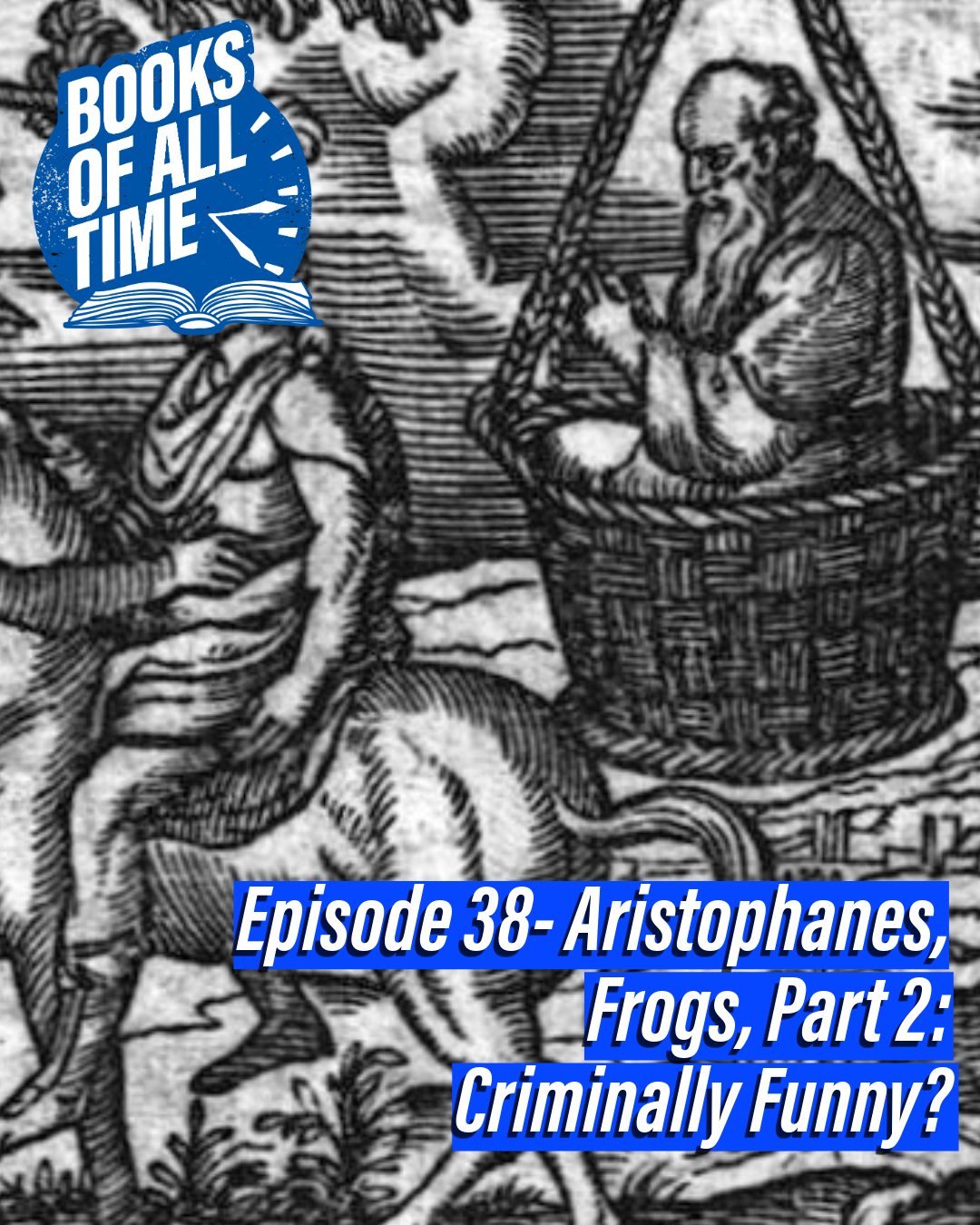
When Socrates arrives – swinging down from the crane, where he has been thinking lofty thoughts in the sky – he immediately begins an elaborate, silly initiation rite for Strepsiades. In this rite, he one in which he declares that there are no Olympian gods like Zeus, just the Clouds, who:
“Keep alive great hordes of clever people:
Purveyors of prophecy, medical experts, long-haired signet-ring-wearers,
Composers of intricate dithyramb lyrics, and cheats,
Layabouts like these they keep alive for treating the Clouds as their Muses.” (Clouds 331-334)
In addition to this inventive blasphemy, Socrates is also a petty thief – he nicks Strepsiades’ cloak for himself – and a fraud. But he meets his match in Strepsiades, who’s utterly unteachable. Toward the end of the play he convinces Pheidippides to enroll in the Thinkery after all, and when the boy comes out, pale, weedy, and full of big ideas, he does not see off his father’s creditors. Instead, he begins beating his father, arguing deftly that he has the right to do so thanks to what he’s learned from Socrates. The play ends with Strepsiades burning the Thinkery down.
This, then, is the play which Plato blames for the decline of Socrates’s reputation – a decline which would eventually lead to Socrates being convicted of blasphemy and corruption of Athenian youth – then put to death! That at least has been the common knowledge on this issue for several millennia. But once again, Stephen Halliwell is here to ask the truly penetrating question that many academics seem afraid to ask: “really, tho?”
First, Halliwell questions the timing. Plato would have been a young child when Clouds was first produced in 423 – Socrates himself would have been roughly 40. Second, Halliwell reminds us that the play was a flop. As a result, it would have been unlikely to have had repeat performances the way more successful plays did. Even if it had, those would have happened at most twice per year, unlike tragedies, which were performed in repertory-style productions far more often.
Finally, comedies were simply not as influential as tragedies – not quoted as often in speeches, for example, and not copied down to be taught in schools or read at home as frequently. So the idea that Clouds would have been fresh in the mind of Athenians when Socrates was, uh, encouraged to die by suicide in 399 BCE – almost 25 years later – is not especially persuasive, let’s say.
But perhaps we’re reading too much into it. It’s kind of understandable, given how many gaps there are in the written evidence we have from Ancient Athens, that we would try to use any source as a doorway into life there. But Stephen Halliwell, again, offers some much-needed perspective here. Quote: “Anyone who looks to Aristophanes for clear or deep insights into Athenian society is likely to be ultimately disappointed.” (Halliwell 2014 liv)
Comedy That Leaves a Mark
That’s it for this episode. I feel like we’ve wound up a bit like the characters at the Thinkery in The Clouds, unable to come down hard on either side of an argument. The evidence about the various controversies around Aristophanes’ comedies can be read to suggest that Aristophanes was both persecuted and given quite a lot of license to ridicule the powerful; that his antagonist Cleon was both a war-monger and a populist hero; and that his portrait of Socrates was both widely known and yet not quite as influential as supposed.
But Stephen Halliwell, yet again, points out that mutually exclusive views of Aristophanes’ legacy are nothing new, especially in the last few centuries. Quote:
“For a long time after the Renaissance, Aristophanes [was] regarded as a shameless, indiscriminate jester or a moral, didactic chastiser of reprobates.” (Halliwell 2017 xlv)
If Aristophanes was trying to do more than land a sick burn – that is, if he was trying, through his comedy, to spur his fellow citizens to hold specific opinions of either Cleon or Socrates, how successful was he? Not very, Halliwell reckons. Cleon, for instance, was repeatedly elected to higher and higher positions of power throughout the period when Aristophanes was writing about him most frequently and viciously. And Socrates would go on teaching for another 30 years or so after the debut of Clouds.
I think it’s possible that the popular idea of Aristophanes as the great leveller – or the great character assassin, in the case of Socrates – comes out of the desire to believe that the right kind of art – dramatic, comedic, whatever – can bring down those who wield power irresponsibly. I think it’s possible that the right kind of art can inspire and sustain the people who are working against those forces, but in and of themselves? Probably not. The tyrants and the subversives are more often brought down by their own overreach and errors – which may or may not include revealing their own weakness and insecurity by attacking people who make fun of them.
Well, this wraps up our summer stage season. But we’re going to spend one more month in Athens, focusing this time on the more serious things: philosophy! Yes, we are going to join the Thinkery and hear from Socrates himself about what makes an ideal society – no gnats or fleas are involved. Join me on Sunday, September 14th (really, I mean it) for Episode 39: Plato, The Republic, Part 1 – The Education of Our Heroes.
Books of All Time is written and produced by me, Rose Judson. The Disclaimer Voice of Doom is Ed Brown. Lluvia Arras designed our cover art and logo. Special thanks to Yelena Shapiro, Cathy Merli, Matt Brough, John Cole and the Books of All Time Advisory Council: Ed Brown, Beck Collins, Neil Dowling, Caitlin McMullin, Hugh Parker, and Jonathan Skipp. You can support the show by subscribing and leaving a rating or review at Apple Podcasts, Spotify, or wherever you get your podcasts. You can also follow us on social media: we’re on Bluesky, Instagram and Facebook. Thanks for listening! I’ll be back in two weeks.
References and Works Cited:
Aristophanes, and Stephen Halliwell. Aristophanes: Frogs and Other Plays: A New Verse Translation, with Introduction and Notes. Oxford University Press, USA, 2014.
Atkinson, J. E. “Curbing the Comedians: Cleon versus Aristophanes and Syracosius’ Decree.” The Classical Quarterly, vol. 42, no. 1, 1992, pp. 56–64, http://www.jstor.org/stable/639144.
Dorey, T. A. “Aristophanes and Cleon.” Greece & Rome, vol. 3, no. 2, 1956, pp. 132–139, http://www.jstor.org/stable/641363.
Duran, Marti. “Aristophanes’ Socrates: A Philosopher of Physis with Atheistic Tendencies.” Educational Evidence, 10 Feb. 2025, educationalevidence.com/en/aristophanes-socrates-a-philosopher-of-physis-with-atheistic-tendencies/.
Edmunds, Lowell. “The Aristophanic Cleon’s ‘Disturbance’ of Athens.” The American Journal of Philology, vol. 108, no. 2, 1987, pp. 233–263, https://doi.org/10.2307/294815.
Hall, Edith. “The Boys from Cydathenaeum: Aristophanes versus Cleon Again.” Edith Hall, 13 Mar. 2018, edithhall.co.uk/wp-content/uploads/2023/03/30-Cleon-proofs-Chap-12-Hall.pdf.
Halliwell, Stephen. “Aristophanes’ Apprenticeship.” The Classical Quarterly, vol. 30, no. 1, 1980, pp. 33–45, http://www.jstor.org/stable/638144.
Halliwell, Stephen. “Greek Laughter and the Problem of the Absurd.” Arion: A Journal of Humanities and the Classics, vol. 13, no. 2, 2005, pp. 121–146, http://www.jstor.org/stable/29737265.
Halliwell, Stephen. “The Uses of Laughter in Greek Culture.” The Classical Quarterly, vol. 41, no. 2, 1991, pp. 279–296, http://www.jstor.org/stable/638898.
Momigliano, Arnaldo, et al. “Socrates and Aristophanes, by Leo Strauss.” Commentary Magazine, 3 Sept. 2015, http://www.commentary.org/articles/arnaldo-momigliano/socrates-and-aristophanes-by-leo-strauss/.


 Books Of All Time
Leave a comment