
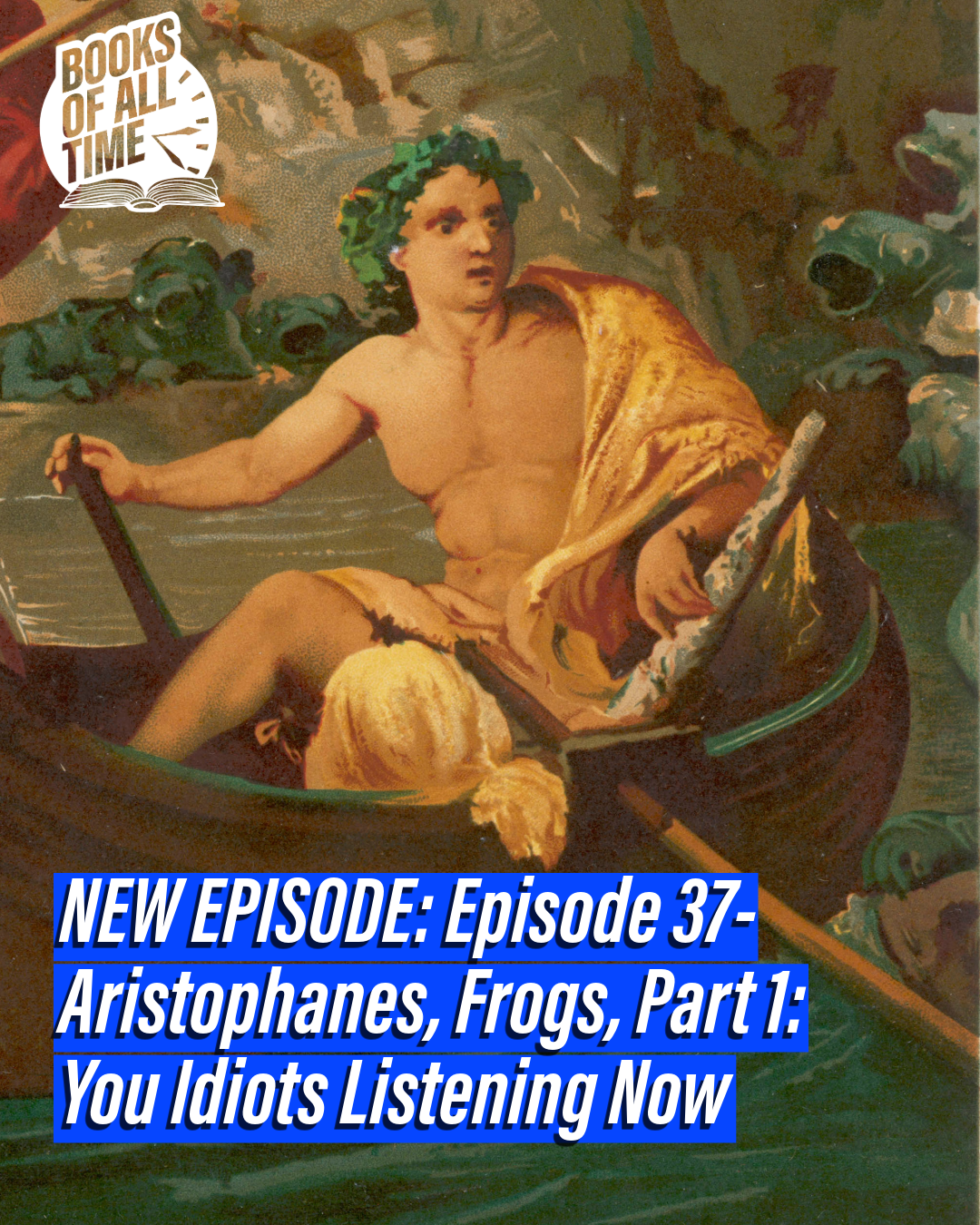
“Please, you idiots listening now, it’s not too late to change your ways
Choose to use the best men once again. If all then turns out well,
Praise will come your way. And if you fail, at least the wise will think
Swinging from a high-grade tree is consolation for the hanged!”
- Aristophanes, Frogs (Trans. Stephen Halliwell, lines 734–737)
The enemy had cut Athens off from its silver mines, but the soldiers and sailors still needed to be paid. So the leaders of Athens went to the newly completed Parthenon on the Acropolis, and they bowed before the gleaming statue of Athena, their patron goddess – a towering work of gold and ivory. They did not go to Athena to pray for deliverance from their dire straits, though that would have been welcome – rumours were flying that the Spartans had sent envoys to Persia, or possibly vice-versa, and any alliance between them would doom Athens.
No, the men went to the statue to pray for her forgiveness. Then they set their sights on the nine golden statues that flanked her. Workmen came, and under the direction of the goldsmiths they began to unpin the decorations on the statues to get at the gold underneath – thin sheets of gold that came away with difficulty from the bronze core.
These statues were broader and taller than a man, so the fact that the gold was barely thicker than a few hairs made little difference – once melted down, it would all make plenty of coins to keep the Athenian military loyal – at least for a little while longer.
The statues, as it happened, all represented the same winged goddess: Nike, bringer of victory. It’s hard not wonder, as they peeled the shining skins off the faces of the goddesses, off their laurel crowns and sandalled feet and flying robes, whether any of the Athenians was able to laugh about it.
I’m Rose Judson. Welcome to Books of All Time.
Books of All Time is a podcast that’s tackling classic literature in chronological order. This is episode 37: Aristophanes, Frogs, Part 1 – You Idiots Listening Now. As always, if you want to read the transcript of this episode or see the references I used to write it, you can visit our website, www.booksofalltime.co.uk. There’s a link in the show notes if you need it. Let’s begin.
We have come to the final episodes of our Big Fat Greek Summer of Theatre. After soaking in tragedy with Sophocles and Euripides (with a detour into Sigmund Freud’s Vienna) we’re finishing off with comedy. Specifically, with Aristophanes. Aristophanes is one of the few writers in what’s known as the “Old Comedy” style whose works survive to the present day. (More on what “Old Comedy” means in a minute.)
Similar to the situation with Euripides, we don’t have a whole lot of biographical detail about Aristophanes, though we definitely know he existed. Here’s an overview of what detail we do have about him: he was born around 446 BCE. He was from a well-to-do family, and he began writing plays in the 420s – possibly when he was as young as 18. He was, according to a comment made in one of his plays, prematurely bald. In later life, he also had three sons who would succeed him as comedians or playwrights. And he died around 383 BCE.
The world into which Aristophanes was born was very different – and very much better off – than the one in which he died. While Aeschylus, Sophocles, and Euripides all experienced the Golden Age of Athens as adults, and died before it ended, Aristophanes was not so lucky. He was born in the peak period of Athenian power, wealth, and influence, but the Peloponnesian War – Athens vs. Sparta, you’ll recall – kicked off when he would have been about 15 years old and ended disastrously for Athens when he was about 42 years old – just six months or so after the premiere of the play we’re discussing today, as a matter of fact.
So the bulk of Aristophanes’ career played out under the shadow of war, political turmoil, and decline. You will probably not be surprised to hear that his work is pretty cynical and satirical – features we’re not unfamiliar with in comedy today.
You may remember way back in our episodes on Aeschylus that the Ancient Greek word for tragedy, tragōidía, seems to mean “song for a goat”. The corresponding word for comedy is far less mysterious – kômôdia means “song for a revel”. Comedy as performed on the stage in ancient Athens looked, in many ways, like tragedy – male performers in masks, a central backdrop with doors in it, a chorus. It was also put on at specific festivals: comedy productions were part of the Dionysia, which was a springtime affair, and also in the Lenaia, which went on at midwinter. But comedy was obviously very different in tone.
Scholars, basically from Aristotle onwards, divide ancient Athenian comedy into two styles: Old and New. The Old Style, of which Aristophanes was considered the master, had an anarchic quality. There are fantastical situations, lots of sexual innuendo and scatological jokes, and very pointed political or cultural commentary. New Comedy, which would reach its peak with Menander (we’ll read him next year), was more like a comedy of manners – people in realistic situations, not so filthy, not so obviously political or satirical.
From what I’ve read, it sounds like Old Comedy is the direct predecessor of things like Monty Python, though Monty Python didn’t often take on contemporary political figures, just political types, like the squabbling members of the Judean People’s Front in Life of Brian. New Comedy sounds like it’s the great-great-great-grandfather of sitcoms. I’ll try to reserve judgement until we actually read Menander, but I feel like I’m more of an Old Comedy person, even though I have a really limited tolerance for jokes about bodily functions.
Aristophanes wrote 40 plays, eleven of which have survived to this day. In choosing which one to share with you for this show, I immediately thought of Lysistrata. It’s probably his most famous play, and it’s the one about the women of Athens deciding to go on a sex strike to end a war. I’d read it as an undergrad, where it was presented as a sort of proto-feminist romp, but when I re-read it this spring, I just didn’t vibe with it. Aristophanes is definitely making fun of those silly girls throughout it. And at my advanced age, I have a limited tolerance for that kind of stuff, too.
Then I read Frogs, and I immediately knew it was the better choice. There are a few reasons for this. First, it was produced just months after Athens had squeaked out a win in a major naval battle by promising citizenship to any slaves who fought in it. And it was produced just months before Athens would lose another, more decisive naval battle – and the 27-year-long Peloponnesian War – leading to siege, starvation, and a series of Spartan-controlled puppet governments forced on Athens. In spite of the fact that it’s a comedy – and in spite of the fact that Aristophanes had no way of anticipating what was coming – Frogs has a definite end-of-the-world-as-we-know-it vibe to it.
Next, its main event is a battle between two tragic poets to see who the best writer is, which offers us a chance to poke some fun at all the heavy drama we’ve been wading through the past few months. And finally, it features one of Aristophanes’ major obsessions: a subject who appears as a character in five of his forty plays, and whose works were parodied in at least three others: Euripides.
Aristophanes was consumed with a desire to make fun of Euripides. The tragedian was his favourite punching bag, even after Euripides died in early 406, a year before Frogs was produced at the Lenaia. In fact, the classicist Stephen Halliwell, who translated the edition of Frogs that I read for this episode, writes that “It seems hard to resist the inference that it was specifically the death of Euripides . . . which triggered in Aristophanes the fundamental impulse of inspiration for Frogs.” (Halliwell 155) That inspiration is the setup: a poetic battle royale between Aeschylus and Euripides.
Unluckily for Aristophanes, in late 406, Sophocles, the other titan of Greek tragedy, also died. At that point Frogs was already in rehearsals, so there wasn’t enough time to re-write the entire play to include Sophocles as a character, too. Instead, Aristophanes wedged in some awkward references to him – as we’ll see.
Right, I think that’s enough background. Let’s go to hell together, shall we?
[music]
Frogs begins with a god, a slave, and a donkey. The god is Dionysus – patron of the Lenaia festival as well as the Dionysia. In case you’ve forgotten, Dionysus is the god of wine, ecstasy, and theatre, among other things. He is leading the donkey, on which rides his slave, Xanthias.
Xanthias is carrying some baggage on a long pole. He begins complaining about his burden, which leads to some banter between him and Dionysus – it’s a bit rich to complain about carrying a heavy bag when the donkey is carrying you, Dionysus points out. Xanthias, in the first of many meta-comments, explains that the audience will expect baggage-slave jokes, and he is just giving the people what they want. Dionysus groans that those kinds of gags bore him.
Xanthias makes a reference to topical events – he says that if he’d only fought in that sea-fight (meaning the battle of Arginousai, the narrow victory in which slaves who were promised their freedom tipped the balance for Athens) he’d be able to give Dionysus a piece of his mind.
“Quiet,” says Dionysus. “We’re here.” The god bangs on the door of the building at the centre of the stage, shouting for admission. Out comes Hercules, furious at the disturbance – until he gets a good look at Dionysus, who is carrying a club and wearing a lion skin over his yellow robes. Hercules cosplay, in other words. The genuine Hercules falls about laughing at his half-brother’s getup.
Dionysus says he needs a Favor. He says he was reading the play Andromeda while sailing in a boat owned by an actual Athenian called Kleisthenes – evidently a notoriously horny gay man, when he was seized with a sudden overwhelming desire for something.
“For Kleisthenes?” asks Hercules.
“No, no,” says Dionysus. He tries to put it in terms this big meathead will understand:
“It’s rather hard to describe.
I’ll have to explain in a somewhat roundabout way.
Have you ever been struck by a sudden desire for—soup?” (Halliwell 174–175)
“Bro, all the time,” says Hercules, who’s what you’d call food motivated. “Well,” says Dionysus, “I have been seized with a similar desire for Euripides! And he’s dead, the last great poet, and I want to go down into Hades, like you did during your 12 labours, to get him back.” (Aside: Hercules was set 12 impossible tasks by the king of Mycenae, the 12th and most dangerous of which was to go into the underworld and bring back Cerberus, the three-headed dog that guards the gates.)
Hercules asks about other poets still living – Iophon (a son of Sophocles), Agathon, Xeonkles, Pythangelos – all writers who are lost to us now, and Dionysus has reasons to dismiss each one in turn. Hercules then asks about Sophocles: why not bring him back? Dionysus just wants Euripides, thank you very much. Of the others he says:
“They’re shrivelled grapes, producers of empty prattle,
And haunts of twittering swallows. They damage the art,
And as soon as they’ve staged a single play they vanish,
Content to have pissed on tragedy just the once!” (Halliwell 176)
He then enthusiastically quotes some Euripides at Hercules, who isn’t impressed at all. “Anyway,” says Dionysus, “that’s why I’m dressed like you, because I want to re-create your journey into Hades. But I need you to tell me where you ate, which inns don’t have bedbugs, and which is the fastest road.”
“Well,” says Hercules, “The fastest way to the underworld is to hang yourself. Or you could drink hemlock. Or you could jump off a tower.”
“I mean your route,” Dionysus replies.
Hercules explains it to him: there’s a lake you’ll have to cross with the help of Charon the ferryman. Then you’ll need to pass by a river of sewage where people who have done wrong in life are submerged up to their necks – perjurers, people who lay violent hands on their parents, people who have sex with boy prostitutes and then rob them – also be careful, because fearsome monsters patrol the banks of that river. Once beyond that, though you should encounter a group of happy, blessed people singing and dancing. These are initiates of the Eleusinian Mysteries, and they will help you find the road to Hades’s palace, where Euripides is most likely living.
Dionysus is pleased. Hercules goes inside. After some more banter with his slave Xanthias about the baggage, Dionysus proposes they start off again. There’s a change of scene as Charon, ferryman of the dead, hoves into view on his boat. (Halliwell’s stage directions indicate that during the original production, the boat would have been on wheels, pulled by a rope.)
Charon calls out various locations in the underworld like a modern bus conductor. “Anyone for the Plain of Forgetting or Hopeless Task, or Kerberos Town, Crows End, or Tainaron Point?” (Halliwell 180)
Dionysus runs over and boards. Charon won’t let Xanthias on, though, as he’s a slave. He’ll need to walk around the lake. However, Dionysus doesn’t get off all that easily, either: he has to help Charon row the boat, and it turns out he’s not very good at it. No sense of rhythm. Fortunately, the Chorus appears in the form of some friendly frogs. They sing:
“Brékekekex ko-ax ko-ax!
Brékekekex ko-ax ko-ax!
You children of marshes and springs,
With the pipe-tuned cries of our hymns
Let’s proclaim our fine-voiced song.
Ko-ax ko-ax!”
The frogs drive Dionysus nuts; he is trying to get into the groove of his rowing, but they keep hopping about in the water after him, singing. He gets into some back-and-forth with them, complaining about their racket, the blisters sprouting on his hands, his sore butt, but the frogs just cheerfully and incessantly brékekekex at him.
Finally he and Charon come ashore, to find Xanthias waiting. “Did you see any of the perjurers or parent-beaters that Hercules mentioned?” asks Dionysus. “I did,” says Xanthias, “and I still do!” And they look out into the audience as Dionysus cries “There they are!”
I’m sure that killed at the Lenaia. Anyway, Dionysus boasts about how unafraid he is, and how he expects Hercules was bluffing about the monsters, which is a pity, because he – Dionysus – would like to show the world he’s a fighter, too.
Xanthias tells his master he’s in luck – the Empousa, a fierce shapeshifting monster, is prowling around nearby. Dionysus does not rise to the occasion, hiding behind his slave, then running into the audience and begging the priest in the front row to protect him. When Xanthias claims the monster is gone, Dionysus cries, “What a wretched business; the sight of her made me pale.” (Halliwell 185)
Xanthias points to his master’s bottom. “But this part here has turned a dark brown colour!”
Believe it or not, this is not the last time Dionysus will crap himself in fright in this play.
[music]
But now something really does approach: torches, soft music, lilting voices! The initiates of Eleusis are come! Dionysus and Xanthias hide at the side of the stage to watch their procession.
The initiates come on and sing a song to Iakchos, the minor god (possibly a form of Dionysus) who is worshipped in the Eleusinian Mysteries – the Eleusinian Mysteries, by the way, refers to an initiation ceremony held at a sanctuary in a place called Eleusis. The initiation was for the cult of Persephone, queen of the underworld, and her mother Demeter, goddess of harvest and fertility. At first, this song seems like a perfectly normal hymn. Quote:
“Come join our dance in this meadow,
Come among the pious followers of your cult
Toss wildly a head that’s crowned
With a wreath luxuriant in fruit
Of myrtle berries, and stamp your foot
In rhythms bold…” (Halliwell 186)
But as is goes on it gets weirder and weirder, with a verse about dancing beside a girl in a ripped dress whose “tit bobbed out” (Halliwell 189). It’s this verse which brings Dionysus out of hiding, and after some vulgar questions about contemporary Athenian citizens from the leader of the chorus – including one about whether the son of Kleisthenes still goes into the graveyard to pluck hairs from his anus as he mourns for someone – Dionysos asks for directions to Hades’s palace.
“Oh, it’s right there,” says the leader.
Dionysus thanks him. The initiates leave, singing about joining young girls in all-night worship while, ahem, brandishing their flaming torches.
Dionysus approaches the door anxiously. He tries to talk himself into knocking on it. “Remember Hercules!” Xanthias says. “Try and do it like he would.”
Dionysus obeys, banging on the door and announcing himself as Hercules. A powerful, furious slave leaps out, yelling that he’ll happily throttle the man who stole Cerberus, god or no god. Dionysus falls down on the ground as the doorkeeper rants about the various monsters he’s going to bring out to eat or stomp on or liquefy Dionysus’ various organs. He goes back into the palace. Dionysus lies there and calls out to Xanthias: “I’ve [crapped] myself! Call a god!” (Halliwell 192)
Xanthias brings a sponge instead, which Dionysus applies to himself. Dionysus bristles when Xanthias calls him a coward, and dares him to try knocking on the door in the Hercules costume himself to see how he likes it. Xanthias takes him up on this: he puts on the lion skin, takes up the club, and bangs on the door.
A different slave appears and embraces Xanthias-as-Hercules. Quote:
“You’ve returned, o dearest Hercules! Come on inside.
As soon as the goddess learnt you’d arrived down here,
She arranged for loaves to be baked and had several pots
Of pea soup boiled for you, got a whole ox roasted,
And had various cakes and breads prepared. Come on in!” (Halliwell 193)
Xanthias tries to get out of this until the second slave adds that there are dancing girls waiting as well, with freshly trimmed, uh, lady gardens, just waiting to meet him. Xanthias turns to Dionysus and orders him to bring the bags inside.
Dionysus instead orders Xanthias to get out of the Hercules costume and give it back to him – this dancing-girl action is much more to his taste. Naturally, as soon as they swap again, two women enter who declare they are innkeepers, and they begin yelling at Dionysus-as-Hercules about a truly epic dine-and-dash he pulled on them when he came down to fetch Cerberus: bread and fish and meat and cheeses – even the baskets the cheeses were stored within.
They go off to get some men to beat Dionysus with. Dionysus again presses Xanthias to swap the costume over, even offering to let Xanthias hit him if he wants to. He declares, quote:
“If I ever attempt to take back these things again,
I wish utter destruction for me and my wife and my kids.” (Halliwell 196)
Xanthias puts the costume back on. The original doorkeeper enters with some very large, rough-looking friends. They accost Xanthias-as-Hercules, and he says he’s perfectly happy to let them torture his slave instead of him. The men accept, and Dionysus finally tries to pull the “but I’m a god” card.
They don’t believe him – clearly this fellow dressed as Hercules is the god. Xanthias, knowing his master is a weakling, proposes that the men take turns hitting them both, and the one who doesn’t cry out is the god. There ensues a series of blows, which both Xanthias and Dionysus take well at first. As the beating becomes more severe, they are able to disguise their cries of pain as the beginning of songs, as cheering, or, in Xanthias’s case, as excitement about the upcoming festival of Hercules. Dionysus, when asked why he’s in tears, even comes out with “I think someone’s cutting onions nearby” as an excuse.
“Well,” says this doorkeeper, “I can’t work out which one of you is the god. So you’d both better come inside and see Hades; he’ll figure out whether you should be here or not.”
Into the palace our gentlemen go, as the chorus returns to the stage. Now begins the parabasis, a sort of intermission within a Greek comedy. All the actors leave the stage, and the Chorus comes on to sing or talk to the audience about some topic that’s completely detached from whatever’s happening in the play.
In the case of Frogs, the parabasis is a roast of an Athenian politician named Cleophon, and a general rant against the foreigners and no-goodniks currently running the city and the war effort. Cleophon (who would die later that same year), was an orator and proud democrat who had, on two occasions up to that point, convinced the Athenian citizenship to turn down offers of peace from the Spartans – including after the sea-battle at Arginousai mentioned earlier in the play.
Aristophanes mocks Cleophon’s accent and his red hair. He has the chorus lament that the old families, who have given sweat and blood for centuries, are not revered as much as the “new gold” – this is likely a reference to the melting-down of the statues of Athena I described at the top of the show – that is, the newly-minted citizens. These arrivistes don’t have manners; they can barely read; they haven’t been to the good schools – while their bravery is no doubt laudable, they shouldn’t be allowed to overshadow the true Athenians just because there’s a war on. True Athenians like Aristophanes, one suspects.
The parabasis also gets in a nice allusion to Hesiod, referring to these immigrants and newcomers as men of “bronze”. The parabasis ends with the quote from the top of the show, begging “you idiots listening now” to go back to choosing leaders from the very best men, instead of these newcomers who wouldn’t have even been admitted into the city walls in times past.
And with that said – and with your host, dear listener, weighed down with an oppressive sense of how far we have not come as human beings in the last two and a half thousand years – the main action of the play resumes.
[music]
Finally, we’re in the palace. Xanthias, back in his normal clothes, comes onto the stage accompanied by another slave. They are talking smack about their betters. When the new slave declares that Dionysus must be a decent master, given that he didn’t beat Xanthias for pretending to be Hercules, Xanthias says, quote:
“But how could he fail to be decent? He’s the type who knows nothing except for drinking and [womanizing].” (Halliwell 203)
Okay, that’s not an exact quote. He didn’t say “womanizing” in the text. But I try to keep this show rated PG-13, so I can’t use the word he did say. Anyway.
Xanthias and the slave commiserate about how delightful it is to slag off their masters, to play little pranks on them, to eavesdrop on their private conversations and then spread them around town.
Then there’s some shouting offstage. “What’s that?” asks Xanthias.
“Oh, it’s Aeschylus and Euripides,” says the slave. “They’re fighting.” When Xanthias asks why, the slave explains, that it’s the custom in the underworld to give the best practitioner of any sophisticated art the right to eat at Hades’s table and a special throne on which to sit. Aeschylus was the undisputed holder of the poetry throne until recently, when Euripides arrived. Quote:
“When Euripides came down to Hades, he started
To harangue the criminals here — the muggers and thieves,
The ones who’d beaten their fathers, the burglars as well.
There’s a crowd of them all in Hades. And when they heard
His debating speeches, his verbal twists and turns,
They went quite crazy about him and called him the best.
He was so puffed up that he laid his claim to the throne
Where Aeschylus sat.” (Halliwell 204–205)
Naturally, there is to be a competition to settle the issue – one that will involve literal scales and rulers and measuring instruments. Hades has decided that since Dionysus is visiting – and is the god of theatre – he should be the one to choose the winner.
Xanthias and his colleague rush inside to watch the action.
The Chorus come out and sing about the two competitors in a very Homeric style, comparing Aeschylus’s poetry to “horse-crested words” and calling Euripides the “mouth-manipulating assessor of verses.” (Halliwell 206-207)
On come Hades and Aeschylus, remote and silent. Following them are Dionysus and Euripides. Euripides is talking a mile a minute about how he won’t let go of the throne for someone who writes so much “pretentious bluster.” Quote:
“I know what he’s like; I saw through him long ago.
He’s a poet who makes his characters wild and wilful,
His style’s uncurbed, unruly, without any limits,
Devoid of slickness, verbosely vaunting its garbage.” (Halliwell 207)
This leads to an outburst from Aeschylus, who accuses Euripides of polluting the stage with stories about incest – surely Sophocles did that, too? Then he gets a pretty sick burn in by declaring that the contest isn’t on equal terms because, quote:
“In my case what I composed hasn’t died with me,
But his has died with him, so he’ll have it to hand.” (Halliwell 208)
Way harsh, Aeschylus.
The contest begins with some formalities: the Chorus sings a song to the muses, and each of the contestants says a prayer to the gods for help. Aeschylus’ is brief and appropriately pious; the prayer of Euripides, who claims to have invented his own gods, is . . . not. Quote:
“O Aither, where I pasture, and Pivoting Tongue,
Astuteness, Nostrils keen to follow the scent,
Help me refute my opponent in all that he says.” (Halliwell 209)
I’m all for people doing their own thing when it comes to religion, but I’m not sure even I can get on board with a nostril god. Moving on.
After the prayers are said, there are opening arguments: each contestant gets to say why he thinks the other guy is terrible. Euripides goes first, and honestly, as stirring as I found Aeschylus at points, he has a point.
He talks about the choruses in Aeschylus being dragged out to, quote, “dump great chains of songs” (Halliwell 210) while the characters stand brooding silently on the stage. He accuses Aeschylus of using opaque language: “his words were enormous crags/ that were hard to interpret at all.” (211)
Dionysus agrees with this, declaring, quote:
“I once lay awake the whole night long unable to sleep while I puzzled
Over what kind of bird he might have meant by his phrase the ‘tawny horse-cock.” (Halliwell 211)
Having torn up Aeschylus, Euripides then goes on to praise himself, starting with an extended metaphor about how bloated and sluggish he found Tragedy when he inherited it from Aeschylus, and how he got it slimmed down again with long walks and a diet, with more direct speeches – but ones full of examples of sound reasoning, too. He declares that his depiction of more domestic situations helped Athenians learn to reason, quote:
“By making reasoning part of my art
And enquiry too . . . they now ponder
And thoroughly grasp all manner of things,
Especially how to improve the way
They organize their domestic affairs
And constantly ask ‘Well how’s this going?”
‘Where’s such and such?’ and ‘Who took that?’” (Halliwell 213)
This is a bit much even for a superfan like Dionysus, who mocks Euripides by sarcastically agreeing that yes of course, nobody ever asked questions before you, Euripides, and today they come in and demand to know who’s eaten the fish they were saving or where their favourite pot is. Your genius has saved them.
It’s Aeschylus’s turn. He can barely begin, he’s so choked with rage. He accuses Euripides of taking the people that he, Aeschylus, had fitted for war and turning them into an argumentative rabble, good for nothing but arguing among themselves. He declares that poets have an obligation to instruct people to strive toward greater things, like Homer and Hesiod (not sure about Hesiod there, pal).
He swears that he has tried to emulate these poets with his own work, highlighting noble values and, though his women murdered people, they never acted like those found in Euripides’s plays. Quote:
“He’s shown us women as go-betweens
And women in childbirth in sacred places
And women who sleep with their very own brothers
And women who say that life is death.
The consequence of all these things
Is our city’s now teeming with minor officials
And buffoons who serve as public monkeys.” (Halliwell 218)
I don’t really follow the chain of reasoning from “lady sleeping with her brother in a play” to “public monkeys,” but I don’t think I’m meant to, either. It is interesting to see that Euripides is basically accused of misogyny here – showing women as anything other than chaste, unless they’re mad, like Cassandra, or foreign, like Medea, is read as a form of hatred.
The Chorus return and announce the next phase of the competition: the two men will dissect each other’s writing.
Euripides is allowed to criticize first. He picks apart the prologue of The Libation Bearers from the Oresteia – the speech Orestes gives when he first appears in the story, telling the audience who he is and why he’s come back to Mycenae. Euripides picks it apart mercilessly – why would you imply that Hermes watched over the murder of Agamemnon without intervening? Isn’t it redundant to have Orestes say, “I come back to this land, returning from exile I come?”
Dionysus likes this: “It’s as if, by Zeus, someone should say to his neighbour ‘Please lend me a kneading-trough — or a trough for kneading.”
Euripides contrasts this with his own work, which he swears would never have such repetitive padding. He begins to recite from the prologue to his Oedipus – a play of his that I think is lost – and is immediately stopped by Aeschylus who says he can’t stand this word-by word dissection. He challenges Euripides to carry on and he, Aeschylus, will ruin all his verses with a miniature oil-jar.
“What?” both Euripides and Dionysus ask. Aeschylus tells him it’s to do with the predictable meter Euripides uses, and urges him to go on and recite something. Euripides begins:
“Aigyptos, so prevailing tradition relates,
With fifty sons traversed the sea by oar,
Put into Argos and –“ (Halliwell 222)
“Lost his miniature oil-jar,” says Aeschylus. Euripides tries again – and again, and again – each time reciting the start of a different prologue, only to be cut off at the appropriate place as Aeschylus finishes the line with the tag about the oil jar. It’s a bit like how you can tag “in bed” onto the end of any fortune-cookie fortune and it works.
Dionysus is annoyed with Aeschylus at the start of this section, but by the end he’s impressed and amused. Throughout this entire section, it’s hard to understand what Dionysus is looking for when he’s judging these guys. He doesn’t really have a reason for why he likes what he likes, any more than you or I might have a reason for liking a particular flavour of ice cream.
Regardless, he now tells the poets it’s time to pick apart each other’s songs. Again, Euripides gets to go first. He very cleverly condenses several of Aeschylus’s songs together, showing how over-wrought and needlessly wordy they are:
“Sacred silence! Beekeepers approach to unlock Artemis’s temple.
Alas, alas, toil of battle, comest thou not to our aid?
I speak with authority of the destined power of men as they start their journey.
Alas, alas, toil of battle, comest thou not to our aid?” (Halliwell 225)
Aeschylus’s blood is up, though, and he’s not about to be cowed by this. He calls out a cheap dancing girl with castanets and tells her to perform while he sings his own parody of Euripides. Part of it sounds a lot like a first draft by Jim Morrison of the Doors, or a lost Spinal Tap song:
“O night’s black-gleaming darkness,
What is this anguished dream
You send me, emerging from invisible Hades
With a soul that is no soul,
Black Night’s shuddering child,
Apparition horrendous,
Draped corpse-like in black,
Blood-filled, blood-filled look in its eyes,
Possessing huge talons.” (Halliwell 227)
The final challenge looms: the two poets will compose lines, and they will be weighed in a scale. The poet with the heaviest lines prevails here. They each take three turns, and it’s a very literal contest: Aeschylus wins all three rounds, because his lines are about things like entire rivers, death, and chariots and corpses, while Euripides talks about persuasion, winged ships, and, in a last act of desperation, an iron club.
In spite of Aeschylus’s performance in this last task, Dionysus can’t decide who the winner is. It’s at this point that he reveals he isn’t just judging them to see who gets the fancy chair. Quote:
“I came down here to find a poet. And why?
To save the city and safeguard its festival plays.
So whichever of you is able to give the city
The best advice, it’s him I’ve resolved to take back.” (Halliwell 230)
So he asks them a few practical questions about how they’d manage the war effort. Euripides suggests rigging up Icarus-style wings for some of the Athenians, who could then fly close to the boats and spray vinegar in their enemies’ eyes. This seems to finally turn Dionysus against Euripides, especially when Aeschylus gives practical advice that aligns with what the Chorus said during the parabasis – use the best men, and give up efforts to expand the empire. Protect the true heartland instead.
Still, when it’s time to announce the winner, Euripides pleads with Dionysus to remember that he swore he’d take Euripides back to the living world. But Dionysus doesn’t. Again, without giving a reason, he chooses Aeschylus to go back with him. Euripides is indignant. Dionysus doesn’t care, especially since Hades has invited him and Aeschylus to a farewell feast.
As they turn to go into the palace, Aeschylus asks Hades to let Sophocles have the poet’s throne while he’s gone, and then the chorus sings them off, confident that Aeschylus will help restore Athens’s fighting spirit.
[music]
That’s Aristophanes’ Frogs, a witty, if somewhat reactionary, little play about how important and ridiculous great art can be, especially during an existential crisis. It also gives us really interesting insight into what some common criticisms of the tragic poets were among the audiences who would have seen their works in the original productions – or, in the case of Aeschylus, who was about two generations removed from Aristophanes, would have been told about them at second hand.
Stephen Halliwell, in his introduction to Frogs, is careful to point out that we shouldn’t take the criticisms expressed in the play as hard confirmation of Aristophanes’ own opinions about what makes a work good or bad. Instead, we should probably see it as a play about how hard it is to describe what makes a work good or bad. There really is no rhyme or reason to what Dionysus decides, apart from maybe a sense of nostalgia and a keen self-interest: all those theatre productions were for him, after all, even the ones that were making fun of him. He didn’t want the city that made those shows possible to be destroyed.
Should you read this? It depends. I liked it, even if it’s hard to find jokes funny when you have to constantly flip to the footnotes to understand what they mean – it’s a bit like reading Shakespeare in this regard. If you already know that isn’t for you, maybe give this a miss. But do consider that, after all the blood-soaked horror and inescapable cruel fates we’ve experienced together during this season of Greek drama, reading Aristophanes was a bit like sinking into a nice warm bath. Even if I still don’t understand why the play’s named for the frogs who only appear in one scene.
For our next episode, we’re going to look at how Aristophanes got himself – and a few of his satirical targets, including Sophocles, the great philosopher – into hot water through his plays. Join me on Sunday, August 17th for Episode 38: Aristophanes, Frogs, Part 2: Criminally Funny.
Books of All Time is written and produced by me, Rose Judson. The Disclaimer Voice of Doom is Ed Brown. Lluvia Arras designed our cover art and logo. Special thanks to Yelena Shapiro, Cathy Merli, Matt Brough, John Cole and the Books of All Time Advisory Council: Ed Brown, Beck Collins, Neil Dowling, Caitlin McMullin, Hugh Parker, and Jonathan Skipp. You can support the show by subscribing and leaving a rating or review at Apple Podcasts, Spotify, or wherever you get your podcasts. You can also follow us on social media: we’re on Bluesky, Instagram and Facebook. Thanks for listening! I’ll be back in two weeks.
References and Works Cited:
Agócs, Peter. “Aristophanes’ Frogs – Study Guide.” Faculty of Arts and Humanities, University College London, 2009, www.ucl.ac.uk/arts-humanities/classics/events/classical-play/past-productions/aristophanes-frogs-2009/aristophanes-frogs-study-guide.
Aristophanes, and Stephen Halliwell. Aristophanes: Frogs and Other Plays: A New Verse Translation, with Introduction and Notes. Oxford University Press, USA, 2017.
Schmitz, Thomas A. “Aristophanes’ Frogs and Reading Culture in Athens: The Journal of Hellenic Studies.” Cambridge Core, Cambridge University Press, 27 Sept. 2023, www.cambridge.org/core/journals/journal-of-hellenic-studies/article/aristophanes-frogs-and-reading-culture-in-athens/403C0739164E66D33074B82654199EAA.
Thompson, Dorothy Burr. The Golden Nikai Reconsidered, (Originally in Hesperia XIII, Jul.-Sep. 1944, pp. 173-209) www.ascsa.edu.gr/uploads/media/hesperia/147012.pdf.


 Books Of All Time
Leave a comment