
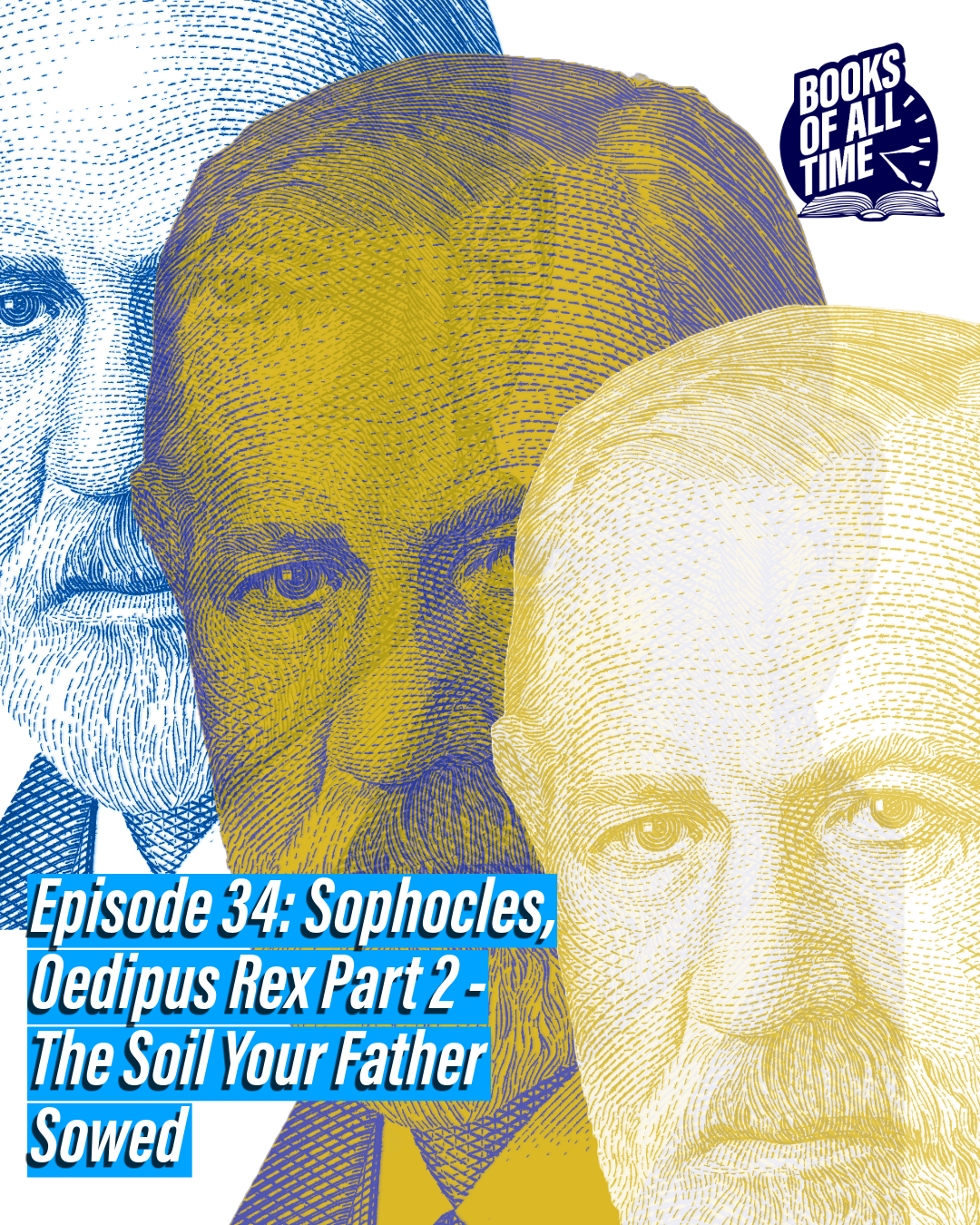
“Why dread marrying your mother?
Many before, in dreams as well, have lain
with their mothers. It’s the man to whom
all this means nothing who gets along most easily.”
Sophocles, Oedipus Rex (Lefkowitz and Romm 274)
Shall we go to the theatre tonight? By “tonight,” of course, I mean a winter night in early 1886, and by “theatre”, I mean the Comédie-Française: an enormous neoclassical pile on the Rue de Richelieu in Paris, all imposing columns and orderly arches. It houses a troupe that, on this evening in the 19th century, is already two hundred years old. The first company of the Comédie-Française, headed by the playwright and comic actor Molière, was founded in 1680 by order of King Louis XIV.
This being Paris’s finest theatre, it is a mostly well-to-do crowd we’ll follow as we sweep in through the Salle Richelieu – gentlemen in evening dress, ladies in gleaming gowns, and here and there a try-hard in a suit or a gown that is obviously not of the highest quality. Rich or aspiring, the patrons are all quietly buzzing as they pass into the lobby and filter toward their seats in the towering theatre with its gilded rococo mouldings and red velvet seats. The gaslight flickers on the tall golden curtains and in the gems dangling from the necks and ears and wrists of the ladies.
This fine audience is not here to see a melodrama. They are not expecting a farce or even one of the so-called “well-made plays” of Messieurs Scribe or Sardou. No, they are here to see something that is both highbrow and scandalous, new and old. They are here to see Monsieur Sully act the lead rôle in Oedipus Rex. It is one of the first permitted stagings of Sophocles’ original play – rather than an adaptation, tailored for Christian moral expectations – in centuries.
Among the middling class of spectators is a young man, just a few months shy of his 30th birthday. He is visiting from Vienna for business – he has been a doctor for nearly three years now – and he has decided to take an evening off from the Salpêtrière clinic, where he is on a neuropathology fellowship, studying under the great doctor Jean-Martin Charcot.
At this point in his career, our young doctor works primarily in neurological research, performing dissections of the brains of various animals and examining them under microscopes. He has recently, however, made a splash with a well-received scientific monograph, Über Coca, which extols the many pharmaceutical benefits of cocaine, a drug he himself uses frequently. (Rosseau 2011)
As well-received as that paper is in the 1880s, however, it will not be his legacy. Not after tonight. Sitting in one of the upper circles of the grand old theatre, young Sigmund Freud will watch a drama unfold that seizes his imagination, planting the seeds of a theory about human desire and motivation that will change the world for a century to come.
I’m Rose Judson. Welcome to Books of All Time.
Books of All Time is a podcast that’s tackling classic literature in chronological order. This is episode 34: Sophocles, Oedipus Rex, Part 2 – The Ground Your Father Sowed. As always, if you want to read the transcript of this episode or see the references I used to write it, you can visit our website, www.booksofalltime.co.uk. There’s a link in the show notes if you need it. Let’s begin.
This is the second of our episodes on the ancient Greek dramatist Sophocles and his most famous play, Oedipus Rex, or Oedipus the King, composed sometime around the 420s or 430s BCE. This week, we’re going to look at one of this famous play’s most famous legacies: the Oedipus complex, a theory about human development devised in the late 19th century by Sigmund Freud, the founder of psychoanalysis.
Psychoanalysis is a form of therapy that Freud defined in his 1913 book Totem and Taboo as being “concerned with the study of the unconscious part of the individual’s psychic life.” (Freud 1913, 17), and the Oedipus complex is one of its defining theories, which claims that all small children go through a phase in which they form a romantic or sexual attachment to their opposite-sex parent while also becoming hostile toward their same-sex parent. The way this phase is or is not resolved results in either a healthy mental state or psychological disturbances later in life.
Now, although you heard our pal Ed Brown read the disclaimer at the top of this episode, I want to just take a moment to flag up again that this episode is going to talk a lot about Freud’s theories in more explicit detail than that short summary I just gave. If you have younger listeners around, or if topics like this don’t appeal to you, please take a moment to decide whether you want to continue listening to this episode now or save it for later.
Still here? Good. Freud read widely, and drew on many works of literature to back up his theories about human psychology – he was an avid reader of Shakespeare, for instance – but he was deeply, deeply affected by Oedipus Rex. In a 1979 paper, “Oedipal Textuality: Reading Freud’s Reading of ‘Oedipus Rex’”, scholar Cynthia Chase notes that “Of all the fictions that Freud calls upon to render an account of the psyche, the drama of Oedipus is his most recurrent and insistent reference.” (Chase 54) Sophocles’ play seems to have inspired not just this theory of Freud’s, but the entire practice of psychoanalysis. In his 1899 book On the Interpretation of Dreams, Freud says:
“The action of the play consists simply in the disclosure, approached step by step and artistically delayed (and comparable to the work of a psychoanalysis) that Oedipus himself is the murderer of Laius, and that he is the son of the murdered man and Jocasta [his wife].” (Freud 1899, 156)
So that mystery-solving structure Sophocles uses to bring Oedipus around to the horrible truth, basically, is capable of being applied to psychological problems of patients. And the crimes that Oedipus is revealed to have committed, according to Freud, move us not because of the terrible workings of fate, but because, quote:
“The oracle laid upon us before our birth the very curse which rested upon him. It may be that we were all destined to direct our first sexual impulses toward our mothers, and our first impulses of hatred and violence toward our fathers; our dreams convince us that we were.” (Freud 1899, 157)
In other words, Freud believes that Sophocles’ play doesn’t just speak to some generalised fear about suddenly finding we must pay a terrible price for the lives we live, or that our lives are founded on lies. Instead, it speaks to a specific fear about a desire we all harbour. Or maybe all boys harbour. Or possibly girls, too, but it’s a bit complicated.
Freud was an incredibly prolific author: over the course of his lifetime, he produced 22 books, dozens of papers (not just the one about cocaine), case studies, articles, and more. And in a great many of these works he discusses, enlarges on, and tries to justify the idea of the Oedipus complex.
Gradually, the Oedipus complex stops being an within Freudian psychoanalysis; it becomes the idea. By 1920, according to one chapter in The Cambridge Companion to Freud, he was actually claiming that you couldn’t call yourself a psychoanalyst unless you accepted the reality of the Oedipus complex. (Simon and Blass 167) He would even go on to say that the Oedipus complex didn’t just explain aspects of individual development – it actually explained the shape of human society and culture.
I think as we progress through philosophy and religion on this show, we’re frequently going to find that writers want to find their “one weird trick” that explains the human condition. Freud’s one weird trick – the apparently universal desire to shag your mom and kill your dad – may just be one of the weirdest tricks all.
Even weirder than the idea itself is the fact that so many people took the Oedipus complex so seriously for so long. Freud seems to have been to the development of psychiatry what, say, Hall and Oates were to the development of pop music: once omnipresent and taken terribly seriously; now seen as archaic, embarrassing, and possibly even dangerous. (Well, maybe not dangerous in the case of Hall and Oates, but still – those guys had six number 1 records on the Billboard Hot 100 in the 70s and 80s. Bruce Springsteen? Zero. Make it make sense.)
Oh, Rose, you’re probably saying to yourself, as you do your vacuuming or walk your dog. Rose Judson, clearly you are psychologically projecting your own feelings about Sigmund Freud (and Hall and Oates) onto the rest of us. Freud was brilliant; a great many people still take him seriously, and accept his theories as fact. I agree with you that he was and that they do!
For example, he actually developed the idea of psychological projection that I’ve just imagined you’ve charged me with. He also coined the terms “libido” and “defense mechanism”, and “anal-retentive”; he mainstreamed ideas about emotional repression and, oh yes, originated the theory of consciousness being divided into the id, the ego, and the superego. Basically, if you think of any psychological concept you have ever thrown around when arguing with your ex and trying to sound high-minded about it, Sigmund Freud had a hand in defining it, or at least in making it popular.
Freud is woven into how many of us think about thinking, and about how our unconscious mind works. That’s why it’s been so wild for me, having never read any of his actual work before, to realize that almost nothing he theorized about has any basis in scientific experimentation or even any kind of systematic observation. He’s very often just speculatin’ about a hypothesis. He tells you about his dreams and what he thinks they mean, or forces his therapy patients’ stories into the structures of ancient myths and claims to have discovered something. He analyses dead artists or indigenous societies and decides that the way they lived or live validate his best ideas.
What I’m trying to say here, having read three of his books for this episode – not a lot of his output, sure, but a fair chunk – is that I think I kind of hate Sigmund Freud. He is history’s most influential cokehead, and I feel bad for everyone born after 1900 who has tried to approach Sophocles’ very fine drama only to find Sigmund Freud’s stank all over it.
Having laid my cards on the table, let’s get to know this guy, huh?
[music]
So Freud was born in 1856, into a family of Jewish wool merchants in what is today the Czech Republic. Freud’s mother was 20 years younger than his father – he’d been widowed twice before he married her – and she and Freud Sr. would go on to have six more children together, in addition to two much older half-brothers from Freud Sr.’s first marriage. Our Freud was a typical boy wonder: studying seven languages in addition to his native German, captivated by literature, matriculating into the University of Vienna as a law student by the age of 17.
He quickly dropped the study of law for the study of medicine, developing an interest in the brain and in hands-on scientific research, which apparently involved dissecting eels. Lots of eels, a heroic number of eels – no wonder he became interested in, and for many years very dependent on, cocaine. (Rousseau 2001)
As an undergraduate and as a medical student, Freud produced extremely important neurological work that led to a greater understanding of the role of nerve fibres within the nervous system. He was also one of the first scientists to explain the function of the medulla oblongata, a part of the brainstem that controls our breathing and heartbeat. According to a 2014 article in the Guardian, Freud’s early scientific work on the structure of the brain even helped contribute to the eventual discovery of the neuron. (Costandi 2014)
And then, he decided lab work wasn’t his jam anymore. His interests began to change with that fateful fellowship in Paris in the winter of 1885 and 1886. Not just because he saw Oedipus Rex there, mind you, but because of his work with the French neurologist Jean-Martin Charcot, who at that time was trying to cure psychiatric conditions with hypnosis. While Freud would eventually disavow hypnosis as a treatment, he did become enduringly interested in the connection between neurological disease – problems with the stuff in your brain – and psychiatric disorders. He moved into clinical practice-based research instead of lab-based research.
The psychiatric disorder that most concerned Freud in his early career was hysteria. Now, hysteria was first described by the Egyptians in 1900 BCE. It referred to any kind of excessive excitability or anxiety in a woman, and the source of this disturbance was believed to be a disorder of the uterus which caused it to go wandering around the body. (The word “hysteria” itself comes from the Greek word hystera, the womb.)
By the time Freud began working on the problem in the 1880s, hysteria was no longer chalked up to a wandering uterus, though it was still primarily considered a female pathology. Sometimes it was even treated in a psychiatrist’s office by physically instigating orgasm in the woman to release blocked energy that was causing the hysteria. (Gray 2005) Freud, to his credit, seems not to have used this technique.
While his mentor Charcot determined that hysteria was largely hereditary, Freud took a different tack: hysteria is the result of sexual abuse in childhood, the memories of which the patient has repressed for a long time. Hysteria develops when some event in the patient’s present “excitates” the memory, but the psyche, in an effort to protect itself from actually remembering the trauma, develops apparently unrelated physical symptoms instead. (Gray 2005)
At first, Freud was trying to match this psychiatric disorder with a physiological cause – some chemical process or electrical irregularity in the brain, say, which causes the conversion of a traumatic experience to energy that fuels symptoms like psychosomatic pain, or anxiety, or something else. Eventually, he gave up on this and became, as the psychiatrist R.A.A. Kanaan put it in a 2016 paper, “freed from the constraints of even a speculative neurophysiology.” That seems to be a polite way of saying he became more of a vibes-based clinician.
Freud began to hang his theoretical hat on meanings. His writings constantly construct relationships between psychiatric disorder and what events, thoughts, or dreams a patient experienced meant to them. Exploring those meanings became the centre of Freud’s practice with patients and his theorizing generally. And Freud felt that getting to the dark, thorny truth inside a patient’s memories would produce a cleansing effect – a catharsis, similar to the one Aristotle says we should experience at the end of a good tragic play. (Kanaan 2016)
“The accessibility of these relationships,” writes Kanaan, “has surely contributed much to Freud’s enduring appeal. Though some of those associations are [contradictory], they are understandable by all, just like a novel.” (Kanaan 2016) In other words, Freud invented stories about why we feel the things we feel, and for decades, many people found those stories compelling.
Freud called this idea that hysteria was caused by repressed memories of childhood sexual abuse the seduction theory. But he soon came to realize that this theory wasn’t fitting with what he saw with his patients in his clinic. In the 1890s, when his father died, Freud became depressed. He began applying his psychoanalytic techniques to himself, and writing about them in letters to his older colleague Wilhelm Fleiss.
It’s out of these letters to Fleiss that the first mention of the Oedipus theory comes – within the context, as the scholar Jim Swan puts it, of Freud’s “attempt to resolve his own neurosis.” (Swan 10). There are mentions in these letters of Freud’s feelings about being cared for during childhood – to him, being fed, dressed, and washed by his nanny were “sexually-tinged experiences.” (Swan 7) He also mentions a time when he was a boy and he happened to catch a glimpse of his mother naked – they were sharing a hotel room on a trip – and he felt aroused by it. (Swan 8)
Finally, on October 15, 1897, Freud wrote: “I have found, in my own case too, falling in love with the mother and jealousy of the father, and I now regard it as a universal event of early childhood.” (Freud to Fleiss, quoted in Swan 10)
I don’t know, Sigmund Freud. Sounds like more of a “you” problem rather than a universal problem. But he would go on to make it the world’s problem, anyway.
[music]
The Oedipus complex formed the core of what would eventually be called Freud’s theory of dynamic development. You may have heard of the different stages of child development Freud outlined? They are named for the area of the body that is the child’s main focus in each stage. They are:
- The oral stage, from birth to about 18 months, when a child mostly experiences pleasure through suckling.
- The anal stage, from 18 months to three years, when a child begins to be toilet trained, and focuses on managing his or her excretions.
- The phallic stage (ages 3–5) when a child becomes aware of his or her genitals and learns the differences between boys and girls.
- The latent stage, from age 5–12, when a child basically doesn’t think about sex, and;
- The genital stage, from age 12 to adulthood, when sexual drive re-emerges and begins to mature.
The Oedipus complex plays out during the phallic stage of development. So when we talk about the Oedipus complex, we are talking about an intense psychic drama playing out in the mind of a preschooler – a drama that Freud believes, as writers Bennett Simon and Rachel Blass put it in their chapter for The Cambridge Companion to Freud, “[becomes] at certain points the basis for the understanding not only of child development, personality trends, and psychopathology, but also of broader phenomena, such as the development of social institutions, religion, and morality.” (Simon and Blass 161)
For the first ten years or so, Freud’s ideas about the Oedipus complex focused mostly on the feelings of attachment and hatred the child would have toward one parent or the other, and for a while the Oedipus complex only applied to boys. (Simon and Blass 162-3) In On the Interpretation of Dreams, the central thesis of which is that all dreams, even nightmares about losing a loved one, are a form of wish fulfilment, he declares that most people dream about sex with a parent, or murdering a parent, and that, quote, “the dream is the (disguised) fulfilment of a (suppressed, repressed) wish.” In this case, a wish that originates in childhood. (Freud 1899, 68)
It’s not until 1910 that Freud actually gives the Oedipus complex its name (Simon and Blass 163) and starts applying it as a framework for understanding the lives of public figures. In a long essay about Leonardo Da Vinci, for instance, Freud takes an off-hand remark da Vinci made about his childhood – that a vulture came and sat on his cradle while he was a boy, and struck his mouth with its tail – and turns it into a metaphor for a “passive homosexual fantasy” which could refer to oral sex but most likely refers to Leonardo’s mother, since the ancient Egyptian symbol for mother was a vulture, and the mother goddess in Egypt was called Mut, which sounds like mutter, and as Leonardo was so well-read he must have known about this and – ugh. (Freud 1910, 87-89)
Can you see why I hate this guy, and the fact that this type of highfalutin, creepy noodling was taken seriously? This is obsessive nonsense. Cynthia Chase put it well when she said that:
“Freud’s own most manifest ‘Oedipus Complex’ is the drive to interpretation and self-analysis dramatized by Sophocles’ hero, which is . . . a more prominent ‘complex’ (an excessively insistent and self-exceeding intention) than any parricidal or incestuous tendency.” (Chase 55)
Got that? She’s saying Freud’s real issue is that he is, like Oedipus, overthinking himself to the point of ruin. I agree, and so did others in the burgeoning psychoanalytical movement at the time. The key dissenter was Carl Jung, a psychologist several years Freud’s junior. Jung initially worshipped Freud, and Freud called Jung his “adoptive son” and “heir apparent” in psychoanalysis.
But then, in 1912, they had a spectacular falling out. Jung couldn’t accept the centrality of the Oedipus complex in personality formation. He also seemed troubled by the fact that there was as yet no corresponding theory for girls. When he tried to propose one, Freud slapped him down and basically excommunicated him from the Vienna Psychoanalytic Society. “It seems to us,” write Simon and Blass in their book chapter, “that Freud and Jung were enacting the dynamics of the Oedipus complex in their scientific debates about the Oedipus complex.” (Simon and Blass 172)
It’s partially in reaction to Jung pushing back against his ideas about the Oedipus complex that Freud wrote Totem and Taboo in 1913. In this book, Freud analyses anthropological writings about so-called “primitive” cultures, such as Australian Aboriginals, and finds ample evidence confirming his theories in them. “With renewed vigor and a heightened sense of conviction,” write Simon and Blass, “Freud . . . proceeds now to reveal [the Oedipus complex’s] prehistoric mythical origins.” (Simon and Blass 164)
It’s more than a heightened sense of conviction, at least to this reader. Throughout Totem and Taboo, Freud is clearly furious that anyone would dare question him. He decides to double and triple down on his theory by declaring that all of human activity can be explained by some themes from this one play by Sophocles – a play which, I remind you, took second prize at the competition in Athens. Quote:
“I want to state the conclusion that the beginnings of religion, ethics, society, and art meet in the Oedipus complex. This is entire accord with the findings of psychoanalysis, namely, that the nucleus of all neuroses as far as our present knowledge of them goes is the Oedipus complex.” (Freud 1913, 95)
He then goes on to say, in a snippy footnote added to a later edition of the work, that what he really meant to say in that passage wasn’t that he’d solved all the origins of human culture, but rather that:
“A new factor has been added to the already known or still-unrecognized origins of religion, morality, and society, which was furnished through psychoanalytic experience. The synthesis of the whole explanation must be left to another. But it is in the nature of this new contribution that it could play none other than the central role in such a synthesis, although it will be necessary to overcome great affective resistances before such importance will be conceded to it.” (Freud 1913, 100)
To summarize all that: We idiots with our affective resistances will come to appreciate his true genius someday. We’ll be sorry we ever doubted ol’ Freud!
I really do hate him.
From 1918 onward, Freud began to try to add detail to the Oedipus complex to explain how it might apply to girls, and how its resolution might account for homosexuality or bisexuality. This happens to correspond with the time when Freud was conducting psychoanalysis on his favourite daughter, Anna, whose own sexuality seems to have been oriented toward women, though she would deny that.
Freud began to incorporate and adapt some of his earlier ideas about castration anxiety – fear of losing the penis, or, if one was unlucky enough to be born a girl, the realization that one was lacking a penis – into the Oedipus complex. A boy’s castration anxiety led to the resolution of his Oedipus complex – he would realize that he could not overcome his father, the rival for his mother’s affections, and try to identify with his father instead in order to avoid castration.
A girl’s castration anxiety, however, began her Oedipus complex journey. Simon and Blass sum up the female Oedipus complex as clearly and succinctly as it’s possible to do. Quote:
“The girl, recognizing that she has been castrated, envies the male for having a penis, depreciates the mother for not having one, and also reproaches the mother for having brought her into the world inadequately equipped. It is only as a consequence of all this that the girl turns away from her original object of love. Normally the girl will then direct her affection toward the father, substituting the wish for a penis with a wish for a baby.” (Simon and Blass 169)
This leads to a girl having nice, normal heterosexual orientations. “The analysis of Anna,” write Simon and Blass, “may have disproportionately influenced Freud’s formulation on the centrality of penis envy in the female Oedipus complex.” You don’t say? (Simon and Blass 172)
Anna Freud, by the way, never married. She is buried in Golders Green cemetery in London next to Dorothy Burlingame, a woman she lived and worked with for virtually her entire adult life. Just thought I’d mention that.
[music]
Ugh, Freud, Freud, Freud. To Freud, the Oedipus complex was his greatest “discovery,” and I really, really struggle with that word in this context. Scientists discover things – provable, material things which can be confirmed by other scientists. Oxygen molecules, black holes, synthetic insulin, things like that. Or neurons, which Freud’s early career work actually pointed to. Freud, even by his own admission, stopped doing science fairly early on the psychoanalysis journey.
He didn’t discover the Oedipus complex or the id and the ego. You could say he proposed the existence of these things, or that he developed a theory about their possible existence. But his research methods were drawn largely from his own thought processes. Research by Howard Markel for his 2011 book “An Anatomy of Addiction: Sigmund Freud, William Halsted, and the Miracle Drug Cocaine” indicates that until quite late in his career, Freud’s thought processes were likely augmented by cocaine use. Many an intelligent cocaine user falls prey to the belief that taking the drug makes them smarter – Freud certainly did. But the rapid and emphatic thinking stimulants cause is not actually the same as better and clearer thinking – just slog your way through On the Interpretation of Dreams, a book Markel says is “haunted by cocaine,” to see this in action.
Quite aside from the drug use, there’s also the fact that Freud’s clinical evidence is drawn mostly from case studies of a fairly limited number of well-to-do residents of Vienna whom he treated – including his own daughter, which, even by the standards of the 1920s, was ethically, a little shaky. Today it would get you fired – and hopefully not just fired from your job, but fired straight into the heart of the sun.
There was always resistance to Freud, even after the messy breakup with Jung. A 1991 article by Bruce Bower, “Oedipus Wrecked” traces the decline of the Oedipus complex, beginning with pushback from Jung and others. While many psychoanalysts and psychologists seemed to accept that adult psychiatric issues could be traced back to childhood problems, they downplayed the role of an Oedipus complex. Rivalries, these other professionals suggested, were probably the result of dysfunction in the family unit – one parent pushing kids to choose them over the other, say. Or, those feelings of rivalry, jealousy, and intense attachment could stem from a craving for attention. After all, tiny humans will die without it. (Bower 248)
Bower also notes that contemporary data about homicides within families (contemporary for the early ‘90s, mind you) does not bear out any kind of Oedipal urges that deal with incestuous desires. For instance, in killings of parents by children, the perpetrator is usually a teenage boy who has had a dispute with his father “over the use and control of family property.” (249)
Finally, one of Freud’s key ideas in Totem and Taboo – that the Oedipus complex lies behind incest taboos within cultures – also doesn’t seem to be borne out by evidence. Many animals, not just humans, avoid incest, and our current best guess is that there is an evolutionary pressure which contributes to a repugnance for incest among close relatives. Meanwhile, previously common incest among less-closely related people, like first cousins, has come to be discouraged by a desire not to see wealth concentrated within families in addition to the fear of a Hapsburg planet. (Bower 250)
I don’t know. Among all the ideas Freud introduced into the public sphere, the Oedipus complex has got to be the worst one. Many of his other theories were perfectly decent! The existence of the unconscious mind, and the idea that it might influence our decisions or behaviors – that is totally acceptable. Talk therapy for mental health issues – also good; I’ve used it myself when dealing with rough patches in my life. Acknowledging that children sometimes have violent or libidinous thoughts and urges during otherwise normal development, fine. Toward the end of his life he was even sort of coming around to the idea that different sexual orientations and gender presentations are a normal part of human variety, and maybe not necessarily pathological.
But the Oedipus complex as the key to human behavior? To me, it’s as if Isaac Newton told the world that while yes, his work on the laws of motion and optics and calculus and whatnot were pretty good, what really mattered was all his theories about alchemy.
Or maybe it’s just that Freud was ultimately a self-absorbed guy and was unable to realize that. “Freud saw himself,” write Simon and Blass, “in a very concrete sense as Oedipus.” (171) On his 50th birthday in 1906, some of his friends in Vienna clubbed together and had a medal struck for him. On one side was his portrait and name. On the other side was Oedipus and the Sphinx, along with a quotation from Sophocles: “He who divined the famed riddle and was most mighty.” (Weiss 256-258) Freud was reportedly deeply shocked by this gift. As a young man, you see, he had dreamed of being so famous that someone would make a statue of him bearing that exact quotation.
In spite of their lingering influence on popular ideas about psychology, Freud’s Oedipus complex and ideas about hysteria began to fade from actual mental healthcare practice after the second World War. In the U.S., psychoanalytical ideas like hysteria and the Oedipus complex were basically excised from psychiatric practice from 1980 onward, beginning with the third edition of the Diagnostic and Statistical Manual of Mental Disorders. (Kanaan 2016) As R.A.A. Kanaan put it, “Psychoanalysis was never about diagnosis (how could it be, when the analyst might not offer an interpretation for many months?)” It was, instead, all about building a story of the patient to fit with a story by Freud about how people develop.
And, given that Freud’s story is based on Sophocles’ drama, it’s a story that Freud always left incomplete. To quote Cynthia Chase:
“If Oedipus’ self-blinding is his final act of the play, are we to understand that a similar action concludes a psychoanalysis? In matching the Sophoclean to the psychoanalytic plot, Freud suggests a critique of psychoanalysis as radical as the most strenuously anti-Freudian and anti-psychoanalytic critic could compose.” (Chase 58)
I think that’s what passes for a sick burn in academic circles.
I should conclude this foray into Freud by noting that the end of his life was extremely hard: although he was an atheist, he was of Jewish descent. After the Nazis took power in Germany, his works were among those singled out for banning and book burning. In spite of this, he was slow to recognize the threat the Nazis posed. He initially insisted he would stay in Vienna no matter what, he changed his mind early in 1938 when Anna was arrested and interrogated by the Gestapo about her and her father’s work.
With a great deal of difficulty, including intervention by highly placed former patients and colleagues, Freud was able to get himself and most of his immediate family safely to London by mid-1938. He would die there of cancer in September 1939, just a few weeks after Britain declared war on Germany. However tiresome I may find his ideas and his writings, he didn’t deserve to be persecuted for them – or for his ethnicity or cultural heritage.
And, anyway, those ideas are losing their grip. Eventually people will be able to read and think about Oedipus Rex without having to wade past Freud first – just as they did for thousands of years before him.
[music]
That’s it for this episode. I’m sure we’ll encounter Freud again at some point: lots of his ideas were absorbed into criticism and cultural theory. And in the far future of this show, we’ll probably tackle Civilization and Its Discontents, one of his last major works. It was written in 1930, and that’s about at the limit of where my reading lists end, roughly a hundred years in the past.
Now it’s time to turn our attention to the last of the ancient Athenian tragedy writers: Euripides. There are more plays to choose from with him. I’m going with Trojan Women, which takes us back to the Trojan War Dramatic Universe, only this time from the perspective of women who are captives in a city under siege. Join me on Thursday, June 26th, for Episode 35: Euripides, The Trojan Women, Part 1: This Counts As Music.
Books of All Time is written and produced by me, Rose Judson. The Disclaimer Voice of Doom is Ed Brown. Lluvia Arras designed our cover art and logo. Special thanks to Yelena Shapiro, Cathy Merli, Matt Brough, John Cole and the Books of All Time Advisory Council: Ed Brown, Beck Collins, Neil Dowling, Caitlin McMullin, Hugh Parker, and Jonathan Skipp. You can support the show by subscribing and leaving a rating or review at Apple Podcasts, Spotify, or wherever you get your podcasts. You can also follow us on social media: we’re on Bluesky, Instagram and Facebook. Thanks for listening! I’ll be back in two weeks.
References and Works Cited:
Birken, Lawrence. “From Seduction Theory to Oedipus Complex: A Historical Analysis.” New German Critique, no. 43, 1988, pp. 83–96, https://doi.org/10.2307/488399.
Blass, Rachel C., and Bennett Simon. “The Development and Vicissitudes of Freud’s Ideas on the Oedipus Complex (Chapter 6) – the Cambridge Companion to Freud.” Cambridge Core, Cambridge University Press, www.cambridge.org/core/books/abs/cambridge-companion-to-freud/development-and-vicissitudes-of-freuds-ideas-on-the-oedipus-complex/F1D2509EF12588AFF32BC8F1B05B4A57.
Bower, Bruce. “Oedipus Wrecked.” Science News, vol. 140, no. 16, 1991, pp. 248–250, https://doi.org/10.2307/3975708.
Chase, Cynthia. “Oedipal Textuality: Reading Freud’s Reading of Oedipus.” Diacritics, vol. 9, no. 1, 1979, pp. 54–68, https://doi.org/10.2307/464700.
Costandi, Mo. “Freud Was a Pioneering Neuroscientist.” The Guardian, Guardian News and Media, 10 Mar. 2014, www.theguardian.com/science/neurophilosophy/2014/mar/10/neuroscience-history-science.
Freud, Sigmund, et al. The Interpretation of Dreams. Penguin, 1895.
Freud, Sigmund. The Ego and the Id. Edited by James Strachey. Translated by Joan Riviere, W.W. Norton, 1962.
Freud, Sigmund. The Standard Edition of the Complete Psychological Works of Sigmund Freud. Edited by Anna Freud. Translated by James Strachey, Hogarth Press and the Institute of Psycho-Analysis, 1910.
Freud, Sigmund. Totem and Taboo: Resemblances Between the Psychic Lives of Savages and Neurotics. Barnes & Noble, 2012.
Gray, Richard. “Lecture Notes: Freud – Aetiology of Hysteria,” University of Washington, 2005, courses.washington.edu/freudlit/Hysteria.Notes.html.
Kanaan, R.A.A. “Freud’s Hysteria and Its Legacy.” Handbook of Clinical Neurology, Elsevier, 6 Oct. 2016, www.sciencedirect.com/science/article/pii/B9780128017722000047.
Kendra Cherry, MSEd. “The Oedipus Complex: One of Freud’s Most Controversial Ideas.” Verywell Mind, Verywell Mind, 26 June 2024, www.verywellmind.com/what-is-an-oedipal-complex-2795403.
Rousseau, George. “Psychology: Giants on Coke.” Nature News, Nature Publishing Group, 24 Aug. 2011, www.nature.com/articles/476397a.
“A Tale of Two Addicts: Freud, Halsted and Cocaine.” NPR, NPR, 25 Nov. 2011, www.npr.org/2011/11/25/142782875/a-tale-of-two-addicts-freud-halsted-and-cocaine.
Weiss, Carina. “Freud and Oedipus–the Medal Gifted to Sigmund Freud on His Fiftieth Birthday.” Translation/Transformation, Routledge, Taylor & Francis Group, Abingdon, Oxon, 2021, pp. 256–264.


 Books Of All Time
Leave a reply to Balloon Juice – Qualified Good News Open Thread: A Court Win for NIH Grant Funding Cancel reply