
“Know the enemy,
Know yourself,
And victory
Is never in doubt,
Not in a hundred battles.
Know Heaven,
Know earth,
And your victory
Is complete.” (Sun Tzu, The Art of War, Book 10 – Trans. John Minford, 2008, p. 71)
He Lu, the King of Wu, entered the pavilion and settled down for the show. On the field, the military strategist Sun Tzu – Master Sun – was about to give a demonstration of his technique for drilling soldiers. The King was excited to watch the Master at work – he had read his treatise on war with great interest. However, the King was not keen to loan the master his actual soldiers for a mere exhibition. So, he had summoned his next-largest group of subordinates: his dozens and dozens of concubines.
There were, according to Sima Qian, the historian of the first century BCE, 180 ladies assembled on the field in total. They had each been issued with a halberd, and, to “show he meant business” (Minford xvii), Sun Tzu himself was flanked by two men, one of whom had a drum for beating out commands. The other had an axe.
Before the demonstration began, the Master made an agreement with the king that he, Sun Tzu, would have absolute command over this unusual company of soldiers. After all, in the Master’s great work of strategy, did he not say that one of the five essentials for victory is to “Have a capable general,/ unhampered by his sovereign”? (Minford 2008, 17)
Sun Tzu divided the women into two companies. He called over the king’s two favourite concubines and made each of them the commanding officer for one of the companies. Sun Tzu taught his two officers the drum signals for getting their troops to carry out commands – turn to the left, to the right, about face, what have you – and then sent them to oversee their companies.
“Turn to the left!” Sun Tzu ordered. The troops all burst out giggling at the drum signal.
Sun Tzu was disappointed. “Well,” he said, “if my commanding officers have failed, it’s possible my orders weren’t clear.” So, he explained the signals all over again, confirming with the commanding officers that they and their halberdiers understood everything.
Everyone took their places. The drum was beaten. “Turn to the left!” the general ordered.
Again, the women fell about laughing. Sun Tzu was grim. “I gave clear orders – orders my commanding officers agreed to carry out. Since they have failed to keep discipline among their troops, I must make an example of them. They must be executed.”
“Now wait a minute,” the King of Wu called from his pavilion. “This is going a bit far. Those are some of my favourite ladies!”
“Did you not agree, my lord, to give me absolute control of the army?” Sun Tzu asked. The King withdrew his objection. The two women were swiftly beheaded, and new commanders chosen in their place. When the Master next ordered the signal drums beaten, the army of concubines performed their maneuvers perfectly – and in perfect silence.
I’m Rose Judson. Welcome to Books of All Time.
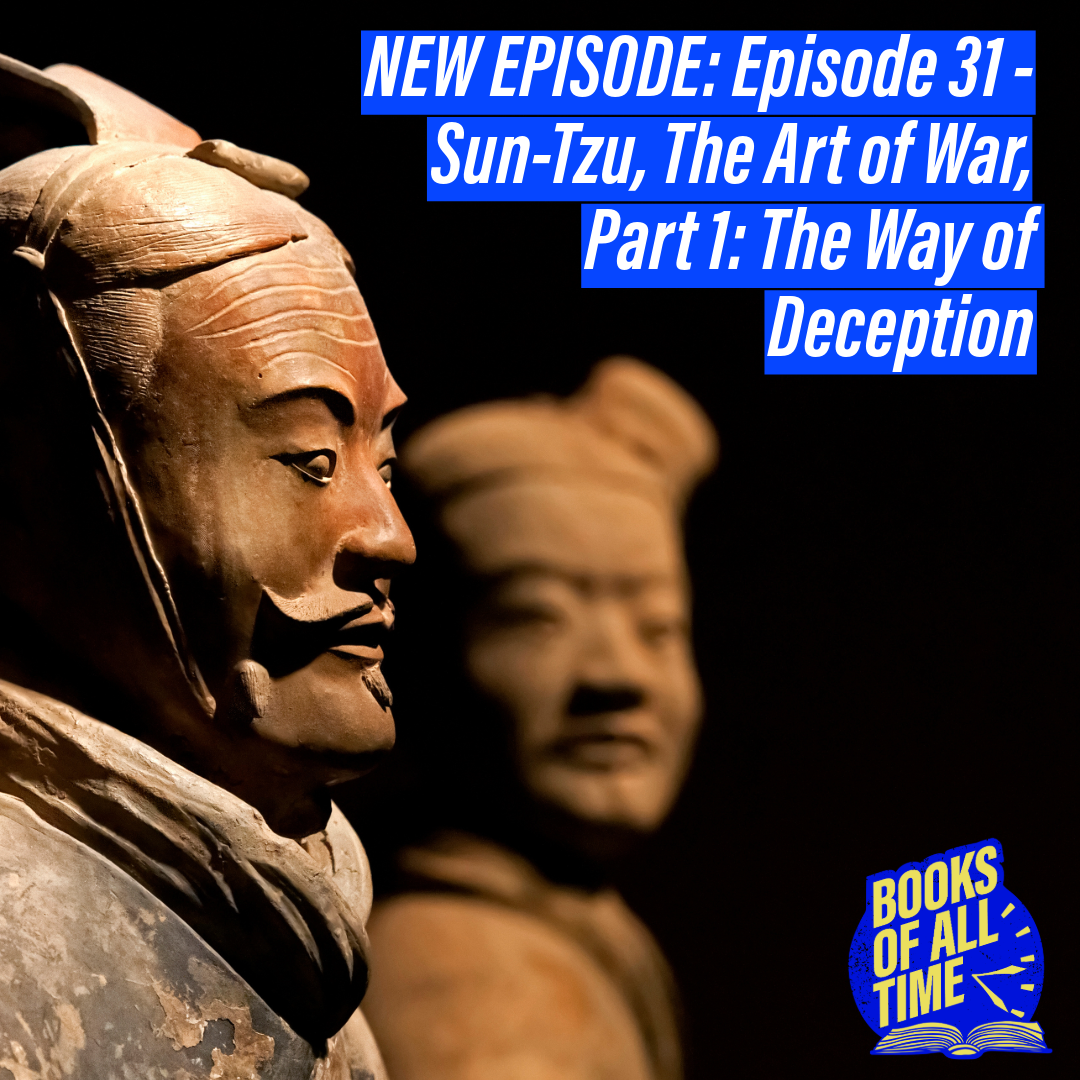
Books of All Time is a podcast that’s tackling classic literature in chronological order. This is episode 31: Sun Tzu, The Art of War, Part 1 – A Way of Deception. As always, if you want to read the transcript of this episode or see the references I used to write it, you can visit our website, www.booksofalltime.co.uk. There’s a link in the show notes if you need it. Let’s begin.
This week we are returning to China. We haven’t been there since last year’s episodes on Confucius, whose Analects shaped the character of China’s family life and civil service for millennia. This time, we’re going to examine The Art of War, the military treatise by the legendary strategist Sun Tzu.
He’s quite literally legendary: he’s supposed to have lived between 544 BCE and 496 BCE – at about the same time as Confucius. But unlike with Confucius, there’s absolutely no evidence of Sun Tzu in sources from the time. Confucius is recorded as having various provincial jobs in contemporary records. If Sun Tzu really was a major advisor to King He Lu of Wu – a verified historical figure – a failure to mention him seems like quite the lapse.
The one single story we have about him as a person – the alarming story about the army of concubines I related at the top of the show – comes from the much, much later Shiji, often called the Records of the Grand Historian in English. This was written by Sima Qian, who died around 86 BCE, so we are looking at a gap of some 400 years, at best, between the possibly historical Sun Tzu and the first solid mention of him as a person. “[The Art of War],” writes the sinologist and translator John Minford in the introduction to the 2002 paperback Penguin Classics edition, “may have had little or nothing to do with a historical person called Master Sun, if such a person existed.” (Minford 2002 xxiii)
The book attributed to him, however, is very real, and appears to have been circulating well before Sima Qian reported the story about the general in the harem. In the 1970s, archaeologists found a copy of The Art of War written on bamboo strips in a tomb from the second century BCE. (Minford xxii) What’s more, that ancient copy was already more or less in the 13-chapter form we know at present, with a more or less identical text.
Today, most scholars put the composition of The Art of War sometime around the beginning of the Warring States Period, sometime between 500 BCE and 430 BCE. This is based on an analysis of the language and some of the descriptions of warfare that are included in it. So I’ve stuck it in our chronology toward the later end of that period, around the same time as Herodotus’s Histories. I dithered about this – where to put The Art of War and the Tao Te Ching in this year’s list caused me quite a lot of bother – but here I am recording, so right or wrong, I am stuck with this order for now.
Now, I hadn’t read The Art of War before this past February. It surprised me on two fronts (surprising the enemy on two fronts: a strategy that Sun Tzu would no doubt find satisfying). First, it’s very short. The Kindle edition I bought is just 101 pages of airy text, and the paperback edition actually prints the entire text twice – once without notes from Chinese commentators, and once with – and it’s still not even half as fat as my whopping great copy of Herodotus.
Second, I didn’t expect The Art of War to be so poetic. Its form is apparently typical of ancient Chinese writing, and that’s in part dictated by the physical way they put works together. Prior to the invention of paper in 105 CE, Chinese thinkers would write down observations and sayings on strips of bamboo, tie them together in sheets, and roll them up in scrolls. (Minford 2002, xxiii). So while you sometimes got full essays in this form, usually you got collections of short, pithy observations or sayings, as with Confucius.
That is what The Art of War basically is. I expected a sort of technical manual; instead, I found something that reads more like poetry, or like some of the more mystical passages from the Upanishads. Sun Tzu’s goal seems to be less about offering a prescription or a set of tactics to deploy for victory and more about cultivating a mindset – one that is cautious, conservative of resources, and deeply rooted in what you might call research. It is not the strategy of the crouching tiger or the hidden dragon, really. It seems more like the strategy of the rat: sniff out the terrain, cover your tracks, and, when cornered, attack with everything you’ve got.
As I said, The Art of War is divided into 13 chapters – by whom, we don’t know – and the text within each of those chapters loosely adhere to a single theme. We will take our summary four or five chapters at a time. Forward, march!
[music]
“War,” begins Master Sun, at the start of chapter one:
“is
A grave affair of state;
It is a place
Of life and death,
A road
To survival and extinction,
A matter
To be pondered carefully.” (Minford 2008 p. 1)
And ponder it he will. This first chapter is called “Making of Plans,” and we may as well pause here to try to get a little more context about why someone would be writing a treatise on military strategy at this time in China at all. All the archaeological evidence – written, material, what have you – shows us that warfare in China was rapidly changing during the fifth century BCE.
BBC Radio 4’s In Our Time covered The Art of War in 2018. In that episode, the historian Hilde De Weerdt explained that, prior to the start of the Warring States Period in which Sun Tzu was probably active, Chinese armies had just undergone tremendous changes. Earlier in the period, these armies seemed to have similar characteristics to what we read about in The Iliad and in parts of the Rig Veda. That is to say, they involved a couple hundred aristocratic heroes in chariots charging bravely at one another, backed by a couple thousand foot soldiers.
By the time The Art of War was written, Chinese battles had become more like something Herodotus talks about when describing Xerxes’s forces in books six and seven of The Histories: massive companies of tens of thousands of warriors, some infantry, some chariots, some newfangled cavalry – all in need of much greater discipline and organization if they were going to be effective. So, Chinese rulers were grappling with a new type of warfare – and, as implied by the name “the Warring States Period”, quite a lot of it. You now had a professional military class developing that was separate from the aristocracy – men who were analyzing and discussing how best to prepare for and execute wars, and The Art of War is the very best example of this type of analytical discussion.
Back to the chapter. Sun Tzu starts off with a list, the “Five Fundamentals” that commanders need to consider when planning to go to war. This is the first of many such lists we’ll encounter in this work. This habit strikes me as a mnemonic device – maybe when not translated into English there’s some sort of linguistic similarity between the list items that makes them more memorable. Or maybe people have just always liked listing things: if you’re a parodist who has the time and inclination, you could probably make a 2014-style Buzzfeed article based on this chapter: “Experts Say These Five Fundamentals Lead to Victory – Number Three Will Shock You!”
Anyway. The Five Fundamentals include: The Way – possibly meaning something like moral authority and/or unity of purpose; Heaven – seasons, weather, climate; Earth – terrain and distance, factors like sickness among the army; Command, which is summed up in five words: “Wisdom, Integrity, Compassion, Courage, Severity” (Minford 2008, 2); and Discipline, which is the logistical bit: managing the resources, ensuring a clear chain of command, etc. He states the obvious: understanding how all of these factors are working for or against you will help you win; not understanding them will lead to defeat.
Then he says:
“The Way of War is
A Way of Deception.
When able,
Feign inability;
When deploying troops,
Appear not to be.
When near,
Appear far;
When far,
Appear near.
Lure with bait;
Strike with chaos.” (Minford 2008, 4-5)
Good advice in battle and elsewhere; I feel like there are American football coaches out there who have heavily underlined this passage.
Chapter two, “Waging of War” basically warns commanders to avoid, wherever possible, a long, drawn-out campaign by illustrating the economic impact it has on the public treasury – and thus the impact it has on the morale of the people left at home. He says:
“Without a full understanding of
The harm
Caused by war,
It is impossible to understand
The most profitable way
Of conducting it.” (Minford 2008, 9)
Sun Tzu gets quite granular about costs: if you have a hundred thousand soldiers and a thousand chariots, you’re going to need a thousand supply wagons. You’ll also need to think about horses and draft animals, food and equipment, plus materials like arrows and shields and glue and lacquer and bowstrings. This will all cost you a thousand taels of silver every day, which comes out of the public coffers. A protracted war will inevitably drain those coffers, leading to higher taxes for the people, plus less food to go around, and this will wind up sapping morale, causing your nation to collapse from the strain.
Therefore, the skillful warrior should aim to provision his army off his enemy’s lands instead. It’s fine to sap his morale and raise prices for his commoners. It’s also a good idea to reward soldiers for capturing chariots, equipment, and, yes, prisoners from your enemy.
Chapter three, “Strategic Offensive,” follows up on this thought by explaining that it is better to capture your enemy’s resources intact than it is to destroy it. He then describes the various forms of warfare from best to worst. Obviously, if you can avoid a battle in the first place, you’ve won in the best possible way:
“Ultimate excellence lies
Not in winning
Every battle
But in defeating the enemy
Without ever fighting.” (Minford 2008, 12)
Start by attacking your enemy’s strategy and alliances via subterfuge and diplomacy first. Then move on to attacking their armies. Only in the last resort should you besiege a city: that takes months of time and is incredibly expensive – two things that Sun Tzu wants to avoid at all costs. Then we get another list which sums up the basis of good attack strategy according to Sun Tzu. This time it’s the Five Essentials:
“There are Five Essentials
For victory:
Know when to fight
And when not to fight;
Understand how to deploy
Large and small
Numbers;
Have officers and men who
Share a single will;
Be ready
For the unexpected;
Have a capable general,
Unhampered by his sovereign.” (Minford 2008, 16-17)
I like how Sun Tzu keeps reminding his audience about how much of a pain it is to be micromanaged. Same as it ever was, eh?
Chapter four, “Forms and Dispositions,” was a little obscure to me at first. It’s full of gnomic passages like this:
“A Skilful Defender
Hides beneath
The Ninefold Earth;
A Skilful Attacker
Moves above
The Ninefold Heaven.
Thus they achieve
Protection
And victory
Intact.” (Minford 2008, 19)
Mmhm. Now, look, part of the whole reason why I do this show is that I want to stretch my own thinking. Reading things that don’t immediately make sense to me – having to chew over concepts or metaphors which don’t immediately register – is like yoga for the brain. And sometimes in yoga you have to be uncomfortable before you settle into the right groove. So I let the words of this chapter sort of wash over me at first – I had vague impressions of masses of men moving about in the dark, of commanders squinting at horizons, of a line of horsemen on a ridge somewhere.
Then I read it a second time and tried to pick it apart: clearly “forms and dispositions” is full of language about hiding your numbers and your position from the enemy while also trying to find out about the enemy’s numbers and position in return. The “Ninefold Earth” and “Ninefold Heaven” must have something to do with natural features or phenomena that you can use to keep your purposes and resources obscure to the enemy – moving in fog, for instance, or stashing the bulk of your cavalry in a forest where it’s hard to see them.
It also occurred to me while reading this that the language in this chapter sounds so much like the Tao Te Ching, which I did read as an undergrad a long time ago. Take this passage, for instance:
“To be victorious in battle
And to be acclaimed
For one’s skill
Is no true
Skill.” (Minford 2008, 20)
With these rough guesses swimming in my head, I turned to the annotated version of the text in the back half of my paperback edition of The Art of War. And what do you know, the commentator and military genius Cao Cao (born 155 CE, died 220 CE) said that hiding beneath the “Ninefold Earth” can be read as, quote, “taking advantage of the shelter provided by mountains, rivers, and other natural features.” (Minford 2002, 152) Several centuries later, the commentator Du You (born 735 CE, died 812 CE), a high-ranking administrator and constitutional expert, said that, quote:
“The Skillful Attacker must take advantage of the transformations of weather and terrain, using flood and fire according to the situation, so that the enemy does not know where to prepare. He moves like a bolt of lightning ‘above the Ninefold Heaven.’” (Minford 2002, 152)
And finally, to make me feel even more smug, John Minford, our contemporary translator, says in the notes early in this chapter that, quote, “At times there is an unmistakable Taoist tinge to Master Sun.” (Minford 2002, 148)
Yes, John Minford, Professor Emeritus of the Australian National University, I, some lady in a room in the middle of England, quite agree with you: the Art of War is basically a devious, murdery Tao Te Ching. Look at me, stretching my thinking over here.
[music]
Chapter five, “Potential Energy,” is full of advice for cultivating an army’s momentum and for identifying the exact right time to strike. It also repeatedly mentions the number five, as in this famous passage:
“There are but
Five notes,
And yet their permutations
Are more
Than can ever be heard.
There are but
Five colours,
And yet their permutations
Are more
Than can ever be seen.
There are but
Five flavours,
And yet their permutations
Are more
Than can ever be tasted.” (Minford 2008 25-26)
In spite of all these fives – Five Fundamentals, Five Essentials – in war, says Sun Tzu, you have just two possibilities: direct confrontation and indirect confrontation. But these can also be combined in endless ways. There is some lovely poetic stuff about the power of momentum and timing, here:
“A rushing torrent
Carries boulders
On its flood;
Such is the energy
Of its momentum.
A swooping falcon
Breaks the back
Of its prey;
Such is the precision
Of its timing.” (Minford 2008, 26-27)
The rest of this chapter advises the skillful warrior – or at least the aspiring skillful warrior – to lay traps for the enemy and spring when he takes the bait; to remain alive to the energy of a situation, and to deploy one’s troops to take advantage of it, trusting that they’ll be swept up with the momentum of the battle, and act however they need to in order to secure victory.
Chapter six, “Empty and Full,” advises commanders to find ways to string out and exhaust the enemy’s army while conserving the energy of their own. The best way to do this is to distract the enemy, and then attack something critical which he suddenly has to rush to defend. The kernel of this chapter, to me, is right at the beginning:
“The Skilful Warrior
Stirs
And is not stirred.
He lures his enemy
Into coming
Or obstructs him
From coming.
Exhaust
A fresh enemy;
Starve
A well-fed enemy;
Unsettle
A settled enemy.
Appear at the place
To which he must hasten;
Hasten to the place
Where he least expects you.” (Minford 2008, 30-31)
Leading your enemy’s larger army on a wild goose-chase over hard terrain, and then turning to attack once they’re exhausted; sending a force to attack the bridge that’s critical to their supply chain so they have to rush out to stop you; constantly looking like you’re preparing for war without giving away the actual place where you plan to attack – these are the methods Sun Tzu offers in this chapter.
In his commentary, John Minford notes that “one of the best recent examples of this (‘letting neither day nor place be known’) was the Normandy landings, whose success was due in no small part to the fact that the Germans knew neither the day nor the place.” (Minford 2002, 189)
Sun Tzu closes this chapter by reminding the reader to remain attuned to what the enemy is actually doing, and steer the situation accordingly:
“Water shapes its current
From the lie of the land.
The warrior shapes his victory
From the dynamic of the enemy.
War has no
Constant dynamic;
Water has no
Constant form.” (Minford 2008, 37)
Six books in, and all the advice has been about planning and distracting and deception. At some point there actually has to be a fight, right? That is what chapter seven seems like it’s going to be about: it’s called “The Fray.” However, it seems to me that it spends yet more time explaining about when not to attack – not when your men have just finished a long march, not in the morning, when the enemy is fresh; not without advice from local guides or without protecting your equipment in your camp. Don’t attack an enemy when he’s obviously pretending to flee; don’t oppose him when his forces have their backs to a hill – don’t, don’t, don’t.
Do, advises Sun Tzu, take an unexpected route to the battleground – he would no doubt have been impressed by Hannibal crossing the Alps to pop in on the Romans, or Washington crossing the Delaware on Christmas Eve to attack King George’s Hessians – and do perfect your signals with torches, drums, and flags. But perhaps the most famous advice of all from this chapter is in that poetic, quasi-mystical vein:
“Be rushing as a wind;
Be stately as a forest;
Be ravaging as a fire;
Be still as a mountain.” (Minford 2008, 42)
In my annotated version of The Art of War, John Minford notes that these four lines were a favourite of the 16th-century Japanese commander Takeda Harunobu, a Zen Buddhist monk, quote, “whose camp equipment apparently included three large kettles for boiling criminals.” (Minford 2002, 204) Yeesh.
Chapter eight, “The Nine Changes,” is the shortest of the bunch, which indicates to at least one of the commentators that there is “some substantial textual problem,” (Minford 2002, 214), meaning, I guess, some loss of the source text over time. At any rate, it’s more advice for what not to do, specifically, nine situations in which it’s wise to go against the orders you’ve been given by your sovereign.
I won’t go through all nine of these situations, but they include issues of terrain: when you realize that the place you’ve been sent to is a bad place to fight or camp, or specific targets that may not be actually worth fighting for, such as a town that offers you no advantage if you take it, or would be too costly to take.
We also get another five-item list in this chapter: the Five Pitfalls, which are:
“Recklessness,
Leading to
Destruction;
Cowardice,
Leading to
Capture;
A hot temper,
Prone to
Provocation;
A delicacy of honour,
Tending to
Shame;
A concern for his men,
Leading to
Trouble.” (Minford 2008, 50-51)
“Now wait,” you may wonder, “shouldn’t a general be concerned for his men? They are how he fights, after all.” And commentators agree that what is meant here is, “the danger of sacrificing any important military advantage to the immediate comfort of his men,” such as letting them rest on enclosed terrain instead of pushing them on for a few more miles, thus letting the enemy attack them as they sleep; or going back to relieve a company or a city for morale’s sake, thus letting the enemy ahead of you regroup. (Minford 2002, 225)
I quite like chapter nine, “On The March” – or I’m guessing I must have, given how heavily I highlighted it. I think it’s because it deals with how to position your forces and confront your enemy in harmony with the terrain you’re in. There’s advice for mountain warfare – stay close to valleys where the water usually is, for example – and tactical advice for how best to fight near a river. For example, you should keep your forces back from the river and wait to attack until about half the enemy troops have come across – this way they will be strung out and waterlogged and not in formation yet.
The sections I have highlighted most, however, are those that involve reading the landscape – movement of birds or animals, but also these four pieces of advice about different types of dust clouds:
“Dust high and peaking
Is a sign
Of chariots approaching;
Dust low and spreading
Is a sign
Of infantry approaching;
Dust in scattered strands
Is a sign
Of firewood’s being collected;
Dust in drifting pockets
Is a sign
Of an army encamping.” (Minford 2008, 57)
I think this resonated with me so much because it tickled the part of my brain that grew up in the woods and looked for signs of animals and birds – I appreciate living in a city nowadays, but on a warm spring evening I do miss being in the forest as the katydids begin singing and the deer file through, looking for their sleeping-places.
Leaving these pleasant reminiscences aside, throughout this chapter you can also see why this book is pored over by management types: there’s a lot of advice for spotting signs of discontent among your troops (or your enemy’s troops) and for keeping everyone on side. Men whispering in groups indicate disaffection; an enemy that talks about peace but doesn’t actually put forward a treaty is plotting against you; soldiers leaning heavily on their spears are probably hungry. And you, as the general, need to keep a grip on yourself. The master says:
“Consistent and effective orders
Inspire obedience;
Inconsistent and ineffective orders
Provoke disobedience.” (Minford 2006, 62)
Firing and rehiring the people in charge of maintaining one’s nuclear arsenal, for instance, is probably not the best way to keep those people from being bribed by foreign officials into giving away classified info about that arsenal. In case you’re wondering what keeps me up at night lately.
[music]
Chapters 10 and 11, “Forms of Terrain” and “The Nine Types of Ground,” respectively, build on – or frankly, seem to repeat – much of the discussion of terrain from chapter nine. Chapter 10 reiterates the importance of closely studying the enemy’s movements and trying to gauge his intentions. It is the source of the quote from the top of the show, perhaps the single most famous line from all of Sun Tzu: “Know your enemy; know yourself.”
Chapter 11 moves from “terrain” – specific types of landscapes – to “ground” – more about various situations. It is organized more around strategies for invading enemy territory. “Fast and hard,” seems like a fair summary of the advice to me. Sun Tzu says that the Skillful Warrior leads his men, quote:
“Like a man
Climbing a height
And kicking away the ladder;
He leads them
Deep into the territory
Of the feudal lords
And releases the trigger.
He burns his boats,
He breaks his pots.” (Minford 2008, 81)
The nine kinds of ground, if you’re wondering, are scattering, light, strategic, open, crossroad, heavy, intractable, enclosed, and death. Several of these are self-explanatory. Some need to be defined. Scattering ground is when your enemy is fighting on home territory, and can, well, scatter to safety if you attack. Heavy ground is where you wind up when you penetrate deeply into enemy territory: you will need to take as many towns and as much plunder as you can to carry on.
Death ground is less about a specific landscape feature than a situation. On death ground, you have no good options: you can’t advance, you can’t retreat, you have no good supply lines, and your enemy has the better of you. “To be on death ground,” said the commenter Chen Hao (lived roughly from 800 to 850 CE), “is like sitting in a leaking boat; like crouching in a burning house.” (Minford 2002, 274) This is the one situation in which Sun Tzu says you absolutely must fight to the last man.
“Throw your men where there is no escape,” he says, “And they will die rather than flee. Men who have faced death can achieve anything.” (Minford 2008, 76-77)
I admit that the title of chapter 12, “Attack by Fire,” got my hopes up a little – I was expecting explosions, gunpowder – but then it occurred to me that no, Sun Tzu’s time was well before gunpowder, which the Chinese did not get round to inventing until 900 CE or so.
Sun Tzu’s advice for using fire to achieve your goals involves yet another five-item list: the Five Ways to Attack by Fire. You can burn men, supplies, equipment, warehouses, or lines of communication. He then gives some basic advice for setting fires and using them safely: stay upwind, make sure the weather is hot and dry, and if possible windy. We get a little glimpse about popular beliefs of the time when Sun Tzu advises using fire depending on the position of the moon:
“The proper days are
When the moon is in
Sagittarius,
Pegasus,
Crater,
Corvus.
These are the
Four Constellations
Of Rising Wind.” (Minford 2008, 90)
I was a little thrown by this: surely the moon doesn’t pass through Pegasus, Crater, or Corvus? They’re too far off the ecliptic, the strip of sky through which the moon and planets seem to move. But of course, I was thinking of Greek constellations. A bit of Googling shows me that the Chinese constellations in question are the Basket of the Azure Dragon of the East (which includes Sagittarius), the Wall of the Black Tortoise of the North (Pegasus), and the Wings (Crater) and Flaming Chariot (Corvus) of the Vermillion Bird of the South. (Minford 2002, 307) Now you know.
Sun Tzu finishes chapter 12 with what seems like a closing statement, including this very pithy summary of all his advice to date:
“Never move
Except for gain;
Never deploy
Except for victory;
Never fight
Except in a crisis.” (Minford 2008, 93)
However, this is probably an issue with how the text was compiled over the years – I did say that The Art of War was very loosely organized around its themes. There’s one final chapter to go: Chapter 13, “Espionage.” In it, Sun Tzu sounds a bit salty as he reminds the reader of the economic and psychological costs of war on the population. War, he says, quote:
“causes commotion
At home and abroad
And sets countless men
Tramping the highways
Exhausted.
It keeps seven hundred thousand families
From their work.” (Minford 2008, 95)
You’re a miser and an idiot, he goes on, if you can’t spare a hundred taels of silver – a tenth of what you shell out every day to keep your army in the field – in order to pay good spies. You can consult all the omens, squint at all the maps, measure all the dust clouds you want. A man placed secretly in the enemy’s camp to your advantage is worth more than a hundred chariots.
Naturally, we get one final five-item list: the Five Sorts of Spies. These include local spies, internal spies, double spies, dead spies, and live spies. Local spies are villagers or other common folk from your enemy’s territory. Internal spies are his officials or officers.
Double spies – well, I’m sure you, dear listeners, have read your Le Carre or watched your James Bond and don’t need me to tell you about double agents. Dead spies are people you feed misinformation to knowing they’ll pass it to your enemy, and live spies are those that bring you information.
Sun Tzu ends his treatise rather abruptly, after singing the praises of spies and the intelligence they provide – but, after all, it is this knowledge, obtained by deception and secrecy, that gives you the best chance of knowing your enemy.
[music]
That is the summary of The Art of War, a book that is, like any good spy, much more than what it seems to be on the surface. There are plenty of places where I found myself underlining passages that made me think of incidents or ongoing issues in my own life. Take, for instance, this observation from chapter nine: “An advantage perceived but not acted on indicates utter exhaustion.” (Minford 2008, 59) That’s meant to be a clue for reading the movements of one’s enemy. I, however, wrote the word “burnout” next to it.
And The Art of War has been appropriated and reinterpreted and applied to all kinds of situations beyond the 6th-century BCE battlefields about which it was written. We could spend an entire other episode about the influence of this little book, and I did start writing one, but it wound up reading like a Wikipedia article, and that’s not very invigorating work. However, I will give you a brief roundup of Sun Tzu’s influence.
Sun Tzu’s ideas, like those of Confucius, very quickly became part of the set texts that aspiring civil servants and military commanders needed to read before they could take their qualifying exams. Also like Confucius, Sun Tzu’s work was soon spreading throughout east Asia. There’s that Japanese monk-slash-feudal-lord-slash-soldier-boiler we mentioned earlier.
Nearer to our own time, there is Mao Zedong, founder of Chinese communism, who quoted Sun Tzu frequently in his works on warfare and other forms of conflict. Officers in the Viet Cong are also said to have studied Sun Tzu and applied his principles in fighting both the French and the Americans during the Vietnam War.
The west came to Sun Tzu quite late – as we’ll learn in the next episode, there was no translation of it in any European language until the 18th century, and no English translation until 1905. It began to be studied in military circles toward the end of the Second World War – in that In Our Time episode, Douglas MacArthur, Supreme Commander of the Allied Powers during WWII is mentioned as studying it in the run-up to the Korean War, and it’s apparently a set text at West Point and other military academies.
I found a 1964 review of a translation of Sun Tzu by Howard L. Boorman, an American Foreign Service Officer, and his son, Scott A. Boorman. The younger Boorman is still active: he’s a professor at Yale University, and by coincidence he published a book about Sun Tzu just last year.
In that 1964 review, the Boormans observe that many generals and military thinkers over the centuries have written their own guides to military strategy. But few of them have aged as well as The Art of War. Quote:
“[Sun Tzu’s] work appears fragmentary and incohesive to the Western reader. Yet the durability of Sun Tzu’s basic concepts is indisputable . . . many recent books on the theory and practice of war are partially outdated. Sun Tzu, however, has been handed down for over two thousand years with reputation virtually untarnished, with text virtually intact. Few books have had a better record.” (Boorman 129)
Indeed. And that influence has seeped out of military matters. Today, people apply Sun Tzu to virtually any endeavour that involves competition. Business is an obvious one – the amoral corporate raider Gordon Gekko, villain of Oliver Stone’s 1987 film Wall Street, quotes Sun Tzu, and it is reportedly made required reading for executives at firms around the world. A quick rifle through the JStor archives shows me articles applying Sun Tzu to international relations, legal trials, and game theory.
It’s also, as you can imagine, massively influential in the sports world. Bill Belichick, former head coach of the NFL’s New England Patriots, claimed to be inspired by The Art of War when preparing for games. Ahead of the 2002 World Cup, Brazilian coach Felipe Scolari gave all his players a copy of the book to read, sometimes even printing out passages and shoving it under their hotel room doors. There is even a version of The Art of War “translated” into soccer language.
In the introduction to his 2002 translation of Sun Tzu, John Minford says that The Art of War is “an ancient book of proverbial wisdom, a book of life.” (xi) But he also cautions against taking its vision of life as a series of lethal competitions to be won as a personal approach to the world. Quote:
“Each reader must relate creatively and reflectively to the enormous potential energy of this book . . . so as to decode the books message of survival and victory and emerge the stronger for it, without succumbing to its insidious cult of deceit and expediency.” (Minford 2002, xxxii)
I think it’s absolutely worth reading, in whatever translation you can find. Read it in an unadorned version and absorb it impressionistically; get an annotated version and go deep in the weeds. You’ll come away having learned something about yourself.
[music]
That’s it for this episode. Now that we’ve explored the content of The Art of War, we’re going to look at how it came over to the West in the 18th century, via a member of a secretive, controversial, frequently banned religious society founded by a mystical ex-soldier: the Jesuits. To hear how a harpsichord-toting, science-loving French missionary became the first Western translator of Sun Tzu, join me on Thursday, May 15, for Episode 32: “Sun Tzu’s Art of War, Part 2: An Ex-Jesuit in Beijing.”
Books of All Time is written and produced by me, Rose Judson. The Disclaimer Voice of Doom is Ed Brown. Lluvia Arras designed our cover art and logo. Special thanks to Yelena Shapiro, Cathy Merli, Matt Brough, John Cole and the Books of All Time Advisory Council: Ed Brown, Beck Collins, Neil Dowling, Caitlin McMullin, Hugh Parker, and Jonathan Skipp. You can support the show by subscribing and leaving a rating or review at Apple Podcasts, Spotify, or wherever you get your podcasts. You can also follow us on social media: we’re on Bluesky, Instagram and Facebook. Thanks for listening! I’ll be back in two weeks.
References and Works Cited:
Boorman, Scott A., et al. “Mao Tse-tung and the Art of War.” The Journal of Asian Studies, vol. 24, no. 1, 1964, pp. 129–137, https://doi.org/10.2307/2050423.
Connley, Courtney. “Patriots Coach Bill Belichick Lives by This Brilliant Quote from ‘The Art of War.’” CNBC, CNBC, 31 Jan. 2019, http://www.cnbc.com/2019/01/31/bill-belichick-uses-this-sun-tzu-quote-to-inspire-the-patriots-to-win.html.
Hallam, Mark. “Brazil Hires ‘Big Phil’ – Again.” Dw.Com, Deutsche Welle, 29 Nov. 2012, http://www.dw.com/en/brazil-goes-back-to-the-future-hiring-scolari-and-parreira/a-16417346.
“In Our Time, Sun Tzu and the Art of War.” BBC Radio 4, BBC, 1 Mar. 2018, http://www.bbc.co.uk/programmes/b09smh59.
Sun-Tzu. The Art of War. Translated by John Minford, Penguin Books, 2002.
Sun-Tzu. The Art of War: Penguin Great Ideas Series. Translated by John Minford, Penguin, 2008.
“Warring States.” Encyclopædia Britannica, Encyclopædia Britannica, inc., http://www.britannica.com/event/Warring-States.


 Books Of All Time
Leave a comment