
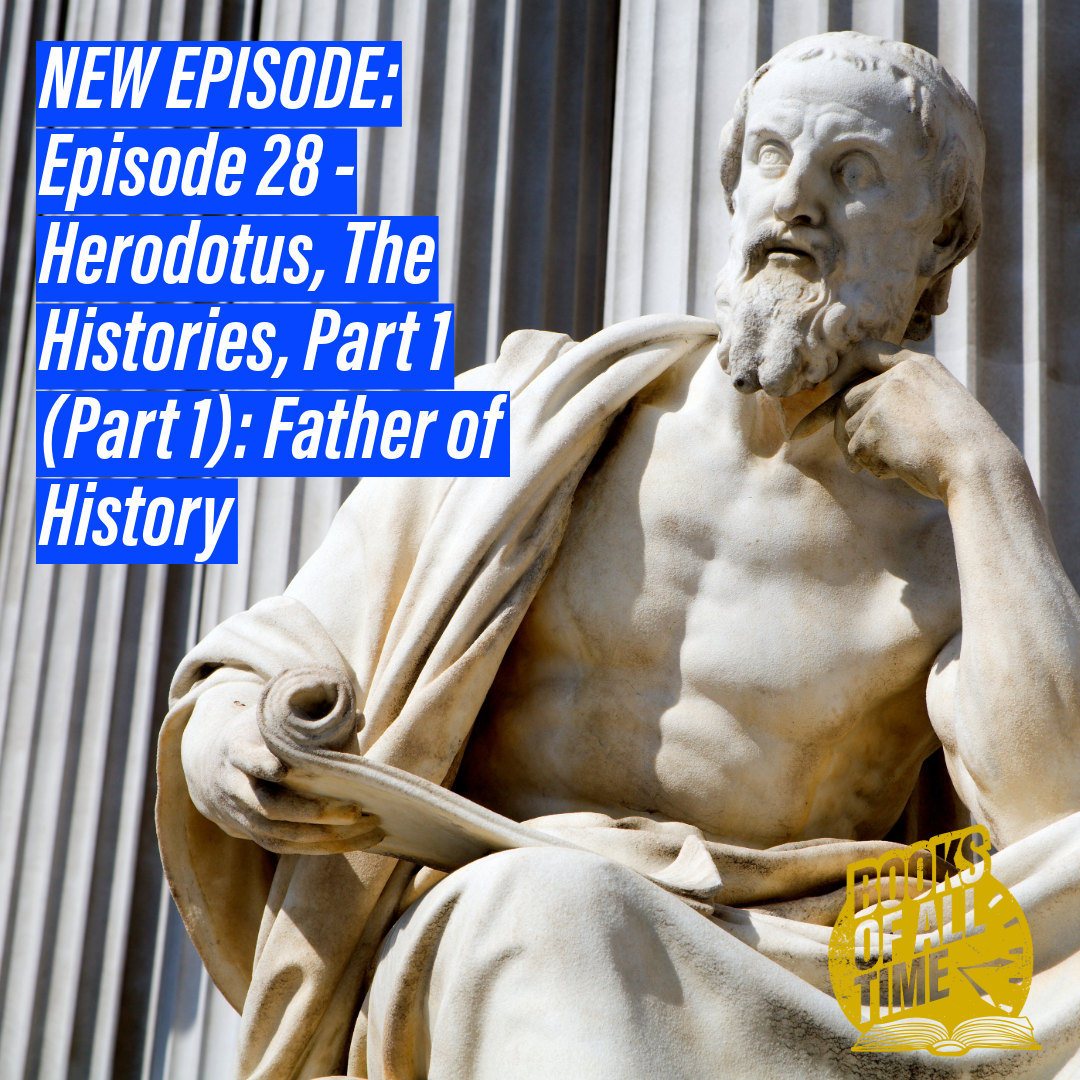
“Most of those which were great once are small today; and those which used to be small were great in my own time. Knowing, therefore, that human prosperity never abides long in the same place, I shall pay attention to both alike.” (Herodotus, Book 1, Mercola 51)
The singer was lost at sea, adrift on a narrow strip of wood. Sun-dazed, parched, weary – he could hardly piece together the series of mishaps which had led him to this disaster. He had been warned not to make this journey, and he had snapped his fingers at fate. And here he was.
Carefully, trying not to overbalance his little craft, he pushed himself up to a seated position and scanned the horizon again. Only water, dazzling water, in every direction.
Until suddenly there wasn’t.
Something dark cut the water, moving against the swells and the wind. The singer did not need to strain his eyes to recognize it. A fin. He began to shake all over, watching it carve a wide circle around him, wondering if he should give in to the overwhelming need to swoon and let himself drown, senseless. But he could not look away. Soon there were two fins. Five. Eight. He lost count, began to pray – or at least to babble words in a pleading tone.
The fins cruised toward him. One of the beasts poked its head above the water. The singer caught a glimpse of its head – a weary, wrinkle-ringed eye, a frowning mouth, with a boxer’s underbite – and he realized that he might not die screaming. They were dolphins. They closed in, clicking and whistling in tones that suggested they thought his predicament was amusing. Their speech rose to a shrieking climax, and the singer lay back down on his board, driving his knuckles into his ears.
All at once the dolphins stopped their discussion. A decision had been taken. Four of the beasts dove and swooped under him in the water – he saw them pass beneath like grey ghosts – and then resurfaced right next to him. They began to shove at his little bark of wood with their noses, and it almost upended him. He screamed. The dolphins withdrew and waited until had calmed himself. Then they swam close and started pushing him again.
The sun was low in the west when the singer slid off his plank of wood and felt sand beneath his feet again. His rescuers gave him little parting shoves, and he ran his hands along their strange skin – slippery, firm – and warmer than any fish he had caught before in his life. He thanked the god who sent them, and then began to push his way through the surf, toward the lights on the shore, toward dry land.
Legend? Most likely. But the writer who first reported this story to us – the story of Arion the Harper, and his rescue by dolphins – confirmed it with two sources. “That is the story as the Corinthians and Lesbians tell it,” he wrote. (Merincola 59) For Herodotus, a story like that is as good as history.
I’m Rose Judson. Welcome to Books of All Time.
Books of All Time is a podcast that’s tackling classic literature in chronological order. This is episode 28: Herodotus, The Histories, Part 1, Part 1 – Father of History. As always, if you want to read the transcript of this episode or see the references I used to write it, you can visit our website, www.booksofalltime.co.uk. There’s a link in the show notes if you need it. Let’s begin.
Today we move from Greek poetry and Greek drama to Greek prose. Specifically, The Histories of Herodotus. Herodotus was born in Halicarnassus – modern-day Bodrum in Turkey – around 484 BCE. He was culturally Greek, but at the time, Halicarnassus was under the control of the Persian Empire. The rise of that empire – and the heroic alliance of Greek city-states that were able to fend it off – is the main topic of his great work, The Histories.
The Histories is the first great work of Greek prose we know of, and they’re considered the starting point for the scholarly pursuit of history – a pursuit that has become more cautious and disciplined in its approach over the centuries since Herodotus. This has benefits for our accurate understanding of historical events, but, as we’ll see, detriments for the entertainment value of history.
We don’t know very much about Herodotus’s life. The only extended biography we have of him is in the Suda – a Byzantine-era manuscript from the 1100s CE. In other words, written nearly 1500 years after Herodotus’s lifetime. Whether the writer of the Suda was working from ancient sources that are lost to us, repeating a tradition about Herodotus, or just kind of spinning his own yarn is unknown. In his introduction to the Penguin Classics edition of The Histories, translated by Aubrey De Selincourt, scholar John Marincola notes that “the biographies composed [for] ancient poets were made up largely of inferences from remarks made in their writing, and much the same thing may have happened in Herodotus’s case.” (Marincola 9)
Well, no kidding. Anyway, the Suda claims that Herodotus was from a greatly influential family, related to epic poets and other important persons, and that he himself would be involved in politics in Halicarnassus, up to the point of being exiled for trying to oust the city’s pro-Persian tyrant at one point. The Suda claims this exile is the reason why Herodotus embarked on a long period of travel around the Mediterranean, North Africa, and the Black Sea – the travel that would lead to him writing The Histories.
There’s no contemporary evidence for this. But the fact that Herodotus was literate and does seem to have travelled to at least some of the many places he writes about suggests that he was not from anything like a hardscrabble background. He seems to have been on the road by about 455 BCE, when he would have been about 30 or so. He claims to have travelled to Egypt, to Babylonia, Syria, Libya, Lydia (modern western Turkey) and Phrygia (modern central Turkey). He also went as far afield as the land of the Scythians – a group of nomads whose main stomping grounds at the time were on the Pontic Steppe north of the Black Sea in modern Ukraine and southern Russia.
At some point, Herodotus settled in Athens. This seems to have been around 445 BCE, which would have been a very exciting time to be in Athens. Its democracy was in full swing – Pericles, the great orator, general, and politician, was considered the “first citizen” of Athens at the time. Aeschylus’s storied dramatic career was coming to an end, and that of Sophocles was beginning – at least one of the articles I read mentions in passing that Herodotus and Sophocles may actually have known each other.
It’s possible Herodotus began writing his Histories during this period, continuing them when he moved to the city of Thurii, an Athenian colony in southern Italy. It’s not known when he died, but the last events alluded to in his work took place around 430 BCE, when the Peloponnesian Wars between Athens and Sparta were beginning to rage. He probably died sometime between then and 415 BCE, when he would have been between the ages of roughly 55 and 70.
Herodotus was not the first person to write a history of events, but he does seem to have been the first westerner to do it without being sponsored by a powerful benefactor. This is incredibly valuable, because it means that he was working to his own instincts, rather than to a party line. The work he produced has its biases – he can’t help but see relations between Athens and Sparta more from Athens’s side, for example. But he wasn’t being compelled to produce propaganda, like ancient Babylonian or Egyptian historians might have.
Herodotus, working from his own interest and enthusiasm, was able to draw on many different sources to inform his work: earlier writers, eyewitnesses, ancient inscriptions on monuments, city records, folk stories – all of it was mined to build his understanding of how the wars between the Persians and Greeks had begun, and how they transpired.
With such a wide range of sources, the work itself is also wide-ranging. It’s much more than a chronicle of battles and dynasties and political decisions. It incorporates customs, religion, folktales and legends, including court gossip and the tall tales of other travelers. Calling this type of sprawling narrative a “history” was perfectly appropriate from the perspective of his time. In Herodotus’s time, “histories” meant something more like “researches” or “inquiries.” What seem to us like digressions were essential parts of the work to him and to his audiences.
And Herodotus did have audiences – literal ones – in his lifetime. Scholars who have analyzed the text of The Histories as it has come down to us propose that he originally wrote his work to be read out or recited as lectures. This makes sense: most people, even in relatively enlightened ancient Athens, were not literate. Writers would not have had much of a following if they limited the circulation of their work to the few readers available.
The many religious festivals that featured poetry or drama also featured some opportunities for prose writers to recite their work – sort of a sideshow to the main stage events – and it’s possible Herodotus worked this circuit when possible. Scholars have identified 28 potential “performance pieces” in the text of The Histories. These pieces wouldn’t have been made public all at once, like a modern book, but brought out as and when he was finished with them.
For centuries, readers of Herodotus have worked their way through nine “books” of his histories. This was very likely a structure imposed on the work a century or two later, probably by librarians at Alexandra. Each of the nine books are named for one of the nine muses, and taken as a whole they focus on the Greco-Persian wars that took place between 499 – 479 BCE, or shortly before Herodotus himself was born.
The Histories are quite dense – most editions run to about 600 pages after you take out any modern introductions and references – so I’m actually going to split this summary into two episodes. This week covers books one through five, and next week – yes, March 27 – we’ll cover books 6 through nine. Then we’ll do the meta-episode on the ups and downs of Herodotus’s reputation on April 10th. So I did not misspeak at the top of the show when I said this was “part one, part one” – like Herodotus, we’re going to run long this month.
So! Adjust your sandals and your peaked Persian cap, and let’s dive in.
[music]
Herodotus begins book one with a big trumpet-blast of a thesis statement. “Herodotus of Halicarnassus here displays his inquiry, so that human achievements may not become forgotten in time, and great and marvellous deeds – some displayed by Greeks, some by barbarians – may not be without their glory; and especially to show why the two peoples fought with each other.” (Marincola 49) By “two peoples” he means the Greeks and the Persians. He then launches into an explanation of the origins of war between eastern and western peoples.
Naturally, it all goes back to wife-snatching. Herodotus blames the Phoenicians for starting the trend of kidnapping other people’s women in the (to him) far distant past. This began an escalating series of woman-stealing events culminating – you guessed it – in the events that led to the Trojan War. Surprisingly, Herodotus says the Greeks were the aggressors, escalating an unfortunate marital event into a 10-year bloodbath.
“Abducting young women . . . is not, indeed, a lawful act,” he writes, “But it is stupid after the event to make a fuss about avenging it. The only sensible thing is to take no notice; for it is obvious that no young woman allows herself to be abducted if she does not wish to be.” (Marincola 50)
There you go, friends: victim-blaming, a fine Western tradition. Anyway. This massive overreaction by the Greeks led the Persians to think of them as antagonistic toward all Asians, such as themselves. The Trojan War was the Ur-conflict, the one that marked the Greeks as targets for destruction.
Herodotus moves on to begin describing how the Persian empire expanded. He begins with the conquest of Lydia, specifically of King Croesus, who we know reigned from about 585 to 546 BCE. In Croesus’s time, Lydia took up basically the whole western half of modern-day Turkey, including the site of Troy and wealthy cities like Smyrna, Ephesus, and Sardis. Herodotus spends time walking us through some of these cities and the ways of the people who live there – this, by the way, is Herodotus’s approach to history: describe a culture, then explain how the Persians came in and tried to wreck it.
At any rate. Croesus. Croesus himself is fabulously wealthy. He inherited a prosperous kingdom with lots of juicy tax revenues from his father, and he expanded those lands through conquest. He had a terrific alliance with the Medes, ruled by his brother (ass-TEE-a-jess) Astyages, and with the Babylonians, ruled by Astyages’s brother-in-law Nebuchadnezzar. He was living the good life.
But, says Herodotus, Croesus was also doomed to come to a sticky end. Like any powerful royal family, there was a crime several generations back that had yet to be atoned for – a crime that had been slowly accruing cosmic interest over the decades. But while the fall of the house of Atreus in the Oresteia begins with child-murder and cannibalism by deception, here, things are set in motion by a king’s cuckold fetish.
(Seriously, just a handful of paragraphs after that high-minded opening statement, Herodotus is serving us gossip from foreign courts. I love him.) Anyway: several generations back, (CAN-do-leez) Candaules, bygone king of Lydia, was super hot for his wife. Not to the point where he’d, you know, tell us her name, but enough to decide that one day he really wanted his bodyguard, Gyges, to sneak a peek at the woman while she was naked.
Gyges demurred, but Candaules was persistent, and Gyges obeyed. He concealed himself in the queen’s bedroom while she undressed. The queen confronted him, and upon learning that Candaules had put Gyges up to it, she goaded Gyges into helping her murder her husband.
(He’s very malleable, this Gyges.) He and the queen kill Candaules. Gyges takes the throne as the founder of the dynasty to which Croesus belongs – a dynasty that is marked for destruction, all because of a bit of voyeurism that got way out of hand.
Now. This straining to join the dots may seem suspect to us, but for Herodotus it made sense. Yes, he was striving toward accuracy or truth in his histories, but he was also an ancient Greek. He believes very strongly in the influence of fate, and will see its hand at work where we would just see a smutty little story.
Anyway. Herodotus recaps the fates of the various Lydian kings up to Croesus, and then brings us back to Croesus’s court, just as the Athenian politician and philosopher Solon turns up for a visit. Croesus shows Solon all the wonders of his treasury. He asks Solon a very loaded question: who is the happiest man you’ve ever seen? (Merincola 61) Solon knows Croesus is fishing for compliments, so he plays coy, giving names of men who died gloriously in battle or after doing some act of great religious piety. Croesus presses him angrily: what about me? Don’t I seem happy? Solon replies with a speech that, even today, tolls like a bell:
“Man is entirely a creature of chance. You seem to be very rich, and you rule a numerous people, but the question you asked me I will not answer, until I know that you have died happily. … until [a man] is dead, keep the word ‘happy’ in reserve. Till then, he is not happy, but only lucky.” (Merincola 64)
A few years after Solon’s visit, Croesus hears that his brother-in-law Astyages has been overthrown by the new young the king of the Persians, Astyages’s own grandson, Cyrus (about whom more momentarily). Croesus wonders if he should attack the upstart. He sends his emissaries to Delphi to see the oracle, and it’s there we get the story that we talked about in episode 25. After an insanely lavish offering – thousands of animals sacrificed, heaps of gold and precious objects given – the emissaries ask whether Croesus should attack the Persians, and if so, who would be the best ally to help him achieve victory.
The response is that if Croesus attacks the Persians, he will destroy a great empire, and that Croesus’s reign will last until a mule sits on the Median throne. “So I’m safe, then,” says Croesus, and goes off to investigate the various Greek poleis to determine which one would be best to make his ally. This gives Herodotus the opportunity to swerve off into the history of Athens and Sparta, and from within that digression we get the little story I adapted at the top of the show: poor Arion the singer, robbed by pirates and thrown off a ship to die, until he is miraculously saved by dolphins.
Amusingly – and here’s me going down a side street – the story of Arion has a real-life counterpart in the present day: in 2010, the legendary American actor Dick Van Dyke told late-night host Craig Ferguson that he fell asleep on his surfboard one afternoon, woke up out of sight of land, and was eventually rescued by friendly porpoises. I think this is a fabulous story. I once told it to a man in a bar in an attempt to win him over, but he was incapable of appreciating it – or me – properly. You could say we were at cross-porpoises.
There, I’ve got that off my chest. To quote Herodotus, “I need not apologize for the digression – it has been my habit throughout this work.” (Merincola 250)
To resume: The upshot of Herodotus’s meander into Greek history at this point in book one is to explain why the Spartans are by far the most successful warriors of the Greek-speaking city-states. Interestingly – to listeners of this show, anyway – the Spartans gained pre-eminence by recovering, at the Oracle of Delphi’s instruction, the bones of Orestes, son of Agamemnon.
At any rate, this alliance with the Spartans is useless – when Croesus attacks Cyrus, he’s defeated, taken hostage, and made to live out his days as a kind of pet advisor to Cyrus. Clearly, Croesus will not qualify for Solon’s definition of happiness, and he bitterly bemoans his fate.
Herodotus now loops us back to Cyrus’s origin story, which will surely have sounded very familiar to any Athenians who’d seen Sophocles’s 429 BCE Dionysia-winner Oedipus Rex. A man – in this case Astyages, king of the Medes – has a dream that the baby his daughter is expecting will usurp him, so when the child is born, he hands it off to an advisor and tells him to leave the little boy to die on the mountainside.
The advisor can’t bear to kill the baby, so he gives it to one of his tenant herdsmen and tells him to do it. The herdsman can’t bear to do it either, but as it happens, his poor wife has just been delivered of a stillborn son. They keep the little prince, wrap their own deceased baby in the rich swaddling clothes and leave him on the mountainside, showing Astyages’s advisors the pitiable little impostor’s body.
Of course, the hidden prince eventually grows up and takes his place as King of the Persians, then promptly conquers the Medes – and his grandfather. Herodotus acknowledges that this is what “the Persians say,” and that Cyrus’s early life may have shaken out differently. But he’s trying to do justice to his sources, you know?
Cyrus, having taken Media and now Lydia, splits his army in two. He leads the main force east, while the other goes on to conquer Ionia, Aolis, and several other Greek-speaking provinces on the west coast of what’s now Turkey. One of them is a place called Pedasus, which holds out against the Persians longer than most thanks to a divine early-warning system: whenever the city is in danger, the head priestess of their temple of Athena suddenly grows a long beard. Herodotus insists that the growing of the beard of doom is “a thing which has actually happened on three occasions.” (Merincola 135) But even Pedasus yields in the end.
Meanwhile, Cyrus has set his sights on the Assyrian empire, and its capital city, Babylon. Herodotus spends many pages waxing lyrical about the geography and customs of Assyria, with special attention paid to its riches – its wealth, Herodotus claims, provides fully a third of the Persian Empire’s revenue. It is a breadbasket:
“The blades of wheat and barley are at least three inches wide. As for millet and sesame, I will not say to what an astonishing size they grow, though I know well enough; but I also know that people who have not been to Babylonia have refused to believe even what I have said already about its fertility.” (Merincola 144)
You had to be there, mate. In spite of this wealth of grain, Herodotus also insists that Assyrians live on dried, powdered fish, and that they bury their dead in honey. He also spends a lot of time on their marriage and sexual practices: for example, Babylonian couples squat over burning incense for many hours to fumigate their nether regions after they’ve had intercourse. Gwyneth Paltrow, take note. (Merincola 147)
Cyrus takes Babylon by damming the (TY-griss) Tigris and getting in under the walls. Once Assyria is subjugated, Cyrus turns his attention to the (mass-uh-GAY-tie) Massagetae, a fierce group of nomads who live well to the East of Persia, between the Caspian and the Aral Seas. These Massagetae were ruled by a queen, (TOM-eer-iss) Tomyris, who was a tough cookie. When Cyrus plays a trick to capture and subdue a third of the Massagetae forces – including Tomyris’s son – she sends him a message which reads, in part:
“I will advise you for your good: give me back my son and get out of my country with your forces intact, and be content with your triumph over a third part of the Massagetae. If you refuse, I swear by the sun our master to give you more blood than you can drink, for all your gluttony.” (Merincola 154)
Tomyris puts her men where her mouth is. Her forces drive back the Persians, killing Cyrus in the process. They bring the queen his head, and she shoves it into a waterskin full of blood, making good on her threat.
Cyrus’s son (cam-BYE-seez) Cambyses now takes the throne of Persia. He will try to one-up his father Cyrus by invading one of the oldest and most venerable kingdoms: Egypt. To to
[music]
Honestly, if you read only one book of Herodotus, make it book two, which is all about Egypt’s history, geography, culture, and animal life. It’s delightful in its enthusiasm, conviction, and plain wackiness. Some of the shine comes off when you consider that people took this as gospel truth for centuries, but hey ho.
Here are a few highlights of Herodotus’s travelogue of Egypt. First, the animals. He spends a great deal of time describing the crocodile. In particular, he seems charmed by its symbiotic relationship:
“Other animals avoid the crocodile, as do all birds too with one exception – the sandpiper, or Egyptian plover; this bird is of service to the crocodile and lives, in consequence, in the greatest amity with him; for when the crocodile comes ashore and lies with his mouth wide open (which he generally does facing towards the west) the bird hops in and swallows the leeches.” (Merincola 188)
There is the hippopotamus, which describes as if he has seen it with his own eyes. You judge:
“This animal has four legs, cloven hoofs like an ox, a snub nose, a horse’s mane and tail, conspicuous tusks, a voice like a horse’s neigh, and is about the size of a very large ox.” (Merincola 188)
I’m not so sure I agree with you a hundred percent on your naturalist work, there, Herodotus.
He also mentions the phoenix, but has the integrity to say he hasn’t seen one himself, only heard reports, and that he is pretty skeptical of some of the details:
“There is a story about the phoenix which I do not find credible; it brings its parent in a lump of myrrh all the way from Arabia, and buries the body in the temple of the Sun.” (Merincola 189)
You heard Herodotus: the phoenix is confirmed by multiple sources, but citation needed re the myrrh.
Like many a middle-aged man, then and now, Herodotus is also a total geek for architecture and infrastructure. Egypt, of course, is chockablock with that stuff. You’d expect him to comment at length about the Great Pyramids – and he does – but he is also up for minutely describing every temple or house or well-made bit of road he encounters. He really wants you to be there with him, understanding the exact dimensions of whatever he’s looking at and the origins of the materials and the building methods, at least as they were described to him.
But his true north is hot gossip, at least in these early books, and there’s a really juicy story about Cheops, builder of the biggest of the three pyramids:
“No crime was too great for Cheops: when he was short of money, he sent his daughter to a brothel with instructions to charge a certain sum – they did not say how much. This she actually did, adding to it a further transaction of her own: a stone. For with the intention of leaving something to be remembered by after her death, and of these stones (the story goes) was built the middle pyramid of the three which stand in front of the great pyramid.” (Merincola 216)
That little parenthetical – “the story goes” – is doing more than is asked of it there, I think.
Herodotus admires the Egyptians. He credits them with introducing the world to the twelve-month year and as the originators of the worship of the twelve gods – the gods of the Greeks, per Herodotus, all have a counterpart in Egypt. He still finds some of their customs odd – he scoffs at people mourning for pet cats, for example – but he is in awe of their culture, their sciences, and their records which stretch back millennia.
Throughout book two, he mentions that he has consulted Egyptian priests about all the various topics he’s interested in, and he is very impressed by the evidence with which they present him – evidence which shows that the first Egyptian king came to the throne 10,500 years before their time.
Which is why it is so distressing when, in book three, Cambyses invades and conquers this venerable civilization, breaking the line of its existence. For all his success in taking over the Egyptians, Cambyses is beginning to show signs of insanity.
Herodotus relates a legend among the Persians which puts the king’s madness down to some sacrilege Cambyses committed, then immediately discounts it in favor of a physiological cause. “There is, in fact, a story that he had suffered from birth from the serious complaint which some call ‘the sacred sickness,’” writes Herodotus, referring to epilepsy. “There would then be nothing strange in the fact that a serious physical malady should have affected his brain.” (Merincola 260)
After Egypt, Cambyses’s military campaigns flounder – he cannot quite conquer Libya and Ethiopia. He murders his brother Smerdis in a fit of madness, then kills himself. He has no sons. His rightful successor is his cousin, Darius, but it’s a contested succession. There’s an attempt by Cambyses’s advisors to prop up a fake Smerdis on the throne. When that fails, there’s an election among the leading Persians as to which type of government they ought to have, and who ought to lead that government. They decide on monarchy, and Darius becomes King of the Persians. The expansion of the Persian Empire is about to begin in earnest.
[music]
We are now in book four. Darius has expanded the satrapies of Persia into India – you may remember from episode 18, “Dionysus, Son of Indus,” that Herodotus credits Darius with discovering “most of Asia” in spite of having sent other people to go look for him. You may also remember that Herodotus reports gold-digging ants live there. More on that toward the end of the show.
For now, we’ll catch up with Herodotus as he describes the Scythians, those fierce nomads whose heartland was in modern Ukraine and around the Black Sea. He recounts several legends about the origins of the Scythians, and seems amused by one that claims their line of kings descends from Hercules. To be fair, Hercules did get around during the time he was completing his Twelve Labors.
Herodotus’s main interest in the Scythians is that they seem to reside at the northernmost fringes of civilization.
“No one has any accurate information about what lies beyond the region I am now discussing, and I have never met anyone who claims to have actually seen it . . . . I will, nevertheless, put down everything which careful inquiry about these remote parts has brought to my notice.” (Merincola 246)
He then goes on to describe everything he’s heard about the wild lands north of the Black Sea, beyond modern Ukraine and Russia. At first it’s relatively sensible – reports of deep forests and snowy tundra beyond the Sea of Azov, seems legit – but his descriptions of the people go off the rails somewhat. The Icyrae seem recognizably human, aside from their practice of lying in trees to wait for game when hunting. The Androphagi, the man-eaters, are also plausible.
Then there are the Arimaspians, a race of one-eyed people who are constantly battling over gold with, well, griffins. You know, those lion-eagle hybrids. Beyond the Arimaspians are the Argrippae, a nation of people who are all, quote, “bald from birth, women and men alike, and have snub noses and long chins.” (Merincola 248)
Finally, Herodotus hopes to hear confirmation about the Hyperboreans, who are mentioned by both Homer and Hesiod as living somewhere beyond the north wind in a land of perpetual sunshine. Now Herodotus admits he finds these accounts of all these people at best unverified and at worst totally fanciful. Regardless, they would be presented as fact by Roman historians, and so repeated deep into the Middle Ages.
Herodotus does not think very highly of the Scythians as a civilization. But he can admire them in one respect. Quote:
“The Scythians . . . have managed one thing, and that the most important in human affairs, better than anyone else on the face of the earth: I mean their own preservation. For such is their manner of life that no one who invades their country can escape destruction, and if they wish to avoid engaging with an enemy, that enemy cannot by any possibility come to grips with them.” (Merincola 342)
Darius isn’t aware of this. All he’s aware of is that when he was young, the Scythians swept down out of the north and seized land that used to belong to the Medes, the Persians’ neighbors. Darius thinks of this land as actually belonging to him, so he crosses the Danube River and sets out to conquer the Scythians.
Retribution is not the best motivation for starting a war – particularly not largely imaginary retribution that is a thin disguise for a land and resource grab (I speak here as an American), and particularly not when your opponent’s culture is full of hardened warriors who like to unwind at the weekends with (again, according to Herodotus) cute little crafts that involve repurposing the flayed skin and skulls of their enemies – rich Scythians, claims Herodotus, gild the inside of the skulls first. (Merincola 348)
The Scythians may or may not have made skull-goblets, but they were certainly skilled riders and archers. Their nimble cavalry maneuvers outfox Darius, splitting his forces and drawing the Persians deeper into their territory, and he’s obliged to withdraw his much larger army and admit defeat. This is excellent news for the Scythians. Less so for other people.
Darius now turns his sights south again. Persian forces conquer Libya (Herodotus pauses to tell us about a nomadic tribe that sprinkles dried, powdered locusts on their milk as a treat), succeeding where Cambyses failed. A division of the Persian army under Darius’s general Megabazus – fantastic name, I hope there’s an Iranian metal band by that name – turns toward Thrace. Thrace covered most of modern Bulgaria, spilling over into modern Turkey and Greece a bit. It was crucial strategically – the roads between the Black Sea and the Aegean Sea ran through it – and it was also incredibly prosperous, according to Herodotus. “If the Thracians could be united under a single ruler, or combine their purpose,” he claims, “they would be the most powerful nation on earth, and no one could cope with them.” (Merincola 408)
The Persians secure a great many towns between the Black Sea and the Aegean Sea, ensuring they control the roads between Europe and Asia. Not everyone in these places resists the Persian invasion. Darius awards various local collaborators with gifts of property and land – in one instance, he gives the town of Myrcinus, which has a silver mine and lots of timber for shipbuilding, to Histiaeus, leader of Miletus, the main city of Ionia. But Histiaeus doesn’t get to enjoy his new town for long – Darius forces him to be an advisor, and drags him along on his travels.
Histiaeus leaves his nephew Aristagoras in charge of Miletus. While Darius is away for some R&R in his home city of Susa, Aristagoras decide to seize his moment and stage a revolt. He goes around Ionia and the nearby island of Naxos trying to scrape up support, but his machinations lead to a lot of backstabbing and broken pledges.
Just as he’s in despair, a messenger arrives from his uncle Histiaeus. “Please shave my head,” says the messenger. Aristagoras does so, and finds the word “revolt” tattooed on the man’s scalp. He stops dithering about with the Ionians and decides to seek help from the Greek mainland. Aristagoras goes to where the best fighters are: he goes to Sparta.
Now, while Herodotus almost never directly comments on current events in his time, you can sense what he thinks about them by the way he treats the Spartans. While we don’t know exactly when Herodotus died, we do know that it was most likely around or right after the outbreak of the Peloponnesian Wars – the wars between Sparta and Athens. So his portrait of king Cleomenes is probably colored by his attitude toward the Spartans as much as any historical knowledge of the man.
Cleomenes is a right tit. “He was, the story goes,” writes Herodotus, “Not quite right in his head – even, indeed, on the verge of madness.” (Merincola 424) When Aristagoras arrives at his court and gives a full-on powerpoint presentation – he brings a map, and walks through it, explaining the riches that Cleomenes and the Spartans could enjoy if they help liberate Ionia – Cleomenes yawns and says he’ll think about it for a couple of days.
In my experience, it’s never good when you pitch something and the client or the producer needs the weekend to consider, and so it is with Cleomenes: it will take three months for the Spartans to move their army to Miletus, even using the good royal road the Persians have established. He’s a no. In fact, he’s a very hard no: get out of my city by sunset, he tells Aristagoras, who then scuttles off to Athens in a hurry.
We break for another digression about infrastructure, in which Herodotus geeks out about the royal road and its 111 fine inns and post-houses where people can rest at regular intervals. Then he resumes with Aristagoras arriving in Athens, and then he breaks off again to recap the history of the Athenian democracy at great length. The practical upshot of this, for the narrative, is that the Athenians take a vote and agree to help the Ionian Greeks. They supply a fleet of twenty warships.
“Apparently it is easier to impose upon a crowd than upon an individual,” chuckles Herodotus, “For Aristagoras, who had failed to impose upon Cleomenes, succeeded with thirty thousand Athenians.” But then he adds, darkly, “These ships were the beginning of evils for the Greeks.” (Merincola 452-453)
The evil isn’t obvious right away. The Ionian-Athenian naval force quickly takes Sardis, the capital of Lydia, burning the entire town to the ground, including its temple. The local Persian garrison reacts slowly, and the revolt soon spreads throughout Ionia, Lydia, Cyprus, and beyond. The Persian forces in Europe are now cut off from their land route home and must be supplied or relieved by sea.
Darius, chilling down in Susa, takes this news with surprising calm. Herodotus writes:
“The story goes that when Darius learnt of the disaster, he did not give a thought to the Ionians, knowing perfectly well that the punishment for their revolt would come; but he asked who the Athenians were, and then, on being told, called for his bow. He took it, set an arrow on the string, shot it up into the air and cried, ‘Grant, O God, that I may punish the Athenians.’ Then he commanded one of his servants to repeat to him the words, ‘Master, remember the Athenians’ three times, whenever he sat down to dinner.” (Merincola 456)
The Persians hire Phoenician ships to take reinforcements to Cyprus, where they begin stamping out the fires of the Ionian revolt. Darius sends Histiaeus to Ionia at the head of an army to prove his loyalty by leading the mop-up crew that will bring his rebellious nephew to heel. But Darius is already thinking of a new frontier. Every time he sits down to a meal, his thoughts turn there:
“Master, remember the Athenians.
Master, remember the Athenians.
Master, remember the Athenians.”
[music]
There ends book five of Herodotus, and there ends our recap for this week. If you think that was a lot, well, I didn’t get to share half the oracles and prophecies people heard, or the droll things the Scythians said to Darius’s envoys, or any of the things Megabazus got up to, aside from his excellent name. And I also promised to circle back to the gold-digging ants in India, so let me do that now:
Back in book three, Herodotus is discussing the farthest eastern reaches of the Persian Empire. In one place, described as a sandy desert, he says:
“There is found in this desert a kind of ant of great size – bigger than a fox, though not so big as a dog. Some specimens, which were caught there, are kept at the palace of the Persian king. These creatures as they burrow underground throw up the sand in heaps, just as ants in Greece throw up the earth. . . . The sand has a rich content of gold, and this it is that the Indians are after when they make their expeditions into the desert.” (Merincola 295-296)
So far, so weird, right? Well, it turns out that back in the 1990s, some people figured out that there was actually a grain of truth to this story – a grain of gold dust. There’s a 1996 article from the New York Times (linked, as always, in the transcript on our website) that reports how a French ethnologist named Michel Peissel came across a place in the Himalayas in Pakistan called the Dansar plain where the people do, in fact, gather gold dust thrown up by the digging of rare, furry creatures – but the creatures are marmots, not ants.
”It was astonishing,” Peissel told the New York Times. “There were the marmots and the burrows and the piles of sand they threw up. I think it vindicates Herodotus, who has often been called a liar.”
The guess is that Herodotus misinterpreted the local or Persian word for “marmot” as “mountain ant,” and so a legend was born. Let this be a lesson to all historians out there: always pay to hire an interpreter when working with interview subjects.
That’s it for this episode. As promised, we will wrap up our summary of Herodotus with a bonus episode that covers the last few books of The Histories. And they’re big ones! The battles of Marathon, Thermopylae, and Salamis await us. Join me on Thursday, March 27th – that’s next week – for episode 29: “Herodotus’s Histories, Part 1, Part 2: Father of Lies.”
Books of All Time is written and produced by me, Rose Judson. The Disclaimer Voice of Doom is Ed Brown. Lluvia Arras designed our cover art and logo. Special thanks to Yelena Shapiro, Cathy Merli, Matt Brough, John Cole and the Books of All Time Advisory Council: Ed Brown, Beck Collins, Neil Dowling, Caitlin McMullin, Hugh Parker, and Jonathan Skipp. You can support the show by subscribing and leaving a rating or review at Apple Podcasts, Spotify, or wherever you get your podcasts. You can also follow us on social media: we’re on Bluesky, Instagram and Facebook. Thanks for listening! I’ll be back next week.
References and Works Cited:
Marincola, John, and Aubrey De Selincourt. The Histories. Penguin, 2003.
Simons, Marlise. “Himalayas Offer Clue to Legend of Gold-Digging ‘Ants.’” The New York Times, 25 Nov. 1996, http://www.nytimes.com/1996/11/25/world/himalayas-offer-clue-to-legend-of-gold-digging-ants.html.


 Books Of All Time
Leave a comment