
“But justice turns the balance scales,
sees that we suffer
and we suffer and we learn.
And we will know the future when it comes.
Greet it too early, weep too soon.
It all comes clear in the light of day.” (Agamemnon, Fagles 111)
It was evening on April 4, 1968. A crowd had gathered at the corner of 17th Street and Broadway in the city of Indianapolis, Indiana, where there was a flatbed truck parked – an improvised stage. The crowd of roughly 2,500 people – most of them Black folks – applauded politely as a white man wearing a suit climbed onto the truck, positioned himself at a microphone, and paused to compose himself. Reporters and local officials were gathered around him.
This was Robert F. Kennedy, Senior. Then 42 years old, RFK was the junior senator from New York, and he was running for president. He had planned to deliver his stump speech here in Indianapolis, but the day’s events had made that impossible. In an age before the internet, he was now tasked with delivering breaking news that would almost certainly break his audience’s hearts. Speaking without notes, he asked people to lower the campaign signs they were carrying. Then he said:
“I have some very sad news for all of you, and, I think, sad news for all of our fellow citizens, and people who love peace all over the world; and that is that Martin Luther King was shot and was killed tonight in Memphis, Tennessee.”
People in the audience cried out in horror. RFK kept going. “In this difficult … time for the United States, it’s perhaps well to ask what kind of a nation we are and what direction we want to move in.” He said that people could choose bitterness, polarization, and vengeance. Or they could choose a different way: King’s way, which was to “replace that violence, that stain of bloodshed that has spread across our land, with an effort to understand, compassion, and love.”
Then he did something he had never yet done in public: he referred to the 1962 assassination of his older brother, President John F. Kennedy, and how it had affected him. He said that he would understand if people in the audience were filled with hatred – he also had been filled with hatred for his brother’s murderer. But the hatred had been conquered with time.
“My favorite poet was Aeschylus,” Kennedy explained. “And he once wrote: ‘Even in our sleep, pain which cannot forget falls drop by drop upon the heart, until, in our own despair, against our will, comes wisdom through the awful grace of God.’”
Kennedy urged the crowd to find that wisdom, to pray for it, to do not what their pain wanted them to do, but what King would have wanted them to do. “Let’s dedicate ourselves to what the Greeks wrote so many years ago,” he concluded, “to tame the savageness of man and make gentle the life of this world. Let us dedicate ourselves to that, and say a prayer for our country and for our people.”
In that awful moment, Kennedy had reached back over two thousand years to words that were first “spoken in Athens on an early spring day in 458 B.C.E.” (Lefkowitz and Romm xiii) They were words from the Oresteia, a trilogy of plays by Aeschylus, the father of tragedy. These plays traced the history of a powerful family trapped in cycles of violence. They examined how sons labor under the legacies and obligations handed down by their fathers. And they charted the passage of a people from clan-based honor killings to the beginnings of democratic justice and the rule of law.
Given who Kennedy was – how he lived, how he died, and what would follow him – his choice of Aeschylus could not have been more fitting, or more powerful. While other cities in the United States erupted with rage as the news of King’s murder spread through that early spring night in 1968, Indianapolis was quiet.
I’m Rose Judson. Welcome to Books of All Time.
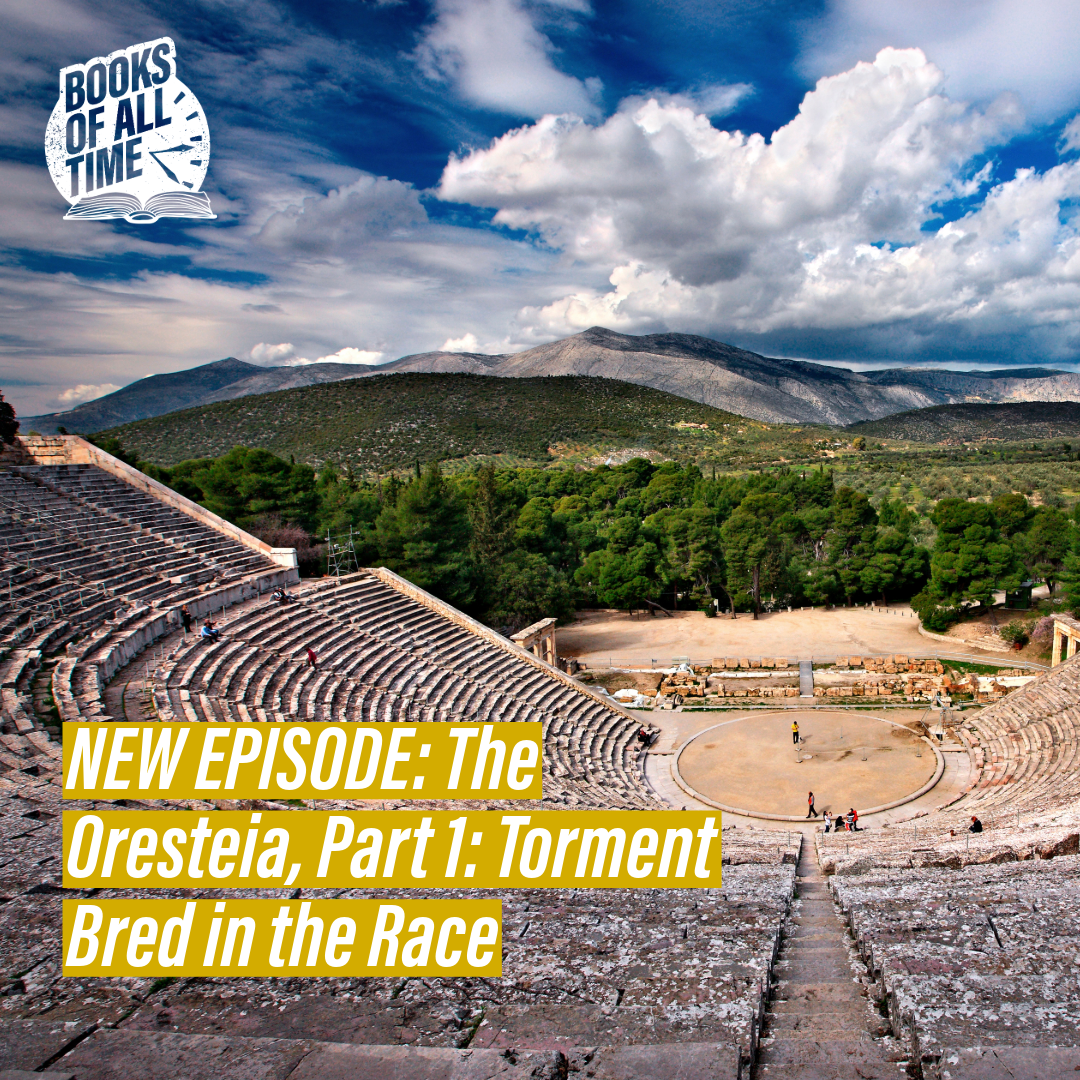
Books of All Time is a podcast that’s tackling classic literature in chronological order. This is episode 26: The Oresteia, Part 1 – Torment Bred in the Race. As always, if you want to read the transcript of this episode or see the references I used to write it, you can visit our website, www.booksofalltime.co.uk. There’s a link in the show notes if you need it. Let’s begin.
This week, we commence our journey into Greek drama, which is going to take up quite a bit of our time over the coming year. We’re starting in Athens in the fifth century BCE, where a murderer’s row of dramatic and comedic talent flourished over a period of about three generations, establishing story-telling templates and character arcs that inform our own stories today. They also established the forms and norms of theatre performance – roles, choruses, scenes – even clever and surprisingly sophisticated special effects.
But that’s me getting ahead of myself: we’ll cover the mechanics of Greek theatre in detail in our next episode. For now, we begin with the first of the great tragedians whose work survives to our time: Aeschylus. I’m pretty sure Aeschylus is the first author we’ve featured on this show who we know for a fact existed, and whose dates we can confidently state.
He was born in 525 BCE in Eleusis to a wealthy family, and over the course of his life, which ended in 456 BCE, he would witness the struggle between tyranny and democracy in Athens and take part in the wars against the encroaching Persian empire. He would be a vineyard worker, a celebrated war hero who saw action at the Battle of Marathon and the Battle of Salmis, and the author of somewhere between 70 and 90 plays.
Today we only have seven of those plays – or possibly six; one may have been written by his son.
Aeschylus was, in Aristotle’s reckoning, the father of tragedy. He was also a theatrical innovator, who expanded the number of actors on stage and established the convention of having actors in main roles interact with each other, not just with the chorus. Many of his works were written as competition entries for the City Dionysia, a festival held in Athens each spring. This festival would pit three tragedians against one another. Each poet would write three tragic plays and a satyr play – a burlesque, some light comic relief – and then a winner would be announced.
In The Greek Plays, [Lefkowitz and Romm] explain that theatre as we know it seems to have begun with the Greeks and possibly even with this particular festival. Quote:
“It was the ancient Athenians who gave to posterity the idea of role playing before a large audience, with trained actors reciting and singing written texts to musical accompaniment.” (Lefkowitz and Romm xvii)
They also note that these plays were more than entertainments for the wealthy: productions were mounted with public money (supplemented by private donations), and the performances were considered important as works of religious devotion as well as a way to promote general civic health.
The subject matter was drawn from the same body of epic poetry that fed the Iliad and the Odyssey, as well as drawing from those stories themselves. The dramatists did not depart wildly from the plots and characterizations of these legends, because, as Lefkowitz and Romm put it, “these stories were for them a kind of history.” (Lefkowitz and Romm xix)
The stories presented for the City Dionysia were always period pieces and always dealt with tragic events in the lives of a royal or noble family. The themes weren’t tragic for the sake of being tragic – instead, the performances were intended to “not only speak to the causes of human despair, [but] also provide the words that can bring at least a partial remedy.” (Lefkowitz and Romm xviii)
Interestingly, the Greek roots of the word tragedy itself have nothing to do with what we think of as the mood or themes of the genre. Instead, they seem to hint at the competitive art format from which these plays emerged. Tragōidia, according to Lefkowitz and Romm, “originally meant a song (ōidē) performed in a singing competition in which the winner took home a goat (tragos) – a significant prize in an agricultural society.” (Lefkowitz and Romm xviii)
Aeschylus, suffice it to say, got his goat more than once. Uniquely among the Athenian dramatists, Aeschylus wrote his three tragedies as if they were connected parts of a continuous story, rather than coming up with works drawn from three different myths, and this appears to have been an effective device. He is said to have won the Dionysia thirteen times, beginning with a victory for a trilogy that included his play Persians, the oldest known trilogy, in 484 BCE. The only complete trilogy of his we have appears to have been his last Dionysia winner. This is the Oresteia, staged in April of 458 BCE, when Aeschylus would have been in his sixties – a seasoned master of his craft.
The Oresteia trilogy takes its name from its most important character: Orestes, son of Agamemnon, king of Argos (or Mycenae). You may remember from our episodes on Homer that Agamemnon was the king who led the Greek coalition at Troy, and that he was, well, a piece of work. He’s the one who got the army cursed when he refused to release the daughter of a priest of Apollo whom he’d taken prisoner. He’s the one who pissed off Achilles by claiming Achilles’s preferred slave girl, Briseis, and he’s the one who had to beg Achilles to come back into the fight after the Greeks were pushed back to their ships by the Trojan defenders.
The Oresteia covers Agamemnon’s homecoming from Troy, though his fate has already been spoiled for us in the Odyssey. When Telemachus, son of Odysseus, sails around looking for his father, he talks to Menelaus and Helen – the Helen, the one whose elopement and/or abduction kicked off the Trojan War – and learns that Agamemnon has been murdered by his wife, Clytemnestra, who has in turn been murdered by her son, Orestes. That is the story Aeschylus covers in the Oresteia, which consists of three plays: Agamemnon, The Libation Bearers, and The Eumenides.
For this episode, I read two translations: first, the Penguin Classics edition by Robert Fagles, and the Faber edition by the late British poet Laureate Ted Hughes. Both of these are masterpieces, and I’ll be quoting from both as I go.
Let’s get into Agamemnon.
[music]
Agamemnon opens with a watchman complaining about his job. He’s stationed on the roof of the palace of Argos – Agamemnon’s palace – and he has spent the better part of ten years looking east from the roof. “I’m sick of the heavens, sick of the darkness,” he says in the Ted Hughes edition. Quote:
“The one light I wait for never comes.
Maybe it will never come –
A beacon-flare that leaps from peak to peak
Bringing the news from Troy –
Victory! After ten years, Victory!
The one word that Clytemnestra prays for.” (Hughes 3)
The watchman then muses on Clytemnestra’s character: he makes it clear she is a formidable woman who has kept order during Agamemnon’s long absence, but he hints at something dark at work there. She has “a man’s heart in a woman’s body,” he says (again, this is Hughes), “a man’s dreadful will in in the scabbard of her body,/ Like a polished blade, a hidden blade./Clytemnestra reigns over fear.” (Hughes 3)
He is just beginning to lament the lost days of peace before the war when he breaks off, because he has spotted it, far in the east, the kindling of a beacon in the distance. He capers about in glee, then runs offstage into the palace to tell the queen. We hear her cry of triumph, and then the chorus enters.
Now, we’ll get into the mechanics of what Greek choruses do and how their songs are structured in our next episode. For this episode, it’s enough to know these three things: First, Greek choruses represent a group of people who aren’t related to the main characters and don’t have a lot of power to influence the plot. Second, it’s their role to comment on what’s happening and provide backstory or context, sometimes by talking to the main characters or else by performing songs. Third, they always have a leader who does most of the talking. In Agamemnon, the chorus is made up of some old men of Argos – men who were too old to go off and fight.
“We are aged past aging,” they sing as they enter (at least per Fagles’s translation). Quote:
“Gloss of the leaf shrivelled
Three legs at a time we falter on,
Old men are children once again
A dream that sways and wavers
Into the hard light of day.” (Fagles 106)
The old men notice that Clytemnestra is up and about, lighting a fire at an altar in front of the palace as if she’s preparing for a ritual. “What’s all this then, your majesty?” they ask, but she ignores them and goes inside. So the Chorus launches into a long song about Agamemnon and Menelaus setting off for war, dwelling on how the armies, as they prepared to take ship, spotted two eagles in the sky.
It seemed like a positive omen until the eagles began to fight over a hare—a hare that, when the eagles tore it apart, turned out to be pregnant: the chorus describes the unborn babies dropping through the empty air. The seer Calchas who was travelling with the army sees this as a mixed omen: the Greeks would triumph, but at a terrible cost.
The down payment soon comes due. Contrary winds trap the Greeks in the harbor, and Calchas tells Agamemnon that they are being delayed due to the wrath of the goddess Artemis. Her price is a blood sacrifice, and the victim must be Agamemnon’s teenage daughter, Iphigeniea.
Agamemnon is torn: if he obeys Artemis, he must ritually sacrifice one of his children. If he defies the goddess, he must dismiss his armies and return home to Argos, sacrificing his honor. The Chorus reports his agonized debate with himself. Via Hughes, quote:
“If I obey the goddess, and kill my daughter –
What do I become?
A monster to myself, to the whole world,
And to all future time, a monster –
Wearing my daughter’s bloody dress
Like a turban. The King of cruelty.” (Hughes 13)
Agamemnon chooses honor.
The chorus describes the terrible hour. Iphigenia – probably a girl of thirteen or so – is carried to the altar by her father’s men: men who had known her since she was a child, men who had played with her, men she trusted. Her screams for mercy are not just distressing; they have the potential to ruin the ritual. So Agamemnon orders her gagged, stripped naked, and slaughtered like a sheep.
“What comes next?” the Chorus asks. They answer that question with the verse from the top of the show: Justice. Suffering. Wisdom.
The Chorus turns its attention back to Clytemnestra, who is back outside and is now aware of the old men of the city. “What gives?” they ask again.
“Troy has fallen at last,” she replies.
“No, really,” the Chorus says, “what is all this about?”
There’s some back-and-forth between the Queen and the leader of the Chorus, who displays an all-too-familiar unwillingness to believe the testimony of a woman. Eventually Clytemnestra has to spell it out for them, describing in detail the chain of beacon fires from Troy to Argos in a poetic version of that one scene from The Lord of the Rings: The Return of the King as directed by Peter Jackson.
Clytemnestra then indulges in some gruesome imagining of what the sack of Troy must have been like for its residents. Quote, from Ted Hughes:
“The women
Are kneeling; shoulders heaving, with eyes hidden,
Over what were yesterday
Husbands, fathers, sons.
They labor at a grief that is already
The first labor of slaves.” (Hughes 20)
Eesh. You begin to understand why everyone seems unnerved by this lady. You also can’t help but remember that Aeschylus, writing this, may himself have been inside a sacked city or two in his time, and may be writing from his own memories. The Oresteia is full of moments like this – moments that turn your guts briefly to ice water.
Anyway, Clytemnestra continues imagining the atrocities visited on the Trojans at length and with relish, until suddenly she seems to realize how very bloody she has revealed her thoughts to be. So she finishes up with:
“I speak as a woman, hear me:
Let the cycle of killing end here.
Murder for murder, evil for evil
Let this be the end of it.
And let our hope succeed. I
Have great hope.” (Hughes 21)
Uh huh. She re-enters the palace. The Chorus sing a song of praise to the gods for the victory, and recap the causus belli of the war for the benefit of anyone who might have forgotten: Helen, wife of Agamemnon’s brother Menelaus (and half-sister of Clytemnestra to boot: they shared a mother, but only Helen had Zeus for a father) elopes with Paris to Troy.
The Chorus relates the anguish of Menelaus at the loss of his wife, but then meditate on the greater grief of the people of Argos, many of whom have only had urns full of their loved ones’ ashes returned to them. Here’s a part of that song as translated by Robert Fagles. Quote:
“Heavy with tears, the urns brimmed full,
The heroes return in gold-dust,
dear, light ash for men, and they
weep. All for another’s woman, so they mutter
in secret and the rancour steals
towards our staunch defenders, Atreus’s sons.” (Fagles 119)
Tension is gathering in the city as well as in the palace. It’s then that the Herald arrives. He has come from Agamemnon’s army. He confirms the message of the beacons: victory is truly come, though it was a near-run thing. He relates a hair-raising tale of near-death on the voyage over the sea, which Ted Hughes renders like so:
“A hurricane skinned the sea.
Lifted it and folded it over.
Our ships mounted each other
In the tumbling tons of foam . . .
Dawn came windless over an oily calm.
The sun rose on an ocean clogged with wreckage
And bodies of men.
And there, in the thick of it all, we sat afloat.
Only a god’s help could have got us through it.
Some god had done a deal.” (Hughes 34)
The herald adds that Argos should prepare or the return of its king, and then runs off to rejoin the army.
The Chorus gets one more song in lamenting how Helen’s faithlessness caused all this death and destruction – no mention of Paris, of course – and then Agamemnon arrives. He is riding in a chariot. He is accompanied by an entourage – men bearing plunder, soldiers in arms, and, sitting impassively beside him in a chariot, a woman. She wears the regalia of a priestess of Apollo. She is Cassandra, princess of Troy. Agamemnon has brought her home as a trophy and concubine.
She is apparently hidden from the view of Clytemnestra, who now emerges from the palace to welcome her husband home after ten long years. She launches into a long soliloquy about the long nights of anxious sorrow she has endured, but there is a hint of a double meaning here, especially when she begins talking about their “missing child”. Quote, from Fagles:
“And so…
Our child is gone, not standing by our side,
The bond of our dearest pledges, mine and yours;
By all rights our child should be here.” (Fagles 136)
This seems to provoke a guilty reaction from Agamemnon, because Clytemnestra is quick to clarify: oh, I meant Orestes, our son. I sent him to be fostered in Phocis by a loyal friend of ours in case unrest broke out in the city. Did you think I meant some other missing child? Some other missing child who has a different, much more permanent reason not to be here?
At any rate, the queen orders her women to lay some cloths on the ground for her husband to walk on. These are not any cloths: these are costly red tapestries, richly embroidered: the kinds of tapestries which would normally only be displayed on a wall in the very best room. They represent hours of labor and vast outlay for materials. “Quickly,” she says to her women, quote:
“Let the red stream flow and bear him home
To the home he never hoped to see – Justice,
Lead him in!
Leave all the rest to me.
The spirit within me never yields to sleep,
We will set things right, with the god’s help.
We will do whatever fate requires.” (Fagles 137)
Sounds good to me, Clytemnestra! Not picking up on any ominous vibes there at all. You just want your husband to walk across a symbolic river of blood as he returns home from war, and I’m sure that sleepless spirit you mentioned was just the result of pining for your husband, not brooding over any heinous crime he might’ve committed in the past.
At any rate, Agamemnon refuses to walk on the tapestries. There is hubris in an act like this – hubris that could get him zapped by an irritated god. There is also the fact that Persian potentates, enemies of Greece, like doing this kind of thing. In refusing to walk on the tapestries, Agamemnon tells his wife, “I have a sense of right and wrong… Once I violate [my ideals], I am lost.” (Fagles 138)
Can you believe this guy? Even if he hadn’t ritualistically murdered his daughter to improve the weather, somewhere in Hades there are quite a few Greeks and Trojans who would beg to differ about Agamemnon’s adherence to any kind of ideal, chief among them Achilles. But he is at last convinced to step down onto the tapestries and walk into the palace.
However. When he climbs out of the chariot, Clytemnestra spots Cassandra sitting there.
“Oh, her,” says Agamemnon, “just one of King Priam’s daughters who I picked up in Troy. Send her down with the other slave girls, won’t you, honey?” And into the palace he goes.
Clytemnestra – and even at a distance of 2400 years you can hear her grinding her teeth – tries to wheedle her husband’s young mistress out of the chariot.
“This is no time for pride. Why, even Heracles,
They say, was sold into bondage long ago,
He had to endure the bitter bread of slaves…
From us
You will receive what custom says is right.” (Fagles 143)
Again, I’m sure there’s no double meaning there. But Cassandra sits unmoving in the chariot, so Clytemnestra eventually gives up and goes inside. There are rituals of thanksgiving to prepare, and her husband needs a bath drawn for him after his long journey.
The Chorus steps in to try to get Cassandra to come out of the chariot. Instead, she begins screaming and screaming and screaming to Apollo. The Chorus Leader tries to calm her down, get some sense out of her, but she is in the grip of a dreadful vision. She tells them that she has come to, quote:
“The house that hates God
An echoing womb of guile, kinsmen
Torturing kinsmen, severed heads,
Slaughterhouse of heroes, soil streaming blood—” (Fagles 145)
We get a long series of exchanges between Cassandra and the old men of the chorus as they try to reason with her to calm down, or maybe keep these thoughts to herself, while she shrieks about horrors, tangling up the past, present, and future as she does so. We learn that she is cursed by Apollo for having the temerity to refuse to sleep with him: she will see the future truly, but nobody will ever believe her visions until it’s too late.
Instead of realizing she is warning them about the imminent death of their king (and of Cassandra herself), the Chorus focuses on the backstory she’s revealing. Talking among themselves, they explain how part of what she’s screaming about is the history of Agamemnon’s family, the house of Atreus, famous in part because two of the previous family leaders tricked people into eating a stew made of their own kidnapped children.
Robert Fagles puts it like this in his long introductory essay to the Oresteia: “The house of Atreus is the embodiment of savagery. No other Greek family can rival it for its accumulated atrocities.” (Fagles 14) And more of those are yet to come: Cassandra fortells of blood and slaughter, a man murdered in the bath by his own wife. She sees the Furies, spirits of vengeance, clustering above the palace roof. And she also sees retribution for Agamemnon to come. Quote, from Fagles:
“We will die,
But not without some honor from the gods.
There will come another to avenge us,
Born to kill his mother, born
His father’s champion.” (Fagles 155)
This refers, of course, to Orestes.
The Chorus mutter to themselves: what could all of this mean? And honestly even setting aside the confounding factor of Apollo’s curse on Cassandra, I feel like these guys would still struggle to understand her: they tut and tone-police her and all but say “cheer up, love, it might never happen.”
Cassandra, resigned to her fate, steps down from the chariot.
“This was life,” she says in Hughes’s edition:
“The luckiest hours
Like scribbles in chalk
On a slate in a classroom.
We stare
And try to understand them.
Then luck turns its back –
And everything’s wiped out.
Joy was not less pathetic
Than the worst grief.” (Hughes 65)
She goes in. Almost immediately, we hear Agamemnon shrieking from within the palace. The men of the chorus run about the stage in confusion and fear: who was that? Was it the king? What should we do?
But before they can get their act together, the doors of the palace open, and two bodies are wheeled out: Agamemnon’s and Cassandra’s. Clytemnestra, hands stained with blood, justifies herself to the Chorus:
“He ripped my daughter’s throat and shook the blood out of her.
To gratify his whimpering love-sick brother
And catch a runaway whore.
Why didn’t you judge Agamemnon?” (Hughes 71)
Indeed, madame. The Chorus call her evil, demand the right to mourn Agamemnon, but they are ultimately commentators, not a force for change, and they yield to the tyrant, lamenting:
“Where is the right and wrong
in this nightmare?
Each becomes the ghost of the other.
Each is driven mad by the ghost of the other.
Who can reason it out?” (Hughes 77)
Then out of the palace comes a man. This is Aegisthus, who is Agamemnon’s cousin. He reminds the audience that he also has beef against Agamemnon: his father Thyestes was tricked into eating some of his other children by his – Thyestes’s – older brother Atreus, the father of Agamemnon. He welcomes the justice dealt out to the king, and also mentions, by the by, that he’s been sleeping with Clytemnestra for pretty much the entire duration of the Trojan War.
The Chorus are almost roused into action by this – almost – but are ultimately unable to bring themselves to start a civil war. Instead, the Chorus bellows impotently that Orestes will have his own back someday. Clytemnestra and Aegisthus scoff at them, and go back into the palace to begin their reign of terror. Thus ends Agamemnon.
[music]
Next, the Libation Bearers. The action kicks off several years after the events depicted in Agamemnon. We are some way outside Argos at the tomb of the slaughtered king as a young man arrives to pay his respects: this is Orestes, son of Agamemnon and Clytemnestra, now grown to early manhood and returning from his exile in Phocis. He is a young royalty, so of course he has an attendant: Pylades, a younger son of the king of Phocis, a strong, silent type.
Orestes lays two locks of his hair on Agamemnon’s tomb, expressing his regret that he was not of an age to prevent his father’s slaughter, nor to lead the mourning at the funeral. But as he is about to warm up into a longer soliloquy, he sees some women approaching with jugs and cups. He and Pylades conceal themselves nearby and wait to see what these women are about.
These are the eponymous libation bearers: slave women paid to visit the tombs of the noble dead and pour out wine or oil to nourish and honor the spirit. They are old, dressed in black, and their cheeks bear the scars and scratches of their own fingernails – ghastly furrows running with blood.
They sing. They tell how they have been sent here by Clytemnestra, who is trying to lay the ghost of Agamemnon. Quote from Fagles:
“Bristling Terror struck –
The seer of the house,
the nightmare ringing clear
breathed its wrath in sleep,
in the midnight watch a cry! …
‘The proud dead stir under earth,
They rage against the ones who took their lives.’” (Fagles 179)
Among these professional mourners is a young noblewoman: Electra, the youngest daughter of Agamemnon and Clytemnestra. With a bitter heart she asks the women to tell her what she should say when she prays to her father’s spirit:
“Shall I say I bring him love for love, a woman’s
love for husband? My mother, love from her?…
Or try the salute we often use at graves?
‘A wreath for a wreath. Now bring the givers
gifts to match.’ No. Give them pain for pain.” (Fagles 180)
The leader of the Chorus suggests that Electra pray for the return of her brother Orestes. Electra seizes on this suggestion, and launches into a long song of prayer to her father’s ghost, begging him to bring Orestes home so that Agamemnon’s murder can be avenged – and also asking him to ensure she does not grow up to be like her mother.
As Electra pours out her libations, she notices the locks of hair on the grave. She immediately guesses that these belong to her brother, and after an argument about it with the leader of the Chorus she also spots some footprints. She is stepping in them, tracing the path back around the grave, when Orestes reveals himself.
These two siblings have been separated since they were very small, and Orestes is obliged to provide Electra with many reassurances before she will trust it’s him. He compares the similarities between their hair, their hands, their feet. And when she finally believes him, she is in raptures. From Ted Hughes, quote:
“It is your face, Orestes.
The face of my four joys –
All that remains of our father;
All that remains of our mother – who became
The murderess of our mother
When she murdered our father;
All that remains of our sister,
Iphigenia, sacrificed so lightly
For a puff of air –
Three vessels of love
Poured into you, my fourth.” (Hughes 102)
Now the siblings launch into a series of exchanges in which they pray to Zeus together to strengthen and guide Orestes as he pursues vengeance for Agamemnon. These exchanges are long and beautiful, but they seem mainly focused on fulfilling a religious purpose rather than developing character or moving the plot. And that’s fine – I’m just letting you know that the Libation Bearers spins its wheels a bit in these sections.
We glean two pieces of information from the siblings in these prayers: first, Orestes has been charged with his mission to return from exile by none other than the Oracle of Delphi. Two, Clytemnestra, when she can snatch a little sleep between the screams of her husband’s ghost, has nightmares that she gives birth to a snake that bites her breast when she nurses it, killing her.
The chorus is terrified that these two innocent young people, who are bound by so much pain and loss, should be sliding toward vengeance. But they recognize the stain of the house of Atreus working in them. From Fagles, quote:
“The flesh crawls to hear them pray.
The hour of doom has waited long…
pray for it once, and oh my god, it comes.
Oh, the torment bred in the race,
the grinding scream of death
and the stroke that hits the vein,
the hemmorhage none can staunch, the grief,
the curse no man can bear.” (Fagles 197-98)
Throughout all of this, Pylades has no comment.
Orestes decides to be the serpent his mother has dreamed of. He sends Electra ahead of him to the palace to pretend nothing has happened, then follows her, pretending he is a messenger from Phocis with bad news for the lady of the house.
Clytemnestra comes out to meet him. She does not recognize him. He tells her Orestes is dead, and that the king of Phocis would like to know whether the queen wants his ashes sent back to Argos.
Clytemnestra is staggered by this, but does not break completely. She reveals that she sent Orestes away from Argos in part because she thought he might avoid the curse of the house of Atreus if he were raised elsewhere:
“And he was trained so well, we’d been so careful,
kept his footsteps clear of the quicksand of death.” (Fagles 207)
In spite of the shattering news this apparent stranger has brought her, Clytemnestra offers the young man and his friend hospitality in the palace. The boys go in. The Chorus come out and sing about how they hope Orestes will have the strength to follow through with his plan when a woman, an old nurse called Cilissa, comes out of the palace in tears.
She tells the chorus she has heard her dear boy Orestes is dead, and that while Clytemnestra is in pain, Aegisthus is quite pleased, and he’s planning to go see the messenger who brought the news – accompanied by his usual bodyguards.
Here the chorus do something they do not often do in Greek drama: they intervene. They get Cilissa to go back into the house and convince Aegisthus not to take a bodyguard with him. She leaves, and the Chorus sing again, this time imploring Zeus and Apollo and Hermes to strengthen Orestes’s resolve. From Fagles, quote:
“When your turn in the action comes, be strong.
When she cries ‘Son!’ cry out ‘My father’s son!’
Go through with the murder – innocent at last.” (Fagles 213)
Aegisthus comes out of the palace alone. He asks the leader of the chorus if she’s heard the news about Orestes. Did she see the messenger? Does she believe it? The leader encourages him to go find the messenger and see for himself. Aegisthus returns into the palace, and we soon hear a scream from inside, as is customary – the Ancient Greeks preferred to keep the most violent action offstage.
Clytemnestra comes rushing out at the noise, along with servants who claim there’s an avenging ghost afoot. Scoffing at them, she arms herself with an axe as the doors of the palace open, revealing Orestes, bloody sword in hand, standing over Aegisthus’s corpse.
Pylades stands nearby. He has no comment.
Clytemnestra recognizes her son as he seizes her. She pulls out her breast and shows it to him, quote:
“No respect for this, my child?
The breast you held, drowsing away the hours,
soft gums tugging the milk that made you grow?” (Fagles 216)
Orestes hesitates. Pylades finally has a comment: Apollo told you to do it, so you must. “Make all mankind your enemy,” he says, “[but] not the gods.” (Fagles 217)
Orestes drags his mother back into the palace. The chorus sings a song of triumph, glad that Clytemnestra and Aegisthus will pay for their crimes at last. The doors of the palace open again, and two bodies are revealed – this time Clytemnestra and Aegisthus instead of Cassandra and Agamemnon. Orestes owns up to what he has done, but he rapidly begins to break down. First he tries talking himself down: of course his mother deserved this, of course it was his duty – then talking himself up: what will he do now? Quote:
“And still, while I still have some self-control,
I say to my friends in public: I killed my mother,
not with a little justice. She was stained
with father’s murder, she was cursed by god.” (Fagles 224)
But he can’t quite bring himself to believe this. He babbles about going back to Delphi, he seems to give up the throne of Argos, and then he screams in terror, because he can suddenly see what Cassandra saw, whirling around the roof of the palace:
“No, no! Women – look – like Gorgons,
shrouded in black, their heads wreathed,
swarming serpents!” (Fagles 225)
They are the Furies, goddesses of retribution. Orestes flees, pursued by these horrors as the Chorus of libation bearers asks:
“Where will it end?
Where will it sink to sleep and rest,
This murderous hate, this Fury?” (Fagles 226)
[music]
Finally, The Eumenides. We move now from Argos to Delphi, before the temple of Apollo. It is some months after Orestes’s revenge-killing of his mother and his lover, and we begin with the Pythia, the priestess of Apollo, beginning another day of duties as a prophet of the God. She praises him and Dionysus and Athena, Poseidon and Zeus, and then turns to the audience. In a nice little bit of breaking the fourth wall, she asks:
“Where are the Greeks among you? Draw your lots and enter.
It is the custom here. I will tell the future
only as the god will lead the way.” (Fagles 232)
She goes inside the temple and immediately comes back out on her hands and knees, shaken to the core by some vision. She tells the audience she has seen a man inside the temple, sitting in the place where suppliants wait to be purged. His hands are dripping blood. He carries a sword. And he isn’t alone:
“But there in a ring around the man, an amazing company –
women, sleeping, nestling against the benches . . .
women? No,
Gorgons I’d call them.” (Fagles 233)
Poor Orestes. The temple doors open to reveal Orestes kneeling before a sacred stone that was kept at the temple of Apollo, known as the “navelstone” because it was believed to mark the center of the earth. Apollo is hovering above Orestes: after hearing of the will of the gods, or hearing others call upon the gods, we are at last in this final act of the Oresteia about to hear from the gods themselves.
Apollo reveals that it is he who has put the Furies to sleep for now. We also learn that Orestes has been journeying from shrine to shrine for months, trying to purge himself of his sins.
Apollo has bad news and good news. The bad news: the Furies will never stop hunting Orestes.
“Deep in the endless heartland they will drive you,
striding horizons, feet pounding the earth for ever,
on, on over seas and cities swept by tides!” (Fagles 235)
The good news is that there can be an end to this if Orestes goes to the Acropolis in Athens and begs for Athena’s mercy. Apollo summons Hermes, the messenger god, to escort Orestes to Athens as quickly as he can. Orestes leaves. His mother’s ghost appears in the shrine of Apollo, grabs the leader of the Furies and tries to shake her awake.
“Can sleep overpower the Furies?” Clytemnestra’s ghost demands in the Hughes edition. Quote:
“Have you forgotten my pain?
Strip his conscience naked
With your whips of words dipped in acid.
Deafen him
With blasts of outrage and execration
From your wombs…
Hunt him into his grave.” (Hughes 152-153)
The Furies – they’re the chorus in this part of the trilogy – are roused. They immediately begin laying into Apollo for using his powers to put them to sleep. Do you remember your Hesiod? The Furies come from an older generation of gods – they are the children of Titans, specifically the goddess Night, and they resent this younger generation sprung from Zeus and his brothers, who are constantly trying to change the way the world works. Quote:
“Blame the new gods
Who buried the older powers
Under the floors of their own shrines
And ruled from new altars –
Altars drenched with blood.” (Hughes 154)
Apollo isn’t in the mood for their guilt-tripping. He calls them the defilers and tells them to get out of his temple. The Furies insist it is their right to pursue people who kill their mothers. Apollo counters this: Shouldn’t a woman who kills her husband, like Clytemnestra did, also be pursued by the Furies? The Furies reply that a spouse isn’t your own flesh and blood, so while killing a spouse would be a crime, it isn’t sacrilege.
Apollo is incredulous: not sacrilege to murder someone you married before the gods? And what about the murder of a father, do children not have a duty to avenge that?
“The earth is like a mad elephant
When a son murders his mother
But the same earth is deaf
When the father is murdered by the mother,
And deaf again when the son avenges his father.
This may be the law of the earth
But it is not human justice.
Only Athena, great Goddess of Wisdom,
Can judge this. She shall hear our call.” (Hughes 158)
So the scene moves to the Acropolis, to the temple of Athena. Orestes has arrived first. He prays to Athena not for cleansing, but for judgement as Apollo has ordered. But the Furies have caught up to him, tracking him into the temple like bloodhounds. “The smell of his mother’s womb clings to his heels/ And sweats from his instep,” they say in the Hughes edition. (Hughes 159) They tell him it’s time for him to pay for what he has done, but he has gained some self-control thanks to the intervention of Apollo on his behalf.
And his prayer to Athena works: she turns up and takes in the scene and demands an explanation. The Furies are blunt: this guy killed his mother. By law, he’s ours. Orestes appeals to his family connection: you knew my father Agamemnon; you intervened on his behalf at Troy. He was brutally murdered by my mother; Apollo ordered me to avenge him.
Huh, says Athena, quote:
“This case is too deep for a man.
Nor should I let the law, like an axe,
Fall mechanically on a murderer…
But your accusers have to be heard.
And if their case fails – what happens to their anger?
It whirls up into the air, it blackens heaven,
It falls like a plague on Athens.” (Hughes 168-169)
She decides to innovate: she summons 12 of the wisest citizens of Athens to sit as jury in the first-ever court trial.
“What is this namby-pamby liberal nonsense?” shriek the Furies. Quote:
“If this new jury, by some juggling.
Exculpate this killer,
His example will become a model –
A license for homicides …
Murder shall be relieved
Of its conscience –
While the citizens cower in their houses.” (Hughes 169)
But Athena goes ahead anyway. The jury is seated. Apollo arrives, ready to testify on Orestes’s behalf. The Furies get to question Orestes first, however. He does not deny that he killed his mother, but he insists that he did so at the behest of Apollo, and he couldn’t disobey the god.
Apollo is questioned by the Furies next. He says that he was also acting on orders: those of Zeus. The Furies are incredulous. Zeus decided this was permissible? He didn’t think Clytemnestra had a legitimate grievance against her husband for the murder of Iphigeneia?
Apollo says that Agamemnon was a divinely anointed king, and recounts how Clytemnestra murdered him: she took Agamemnon unawares in the bath, winding him up in a robe and then stabbing him.
“Citizens, and you who sit in on the jury,” Apollo says, quote:
“This was how the father of Orestes died,
Whose royal eye had launched the vast fleet
And steered a whole army across oceans.” (Hughes 176)
The Furies scoff at this: they can’t imagine that Zeus cares all that much for the fate of fathers, given that he castrated his own. Apollo insists that women are simply vessels for the father’s seed, and may even be unnecessary – after all, didn’t Athena spring fully formed from her own father’s head?
Speaking of Athena, she now tells the jury to deliberate and then cast their votes, reminding them that history is watching:
“I open on this rock
The pure spring of my laws.
Do not taint them
By any expedient shift for advantages.
Protect this court
Which will protect you all
From the headstrong license of any man’s will
And from slavery.” (Hughes 178)
The jury’s votes are tied. Athena, citing the fact that she herself had no mother, acts as tiebreaker, and Orestes is acquitted. He praises Athena, swearing an undying alliance between the people of Argos and the people of Athens forever. He departs for home, accompanied by Apollo.
The Furies are, well, you know. They confront Athena – threaten her, really – shrieking that she has turned justice on its head and deprived them of their rights. They sing:
“You, you younger gods! You have ridden down
the ancient laws, wrenched them from my grasp –
and I, robbed of my birthright, suffering, great with wrath,
I loose my poison over the soil…” (Fagles 267)
There follows a long series of exchanges where Athena gently but firmly persuades the Furies – laying on a lot of flattery about how much older and wiser they are than her – to give up tribal bloodlust and establish a new home in Athens. There, they can become agents of peace, not retribution. They can become beloved spirits of marriage and childbirth – no longer the Erinyes, the Furies, but the Eumenides – the Kindly Ones.
Her persuasion works. Calmed by her words, they do not riot: instead, they embrace the new role with joy, and Athena closes the trilogy with song:
“Pour out the wine.
Let the pine bough crack and blaze.
Zeus, Father of All,
Guards the city of Athens.
So God and Fate, in a divine marriage,
Are made one in the flesh
Of all our people –
And the voice of their shout is single and holy.” (Hughes 194)
So ends the Oresteia of Aeschylus. No shade to Homer, but it has affected me more than anything else we’ve read from ancient Greece to date. Maybe that’s because its themes are painfully timely. Maybe it’s also because the rule of law it holds up as so revolutionary and sacred is so very obviously flawed: Apollo’s argument about mothers not being really related to their children is ridiculous on its face, and Athena’s intervention in the voting is also very biased. But even a flawed rule of law is better than none.
In a 2016 episode of BBC Radio 4’s In Our Time about the Oresteia, Simon Goldhill of the University of Cambridge said that, “This isn’t simple literature for easy answers. It’s a complex, tragic, often despairing vision. It’s a vision we need if we’re going to make sense of the world.”
Visions, it’s true, can help us understand how we came to where we are. As Orestes discovered, however, they don’t necessarily show us when or how to act. That’s the tricky part. That’s where we must fumble forward, helped now and then in times of tragedy by the poets of the past.
[music]
That’s it for this week’s episode. If you would like to read the Oresteia for yourself, Ted Hughes’s edition for Faber was by far the more viscerally affecting of the two I read. Fagles’s is also beautiful, and has the added advantage of including more stage direction in it, but the earthy, muscly poetry of Hughes is really hard to deny. You yourself start having visions. You almost don’t need to imagine the action on stage.
Speaking of the ancient Greek stage, our next episode will go deeper into how theatre worked in classical Athens, from the writing to the actors to – yes – the special effects. Join me on Thursday, March 6th for episode 27: “The Oresteia, Part 2: Deus Ex Machina.”
Books of All Time is written and produced by me, Rose Judson. The Disclaimer Voice of Doom is Ed Brown. Lluvia Arras designed our cover art and logo. Special thanks to Yelena Shapiro, Cathy Merli, Matt Brough, John Cole and the Books of All Time Advisory Council: Ed Brown, Beck Collins, Neil Dowling, Caitlin McMullin, Hugh Parker, and Jonathan Skipp. You can support the show by subscribing and leaving a rating or review at Apple Podcasts, Spotify, or wherever you get your podcasts. You can also follow us on social media: we’re on Bluesky, Instagram and Facebook. Thanks for listening! I’ll be back in two weeks.
References and Works Cited:
Aeschylus, and Ted Hughes. The Oresteia. Faber, 1999.
Aeschylus. The Oresteia. Edited by William Bedell Stanford. Translated by Robert Fagles, Penguin Books, 1984.
Hall, Edith. Greek Tragedy: Suffering under the Sun. Oxford University Press, 2010.
Higgins, Will. “April 4, 1968: How RFK Saved Indianapolis.” Indianapolis Star, 2 Apr. 2015, web.archive.org/web/20160823215224/www.indystar.com/story/life/2015/04/02/april-rfk-saved-indianapolis/70817218/.
Ryckaert, Vic. “Remembering Robert F. Kennedy’s Historic MLK Speech.” Indianapolis Star, 30 Mar. 2016, web.archive.org/web/20160823214623/www.indystar.com/story/news/2016/03/30/remebering-robert-f-kennedys-historic-mlk-speech/82416498/.
Vellacott, Philip. “Aeschylus’ Orestes.” The Classical World, vol. 77, no. 3, 1984, pp. 145–157, https://doi.org/10.2307/4349540.


 Books Of All Time
Leave a comment