
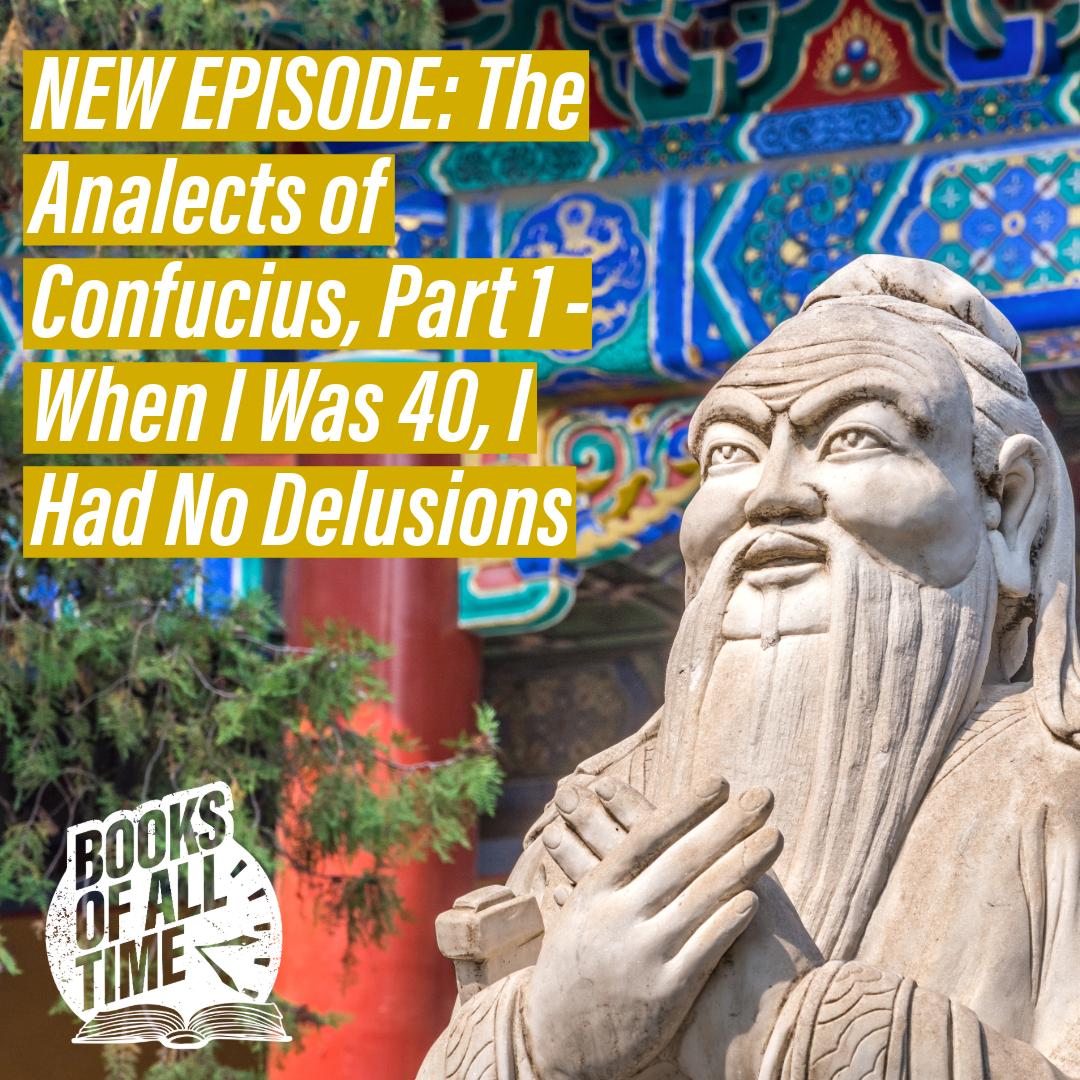
“At fifteen, I set my heart on learning. At thirty, I found my balance through the rites. At 40, I had no delusions. At fifty, I understood what Heaven intended me to do. At sixty, I was attuned to what I heard. At seventy, I followed what my heart desired without overstepping the line.” (Confucius 2.3, Chin 13)
When I was younger and more ambitious – and still living in America – I entertained the possibility of joining the U.S. Foreign Service. On investigating the idea, however, I realized that it probably wasn’t feasible. I didn’t have the right kind of degree from the right kind of university; I didn’t have much facility with foreign languages, and, to be perfectly candid, I didn’t fancy taking the notoriously difficult exam that’s required. I was a child of the 90s, when standardized testing became an annual rite of passage. Even though I was very good at test-taking, at that point in my early 20s, I would have preferred to eat a nice big bowl of scabs rather than face another exam.
More fool me, maybe. I sometimes wonder who I’d be now if I had gone for it. I bring this up not to do therapy at you, but because researching this week’s episode got me thinking about civil service examinations. I never realized how long and venerable the practice of making aspiring leaders sit an exam really is. In China, for instance, it goes back at least 1,400 years.
There had long been a competitive process for entering government service – during the Zhou dynasty, which ended around 256 BCE, officials had to pass a practical exam that included, among other things, archery. The Han dynasty, which ended around 200 CE, introduced written exams for certain positions at the emperor’s court. For the next 700 years the exams waxed and waned, but they really took off with the Song dynasty, which began in 960 CE. Now, instead of certain court officials needing to take the exam, they were required at every level of the bureaucracy: county, provincial, and court.
According to a webpage on the Imperial Exam system written by scholars at Columbia University, “even a youth from the poorest family could theoretically join the ranks of the educated elite by succeeding in the examination system.” Boys would sit the county-level exam at their county seat. If they passed that, they gained a xiucai degree. Then they would travel to the provincial capitol to take the provincial exam, earning the juren degree if successful. The highest-level exam took place in the imperial palace. Candidates who passed that exam earned the jinshi degree, and were immediately launched into the ranks of the country’s scholarly elite.
The Imperial Civil Service examination promoted a much broader attainment of literacy – at least among boys – than China had ever experienced before. Its utility for identifying talented young people from disadvantaged backgrounds inspired other nations to adopt their own versions of it – this included China’s near neighbors, such as Japan, and also organizations much further afield, such as the British East India Company.
And what was the curriculum for this examination in China? We have a pretty good idea, because the Imperial civil service exam lasted until 1905. It did not test one’s ability to read or set a budget, or mastery of geography, or knowledge of specific government roles and functions. Instead, it focused on a student’s ability to understand and interpret a body of literature produced by – or inspired by – an itinerant philosopher who’d died in 479 BCE.
This philosopher never held a high government post himself, but his ideas about traditional morality and its necessity to the orderly running of a state took hold in a group of passionate disciples, then spread. Over the generations, hundreds of thousands of young men studied his teachings to pass their exams, and many of them probably even tried to live up to them. Perhaps no single educator in world history has had the lasting influence of the old master, Kong Qiu – known here in the west as Confucius.
I’m Rose Judson. Welcome to Books of All Time.
Books of All Time is a podcast that’s tackling classic literature in chronological order. This is episode 20: The Analects of Confucius, Part 1: When I Was 40, I Had No Delusions. As always, if you want to read the transcript of this episode or see the references I used to write it, you can visit our website, www.booksofalltime.co.uk. There’s a link in the show notes if you need it. Let’s begin.
This week we are expanding the world map of the show. To date, we’ve been circumambulating the same five-ish cultures, all rooted in North Africa and the Middle East, the Mediterranean, and South Asia. Now we’re moving to East Asia. But while we’re taking a leap in terms of distance, we’re not moving forward very much in time from our girl Sappho. Confucius was born around 551 BCE, about 20 years after it’s believed Sappho died. Confucius then died in 479 BCE, and his life was roughly contemporaneous with some of the other greats of Classical Greece: the philosopher Socrates, the dramatists Aeschylus and Sophocles. The historian Herodotus would have been a small boy when Confucius died.
China at this time was in a period of great turbulence. The Chinese call this age of their history from the Spring and Autumn Period¸ a roughly 300-year span from 770 to 481 BCE, when the Zhou dynasty which ruled much of China was collapsing, and its former vassal states were beginning to jockey for supremacy. The Spring and Autumn Period was swiftly followed by the Warring States Period, so I think you can imagine how that all shook out for China.
Regardless, this was the time of Confucius. According to the scholar D.C. Lau, who translated the 1979 edition of The Analects for Penguin Classics, Confucius was from a family on the fringes of Chinese nobility. They had a good name, but not much else to show for it. Confucius – and that’s a westernized form of his name, by the way: in Chinese he would have been Kong Qiu, or K’ung Ch’iu, or possibly K’ung Chung-ni – became an orphan when still just a boy. Little is known of his youth beyond what he says about himself: that he was poor and devoted to learning. (Lau 9)
This learning bore some fruit, because around 500 BCE Confucius pops up in the historical record, serving as minister of crime – a relatively minor administrative position – for Duke Ting of Lu, a province in Eastern China. (Lau 9-10) Confucius left his position under unclear circumstances. According to some sources, he may have been scandalized by his overlord’s decision to accept a gift of dancing girls, or he may have been offended by his colleagues’ failure to observe correct procedure during a sacrificial rite. Either way, he was out of a job. He did what many modern political personalities do after jumping ship from an administration: he put out his shingle as a political consultant and went looking for work. (Lau 10)
For about 14 years he travelled from court to court, trying to convince this or that duke to take him on as an advisor. By the time he was about 68 years old, however, he realized his brand of philosophy wasn’t attractive to the rulers of the day. “None of the regional rulers,” says Annping Chin in her introduction to her 2014 translation of The Analects – again for Penguin Classics – “was interested in the security of the empire or the idea of the greater good.” (Chin xxii)
The greater good was Confucius’s obsession, and he had a very particular idea of how to promote it – a particular idea that involved rulers striving toward moral perfection and returning to the ritual practices of their ancestors – specifically those from the early Zhou dynasty, when things were relatively settled and harmonious.
However, according to Daniel Gardner, the author of Confucianism: A Very Short Introduction, power was maintained at this time “not through moral behavior and genuine concern for the people but through laws, punishments, and force.” (Gardner 1) In a 2001 episode of BBC Radio 4’s In Our Time, Tim Barrett of SOAS at the University of London argued along the same lines, saying that “the way the world was going at that time was more and more toward sheer efficiency,” by which he meant “military efficiency” – smashing your rivals. In this environment, Confucius’s insistence on the cultivation of education and humane attitudes toward others was, to put it mildly, unpopular. To the rulers Confucius tried to sway to his way of thinking, according to Barrett, his ideas “looked just plain silly.” (In Our Time)
Disillusioned by the political climate of his times, Confucius then did another thing we see political functionaries do once they’ve left behind the cut-and-thrust of being in government: he started teaching. He began to gather a group of followers, younger men whom he hoped would “embrace his political ideals and go on to succeed in official life where he himself had failed.” (Gardener 3). Gardner notes that most accounts say Confucius had 72 disciples, and Annping Chin notes that they came from a cross-section of Chinese society: “sons of aristocrats, children of common gentlemen, farmers, artisans, criminals, and sons of criminals.” (Chin xxvii)
It was these disciples who gave us the work we now know as the Analects, which were probably complied not long after Confucius died under the direction of people who knew him personally. Called the “Lunyu” in Chinese, the Analects are a collection of 20 books – chapters really – of the sayings of Confucius. These 20 books cover roughly 500 verses, and they span topics from music and poetry to tax policy during famine and the correct way to conduct a sacrifice.
Some of the sayings in the Analects are drawn from lectures Confucius gave, others from conversations he had, or anecdotes about him. They are by turns chatty and profound, gossipy and gnomic. They are, according to Annping Chin, the product of a community that not only wanted to preserve the wisdom of the Master so that it could be passed on to new generations, but also, in part, to capture what it was like to know Confucius as a person, and what it was like to be part of his community.
For example, there are anecdotes about him insisting that a gentleman should never wear scarlet at home, or that he was so fussy about the placement of his sleeping mat that he couldn’t sleep unless it was aligned properly. (In Our Time) There’s also a very funny passage in Book 14 in which Confucius sees one of his disciples sitting with his legs wide apart – manspreading, as we’d now call it – and hits him with a stick to make him stop, but not until he’d remarked “To be neither modest nor deferential when young, to have passed on nothing worthwhile when grown up, and to refuse to die when old: that is what I call a pest.” (14.43, Lau 131)
The personality that shines through the pages of the Analects is admirable and lovable – worthy of the respect of scholars. The result of his disciples’ devotion is “the single most important book in the history of China.” (Chin vii)
The Analects are, as I’ve said, wide-ranging. You often can’t find a coherent theme in any given chapter. But several major ideas come through repeatedly. What we’ll do in today’s episode is explore a few of those ideas, illustrated with selected passages from the Analects. For the last two thousand years, most people who come to study Confucius have had to rely on commentators to unpick the meaning or the context of a particular verse, so we’re not doing anything too radical here by taking this approach.
What are the themes we’ll cover? Well, according to the Analects:
“The Master instructs under four heads: culture, moral conduct, doing one’s best, and being trustworthy in what one says.” (Analects 7.25, Lau 89)
Confucius was convinced that learning could shape the character of the nation’s leaders – particularly learning rooted in the culture and history of the past. He felt that constant self-examination was part of learning. He had an idea about a state of moral perfection – ren, was his term for it – which men ought to strive for throughout that education. And he firmly believed that “the moral resolve of a few could favorably affect the fate of many.” (Chin xxiii) His goal was to create “a moral vanguard” of individuals who could influence the aristocracy. (Gardener 16) A wise, educated ruler, Confucius insisted, would encourage morality in his people and harmony in his state.
That may have sounded plain silly to the leaders of Confucius’s time. To me, here, in mid-November of 2024, it sounds like bitter irony.
[music]
So, let’s tackle two topics at once: culture and doing one’s best – for Confucius, these two things form the backbone of an education. By “education,” Confucius means more than the mere acquisition of technical skills or knowledge. He’s referring to more of a holistic process – a refining and strengthening of one’s own moral character and one’s intellect through the study of history and a dedication to specific cultural practices. And this holistic process begins by internalizing and understanding the wisdom of the past. In the first verse of Book 7, Confucius says: “I transmit but do not innovate. I love antiquity and have faith in it.” (Chin 97)
In spite of that declaration, Confucius was an innovator in one regard: he felt that education should be offered to anyone who wanted it regardless of their social station in life. “In instruction,” Confucius says in book 15, “there are to be no distinctions of status.” (Gardner 19) While Confucius himself was able to practice what he preached, given the socioeconomic diversity of his own disciple group, the reality was that education was out of reach for many of the subsistence farmers who made up most of the Chinese population at this time. As Confucius himself said in Book 8 of the Analects: “It is not easy to find a man who can study for three years without thinking about earning a salary.” (8.12, Lau 94)
In addition to the costs of tutoring, ink, paper, and books, there was also the loss of a son’s labor at planting and harvest. (Gardner 20) Still, this is one of those times in history when the thought really was what counted: this Confucian affirmation of status-blind education would contribute to social mobility in later centuries once the Chinese state began its civil service examination system, and poorer scholars were able to receive some financial support once they’d demonstrated sufficient merit.
Back to Confucius’s love of antiquity: what did he mean by that? Throughout the Analects, Confucius exhorts his disciples to faithfully practice “the rites,” that is, the rituals surrounding ancestor worship. Observing the rites with diligence and propriety, according to Confucius, seeded attitudes of reverence, humility, and respect for tradition within a man – attitudes necessary to receiving more formal education through reading and memorizing texts. (Observing the rites, which had strict rules about who could perform which types of sacrifice and when, also reinforced social hierarchies – very important, to Confucius’s mind, for the harmonious functioning of society.)
Confucius repeatedly mentions two set texts his disciples ought to know inside and out. One was The Book of Odes, a collection of 305 poems composed between the 11th century BCE and the 7th century BCE, and the other was the Annals, the history of the state of Lu – Confucius’s home state. Throughout the Analects he’s particularly insistent on the importance of the Odes. Here’s just two examples from Book 17:
“The Master said to Po-yü . . . ‘To be a man and not study [the Odes] is, I would say, like standing with one’s face directly towards the wall.’” (17.10, Lau 145)
Another quote:
“The Master said, ‘Why is it none of you, my young friends, study the Odes? An apt quotation from the Odes may serve to stimulate the imagination, to show one’s breeding, to smooth over difficulties in a group and to give expression to complaints.’” (17.9, Lau 145)
This is very prettily said. In our day and age, I would argue that in the right group an apt quotation from a Monty Python sketch or an episode of I Think You Should Leave serves the same purpose. But the larger point is clear: cultivating a relationship with literature can help a person develop their capacity for empathy and imagination, allowing them to show others respect in sticky social situations.
And that was the point of this focus on the past, per Daniel Gardner: Confucius wanted to “regenerate civility, harmony, and ritual elegance in Chinese society.” (Gardner 18) He had no patience for people who branched out in odd directions: “To pursue strange theories or to get sidetracked in your studies can only bring harm.” (2.16, Chin 19)
A dedication to learning, Confucius argued, was the underpinning of all other virtue and capability. Again, from book 17:
“To love benevolence without loving learning is liable to lead to foolishness. To love cleverness without loving learning is liable to lead to deviation from the right path. To love trustworthiness in word without loving learning is liable to lead to harmful behavior. To love forthrightness without loving learning is liable to lead to intolerance. To love courage without loving learning is liable to lead to insubordination.” (17.8, Lau 144-145)
Education was a process of relentless self-improvement. “When you meet someone better than yourself,” Confucius says in Book 4, “turn your thoughts to becoming his equal. When you meet someone not as good as you are, look within and examine your own self.” (4.17, Lau 74) Constantly asking questions, constantly evaluating one’s own faults – these were as important to becoming educated, by Confucius’s lights, as memorizing poetry or learning to write with style. He was pleased when his disciples showed self-awareness, particularly an awareness of their own limitations. (5.6, Lau 76)
Confucius was also capable of recognizing when his students were more talented than he was. When his disciple Tzu-Kung said of a colleague, “When Hui is told one thing he understands 10. When I am told one thing I understand only two,” Confucius agrees and adds, “You are not as good as he is. Neither of us is as good as he is.” (5.9, Lau 77) But sometimes he threw up his hands in despair: “I suppose I should give up hope. I have yet to meet the man who, on seeing his own errors, is able to take himself to task inwardly.” (5.27, Lau 80) He should probably have referred to what he said of himself elsewhere in the Analects:
“There are three things constantly on the lips of the gentleman, none of which I have succeeded in following: ‘A man of benevolence never worries; a man of wisdom is never in two minds; a man of courage is never afraid.’” (14.28, Lau 128)
So if the point of education was not to gain specific technical knowledge, what was it? The answer is in that somewhat nebulous, difficult-to-define word: Ren.
[Music]
Ren is a term used throughout the Analects which has no direct translation in English. “No translation quite captures the full significance of the term,” says Daniel Gardner, adding that “ren exists only as it is manifested in relation to others and in the treatment of others.” (Gardner 22) He goes on to share that other translators have tried to approximate it in various ways: D.C. Lau calls it “benevolence,” for example, while others call it “humanity.” Gardner prefers “true goodness,” and he has a good go at defining the undefinable:
“True goodness can be to love others, to subdue the self and return to ritual propriety, to be respectful, tolerant, trustworthy, diligent, and kind, to be possessed of courage, to be free from worry, or to be resolute and firm.” (Gardner 23)
Me, I’m more partial to Annping Ching’s rendering of ren: “humaneness.”For me, this is the English word that’s best able to embrace many of ren’s key attitudes: courage in the face of difficulty, empathy toward others, reverence for spiritual practices, and cultivation of one’s intellectual development. Humaneness is also only practicable in relation to other people – as Daniel Gardner notes, you can’t withdraw from the world into a monk’s cell and embody ren: “True goodness in the Confucian tradition is not a quality that can be cultivated and expressed in isolation.” (Gardner 24)
There is no such thing as a perfectly humane individual. Confucius recognizes this, but emphasizes throughout the Analects that striving toward ren is what matters most. He gives constant examples of what a man possessed of ren does and thinks. In D.C. Lau’s translation, this ideal Confucian man is referred to simply as “the gentleman,” and here are a few things Confucius tells us about him:
“The Master said, ‘What the gentleman seeks, he seeks within himself; what the small man seeks, he seeks in others.’” (15.21, Lau 135)
“The Master said, ‘The gentleman understands what is moral. The small man understands what is profitable.’” (4.16, Lau 74)
“The Master said, ‘The gentleman helps others to realize what is good in them . . . the small man does the opposite.’” (12.16, Lau 115)
And finally:
“The Master said, ‘The gentleman is at ease without being arrogant; the small man is arrogant without being at ease.’” (13.26, Lau 123)
This gentleman sounds like an impossible paragon of virtue, no? Maybe that’s why Confucius said, “In unstinted effort I can compare with others, but in being a practicing gentleman I have had, as yet, no success.” (7.33, Lau 90)
So ren is this state of dignity and acculturation. Developing it begins at home, in childhood. Filial piety is the first step toward proper moral alignment, according to Confucius. The family, as the organizing unit of society, must be a place where children submit to parents, wives submit to husbands, husbands to their own parents, and so on. Navigating social hierarchies while observing the proprieties is, to Confucius’s mind, part of honoring the wisdom of the past – part of your education. This honor is distinctly lacking, says Confucius, in kids these days—the lament of the elderly man throughout all of recorded time and beyond.
“Nowadays for a man to be filial means no more than that he is able to provide his parents with food. Even hounds and horses are . . . provided with food. If a man shows no reverence, where is the difference?” (1.7, Lau 64)
He also said many sweet things about filial piety: the truly filial son, for example, will be constantly anxious that his parents will fall ill. Also, don’t give your parents any cause for anxiety other than when you get sick, Confucius says (2.6, Lau 64); try to control your facial expression when they tick you off (2.8, Lau 64), and, should you find yourself in the awkward position of having to tell your parents they are doing something wrong, bring the matter up once, gently, and then drop it. (4.18, Chin 53)
Interestingly, there’s also one slightly out-of-character anecdote which involves Confucius implying that filial piety is actually the most important form of morality. From Book 13:
“The Governor of She said to Confucius, ‘In our village there is a man nicknamed ‘Straight Man’. When his father stole a sheep, he gave evidence against him.’ Confucius answered, ‘In our village those who are straight are quite different. Fathers cover up for their sons, and sons for their fathers. Straightness is to be found in such behavior.’” (13.18, Lau 121)
Lying to the law – that’s not very ren, is it, Confucius?
The next step in developing ren is to learn to practice the rites. We’ll go into more about what these rites actually looked like in practice in our next episode on Confucius’s legacy, but for now, it’s enough to know that this word meant not only specific religious practices, but also general rules of etiquette not only was it important to know what to do and how to do it, it was also important to understand when to do it and who could (or could not) do certain parts of it.
Conversations between Confucius and his disciples throughout the Analects reveal that there are certain rites that must be done at the new moon, that some rites are only to be performed by the local king or the emperor or members of his household, and, most importantly, that rites must be performed in a genuine spirit of sincerity, not as mere gestures. In Book 3, Confucius says:
“Sacrifice as if they were present,” means sacrifice to the spirits as if the spirits were present . . . If I do not take part in the sacrifice, it is as if I did not sacrifice at all.” (3.26, Chin 32)
By taking part, he means putting his whole attention and emotion into performing the ritual. Gardner quotes Confucius as saying this about ritual:
“The instructive and transforming power of rituals is subtle: they stop depravity before it has taken form, causing men daily to move towards what is good and to distance themselves from vice, without being themselves conscious of it.” (Gardner 27)
Speaking as a lapsed Catholic who left the Church after the abuse scandals were revealed, all I can really say about this rosy view of the power of ritual to reform men is: isn’t it pretty to think so?
Still, for Confucius, ritual and etiquette were an important part of what he saw as ren, and you can understand why, given how his society was sliding into violence and disarray. It was his hope that men possessed of ren could not just save each other, but save China. That brings us to our third topic: being trustworthy, the primary concern of politicians everywhere.
Aren’t you impressed that I said that without laughing or crying? I am.
[music]
Confucius had a very simple theory of government. Perhaps too simple: to his mind, a virtuous leader would, simply by living virtuously and striving to do good for all, create a political and social environment that was harmonious, prosperous, and peaceful – trickle-down enlightenment, I guess you could call it. We first encounter this idea in two passages from Book 2. First:
“Duke Ai asked, ‘What must I do before the common people will look up to me?’
Confucius answered, ‘Raise the straight and set them over the crooked, and the common people will look up to you. Raise the crooked and set them over the straight and the common people will not look up to you.’” (2.19, Lau 65)
And then, immediately after it:
“Chi K’ang Tzu asked, ‘How can one inculcate in the common people the virtue of reverence, of doing their best and of enthusiasm?’
The Master said, ‘Rule over them with dignity and they will be reverent; treat them with kindness and they will do their best; raise the good and instruct those who are backward and they will be imbued with enthusiasm.’” (2.20, Lau 65)
Uh-huh. Perhaps the most famous quotation of Confucius on this score is from the very opening of Book 2:
“The rule of virtue can be compared to the Pole Star which commands the homage of the multitude of stars without leaving its place.” (2.1, Lau 63)
Of course, when disorder does arrive, it is the duty of the ruler to look within himself to see how his own faults have influenced the people. When speaking to Chi K’ang Tzu – he was the ruler of a province, not a disciple – about the burglary problem in his kingdom in Book 12, Confucius says: “If you yourself were not a man of [covetous] desires, no one would steal even if stealing carried a reward.” (12.18, Lau 115)
There’s something of a more practical component to this, of course: Confucius is also adamant that part of being a virtuous ruler is tirelessly working to improve the well-being of the people one rules, and so winning their trust. This, for Confucius, is being trustworthy: demonstrating your dedication to improving the lives of others in any circumstances. How to promote a population’s well-being and win their trust? First, says Confucius to a disciple, make them secure. Then make them wealthy. Then teach them. (13.9, Lau 119-120)
Another disciple asks, “If one has to give up [food, security, or trust], which should one give up first?” Confucius’s answer: first the security, then the food, but never the trust. “Death has always been with us since the beginning of time, but when there is no trust, the common people will have nothing to stand on.” (12.7, Lau 113)
Naturally, people liked to test Confucius – sometimes his disciples, but more often the rulers he visited. Take Chi K’ang Tzu again. In Book 12, he asks:
“’What would you think if, in order to move closer to those who possess the virtue, I were to kill those who do not follow virtue?’
Confucius answered, ‘In administering your government, what need is there for you to kill? Just desire the good yourself and the common people will be good. The virtue of the gentleman is like wind; the virtue of the small man is like grass. Let the wind blow over the grass and it is sure to bend.’” (12.19, Lau 115-116)
Always with the snappy comebacks, Confucius. He’s quite firm about the need to avoid violence, however. In the very last book of the Analects, Book 20, we come across a discussion he has with a disciple called Tzu-Chang. Tzu-Chang wants Confucius to tell him how he will know if he’s ready to take part in government. Confucius replies that there are five excellent practices and four wicked practices.
The excellent practices, well, by now, you should be able to guess. A man is ready for government when he’s generous, desires only what is necessary, lacks arrogance, is awe-inspiring without seeming fierce, and, interestingly, “works others hard without their complaining.” (20.2, Lau 159)
The four wicked practices are also instructive. Confucius explains:
“To impose the death penalty without first attempting to reform is to be cruel; to expect results without first giving warning is to be tyrannical; to insist on a time limit when tardy in issuing orders is to cause injury. When something has to be given to others anyway, to be miserly in the actual giving is to be officious.’” (20.2, Lau 160)
This sounds an awful lot like a toxic boss, aside from the death penalty. I can see how Confucianism would go on to find new life in executive training culture in the 90s.
In all seriousness, I can see why rulers dealing with a Game of Thrones-style breakdown of the social order would find Confucius’s ideas “plain silly,” as the scholar Tim Barrett put it in that episode of In Our Time. But maybe, as with ren, Confucius’s ideal state is something to strive for, rather than something we can actually hope to achieve. At least, not in our lifetimes, anyway.
[Music]
That’s it for this episode. Wry comments aside, I really enjoyed reading the Analects and getting to know Confucius. Hesiod was kind of a bitter blowhard; Confucius, as presented by his disciples, really does radiate wisdom across the centuries – even if I find that wisdom a little too idealistic about human nature. It does not take long to read the Analects; I was able to read two different translations of them, both from Penguin Classics, within a week or 10 days or so.
If you just want to let Confucius’s ideas wash over you, look for a used copy of the D.C. Lau translation – it was reissued in 2003. If you prefer having some lucid explanatory material between verses, choose the newer translation by Annping Chin. That one’s also available as an e-book. If you’ve read the Analects before, and you have a preferred translation, do drop me a line – click the link in the show notes and drop a comment at the bottom of the transcript for this episode (you can do that if you have any comments, actually).
Next time, we’re going to take a look at Confucius’s legacy, following his influence as it spreads across China and beyond. Join me on Thursday, December 5th for episode 21: The Analects of Confucius, Part 2 – The Confucian World.”
Books of All Time is written and produced by me, Rose Judson. The Disclaimer Voice of Doom is Ed Brown. Lluvia Arras designed our cover art and logo. Special thanks to Yelena Shapiro, Cathy Merli, Matt Brough, John Cole and the Books of All Time Advisory Council: Ed Brown, Beck Collins, Neil Dowling, Caitlin McMullin, Hugh Parker, and Jonathan Skipp. You can support the show by subscribing and leaving a rating or review at Apple Podcasts, Spotify, or wherever you get your podcasts. You can also follow us on social media: we’re on Bluesky, Instagram and Facebook. Thanks for listening! I’ll be back in two weeks.
References and Works Cited:
Confucius, and D. C. Lau. The Analects. Penguin Books Ltd, 2003.
Confucius. Analects. Translated by Annping Chin, Penguin Books Ltd, 2014.
Gardner, Daniel K. Confucianism: A Very Short Introduction. Oxford University Press, 2014.
“In Our Time, Confucius.” BBC Radio 4, BBC, 1 Nov. 2001, http://www.bbc.co.uk/programmes/p00547k8.


 Books Of All Time
Leave a comment