
“There was a man who saw the deep, the bedrock of the land, who knew the ways and learned all things: Gilgamesh saw the deep, the bedrock of the land, he knew the ways and learned all things. . . He came back from far roads, exhausted but at peace, as he set down all his trials on a slab of stone…” (Helle, pp. 3-4)
Roughly 2,700 years ago, in the city of Nineveh—near modern-day Mosul in Iraq—a scribe took up a tablet of damp river clay about the size of his palm. Using a pen made from a reed, he began to write on it—precise, wedge-shaped markings that resemble the tracks of birds. He was copying out a new edition of the story we’re discussing today—a story that in his time was already a classic. A story that was already over a thousand years old.
When he finished copying his tablet (and the other ten which made up the whole story), he would have had it dried in the sun, or possibly fired in a kiln, and then catalogued with the rest of the texts in the library of his employer, King Ashurbanipal of Assyria. This library was a minor wonder of the ancient world: a lavishly decorated repository of more than 10,000 different texts spanning history, poetry, geography, and other topics.
But you won’t have heard about the library—or the tale we’re talking about today—from the Greeks or the Romans. It was unknown in ancient China, unheard of in medieval Europe. Benjamin Franklin never read it, nor did Charles Dickens or Nikolai Gogol or Mary Shelley, which is a shame, because it would be wonderful to know what they all thought of it. None of them ever heard of it because about a hundred years after our scribe copied out the Gilgamesh tablets, an alliance of Babylonians, Scythians, and Medes sacked the city of Nineveh.
The library was burned. The city became a ruin. And the Epic of Gilgamesh—a story about a hero from the world’s earliest known empire—passed out of record for more than two thousand years, when it was rediscovered by agents of the largest and most powerful empire the world has yet known.
I’m Rose Judson. Welcome to Books of All Time.
[theme music: Hyperlapse by Mattijs Muller (licensed via Shutterstock)]
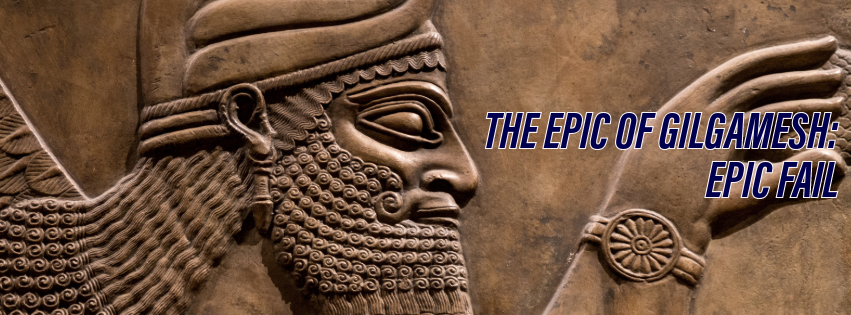
Books of All Time is a podcast that’s tackling classic literature in chronological order. If you’d like to know more about the show, you can head to our website, books of all time dot co dot uk. There’s a page called “About the Podcast” that explains the project. On the website you can also find transcripts of each show, plus links, reading lists, and more. This is episode one, “The Epic of Gilgamesh: Epic Fail.”
The Epic of Gilgamesh is the oldest work of narrative literature of which we are aware. It’s a poem about 3,500 lines long—if that sounds like a lot, consider that Homer’s Iliad is about 15,000 lines long. The Epic of Gilgamesh isn’t the work of one single author. In fact, it’s not even the work of one single culture. The poet and scholar Michael Schmidt, in his book “Gilgamesh: The Life of a Poem” calls Gilgamesh an “accretion” (p. 29). It seems to have its origins in Sumerian culture. Sumer was situated in modern Iraq, and the Sumerians co-existed with the earliest ancient Egyptians, the Indus valley culture, and the Elamites, who lived in what’s now Iran.
The Sumerians are the first culture we know of who developed a proper writing system. This system was handed on to the cultures that followed them in the region: the Akkadians, the Babylonians, and the Assyrians. All four of these cultures wrote on clay tablets using reed pens that made those wedge-shaped marks, and the name of the writing, cuneiform, comes from that shape. Originally they used it for accounting, then for hymns, poetry, customer complaints, jokes—there’s even a joke about a dog walking into a bar. And, of course, they used it to write down stories—stories that they had certainly been reciting far longer than they had been writing. Many of these stories were about a king who seems actually to have existed about 4,600 years ago: Gilgamesh, king of Uruk, which is now Warka in Iraq.
Gilgamesh was a hero to all the cuneiform cultures. They tell stories about him fighting monsters, fending off a siege, and talking to the dead. But one legend seems to have been valued most: the story of how he set out to find the secret to immortality–and failed.
The oldest copies of a Gilgamesh poem from Sumer come from around 2100 BCE. (George, lx) Around 1200 BCE or so, this particular story about Gilgamesh was compiled into a standard form by a Babylonian scribe called Sîn-lēqi-unninni. This version was the one our scribe copied—the one that made it into Ashurbanipal’s library, and was eventually dug up by archaeologists working on behalf of the British Museum in the 1800s.
Here’s how it goes.
We begin with a prologue singing the praises of Gilgamesh—that’s the “There was a man who saw the deep,” that I quoted in part at the top of the episode. The narrator then describes Uruk: its temple and pastures and claypits; its streets and fine buildings, and its enormous wall of strong glazed bricks—an innovation of Gilgamesh’s, intended to make the city more resistant to attack. Perhaps in tribute to this wall, the city is referred to as “Uruk the Sheepfold” throughout the poem, identifying it as a safe gathering-place for its people. Then the narrator invites us into the palace, where we are urged to open a box, take out a tablet of stone, and read about this king.
And what a king he is. Gilgamesh is described as being two-thirds God. He is eighteen feet tall and gorgeous: huge chest, strong legs, five-foot-long beard. He’s also very restless. This is emphasized a lot, actually: how restless he is, like a semi-divine border collie trapped in a studio apartment. In spite of the fact that the people and the elders all revere him, his restlessness is driving him to become a bit of a tyrant.
He’s constantly challenging the men of Uruk—ordinary men, remember, who are at best one-third his size—to wrestling matches. He’s also exercising the right of the first night—jus primae noctis—by sleeping with every new bride before her husband does. This doesn’t sit well with the people of Uruk.
The women of Uruk decide to go over their king’s head to a higher authority–namely, the god Anu. Anu hears the women’s complaints and takes them on board. He decides that, instead of punishing Gilgamesh, he’s going to redirect his energies. Gilgamesh needs a new friend.
He asks the goddess Aruru to arrange a companion for Gilgamesh. Aruru spits on the ground and makes some clay, and from this clay she makes a man who is proportionate to Gilgamesh: superhumanly tall and divinely beautiful. But also in need of a shave. In the 1999 translation by the Assyriologist Andrew George, we have:
“All his body is matted with hair;
he bears long tresses like those of a woman:
the hair of his head grows as thickly as barley,
he knows not a people, nor even a country” (p. 5)
This man—this beautiful, hairy man—is called Enkidu. And where does Aruru put this Enkidu? She doesn’t do anything so straightforward as plunking him down in Gilgamesh’s palace, or having him emerge from a cloud of incense in the temple, or even arranging a meet-cute at the next wedding Gilgamesh plans to crash. Instead, she places him in the wilderness, in the midst of a herd of gazelles. Enkidu lives among them: grazing, hanging out at the watering hole, and using his human thumbs to disarm hunters’ traps.
It’s through a hunter that word of Enkidu first gets back to Uruk. Gilgamesh is intrigued by the hunter’s report, and thinks of a way to catch this wild man with a trap he can’t resist: Shamhat, one of the priestesses of Uruk’s temple of Ishtar. Ishtar is the goddess of love, fertility, and war, and her priestesses’ sacred duties include having sex with single or lonely men.
Shamhat accompanies the hunter to his camp near a watering hole that Enkidu’s herd visits. She starts lounging naked on the shore, and soon enough, Enkidu sees her, and is enthralled. He proceeds to get freaky with Shamhat (who is, it’s worth remembering, is approximately one-third his size), and he enjoys it so much that they keep at it for seven straight days.
While Shamhat is, er, camping with Enkidu, Gilgamesh is having some very strange dreams. In the first dream, he sees a meteorite fall from the sky. In the second, he’s given an amazing axe. In both of the dreams, he feels very emotionally attached to these objects–clasping them like a lover, experiencing overwhelming waves of affection. After each dream he asks his mother, Ninsun, the goddess of cattle, to interpret, and each time Ninsun tells him: someone is coming into your life to change it forever. A friend and advisor, someone who will be an equal with you.
Meanwhile, back at the sex pond, Enkidu and Shamhat have come to the end of their orgy, and now the gazelles don’t accept him. Again, from Andrew George:
Enkidu had defiled his body so pure,
his legs stood still, though his herd was in motion.
Enkidu was weakened, could not run as before,
but now he had reason and wide understanding. (p. 8)
I absolutely believe that Enkidu would feel weakened after seven straight days of getting it on, but to have “reason and wide understanding”? It struck me that most of us nowadays would consider lust and sex to be destabilizing rather than conferring any kind of rationality. It’s interesting that this culture takes it for granted that sexual congress with Shamhat is actually necessary to set the seal on Enkidu’s humanity—yes, he’s “defiled”, but read fully in context, that defiling seems mainly to be from the perspective of the gazelles.
Anyway. Shamhat, like many a poorly socialized young man’s first girlfriend, sets about improving her new beau’s hygiene. In what is certainly the world’s earliest makeover montage, Shamhat convinces Enkidu to bathe, shave off all that inconvenient body hair, and get some clothes on.
Enkidu is now a man, not an animal, and he’s ready to head to the big city, which Shamhat sells him on with all the enthusiasm of a regional tourism board. The temple! The women! The market! The glazed bricks! And our king, Gilgamesh! He wants to meet you.
Enkidu is on board. By the time they arrive in Uruk, he’s ready for a night on the town. As Shamhat is showing him the sights, they cross paths with a well-dressed young man who says he’s going to a wedding. Enkidu doesn’t know what that is, so the young man explains: the flowers, the feasts, and, oh yes–the King of Uruk is coming, and he’s going to sleep with the bride before her husband. Enkidu is outraged. He rushes to the house where the wedding is happening just as Gilgamesh arrives. Enkidu blocks Gilgamesh from entering, and the two begin brawling in the street.
Walls are shaken and doors shattered as giant, oiled-up man-limbs entangle. Normal-sized humans scatter to a safe distance. When the dust settles, a mutual-admiration society has been formed.
Gilgamesh and Enkidu are now friends, as the gods planned. However, the gods should probably have included an itinerary (or at least a set of rules) with that plan. Gilgamesh and Enkidu quickly become bored with city life. They want to achieve great deeds and make names for themselves together. Gilgamesh proposes that they should travel to the cedar forests of Lebanon and defeat a monster that lives there: the fierce Humbaba.
[Music]
“His speech is fire, his breath is death,” says Enkidu, in George’s translation, “he hears the forest murmur at sixty leagues’ distance. Who is there who would venture into his forest?” (p. 19)
Me, obviously, says Gilgamesh. After applying some peer pressure, he gets Enkidu’s agreement to go and fight Humbaba. As part of their preparations, Gilgamesh takes Enkidu to meet his mother. Ninsun is horrified when he asks her blessing for his quest–Humbaba lives in the cedar forest by right, having been placed there by the god Enlil to protect the trees. Destroying him–even if that’s possible–would almost certainly be sacrilegious. She tries to get him not to go.
But Gilgamesh is determined–you get the distinct impression he doesn’t want to look like a wimp in front of Enkidu by letting his mother bully him–so Ninsun relents. While Gilgamesh and Enkidu trot off to the smithy to have weapons and armor made, Ninsun offers up her own prayers to the sun god Shamash. “Why did you give my son such a restless heart?” she wails, before begging Shamash to protect her son on his journey.
After trusting the city to the stewardship of the elders and promising to return in triumph, Enkidu and Gilgamesh set off. They don’t bother with horses or entourages–this is a real guy’s trip, just two best buds and six hundred pounds of metal.
They hike to their destination over the course of seven days, camping on different mountain peaks. Each night, Gilgamesh conducts a ritual to bring him a divinely inspired dream. These dreams are darker than the ones that preceded the arrival of Enkidu in Gilgamesh’s life. In the Danish Assyriologist Sophus Helle’s 2021 translation of the poem:
“I carried a mountain on my shoulders,
but it crumbled and crushed me down.
Despair chained my legs, awe shook my arms.
But there was a man. He
came to me, lionlike,
and lit up the land with his beauty.” (p. 37)
Given how opposed Enkidu was to this little expedition, you’d think he would seize the opportunity to encourage Gilgamesh to turn back–these are literally ominous dreams. Instead, he puts the best possible gloss on them–the mountain is Humbaba, the man is Shamash, who will protect you. The men come at last to the Cedar Mountain, where they must face Humbaba and his seven “auras”, or “powers”, or “radiant beams”. This section of the poem seems to flummox translators slightly, but a 2014 paper by Andrew George and Farouk Al-Rawi points out that these auras could also be described as Humbaba’s sons, “part demon, part tree”. (p. 75)
Regardless of what the auras are or aren’t, our heroes defeat or elude them and corner Humbaba in his lair. After a fight in which Shamash sends a tempest to weaken Humbaba, Humbaba rather pathetically pleads for mercy for himself and for the forest he has been commanded to guard. This pleading touches Gilgamesh, and he’s on the verge of giving way until Enkidu speaks up and reminds him of the vows he made.
Humbaba screams at Enkidu that he has betrayed the wilderness out of which he came, but it’s too late: Gilgamesh strikes the first blow against Humbaba with his axe, and Enkidu the second. Gilgamesh delivers the fatal third blow, and Humbaba dies with a terrible cry that shakes the Cedar Forest. Having destroyed the guardian, the two heroes set about chopping down trees–their male bonding trip has now pivoted from murder to deforestation.
Before they begin their return journey, they set up a makeshift altar on which they place several cedar trees and Humbaba’s head, thanking the gods for granting them their triumph. The gods, however, are aghast–particularly the chief god Enlil, who appointed Humbaba as guardian of the forest. He curses the heroes, and vows to take revenge on Gilgamesh and Enkidu.
For now, our lads are blissfully unaware of the wrath they’ve provoked. They return to Uruk and bask in the admiration of the people. Gilgamesh, dressed in his royal regalia for the celebration, dazzles Enkidu and all the people of Uruk–and some divine onlookers, too. Ishtar looks down from wherever the gods dwell at the magnificent Gilgamesh and develops a serious thirst.
She appears before Gilgamesh in her most appealing manifestation, confessing her lust and making him lavish promises of the riches he can obtain if he lets her handle the royal scepter: swift chariots chased in gold and lapis lazuli, sheep that only birth twins and goats that only birth triplets and, obviously, the fawning submission of other kings and rulers around the world.
Gilgamesh isn’t having it. “First of all,” he says, “It would hardly be a partnership of equals, because I can’t give you anything nearly as impressive as what you offer. And also, you have quite the reputation.” He rattles off a list of Ishtar’s exes: men who succumbed to her charms and then met a variety of terrible ends. There’s a shepherd she turned into a wolf, a gardener she transformed into a mole, and a minor horse god who is doomed to serve in battle for all eternity.
As if that isn’t bad enough, he also takes the opportunity to roast her. I like the version of this scene from the poet Jenny Lewis’s Gilgamesh Retold best:
“You’re a blade of frost scraping the ice
A broken door that lets the wind through
A cup that cuts the lip of the drinker
A shoe that bites the foot of its owner.” (p. 70)
Nobody loves having their nose rubbed in their shortcomings, least of all the Goddess of War and Lust. She storms off to Anu and demands that he loan her the Bull of Heaven so she can teach this upstart Gilgamesh a lesson.
Anu demurs at first–you know, Ishtar, honey, Gil does have a point, you did do all those things he mentioned–but he relents once Ishtar pitches another fit and threatens to smash the gates of the underworld, releasing millions of ghosts into the land of the living.
The Bull of Heaven is summoned and descends onto a plain outside Uruk. It snorts once, and the earth quakes. It snorts twice, and hundreds of citizens of Uruk die. It snorts a third time, and Enkidu is thrown off his feet. But he’s nothing if not nimble, our former foster-gazelle. He recovers his composure and leaps onto the bull’s back.
He cries out to Gilgamesh–you said you wanted us to make immortal names for ourselves, so strike hard and true! And Gilgamesh does, driving his sword deep into the bull’s neck between its shoulders. It dies. The people rejoice. The two heroes set about butchering the bull. They cut its heart out and offer it to Shamash as Ishtar fumes and rains florid curses down upon them.
Enkidu tears off some part of the Bull’s nether regions–either an inner thigh muscle, a testicle, or possibly even its penis, depending on which version you read–and throws it straight in Ishtar’s face.
This is a good place to pause and recap Enkidu’s career to date. Since leaving the relative calm of the sex pond, Enkidu has started a fight with Gilgamesh, conspired to kill the guardian of the cedar forest, conspired to kill the Bull of Heaven, and has now thrown a bloody bit of bull-crotch in the face of she who is the morning and the evening star.
He may think that he has won a point as Ishtar retires from the scene, singing lamentations for the Bull of Heaven, but he’s now angered a second important god. And unlike Gilgamesh, Enkidu doesn’t have an important mother-goddess who can intercede for him.
Gilgamesh and Enkidu take the lapis-enameled horns of the Bull of Heaven to the palace for display. There’s a parade and feasting and merriment, Gilgamesh delights the crowds by cavorting with some singing girls, flowers are strewn over the streets and absolutely nobody seems to remember the few hundred people who died at the outset of this part of the tale.
The following morning, Enkidu is distraught. He tells Gilgamesh that in the night, he dreamt that the gods met to discuss Gilgamesh and Enkidu’s behavior, and they’ve decided that one of the men must pay with his life for the outrages against Humbaba and the Bull of Heaven. Naturally, the gods conclude it’s Enkidu who has to die.
He’s immediately taken ill and has to retire to a sickbed, where Gilgamesh nurses him and tries to reassure him. As he sinks into his illness, Enkidu issues curses.
He curses the great gate of Uruk. He curses the cedars he and Gilgamesh brought back from Lebanon after murdering Humbaba. He curses the huntsman who first spotted him in the wild, and he saves some of his most inventively vindictive curses for poor Shamhat. These latter curses are so vicious that Gilgamesh has to interrupt him: think about what you’re saying, my friend.
Enkidu retracts his curse, and lapses back into sleep, where he dreams about death, described in the N.K. Sandars prose edition as “the somber-faced man-bird . . . his was a vampire face, his foot was a lion’s foot, his hand was an eagle’s talon.” (p. 28) The man-bird seizes Enkidu in his claws, and Enkidu is transformed. His arms become covered with feathers, and he is taken to the underworld, where Irkalla, Queen of Darkness reigns. It is “the house from which none who enters ever returns, down the road from which there is no coming back.” (Sandars 28)
This hell isn’t a place of flames and torment. Instead, it’s a bleak, silent, joyless place where the shades of the dead sit in darkness eating dust. Enkidu recognizes kings, all crownless now in the terrible equity of death, serving others cold water and little cakes of dust. He is led over to Belit-Sheri, who is the scribe of the book of death. She looks up from the clay tablets she is ceaselessly inscribing and says to Enkidu, “Who are you?”
That’s when he wakes up.
He recounts this chilling dream to Gilgamesh, who acknowledges the wisdom of it even as he weeps.
“The dream was marvelous,” he tells Enkidu, “But the terror was great; we must treasure the dream whatever the terror; for the dream has shown that misery comes at last to the healthy man; the end of life is sorrow.” (Sandars 29)
Enkidu lingers on his deathbed for 12 days, ceaselessly lamenting his offenses against Ishtar and bitterly deploring the shameful death in store for him as a result–not a hero’s death in battle, but a slow, pathetic withering away in bed.
Gilgamesh steps away from Enkidu’s deathbed long enough to give orders to the people of Uruk that they must prepare to mourn. When he returns to Enkidu’s side, he lays a hand on his friend’s breast–and he’s gone.
[Music]
Gilgamesh rages and weeps, refusing to leave his friend’s body or allow priests to care for it. On the seventh day, as Gilgamesh stoops to kiss the cold face of his friend, a maggot drops from Enkidu’s nostril. This horror shocks Gilgamesh out of his denial, and he allows the priests to begin the funeral rites. Numb with misery, Gilgamesh dresses in his kingly finery and makes the requisite offerings of butter and honey at the temple of Shamash. He commissions a lavish memorial statue of Enkidu from the city’s artisans.
Then he strips off his regalia and walks out of Uruk.
He is restless again, but this time it’s a restlessness born out of grief and despair. He roams the wilderness, mourning the loss of his friend and trying to grapple with his new keen sense of his own mortality. He loosely decides on a course of action: he will go seek Utnapishtim, the one mortal man known to have been granted everlasting life.
The problem is that Gilgamesh isn’t quite sure where to find this figure of legend, so he’s left at a loose end for a bit, wandering the plains, killing lions, looking for clues. It’s at this point that Shamash the sun god suddenly notices Gilgamesh again–in all four of the versions I’ve read, Shamash seems oddly absent-minded, as if he’s at the playground “watching” his kids while paying attention to a football game on his phone. At any rate, he tells Gilgamesh to stop wasting his time. “We’re never going to make you immortal,” he says, “Stop all this wandering nonsense and go get some rest, you look terrible.” “I’ll rest when I’m dead,” Gilgamesh tells him.
Gilgamesh hears of the Mountains of Mashu—though it’s not clear how; the tablets this part of the story is from are very fragmentary. The caverns under these mountains pass into the underworld, and the gates of the caverns are guarded by a pair of ferocious humanoid scorpions whose glare can kill a man. But they detect Gilgamesh’s divinity as he approaches.
“What on earth are you doing here?” the scorpions ask him. Gilgamesh tells them he wishes to find Utnapishtim. The scorpions say that Utnapishtim lives beyond the far end of the passage under the mountain, but that this passage is 12 leagues long and profoundly, utterly dark. “I will do it with sighs and weeping,” Gilgamesh tells them. “But I must do it.”
The scorpions stand aside, and Gilgamesh walks through the gates with their blessing. After spending several days walking in the dark, Gilgamesh emerges in a borderland between the human world and the gods’ world. He passes through a garden where every fruiting shrub brings forth gems and the thorns on the roses are made of semi-precious stones.
Gilgamesh heads toward a shoreline where there’s a tavern. The tavern is kept by Siduri, a kind of semi-divine Karen who pulls pints for passing deities, I guess. “He looks like trouble,” she mutters to herself, as she sees the ragged giant Gilgamesh approaching her pub. She hurries inside and bolts the doors and windows. Gilgamesh is offended. He stands outside the tavern loudly reciting his lineage and his deeds. “These are very nice stories and all,” she says, “But you look like a wreck, and I don’t want you in here.”
Of course I’m a wreck, says Gilgamesh. He tells her about his beloved Enkidu, and it’s a speech he’ll give to everyone else he meets from here on out. Helle renders it like this:
“My friend, whom I loved so much.
who with me went through every danger!
My friend Enkidu, whom I loved so much,
who with me went through every danger!
“The fate of humankind caught up with him.
For six days and seven nights, I wept for him.
I would not let his body be buried,
until a maggot fell from his nose.” (pp. 89-90)
He is really traumatized by that maggot. And fair enough. Gilgamesh’s lament ends with him wailing about his fear of death, and demanding that Siduri tell him where Utnapishtim is.
“Don’t be an idiot,” Siduri tells him, “You won’t get what you’re looking for even if you do get across the ocean to Utnapishtim. Only the gods decide who lives forever.”
“Is that what I have to do?” says Gilgamesh. “Cross the ocean?”
“Yes,” says Siduri, “This water is magic–you can’t even touch it, or it will kill you. But if you ask the boatman, Urshanabi–”
Here we see a flash of the old Gilgamesh, because he immediately charges off toward the water, drawing his axe as he goes. He rushes down toward Urshanabi’s boat, and begins smashing it up. Crucially, he destroys some stone objects (or possibly stone people, versions vary) that make navigating the ocean possible.
Once his tantrum subsides, he spots Urshanabi. Instead of whacking Gilgamesh with an oar for vandalizing his boat, Urshanabi starts a conversation with him–maybe he was a hostage negotiator or a therapist in a previous life. Urshanabi comments on how awful Gilgamesh looks. Gilgamesh repeats his entire tale of woe: Enkidu, nostril, maggot; unbearable existential dread, etc., and then half-begs, half-commands Urshanabi to take him across the water of death.
“Joke’s on you,” Urshanabi says. “You’ve damaged my boat and the ambiguous but important stone objects I need to get across the ocean. The only way I could possibly help you is if I had 120 wooden poles, each 60 cubits in length, with a coating of tar and metal ferrules to protect our hands.”
“Say no more,” Gilgamesh replies, and rushes off to start cutting wood for the poles. I’m not sure where he gets the 120 metal ferrules from–perhaps he keeps some strung in his five-foot-long beard, for emergencies–but soon enough he has the poles ready, and Urshanabi lets him board. They cross the ocean using each pole once until at last they approach the far east of the world where Utnapishtim lives.
Utnapishtim is sitting on his patio overlooking the ocean as the boat approaches, and he’s immediately on alert. “What happened to Urshanabi’s boat?” he wonders. “Where’s the sails; where’s the stone, you know, things? Who’s that tall guy? He looks awful.”
Urshanabi and Gilgamesh come ashore, and Gilgamesh, for the final time, launches into his great lament for Enkidu–the maggot, the nostril, et cetera–adding a coda that relates all he has done and endured to arrive here for an audience with Utnapishtim. He finishes up by saying, “I had planned to beat you up, but I’ll just beg you to tell me: How did you achieve the life everlasting?”
And now we come to the part of the story that shocked 19th-century society when it was translated for the first time. If you’re familiar with the Book of Genesis in the Bible—a book that eventually gets written around 950 BCE, 400 years after the later Babylonian versions of Gilgamesh—this will sound very familiar.
Utnapishtim tells Gilgamesh that he used to live in a city on the banks of the Euphrates. In the prose version of the story, he says that “in those days the world teemed, the people multiplied, the world bellowed like a wild bull.” (Sandars p. 43) This apparently irritated the great god Enlil. “I can’t sleep with all this racket,” he tells the other gods. They take a decision to exterminate mankind, and, you know: who among us has not had a noisy neighbor they’ve wanted to drown?
So the Gods begin preparing to flood the earth. One particular god, Ea, has reservations about this. For reasons that aren’t particularly clear he goes to Utnapishtim’s house. Ea either appears to Utnapishtim in a dream or speaks through the wind, warning him to get out of there. “Son of Ubara-Tutu, tear down your house and build a boat!” (Sandars 43)
Ea gives Utnapishtim detailed instructions as to the boat’s size and shape and materials, and also commands him to take “the seed of all living creatures” on the journey with him. “I’m with you so far,” Utnapishtim says, “But what will I tell the neighbors when they see that I’m building this boat?
Ea suggests Utnapishtim tell the people that Enlil has cursed him, and that if he leaves the city there’ll be a rain…of prosperity. Yes, that should work.
Utnapishtim gets cracking on the boat, helped by his family and his neighbors and what seems like two-thirds of the city. They’re boiling tar, they’re building bulkheads, they’re having wine and barbecue, and honestly, given the nature of Enlil’s complaint against humanity, I’m surprised the gods didn’t conjure up a tsunami then and there.
Utnapishtim gets his boat on the river just as the rain begins. Six days and seven nights the storm rages, even alarming the gods in heaven. When it finally stops, Utnapishtim goes up on deck. In every direction he sees only endless water, flat and featureless as a rooftop. He weeps with despair for the people of his city.
[Music]
The boat eventually gets snagged on the peak of a mountain. Utnapishtim sends out birds to scout for land. First he sends a dove with no result. Then he sends a swallow, but no luck there either. On the third go he sends a raven, and she comes back with a branch in her talons.
Utnapishtim and his family disembark on the mountaintop and sacrifice to the gods in their gratitude. The smoke rising from the sacrifice draws all the gods to it–the entire pantheon clustering around this one, sad and terrified little family like divine flies.
The gods realize belatedly that without humans, there is nobody to make these sweet sacrifices, or build and dedicate temples, or sing songs of praise that originate from deep within sincere, if noisy, human hearts. Enlil and the gods vow never to do this again. As an apology for the trauma they’ve put him through, they bless Utnapishtim and his wife with everlasting life.
And that’s Utnapishtim’s secret: he just happened to survive a one-off catastrophe. There’s no special prayer or ritual Gilgamesh can emulate. It’s like Siduri told him: only the gods decide.
But the King of Uruk still can’t accept this. He insists there has to be one weird trick for getting out of the mortality trap. “Fine,” says Utnapishtim. “Try this: stay awake for seven days straight. If you do that, you just might have what it takes to defy death.”
“You’re on,” says Gilgamesh. He sits down and immediately conks out. Utnapishtim’s wife is exasperated. “Have pity on him,” she says. “Wake him up and send him back to wherever he came from.”
“No,” says Utnapishtim. “For one thing, this is the kind of man who wakes up and swears he was just resting his eyes. For another, he’s been through some things. Let him rest; he’ll feel better. But for every day he sleeps, bake a loaf of bread and leave it next to him. When he wakes up, he won’t be able to deny he’s been beaten.”
So Mrs. Utnapishtim carries on with her baking while this ragged demi-god snores off his nervous breakdown in her kitchen. On the seventh day, Gilgamesh wakes up, and sure enough, he tries the “I was just meditating” line. But the row of mouldy and stale loaves of bread puts the lie to that.
“Death is all around me!” wails Gilgamesh. Utnapishtim has finally had enough of his big emo houseguest. He orders Urshanabi–who I guess has just been kicking his heels all week–to get Gilgamesh cleaned up and to escort him not just off the premises, but all the way back to Uruk.
Once Gilgamesh is ready to leave, Utnapishtim offers him a consolation prize. You can’t live forever, he says, but there is a plant that can help you restore your youth. Just dive at a specific place along the shore here where the water won’t kill you. The magic plant is growing on the seafloor.
So Gilgamesh goes with Urshanabi, and is able to harvest the magic plant before they head back to open water. Unfortunately, once they are back on dry land, Gilgamesh leaves the plant unattended by a spring as he goes for a swim. An elderly snake passing by eats it, sheds its skin, and goes merrily on its way.
Gilgamesh has lost his last shot at prolonging his life, and although he does lament about it some, he seems more resigned now to his mortality. He and Urshanabi continue their journey, and when they arrive at Uruk, Gilgamesh takes Urshanabi up to the ramparts: Look at my city, he says, the city we have built. Isn’t it splendid, with its glazed bricks and its beautiful temple?
And that is where the Epic of Gilgamesh ends: with the weary young king, “back from far roads, exhausted but at peace”, taking his visitor on a tour.
[Music]
I’ve read four different versions of Gilgamesh preparing for this episode, and I love all of them. While each one brings out different details, they all tell a story that is both bleak and hopeful; silly and stirring. I love the details of the culture, of a people who valued beer and sanctified sex workers. I love the irritable, squabbling gods who, for all their power, need people just as much as people need them. And, of course, I love the friendship at the center of the Epic: these two men who care for each other so passionately, telling each other their dreams and spurring each other on to adventures.
However, I think what stays with me most of all is this: Gilgamesh, the great hero, fails at what he sets out to do. He does not discover a secret to everlasting life–at least, not one he can exploit on his own behalf–and he can’t bring Enkidu back. He has to learn to live without him, and with his own eventual extinction. These are griefs and anxieties we must all grapple with in whatever way works best for us, even if we’re eighteen feet tall and two-thirds divine.
If you want to read the Epic of Gilgamesh, you’re in luck. First, it’s not very long; I think most people could get through it in an afternoon. Second, there are several English versions available. Some are translations by actual Assyriologists–scholars who can read the original cuneiform tablets–and some are retellings by writers or poets who don’t have that expertise, but who have an interesting take on the story nevertheless.
Here are the four I read–you can find specific publishing information and links to each one in the transcript of this episode, available on the show’s website, booksofalltime.co.uk.
First, 2021’s Gilgamesh: A New Translation of the Ancient Epic, by the Danish scholar and writer Sophus Helle. Helle is an Assyriologist who can read the tablets, and his translation balances lovely, rolling, rhythmic language with a sense of how fragmentary the actual Gilgamesh tablets are by representing places where there are gaps or incomplete lines.
Next is the 1999 Penguin Classics edition of The Epic of Gilgameshtranslated by Andrew George, Professor of Babylonian at the University of London’s School of Oriental and African Studies. I have a paperback copy that I bought in 2009 or so, but if you buy this version now, it will be updated with new text following the discovery of a new Gilgamesh tablet–this constant updating of the is a pretty exciting feature of Assyriology, which I’ll go into more in the next episode. This translation is also in verse, and also gives you a flavor for just how much of the story is missing.
The third version is the 1960 Penguin Classics prose retelling, The Epic of Gilgamesh, by N.K. Sandars. If you just want to read the story, or if you struggle to read poetry, this is probably the edition for you. Please note that some scholars and critics think Sandars took liberties with her version–for example, hers is the only version that gives the gods a justification for causing the Great Deluge.
Finally, there is Jenny Lewis’s 2018 Gilgamesh Retold: A Response to the Ancient Epic. Lewis’s version is a retelling in modern poetry. Each section uses a different format of verse; Lewis says this was meant to “reflect the idea of many different voices speaking their own version of the story” (p. 127). I found this really effective–it got me thinking about how many voices and lives the Gilgamesh and Enkidu story moved through over the millennia. He may, in a way, just manage to live forever.
We’re not done with Gilgamesh yet, though: our next episode will cover the exciting rediscovery of the story in the 19th century–a story that involves archaeological rivalries, backbiting museum curators, and a working-class language prodigy who may have made better use of his lunch break than anyone in human history. Episode two, The Library, The Museum, and The Lawsuit, coming on Thursday, March 14.
[Theme Music for Outro]
Books of All Time is written and produced by me, Rose Judson. The Disclaimer Voice of Doom is Ed Brown, Lluvia Arras designed our cover art and logo. Special thanks to Yelena Shapiro, Cathy Merli, Matt Brough and the Books of All Time Advisory Council: Ed Brown, Beck Collins, Neil Dowling, Caitlin McMullin, Hugh Parker, and Jonathan Skipp. You can support the show by subscribing and leaving a rating or review at Apple Podcasts, Spotify, or wherever you get your podcasts. Thanks for listening! I’ll be back in two weeks.


 Books Of All Time
Leave a comment