
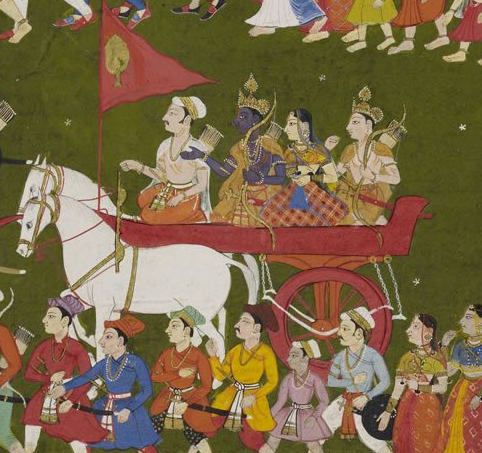
“Is there a man in the world today who is truly virtuous? Who is there who is mighty and yet knows both what is right and how to act upon it? Who, when his fury is aroused in battle, is feared even by the gods? This is what I want to hear, for my desire to know is very strong.” – (The Ramayana of Vālmīki, Goldman and Sutherland Goldman, 51)
The king surveyed what was left of his forces, too weary even to despair. All the way to the walls of his city the dead lay in their thousands. Bodies broken upon spears or lying crushed beneath shattered chariots; bodies tangled in the harness of once-fine horses shot from underneath them; bodies upon bodies in the ditches along the high road. A man with no legs dragged himself toward the enemy lines—one of his men, he noticed. Two stout boys broke away from a company of the northerners, lifted the wounded soldier onto one of their monkey banners, and carried him off.
The king could not blame a soldier for seeking mercy. And those princes, the brothers; they were nothing if not merciful men. For him, however, there would be no mercy. There was only his destiny, which would shortly emerge from the battle tent two bowshots from where he now sat slouched on his horse. The tent shone out from the mud and the carnage, white a winter mountaintop, the only clean thing he could see anywhere. He supposed it might be the last clean thing in the world.
Certainly he was unclean. All his life he had practiced the austerities, heeded the teachers of the dharma. He fasted regularly; flesh had never once passed his lips. He read scripture and engaged in discussions with scholars. He made a solemn vow never to touch a woman who was not his wife. And then he had seen the face of Sita—a face to rival the moon on the water, the sun stretching its fingers through the leaves. All was lost.
He had broken his vow and with it, he had broken the chain of his life. He could feel himself sinking on the wheel of time as the tent curtains parted and the prince of Ayodhya stepped forth, followed by his brother. The king, Ravana, bent his neck—his one solitary neck—and swallowed his rising panic. If he was to be plunged once again into the ocean of rebirth, he would at least step into those waters as the master of his own fear.
I’m Rose Judson. Welcome to Books of All Time.
Intro – Exploring Dharma, and the Dharmic Faiths, Through the Ramayana
Books of All Time is a podcast that’s tackling classic literature in chronological order. This is episode 43: The Ramayana, Part 2 – By Means of Every Holy Rite. If you’d like to read the transcript for this episode or see the list of references I used to write it, you can visit our website, booksofalltime.co.uk. There’s a link in the show notes if you need it. Let’s begin.
In our last episode we went romping through the Ramayana, an epic Sanskrit poem attributed to the sage Valmiki which began to be written down around 300 BCE, though much of it probably originates closer to 700 BCE. It’s about the trials and triumphs of Rama, prince (and then king) of Ayodhya. In that episode, we mostly stuck to the plot, and with good reason: there is an awful lot of plot to get through, as the Ramayana is more than twice as long as Homer’s Iliad or Odyssey. In this episode, we’re going to address one of the major themes that I had to set to one side while recapping Rama’s exile and all of Hanuman’s adventures and those massive battles with Ravana and his demons: namely, the issue of dharma.
Dharma is a concept that originates in the religion and philosophy of Ancient India. It has several meanings. The most common meanings I’ve come across are righteousness and the idea of adhering to one’s duty, whether that’s a moral or societal duty. This isn’t a concept unique to Ancient India—you may recall from our episodes on Plato’s Republic that to Socrates, adhering to one’s duty in life was the definition of moral or just living.
Dharma became the common foundational principle of three faiths, all native to the Indian subcontinent, which were beginning to flourish at the time the Ramayana was written—namely, Hinduism, Buddhism, and Jainism. These, along with Sikhism, which was founded in the 15th century CE, are the dharmic faiths. Our exploration of dharma not only gives us an opportunity to get a deeper insight into the themes of the Ramayana: it also gives us an opportunity to catch up on some Indian history after spending so long in Greece.
So, we’ll start with a look at how the idea of dharma affects the plot and characterization of the Ramayana. Then we’ll get an overview of each of the three ancient dharmic faiths, and how they’re developing up to this point in our timeline, and how they each treat dharma—and the Ramayana— slightly differently.
Right, our path is laid before us. Let’s head back to Ayodhya first.
Part 1: Dharma in the Ramayana
I have a confession to make: I can’t read Sanskrit. I know, I know. I won’t blame anyone who wants to switch the show off now. However, thanks to a scholar named John Brockington, and his 2004 paper “The Concept of Dharma in the Ramayana”, I was able to get a feel for the many, many different shades of meaning the word dharma can take within the epic and within South Asian culture generally. Brockington explains that, quote “[w]hile the majority of the occurrences of dharma denote broadly morality or propriety, there is a significant emphasis also on caste, family or personal duties and on an element of necessity, as well as on the duties of a king.” (Brockington 655-656) Endquote.
He also explains that dharma, in the early Vedic and Brahmanic religions on which today’s Hinduism, Buddhism, and Jainism all draw, was about ritual duty: it was about performing (or sponsoring brahmanic priests to perform) sacrifices and other rites. These rites performed a double duty. The first is for the worship of divinity: people can show reverence to the gods, and also petition them to uphold the natural order of the cosmos, or ensure human security and prosperity. The second is more of a personal sense of duty, whether to your family or your society: right conduct that can improve your chances of a better afterlife and rebirth experience.
Brockington explains that, in his evaluation of all 1,100 mentions of dharma in the Ramayana, about two-thirds of them are closer to this meaning of morality or propriety. (Brockington 658) The remaining portion of the mentions take in the older, ritual sense, but can also mean anything from a legal right within mundane or technical law to the laws of time, space, and mortality. There is a lot of linguistic jargon in Brockington’s paper that escaped me (which is fine, the paper is for specialists, after all) but it was still interesting to see how different prefixes, suffixes, and placements of dharma within sentences affect its connotation. If diving deep into that kind of thing jazzes you up, I have a link to that paper on our website – hit the link in the show notes to head there; it’s in the references section of the transcript.
Moving on. Dharma is a concern of the Ramayana right from its opening scenes. The story, you may recall, begins with Valmiki, the sage traditionally identified as the author of the poem, asking another holy man whether there is anyone left in the world who is virtuous. What he really asks is whether there is anyone left who lives according to, or who lives up to, his dharma. You may also recall that the holy man immediately responds that Rama is the man Valmiki needs to know about. The entire Ramayana, as the introduction to the Princeton prose edition I read explains, is structured as an illustration of how to follow one’s dharma, even “in the face of the most dire challenges and ethical dilemmas.” (Goldman 5)
I didn’t address this in the plot summary last week—I was focused mainly on the journey the poem describes. But by following the journey of Rama, and how he reacts to the events and situations he encounters—the court politics and the sacred vultures and wife-snatching—readers or listeners are presented with an example of how to live out your dharma. “Rama,” write Robert and Sally Goldman in the introduction to the prose edition, quote “serves as the model for the ideal son, the ideal husband, the ideal warrior, and the ideal king.” (Goldman 5)
Each of these roles Rama must fulfill come with their own dharmas. An individual may have several different dharmas which are unique to their life circumstances. These dharmas can overlap and contradict each other, and these conflicts can lead to painful choices. Take the bind Rama’s father Dasharatha finds himself in: as king of Ayodhya, it’s his dharma to ensure that the people are well-ruled, and this is why he initially sets out to make Rama the prince regent. He realizes that he is getting older and that his son is poised to be a far better king than he is—following his dharma means initiating this transition out of his leading role into an advisory one, even if it means reduced status and control for him.
Unfortunately, this dharma also conflicts with another one: the duty Dasharatha has to his junior wife, Kaikeyi. He has made promises to her, and when she claims those promises, he has to follow through regardless of how unjust or painful it may seem to him. This preserves not only his husbandly and kingly dharma, but also Kaikeyi’s dharma—in attempting to elevate her son Bharata, you could argue that she is upholding her own motherly dharma. Her insistence on sending Rama into exile, however, is adharmic, as she’s gratuitously inflicting harm on him.
Rama, when informed that he’s to be exiled, takes the news calmly. He could have protested, or even kicked off some kind of Game of Thrones-style intrigue or coup against his stepmother and the half-brother she sought to elevate over him. But according to dharma, it’s his duty as a son to obey his father’s order to leave Ayodhya. It’s also his duty as the subject of a king to help that king uphold his own dharma. In this case, Rama supports the integrity of his father’s reign by willingly going into exile.
Rama is not the only exemplar of following one’s dharma: his wife Sita and brother Lakshman also demonstrate courage, strength, and steadfastness as they carry out their respective duties toward Rama as wife and brother. Lakshman, for example, willingly goes into exile to serve his elder brother. He submits to Rama’s authority—and, unfortunately, also obeys Sita when she orders him to go find Rama in the forest, in spite of the fact that this will leave her unprotected in their cottage. While the decision to obey his sister-in-law (who is considered an extension of his older brother) is dharmically correct on Lakshman’s part, it gives Ravana the opening he needs to abduct Sita.
Sita herself is following her dharma as a wife by insisting on going with Rama into exile. This conflicts with his husbandly dharma, which includes protecting his wife from suffering and harm, but she is eventually able to convince him that separation would do her more harm than any privations or dangers she might encounter while living in the forest.
You could argue that Sita acts adharmically when she brow-beats Lakshman into investigating what she thinks are Rama’s death cries—she knows that Lakshman has a duty to obey his brother’s orders, and she pressures him into going against them. But this in no way means she deserves her terrifying abduction. Overall, Sita’s adherence to her wifely dharma is, frankly, heroic: she maintains her purity even when in the power of a ten-headed, twenty-armed demon no god can destroy.
Speaking of Ravana, in spite of the fact that he’s a demon, he is still bound by dharma, even though he cheerfully ignores it unless it’s convenient for him to point out how others need to obey theirs. He uses his gift of intelligence (he has ten brains, after all) adharmically, to gratify his insatiable lust for women. In addition to failing to adhere to his own dharma, he violates the dharma of his victims and their husbands by abducting and then seducing (or raping) those women. Rama, by doing his utmost to defeat Ravana, is not just fulfilling his own dharma as a husband or as a member of the warrior class; he’s also acting as a divine instrument of dharma, as an embodiment of the cosmic struggle between good and evil, order and chaos.
However, Rama himself seems to stumble—or at least, to make morally murky choices—with regard to his dharma in at least two parts of the story. The first comes when he makes his alliance with Sugriva the monkey king. Rama agrees to help Sugriva reclaim his throne from his upstart brother, Valin. This results in Rama killing Valin in a pretty shady fashion: by shooting him from behind with an arrow just as Valin is about to defeat Sugriva.
Valin, as he dies, points out that Rama has sided with Sugriva without bothering to hear Valin’s side of the story. He has also killed Valin in a very unsportsmanlike way, which potentially violates Rama’s dharma as a member of the warrior caste. There are rules, after all, about how you fight someone with honour. But this situation can also be read as yet another clash between conflicting dharmas: Yes, Rama has an obligation not to harm other beings, and a caste obligation to uphold certain standards of behaviour, even in the heat of battle. However, he has to prioritize.
As a prince and a man, his dharmic commitments to his wife are paramount. As an avatar of Vishnu, he also has an obligation to follow through on his divine quest to rid the world of Ravana’s evil. But once he has defeated Ravana, this changes. Now the conduct demanded of him is that of a king, and it’s here where we see the second stumble. Suddenly, his duties toward his wife are less important than his duties to his realm. He must maintain order, and that means being personally beyond reproach. Even though Sita’s abduction was not Rama’s fault—and certainly not her fault—according to the morals of the time, it reflects badly on him that he might accept quote-unquote soiled goods into his household.
As Kim Knott puts it in Hinduism: A Very Short Introduction (where would I be without that series of books?), quote:
“[Rama’s] own failure to protect his wife from Ravana and a-dharma or disorder had led to doubt in the minds of his subjects, and stilling their fears and the social disorder which might follow became his primary duty, despite his knowledge of her innocence.” (Knott 78)
Rama knows Sita is pure, but he also knows that if the people doubt him at all, he risks putting cracks in the foundation of his legitimacy as a king. Dharma requires him to first test his wife’s chastity in public with the apparently cruel trial by fire, and then, when the rumours persist, to send her into exile.
Rama is tormented by his decision, and to many audiences, ancient and modern, it seems he has adharmically given in to public opinion instead of standing by his wife. But this is one of the great lessons of the Ramayana: the way of dharma is difficult, and for an ordinary human—even for a human who is an incarnation of a god—reconciling the competing demands of one’s personal dharmas is often impossible and painful.
I was about to start the musical stinger there, but before we move on, you may be wondering: does Hanuman, the monkey god, have dharma? Yes. His dharma is to offer his masculine strength and heroism in the service of a higher good—in this case, to serve Rama and Sita. He’ll have more to say about dharma when he appears in the Mahabharata, our next work. I really do love that monkey.
Part 2: Hinduism
Let’s turn now to the oldest of the three religions we’re covering in this episode—indeed, one of the oldest religions in the world: the diverse tapestry of faith traditions known today as Hinduism. “Hindu,” as Harvard University’s Pluralism Project explains, is an exonym: a name given by outsiders. It was first used by the Ancient Greeks and Persians to refer to the people living near the Indus River. It was a geographic or regional term rather than a religious one.
Much, much, much later—in the 19th century, actually—”Hindu” became a label slapped on the majority of the people in the subcontinent by the British, who wanted to categorize them as separate from Muslims, Christians, Buddhists, and other faith traditions in the country. Categories are bureaucratically important, but often clumsily applied by outsiders. (In fact, I feel clumsy trying to explain it to you. Organising my thoughts about this is a bit like describing the shape of a cloud on a windy day. But part of this show is about taking you along on this journey with me. Hopefully, if you are one of my many listeners in India, you’re not too appalled by this episode.)
To resume. People in India gradually appropriated the “Hindu” label to apply to any faith tradition with roots in the Rigveda and other Vedic scriptures. Many Hindus describe their religion as sanatana dharma–the eternal way, or the eternal religion. But even this is a relatively recent term. (Knott 31) In our century, “Hinduism” is still being refined and defined, most notably by Hindu nationalists. Kim Knott says that the Hindu nationalists believe Hinduism to be the one true religion of India, quote:
“[A] divine truth [that] was revealed to the Aryans, whom they see as the noble, enlightened race which lived in India thousands of years ago . . . people belonging to the religions which developed in India after the time of the Aryans, like Buddhists, Jains, and Sikhs, are all embraced as part of the Hindu religion.” (Knott 31)
This… is not how the Buddhists, Jains and Sikhs see it, to say the least. And the archaeological evidence points to a fuzzier origin story, one which seems to blend the Vedic or Aryan culture with practices and symbolism from the still-mysterious Indus Valley or Harappan society which flourished from 2500 to 1800 BCE—well before the Aryans arrived in the region in 1500 BCE. (The Harappan/Indus Valley people are mysterious, if you’re wondering, because they have a script we’ve yet to learn to read. If at some point soon someone cracks their script and a story older than Gilgamesh turns up, you can expect a bonus episode from me about it.)
Anyway, what can be agreed on is that Hinduism’s origins stretch far, far into the past. There is no single founding personality, but the Sanskrit texts we’ve been looking at over the course of this show, up to and including the Ramayana, are central to modern Hinduism’s many varied religious and cultural identities inside the Indian subcontinent and beyond.
So what sort of religious life would we see signs of if we rocked up to Ayodhya around 300 BCE, when scribes were writing down the Ramayana? At that point, nobody within the Indian subcontinent was talking about “Hinduism.” They very likely weren’t talking about any kind of overarching religious group at all. Instead, what we would be looking at around 300 BCE was what scholars today refer to as the Brahmanic tradition—a series of beliefs and practices which evolved from the Vedas and Upanishads.
The Vedas and Upanishads are both considered by Hindus today to be shruti: divinely revealed, timeless wisdom. The Ramayana and later Sanskrit works, including the Sutras and Puranas, which we may look into during year three of our show, are smriti: works inspired by shruti writings but composed by holy, though mortal, sages and teachers.
The practices and beliefs from the Vedas and Upanishads were passed on and mediated by the Brahmin, or priestly classes. Although beliefs varied from region to region and even community to community, one near-universal belief within the Brahmanic tradition is the idea of an absolute reality which we talked about in our episodes on the Upanishads. That absolute reality is also known as Brahman.
Within each person is an atman, an eternal essence that is of and from Brahman. All living things are fundamentally one, and all go through a cycle of death and rebirth, the outcomes of which can be influenced by actions taken during one’s current lifetime—actions which must be in accordance with one’s dharma, which, again, was contextual depending on the caste you were born into, your gender, your family, and so on. The goal of existence is to escape the transmigratory cycle of the soul to rejoin the essential cosmic reality.
So far, so familiar. What’s different around 300 BCE is that we are seeing clear signs of various theistic practices and sects. The iconographies and mythologies of many of the Vedic gods were beginning to crystallise at this time. Certain attributes of Vishnu—his position as a preserver and warrior who goes about armed with a discus and a mace, for example—are present within the Ramayana. Two of these gods in particular were also beginning to attract followers or devotees, known as bhaktis. There were those dedicated to Vishnu, or the Vaishnavas, and those of Shiva, or Shaivas. These two devotional traditions would be widespread within India by the first century BCE. They still persist today, along with a third, later tradition: that of Shaktism, the worship of Shakti, a powerful goddess who is often depicted as Shiva’s consort.
One missing piece of the religious landscape in 300 BCE—at least to a modern mind—would be that of temples. Instead, worship might take place in sacred groves or fields, and it would be led by a priestly class that was still practicing animal sacrifices as per the Vedas. This priestly class would also take an active role in enforcing the caste order and its various dharmas. Naturally, this rigid structure chafed some people, as did the perceived worldliness and waste of resources involved with the mass sacrifice of animals.
Beginning in 500 BCE, people began to renounce the Vedic traditions in favor of ascetic practices. Young men were running off into the forests to renounce their worldly status and live austere lives of contemplation.
In response to this, the Brahmanic tradition evolved. By 300 BCE, a new doctrine began to circulate: one which split a man’s lifespan into four distinct ashramas, or stages. Young men would first live as celibate students of the Vedas, then transition into married householder life. After their children were grown, they could move to the forest to live in religious communities before progressing to the final phase: that of the wandering ascetic, who had no personal goods or belongings.
Each phase of life had its own dharmas to follow. You can see signs of each of these phases within Valmiki’s Ramayana: Rama, Sita, and Lakshman are constantly encountering holy people in the forest who are middle-aged or elderly, and who have renounced high-status lives elsewhere. This may also be why Rama’s exile in the forest is depicted as distressing: he is still a young married man. According to the doctrine of the ashramas, he ought to be embarking on the householder phase of his life rather than the contemplative phase.
The development of the ashrama doctrine and its attendant dharmas seems to have been intended to prevent people from abandoning the ancient traditions. But the call of the forest was too strong. Thousands of people answered, walking away to follow their own versions of dharma. Foremost among these young ascetics was a nobleman’s son named Siddartha Gautama. He is known to us today as the Buddha.
Part 3: Buddhism
Siddartha Gautama was born in what is now Nepal, near the foothills of the Himalayas. His dates are approximate: Damien Keown, in Buddhism: A Very Short Introduction (yes, them again) says that while most tradition puts the Buddha’s dates between 566–486 BCE, more recent scholarship suggests that he may have lived from about 490 BCE to 410 BCE. (Keown 17) This set of dates would mean that his lifetime overlapped with that of both Socrates (470–399 BCE) and Confucius (551–479 BCE), as well as most of our Athenian playwrights and, for a decade or so, Plato. What a time, as the kids used to say, to be alive.
There is no early complete biography of the Buddha—biography wasn’t really a genre in the 5th century BCE. Most of what is known about him comes from a writing called the Pali Canon (“Pali” is the language in which it was written), which dates from the 1st century BCE. There are other canons in other languages, and they differ greatly from one another. (Keown 19)
The generally agreed-upon “facts” of the Buddha’s life are these: Siddartha was born into a noble family. His mother, Maya, dreamed that she conceived when a baby white elephant entered her body—an omen that she would bear a son with a great destiny. While traveling to her father’s home to give birth, she was caught short and wound up delivering her son standing up while holding on to the trunk of a tree. The ground shook and the gods came down to admire the tiny infant as he was washed clean by divine rain. Then he stood up, toddled seven steps, and announced that this was his final incarnation.
Poor Maya died seven days later, and Siddartha was raised by his aunt in his father’s luxurious palaces. At the age of 16, he married an appropriate noblewoman, and she gave him a son. His father, fearing that his son’s great destiny would either involve supplanting him or abandoning his inheritance, kept him sheltered in the palace: his every whim was met, and even on his progresses outside the city in his chariot, crowds were carefully curated so that he would only see young, beautiful, healthy people.
Eventually, however, this curation broke down, and reality was able to break through. On three separate journeys Siddartha encountered an old person, a sick and disfigured person, and, finally, a corpse. He was deeply troubled by the realization that life was full of suffering and that it ended in death. Then, on a fourth trip beyond the palace he saw a potential answer to all of this: he saw a samana, a wandering holy man. He realized that he, too, could follow a spiritual calling. He abandoned his old life and became a samana himself.
Siddhartha was about thirty years of age when he embarked on this new life, and Damien Keown points out that he was joining an established, quote, “counterculture of homeless religious mendicants.” (Keown 23)
It was from these mendicants that Siddartha learned meditation techniques, and though Siddartha found the states of bliss and serenity these techniques elicited useful, he knew they were at best a temporary solution to the problem of suffering. He then sought to tame his desires through extreme self-austerities: trying to control his breath, or punishing himself with incredibly restrictive fasts. These practices, however, solved nothing in themselves. He began to understand that a “middle way” was possible: one of meeting appetites to an appropriate degree without attachment.
Having found his balance, Siddhartha sat beneath a fig tree to meditate. In the course of one night, he was able to elevate himself to a level of complete spiritual knowledge and release from the cycle of death and rebirth. He became able to recall his past incarnations. He gained the ability to see the past and future incarnations of other beings. And he came to know that he had purged himself of his appetites and illusions. He had reached nirvana, and become the Buddha – the enlightened one.
His preaching career began soon after this. The Buddha’s teachings became known as the dharma—the way or the doctrine. His first sermon is called “Setting in Motion the Wheel of the Dharma,” and this wheel was, writes Damien Keown, quote, “a wheel which would roll forward unceasingly as Buddhism spread throughout Asia.” (Keown 27) The Buddha died around 410 BCE, having attracted thousands of followers and inspired the development of many Buddhist monasteries. Just a generation or so after 300 BCE, the rough point we’re at in our timeline, would see the reign of the emperor Ashoka. A professed Buddhist, Ashoka founded India’s first empire, and this would accelerate the rise of Buddhism beyond its heartland to southeast Asia and China.
We will at some point dive deeply into the tenets of Buddhism and the story of its spread, but for now, it’s enough to walk through a few of the ways that it connects to or diverges from the Brahmanic tradition.
First, Buddhism de-emphasizes the role of gods. They’re still there, and many of them, such as Indra and Brahma, are carried over from the older traditions. But they act more as guardian angels than cosmic forces, and they are subject to reincarnation just like any other being. Next, Buddhism rejects the caste system as an indication of a person’s spiritual worth (Long 206), and also considers the Vedas to be literature, rather than any kind of binding scripture.
Obviously, Buddhism also embraces the concept of samsara (that is, the cycle of birth and rebirth). Virtuous or proper conduct matters to both traditions, and both seek to achieve transcendence, but Buddhists place much more emphasis on inner transformation through personal self-reflection and meditation rather than the Brahmanic formula of good deeds plus the of specific religious rites.
One important difference from Brahmanism is that in Buddhism, there is no suggestion of what most of us would consider a soul—no atman, no eternal individual essence. Instead, individuals consist of five perishable factors: the body, emotions and sensations, thoughts, character traits, and consciousness. (Keown 51-53) Keown writes:
“[The Buddha’s] approach was practical and empirical, more akin to psychology than theology. He explained human nature as constituted by the five factors much in the way that an automobile is constituted by its wheels, transmission, engine, steering, and chassis. . . . Because human beings are made up of these five constantly shifting components it is inevitable that sooner or later suffering will arise, just as an automobile will eventually wear out and break down. Suffering is thus ingrained in the very fabric of our being.” (Keown 52)
As mentioned above, in Buddhism, the term dharma is used as a shorthand or description of the teachings of the Buddha, enfolding everything from specific points of doctrine like the Four Noble Truths to a quite elaborate cosmology that includes, among other things, 26 different heavens. It can also have a similar meaning to that of the Brahmanic or Hindu interpretation—conduct that supports one’s duty to others, or one’s correct role in society— but what I have read suggests that Buddhism leans heavier into the “cosmic law” interpretation.
Now, what about the Ramayana? Well, multiple Buddhist retellings of the Ramayana exist, and some of them are nearly as old as the versions attributed to Valmiki—in fact, there is a great deal of debate as to which version came first: the Buddha’s or Valmiki’s. As the issue of primacy isn’t settled, we’ll leave it to one side for now and focus on differences in the story instead.
I found a 1991 book from the University of California Press called Many Ramayanas. One chapter by Frank E. Reynolds discusses some of the Buddhist Ramayanas. In one of these retellings, the Dasaratha Jataka, it’s the Buddha who narrates the story of Rama, which he presents as one of his past lives. The demon king Ravana is treated as more of an allegory than a real demon. Reynolds writes that, quote:
“The enemy is the kind of desirous attachment that binds persons to this worldly life; and the victory comes when the exiled Rama confronts the news of his father’s untimely death with an appropriately Buddhist attitude of equanimity and an appropriately Buddhist commitment to compassionate activity.” (Reynolds 54)
In other versions from Laos and Thailand, Rama is facing off against an embodied Ravana, but the narration makes it clear that this Ravana is someone the Buddha knew in his own life—either a cynical cousin whom he eventually converted to the Dharma, or a personified version of the desires and vices he would eventually overcome to attain nirvana. In any event, the Buddhist Rama is one who still embodies dharma. Only this time, he does so in the Buddhist sense. The happily-ever-after of the story is not just that Rama comes into his kingdom; it’s that he arrives there embodying Buddhist values.
The Buddha was by far the most influential leader to emerge from the samana tradition of forest-dwelling holy men. But he was not the only one. The life of the Buddha overlapped with another great ascetic who preached non-violence and liberation from desire. His name was Mahavira, and he was one of the most revered teachers of Jainism, the third dharmic faith.
Part 4: Jainism
If you’re a westerner, like me, it’s possible you are only dimly aware of the Jains. They are not one of the largest faith groups: there are only about four million of them, and the vast majority live in India. But Jainism is at least as old as Buddhism, and possibly significantly older.
The Jains teach that there have been 24 tirthankaras—near-omniscient preachers of the dharma. Tirthankara means “ford-maker”, as in one who makes a crossing place on a river. The tirthankaras are near-omniscient preachers who have attained a perfect understanding of their souls to achieve liberation from the cycle of birth and death (which, in the Jain tradition, is called moksha). So the river being crossed is that of death and rebirth.
The first tirthankara, according to the Jains, lived millions of years ago. Mahavira, the 24th tirthankara, is actually attested historically, though his dates are uncertain. For a long time he was held to have lived from 599 BCE to 529 BCE, but more recent scholarship suggests it’s possible he lived from 499 to 427 BCE, which would have him overlap with the life of the Buddha. (Long 206)
Mahavira’s name at birth was Vardhamana, and like the Buddha, he was born into a wealthy family, became dissatisfied with his life as a young man, and decided to head into the forest to pursue a simpler life around the age of 30. (Dalrymple 26) He embraced austerities and self-mortification—the sort of fasting and harsh discipline the Buddha would later reject in favour of a more moderate approach to life.
In his book The Golden Road, William Dalrymple relates a Jain scriptural passage in which a Jain monk says, quote:
“Austerity is my sacrificial fire . . . and my life is the place where the fire is kindled. My body is the dung fuel for the fire, my actions my firewood.” (Dalrymple 26)
To the Jains, dharma can mean both a spiritual path of righteousness and also a sort of mystical substance through which all things move. Likewise, the Jains believe that karma is an actual substance, like spiritual particles, which beings accumulate throughout their lives. Austerities help purge you of this karmic lint. (Gorisse)
The values of the Jains include ahimsa, or non-violence. This is a tenet of both Buddhism and Brahmanism-slash-Hinduism, as well, but the Jains take it to extreme lengths. All Jains, whether laypersons or monastics, practice vegetarianism—and according to the scholar Jeffrey Long, it’s possible that Jains influenced the Hindus with regard to this aspect of their diet (Long 206). In addition to this, the most disciplined Jain monks and nuns may carry a whisk or broom to brush the ground before them as they walk to avoid stepping on insects, or wear face masks to avoid accidentally inhaling small creatures. The Jains also reject possessiveness, and there are monks of the Digambara Jain sect who interpret this to mean they should not even wear clothes.
Another key precept of Jainism is the idea that there is truth in every perspective. While all the dharmic faiths embrace disputation and discussion, the Jains bring the most debate me, bro-type energy (at least going by what I’ve read so far.) (Long 206) And this third idea, which tends to lead them toward a more rationalist attitude toward literature, leads us to their very, very unique take on the Ramayana, which I hinted at in the vignette at the top of the show: the Jains present the entire story from Ravana’s point of view instead.
The scholar A.K. Ramanujan, writing in chapter three of the Many Ramayanas book, notes that the Jain edition of the Ramayana seeks to set right the (quote) “errors and Hindu extravagances” of Valmiki. (Ramanujan 34) The Jain authors scoff at many of the more fantastical elements of Valmiki’s version in their opening:
“How can monkeys vanquish the powerful raksasa warriors like Ravana? How can noble men and Jaina worthies like Ravana eat flesh and drink blood? How can Kumbhakarna sleep through six months of the year, and never wake up even though boiling oil was poured into his cars, elephants were made to trample over him, and war trumpets and conches blow around him? . . . All this looks a bit fantastic and extreme. They are lies and contrary to reason.” (Ramanujan 33-34)
While Ravana is traditionally depicted as a ten-headed demon king in other versions of the story, here he is a normal human being, not a demon at all. The legend of his having ten heads is a misunderstanding: his mother put a gemstone necklace on him when he was an infant, and, seeing the many reflections of his face, remarked that it looked as if her little boy had ten heads. (Ramanujan 35)
The Jains’ Ravana, furthermore, is a learned nobleman from the warrior caste. He follows the teaching of the Jains, and his austerities are rewarded with semi-divine powers and weapons. However, he has a fatal flaw: he loves the ladies. As in the Hindu and Buddhist Ramayanas, Ravana abducts Sita and, undone by his lust, is defeated in battle by Rama. Now, the Jain Ramayanas don’t completely flip the script by presenting Rama as the villain of the story—they are just insistent that people must look at Ravana differently. Writes Ramanujan, quote:
“In these tellings, [Ravana] is a great man undone by a passion that he has vowed against but that he cannot resist . . . In fact, to our modern eyes, this Ravana is a tragic figure; we are moved to admiration and pity for Ravana when the Jainas tell the story.” (Ramanujan 34)
In a further divergence from the Valmiki narrative, the Jain Ramayana presents Rama as too devoted to ahimsa to strike down Ravana himself. Apparently he’s on his final birth, and he doesn’t want to mess up his moksha by killing someone, no matter how justifiably. Instead, he subcontracts the job to his brother Lakshman instead. Presumably Lakshman was already heading for a rebirth, so it’s not as big a deal for him to do the deed.
As for the army of millions of monkeys? They were a normal human army (or perhaps a semi-divine one) which marched under a banner with a monkey pictured on it. I can’t decide whether I think that’s brilliant, subversive story-telling, or more akin to the kind of tediously contrarian, “gritty remake” attitude many filmmakers take to fairy tales nowadays. But maybe I’m biased, because I do really love that monkey.
Wrap-Up and Outro
That’s it for this episode. I really enjoyed surveying some of the different Ramayana traditions, and I’m glad I took the time to examine these three faith traditions, too. I feel like my feet are firmly back on the ground in the Indian subcontinent after this, and that I have a clearer understanding of what dharma can mean. I hope you do too, because we are going to need that background as we prepare for our next set of episodes.
We are moving from this epic to an even, uh, epic-er epic: The Mahabharata. It’s one of the longest works of literature in any language, and it’s the story of two warring families told over generations. Within its eighteen books it happens to include one of the most important works of sacred literature the world has ever known: the Bhagavad Gita. Join me next time for episode 44: The Mahabharata, Part 1—Sacred and Marvelous Tales.
Books of All Time is written and produced by me, Rose Judson. The Disclaimer Voice of Doom is Ed Brown. Lluvia Arras designed our cover art and logo. Special thanks to Yelena Shapiro, Cathy Merli, Matt Brough, John Cole and the Books of All Time Advisory Council: Ed Brown, Beck Collins, Neil Dowling, Caitlin McMullin, Hugh Parker, and Jonathan Skipp. You can support the show by subscribing and leaving a rating or review at Apple Podcasts, Spotify, or wherever you get your podcasts. You can also follow us on social media: we’re on Bluesky, Instagram and Facebook. Thanks for listening! I’ll be back soon.
References and Works Cited:
- Brockington, John. “The Concept of ‘Dharma’ in the Rāmāyaṇa.” Journal of Indian Philosophy, vol. 32, no. 5/6, 2004, pp. 655–670, http://www.jstor.org/stable/23497156.
- Dalrymple, William. The Golden Road. Bloomsbury, 2025.
- Doniger, Wendy. The Hindus: An Alternative History. Oxford University Press, 2010.
- Gorisse, Marie-Hélène. “Jaina Philosophy.” Stanford Encyclopedia of Philosophy, Stanford University, 13 Feb. 2023, plato.stanford.edu/entries/jaina-philosophy/.
- Keown, Damien. Buddhism: A Very Short Introduction. Oxford University Press, 2013.
- Knott, Kim. Hinduism: A Very Short Introduction. Oxford University Press, 2016.
- Krishnan, Paddy. “Rama and Dharma: A Multi-Perspective Summary.” Gold Coast Hindu, 15 Feb. 2020, goldcoasthindu.wordpress.com/2020/02/15/rama-and-dharma-a-multi-perspective-summary/.
- Long, Jeffery D. Historical Dictionary of Hinduism. Rowman & Littlefield Publishing Group, Inc, 2020.
- Ramamujan, A.M. “Three Hundred Ramayana’s: Five Examples and Three Thoughts on Translation.” Many Ramayanas, University of California Press, 1991, publishing.cdlib.org/ucpressebooks/view?docId=ft3j49n8h7&chunk.id=d0e2353&toc.depth=1&toc.id=d0e1254&brand=eschol.
- Reynolds, Frank E. “The Ramayana, Rama Jataka, and Ramakien: A Comparative Study of Hindu and Buddhist Traditions.” Many Ramayanas, UC Press E-Books Collection, University of California Press, 1991, publishing.cdlib.org/ucpressebooks/view?docId=ft3j49n8h7&chunk.id=d0e3418&toc.depth=1&toc.id=d0e3418&brand=eschol.
- Valmiki. Ramayana. Translated by Romesh C. Dutt, Pan Macmillan, 2025.
- van Buitenen, J.A.B. “History of Hinduism.” Britannica, Encyclopaedia Britannica, 23 Dec. 2025, http://www.britannica.com/topic/Hinduism/The-history-of-Hinduism.
- Vālmīki. The Ramayana of Valmiki: An Epic of Ancient India. Volume III, Aranyakana. Edited by Robert P. Goldman and Sally J. Sutherland Goldman. Translated by Sheldon I. Pollock et al., Princeton University Press, 2016.
- “What Does ‘Hindu’ Mean?” The Pluralism Project, Harvard University, pluralism.org/what-does-%E2%80%9Chindu%E2%80%9D-mean. Accessed 14 Dec. 2025.


 Books Of All Time
Leave a comment