
“Amongst living creatures, it is the great ones that God smites with his thunder . . . the little ones do not vex him. It is always the great buildings and the tall trees which are struck by lightning. It is God’s way to bring the lofty low.” (Herodotus, Book 7, Merincola 532)
In the spring, the roads and towpaths and trackways fill up with runners on a mission. They trot or trundle along early on Sunday mornings, stooping a little under hydropacks, checking their watches every eight or ten or twelve minutes. They huff along for twenty miles or more, sucking down sickly, goopy gels to keep their electrolytes up. They dodge cars, cyclists, Canada geese, and middle-aged ladies like me.
The runners are training for a future Sunday morning – one in late April when they, with about 20,000 other weirdoes, will travel to Greenwich Park on the south side of the Thames. The runners will filter into corrals on Shooters Hill Road. Then, sometime after 9:30 a.m., they will stream east, down a hill, to begin the London Marathon.
If you’ve ever had a marathon phase – mine lasted from 2002 to 2015; I ran eleven of the things, and Books of All Time advisory council member Caitlin McMullin has run 20 so far, including two ultras – you know that the marathon has its origins in ancient Greece. Pheidippides, we are told, was a message-runner who sprinted 25 miles from the plain of Marathon to the city of Athens to announce the stunning news that the Greeks, vastly outnumbered, had beaten back the Persian army. We are told that he burst into the Acropolis, crying, “Nike! Nike! Nenikekiam!” (“Victory, victory! Rejoice, we have conquered!”) We are also told that he died immediately after delivering his message.
If you believe Herodotus, however, the truth about Pheidippides is even wilder. In Herodotus’s telling, Pheidippides was dispatched to run from Athens to Sparta before the battle to seek an alliance. For two whole days Pheidippides ran, covering 150 miles of hilly and treacherous terrain, only to arrive and learn that the Spartans, mmm, well, they were a bit tied up with a religious festival, and if Pheidippides could wait until after the full moon six or seven days from now, they might send some men.
Pheidippides couldn’t wait. After a night’s sleep and some food, he started his return journey, again covering 150 miles in two days, and – according to Herodotus – encountering the goat-god Pan as he ran up Mount Parthenium. This was interpreted as a religious experience, but anyone who’s ever run all night can tell you that visions come with the territory: a Runner’s World article about ultra-runners’ hallucinations from 2022 shares visions of phantom dogs, stars floating down from the sky, and rotisserie chickens strung up in trees.
I have to say I’m grateful that Herodotus’s version of the great run didn’t become the racing standard. I can just about scrape 26.2 miles. If it came to running 300 – well. I’d let the Persians conquer anything they liked rather than tackle that.
I’m Rose Judson. Welcome to Books of All Time.
Books of All Time is a podcast that’s tackling classic literature in chronological order. This is episode 29: Herodotus, The Histories, Part 1, Part 2 – Father of Lies. As always, if you want to read the transcript of this episode or see the references I used to write it, you can visit our website, www.booksofalltime.co.uk. There’s a link in the show notes if you need it. Let’s begin.
This is the second part of our summary of Herodotus’s Histories. Written in the fifth century BCE by Herodotus of Halicarnassus – modern-day Bodrum in Turkey – the Histories cover the Greco-Persian wars of the late sixth and early fifth century BCE – about a generation before Herodotus was writing. The Histories were popular in Herodotus’s own time and would go on to be preserved by the librarians at Alexandria, who divided the text into nine “books”. Last week, we covered books one through five, and this week we’ll cover books six through nine. First, here’s a quick recap of the major events of the main narrative:
Book one begins with Herodotus explaining how the Trojan War set in motion the antagonism between Asia (to him, including Turkey and anything east of there) and Europe (which includes Greece). He described the rise of Cyrus the Great of Persia, and how he conquered Assyria, the city of Babylon, and the Greek-speaking region of Ionia only to meet his death far to the north in what is today Ukraine. (Herodotus also introduced us to the Massagetae, a fierce group of nomads whose even fiercer queen, Tomyris, stuck Cyrus’s severed head in a bladder full of blood.)
In books two and three we met Cambyses, Cyrus’s son and successor, who conquered Egypt before succumbing to some form of insanity, which drove him to take his own life. Cambyses was then succeeded by his cousin Darius, who put the Persians back in fine conquering form, successfully invading Libya, Thrace, Samos, and parts of western India.
Then, in books four and five, we moved back to Ionia just as Aristagoras, a Greek managing the city of Miletus on behalf of Cyrus, decided to stage a revolt after receiving a very weird messenger from his father, Histiaeus. This was the messenger who’d asked Aristagoras to shave his head, revealing that the word “REVOLT” had been tattooed on his scalp. After failing to enlist the Spartans to help him secure his revolution, Aristagoras convinced the Athenians to form an alliance instead.
Darius, getting to hear of this as he was vacationing at home in Persia, vowed revenge on the Athenians. When we left off, Darius was brooding over his dinner while a servant chanted a reminder: “Master, remember the Athenians; master, remember the Athenians…”
Let’s pick up in book six, to see how the Ionian revolt is progressing.
[music]
Things are not looking great in Ionia. Despite acquiring twenty warships and plenty of troops from the Athenians, Aristagoras and the Ionians are beaten back once the Persians borrow some boats from the Phoenicians and retake the island of Cyprus. Aristagoras must flee his home city of Miletus, but when he tries to take refuge in Myrcinus, the people there kill him.
Histiaeus, Aristagoras’s father, arrives in Sardis, the capital of Ionia. He’s still pretending that he is loyal to the Persians even though he encouraged his son to start his ill-fated revolt. The local Persian governor of Sardis, Artaphernes, has his suspicions. He denounces Histiaeus, saying, “you made this shoe and Aristagoras put it on.” (Merincola 464)
Naturally, Histiaeus is alarmed to realize that Artaphernes is on to him, so he too flees to another part of Ionia. However, the people there believe he’s working for the Persians, so after some false starts, Histiaeus winds up becoming a pirate. He gets a gang of sailors from Lesbos together, and they set up off the coast of Byzantium – modern Istanbul – raiding ships as they head toward the Bosphorus straits that connects the Aegean Sea to the Black Sea.
Miletus, the city where this revolt got started, is undefended. The Persians take an island close to the harbor of Miletus. They conquer that city, killing much of its population, enslaving others, driving out the rest. Herodotus mentions that the sack of Miletus became a byword for tragedy throughout the Greek world:
“The Athenians . . . showed their profound distress at the capture of Miletus in a number of ways, and in particular, when Phrynichus produced his play, The Capture of Miletus, the audience in the theatre burst into tears. The author was fined a thousand drachmas for reminding them of their own evils, and they forbade anybody ever to put the play on the stage again.” (Marincola 471)
The Persians spend a year stamping out the remnants of the Ionian revolt, eventually getting their hands on Histiaeus the Pirate. Artaphernes has Histiaeus impaled, decapitated, and then sends his mummified head down to Darius in Susa. Darius is upset about this – it seems he was fond of Histiaeus even after his heel turn.
“Darius . . . gave orders for the head to be washed and tended, and buried with all the honour due to a man who had done good service to Persia and the king.” (Marincola 474)
Once the Ionian revolt is quashed, the Persians can turn their attention to the mainland. Darius sends his son-in-law Mardonius to conquer the Macedonians and other cities to further bulk up the Persians’ supplies. Then he sends out emissaries to each of the major Greek city-states, demanding a symbolic tribute of earth and water as a sign of their submission to Persia. Many Greek city-states agree to submit, including a small island called Aegina.
Aegina is, according to the ancient history website Livius.org, a “stony, infertile island” sitting in a gulf south of Athens and east of Corinth. The Aeginetan surrender alarms the Athenians – Persian ships could dock at Aegina to invade the mainland. So the Athenians immediately send messages – Pheidippides and his colleagues, I guess – to the Spartans.
Now, the Spartans were still ruled by the same king we met in the last episode – Cleomenes, who Herodotus says was not quite right in the head. Cleomenes sails to Aegina with a bunch of warriors. He wants to stop it from being used as a base for Persia. There’s some resistance, and a local man points out that Cleomenes doesn’t have the whole Spartan government behind him.
It turns out that the Spartans have this weird dual kingship thing, and the second king, Demaratus, didn’t sign off on Cleomenes’s little expedition. In fact, Demaratus has started causing some trouble back in Sparta, seeking to get rid of Cleomenes as co-king, so Cleomenes has to leave Aegina without having achieved very much at all, because Athens and Aegina start attacking each other.
Here we get a long digression from Herodotus about the origins of the Spartans’ double-kingship arrangement. He gives multiple explanations as he has heard them from different sources, including one that suggests the Spartans descend from the Egyptians, who used to have kings of lower and upper Egypt. My favourite version of the story is that the arrangement is the offshoot of a past king of Sparta having identical twin sons. When it came time for the elder of the twins to inherit the throne, there was a problem:
“As they were both the same size and each exactly like the other, it was impossible to tell which to choose. Thus baffled [the Spartan elders] asked the mother; but she said that she was no more able to tell them apart herself.” (Marincola 483)
With the blessing of the Oracle at Delphi, the Spartans made the twins co-kings, and that is why Cleomenes has to sail back to Sparta to deal with this Demaratus character. Along the way he comes up with a brilliant plan: he will bribe the Priestess of the Oracle at Delphi to declare that Demaratus is the illegitimate son of a stable hand, not the son of a Spartan nobleman. This plot works in the short term: Demaratus is demoted to magistrate – but when news of Cleomenes’s sacrilegious trick gets out, he too is deposed. After a brief spell in exile, he returns to Sparta, but his power is broken. Herodotus tells us:
“He had always been a little strange in the head, but no sooner had he returned to Sparta than he went quite mad, and began poking his staff into the face of every Spartan he met. As a result of this lunatic behaviour, his relatives put him in the stocks.” (Marincola 494)
While imprisoned in the stocks, Cleomenes gets his hands on a knife, and somehow can mutilate himself with it, cutting his flesh into strips until he dies from loss of blood.
Meanwhile, Darius has been busy. He’s still getting daily reminders from his servant to remember to punish the Athenians, and he prepares for that by reorganizing his military commanders. He replaces his son-in-law Mardonius with a disgruntled Athenian exile named Hippias. More importantly, he arranges for the construction of an enormous new naval force with hundreds of ships.
These ships sail through the Aegean, capturing islands and coastal cities, adding more slaves, supplies, and soldiers to the swelling Persian forces. The Persians also have their legendary cavalry on board, and that is what persuades Hippias to choose the coastal plain of Marathon as the place to launch his assault by land.
We discussed the fantastic journey of Pheidippides in the show opener, so we won’t repeat that here. Suffice it to say that when the Athenians muster their forces – 10,000 infantrymen, according to Herodotus – they are vastly outnumbered by the approaching force of 25,000 Persians.
The night before the battle, Hippias, the turncoat Athenian leading the Persian forces, has a dream:
“[He] dreamed that he was sleeping with his mother, and he supposed that the dream meant that he would return to Athens, recover his power, and die peacefully at home in old age. So much for his interpretation.” (Marincola 508)
The following morning, however, Hippias has an enormous coughing fit. Says Herodotus:
“As he was an oldish man, and most of his teeth were loose, he coughed one of them right out of his mouth. It fell somewhere in the sand, and though he searched and searched in his efforts to find it, it was nowhere to be seen. Hippias then turned to his companions, and said with a deep groan: ‘This land is not ours; we shall never be able to conquer it.’” (Marincola 508)
And so it is. Led by the Athenian general Militades – an Olympic games champion, according to Herodotus – draws up his men with a temptingly weak center line flanked by two strong wings. He orders his men to run right for the enemy:
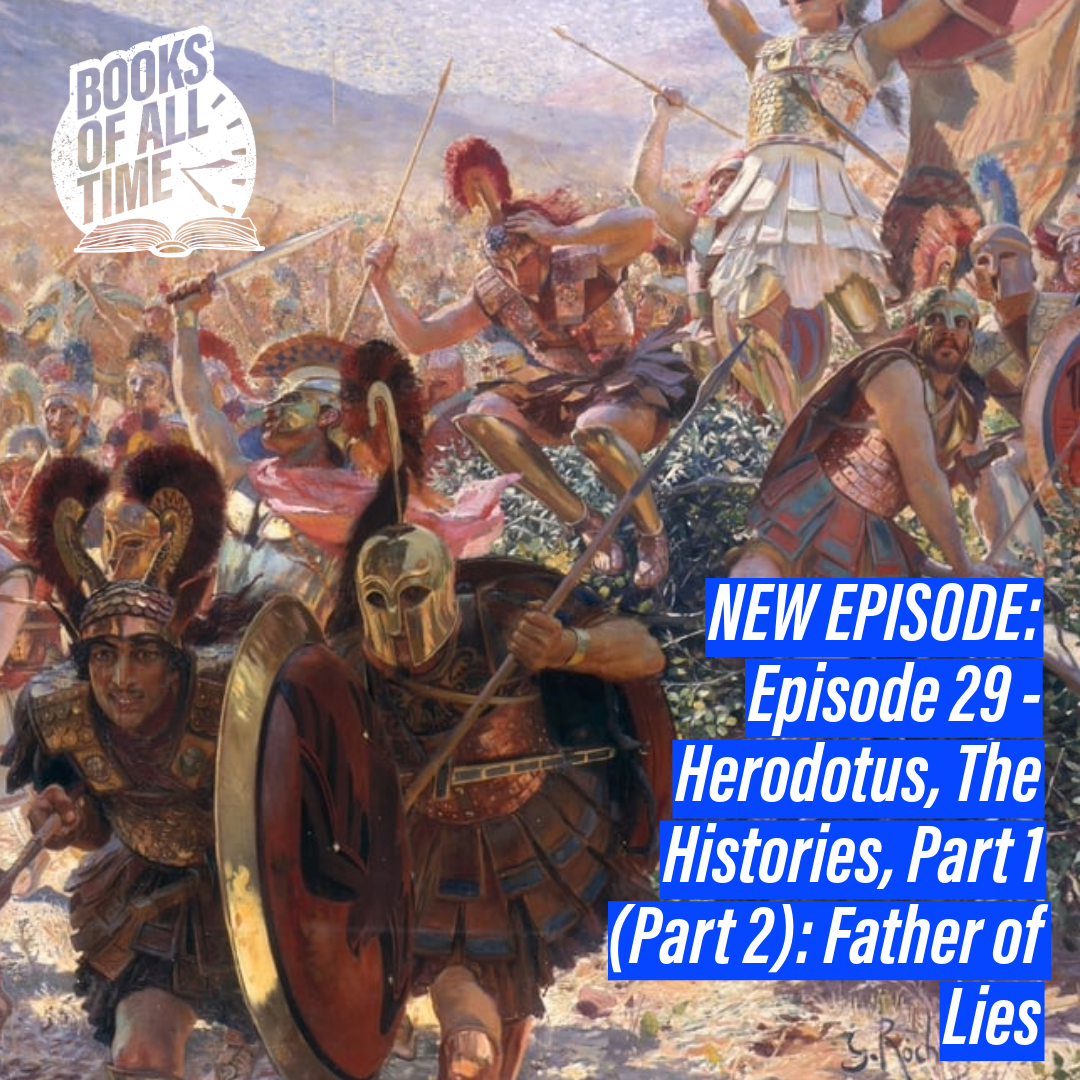
“The Athenians came on, closed with the enemy all along the line, and fought in a way not to be forgotten; they were the first Greeks, so far as we know, to charge at a run, and the first who dared to look without flinching at [Persians]; for until that day came, no Greek could hear even the word Persian without terror.” (Marincola 512)
The Persians focus their efforts on the weak center line, but the flanks of the Athenian army close in on them, and they are forced to retreat to their ships. Herodotus tells us that 6,400 Persians were killed, while the Athenians lost only 192. The Athenian forces bury their dead – a mound you can see in Marathon to this day – and then return to defend their city from the Persian fleet. But it isn’t necessary: the Persians sail back to Asia, tail firmly tucked between legs.
A few days later, after the full moon, two thousand Spartans turn up. “They had, of course, missed the battle,” sniffs Herodotus, “but such was their passion to see the Persians, that they went to Marathon to have a look at the bodies. That done, they praised the Athenians on their good work, and returned home.” (Marincola 514)
These Spartans, man: they may be amazing warriors, but they’re lousy allies.
[music]
Believe it or not, the Spartan kings don’t have the worst timing in The Histories. No, that distinction belongs to Darius: after hearing of the disaster at Marathon, he decides, at the opening of book seven, to spend three years amassing an even bigger force with more ships and more supply depots to prepare for a full-on assault of the Greek mainland.
Unfortunately for Darius, he soon has two very pressing distractions on his hands: a full-scale revolt in Egypt, and a violent fight among his sons about who should succeed him as king of the Persians. The contenders are Artabazanes, son of Darius’s first wife, and Xerxes, son of Darius’s second (and favourite) wife Atossa. Atossa is Darius’s first cousin, too: her father was Cyrus the Great.
These distractions seem to overwhelm Darius, and he dies. Xerxes, being descended from two kings of Persia, ascends the throne. He’s not all that interested in the Greek project – he is much more concerned with putting down the Egyptian revolt at first: the Persian war machine needs supplies and taxes to keep flowing from Egypt, so this seems quite sensible.
Once the Egyptians are subdued, Xerxes reconsiders the conquest of Greece. He calls together his ministers and generals and explains that he wishes to complete the task his father left unfinished – vengeance on the Athenians and all the other city-states of Greece. Does anyone have any objections?
His cousin Mardonius urges him to do it. His uncle Artabanus is opposed. He gives the warning I quoted at the top of the show, about how God smites the great (the Persians, I should note, are a monotheistic religion by this point – they worship Ahura Mazda, a creator- and sky-god). “God tolerates pride in none but Himself,” Artabanus continues. “Haste is the mother of failure.” (Marincola 532) Xerxes is so annoyed by this that he tells Artabanus to stay at home with the women when he and his army depart.
But Xerxes is not as decisive as he first sounds. The night following this conference, he goes to sleep with doubts in his mind. He has a dream in which a strange man tells him that he has no choice but to lead an army against Greece, or God will punish him. Xerxes dithers for a few days about whether to go to Greece. When his uncle Artabanus reports he had the same dream, he tells Xerxes that he retracts his earlier advice:
“I admit that I was mistaken. Tell the Persians about the vision which God has sent us; make them prepare for war . . . and, as God is offering you this great opportunity, play your own part to the full in realizing it.” (Marincola 538)
Resigned to the fact that this mission is the will of a god, Xerxes prepares a fighting force like none the world has ever seen: the armies of Darius, the Scythians, even of Agamemnon, were nothing to compare with it.
“Was there a nation in Asia that Xerxes did not take with him against Greece? Was there a stream his army drank from that was not drunk dry?” asks Herodotus (539)
We’re assured that it’s not just the size of his army or the number of ships he commands that makes Xerxes’s assault force so singular. No, it’s also the ingenuity with which the Persians try to master the tricky terrain between Asia and Europe. There’s a specific place called Athos where Xerxes dug a canal – traces of it are visible to this day. It’s been a while since Herodotus had infrastructure to geek out about, and he does so over the building of the canal at Athos. But he also considers it to be a bit showy and unnecessary:
“Thinking it over I cannot but conclude that it was mere ostentation that made Xerxes have the canal dug – he wanted to show his power and to leave something to be remembered by. There would have been no difficulty at all in getting the ships hauled across the isthmus on land; yet he ordered the construction of a channel for the sea broad enough for two ships to be rowed abreast.” (Marincola 540)
Xerxes also builds a bridge across the Hellespont. This is called the Dardanelles today – it’s a narrow strait of water that connects the Sea of Marmara to the Aegean Sea, and it’s generally accepted as part of the boundary between the Asia and Europe. This bridge, situated at Abydos, gets blown down in a storm. Herodotus tells us that:
“Xerxes was very angry when he learned of the disaster, and gave orders that the Hellespont should receive three hundred lashes and have a pair of fetters thrown into it. I have heard before now that he also sent people to brand it with hot irons.” (Marincola 544)
Xerxes also has the engineers who built this bridge decapitated. Then he builds a temporary pontoon bridge made entirely of ships lashed together with flax and papyrus cables at a place called Abydos. A digression from me: the first fixed crossing of the Hellespont is the Çanakkale Bridge. It is the world’s longest suspension bridge, and it was not completed until 2022. So it took a good 2,500 years before a permanent bridge crossed the body of water Xerxes’s engineers couldn’t quite master back around 480 BCE.
Moving on. Herodotus spends many pages describing the splendor of Xerxes’s army – their gleaming spears, their fine armor, the beautiful horses and chariots – and Xerxes’s visit to the site of Troy. At Abydos, Xerxes sits upon a white marble throne on a hillside to review his entire army and navy in one glance – and bursts into tears.
Artabanus asks him what the matter is. Xerxes replies,
“It came into my mind how pitifully short human life is – for of all these thousands of men not one will be alive in a hundred years’ time.” (Marincola 548)
“Yes, true,” says Artabanus, ever the ray of sunshine. “What’s more, many of them will suffer to the point that they wish they were dead many times between now and then. Oh well!”
The Persians cross the bridge. It takes seven days for the entire force to pass – Herodotus estimates that there are more than 1.7 million warriors, though modern scholars estimate the real number was at most 300,000. Once the crossing is complete, there are strange omens reported – a mare giving birth to a hare, a mule’s foal being born with two different sets of genitals – but Xerxes ignores these omens.
The Persians continue reshaping the landscape as they move deeper into Europe: they build bridges across smaller rivers, they cut roads through forests to bypass mountains. And, of course, they demand earth and water from the Greek towns they pass. Thessaly and Thebes are among those that submit to Xerxes.
“To Athens and Sparta,” says Herodotus, “Xerxes sent no demand for submission because of what happened to the messengers whom Darius had sent . . . at Athens they were thrown into the pit like criminals, at Sparta they were pushed into a well – and told that if they wanted earth and water for the king, to get them from there.” (Marincola 577)
Meanwhile, Sparta is actually mustering itself to be of practical use to its neighbours at last. Time and again throughout The Histories various city-states have gone running to the Spartans seeking help only to be rebuffed or to have the help turn up laughably late. Now, the Spartans convene a meeting of Greek leaders in Corinth and form a league. All hostilities among Greek communities must be suspended, and troops deployed wherever necessary to repel the Persian invasion.
But the Athenians also play a role here: they have built up something of a naval force over the years since Darius’s death. While nothing like the Persian fleet in size, the Athenian ships are able to resist the Persians by sea. And the Athenians did this, explains Herodotus, despite a terrifying warning from the oracle at Delphi, which goes, in part:
“Why sit you, doomed ones? Fly to the world’s end, leaving
Home and the heights your city circles like a wheel . . .
All is ruined, for fire and the headlong god of war
Speeding in a Syrian chariot shall bring you low. . .
Haste from the sanctuary and bow your hearts to grief.” (Marincola 581)
Crucially, the oracle also tells them that “the wooden wall” alone will not fall in the defence of Athens, and she mentions that Salamis will bring death to women’s sons. (Marincola 582)
The council at Corinth gets to hear that the Persians are mustering forces in captive Thessaly, which sits on a road into central Greece. Along this road is a narrow pass just six feet wide, with mountains on the south side of the road and sheer cliffs dropping to the sea on the north side. The pass is called Thermopylae.
[music]
The allied Greek council decides that Thermopylae can probably be defended with quite a small group of fighters. They send 4,000 men to defend it. The leader of the Greek garrison is the new Spartan king, Leonidas, half-brother of the flaky king Cleomenes. He has just 300 of his countrymen with him. Herodotus gives us Leonidas’s pedigree, tracing his fathers and grandfathers back to Heracles himself, and mentions that Leonidas is determined to fight no matter what: he has been told by a prophecy that Sparta will lose either its king or the city itself in the battles to come.
Herodotus also mentions that Leonidas has sent runners to beg the other cities in the league for reinforcements. But yet again, religious observances are messing with the Greeks’ ability to put together a fighting force in a timely fashion – the Olympic Games are happening just as this invasion is getting underway. No reinforcements will come.
The Persians get into position, led by Xerxes himself. A scout returns from the Greek camp and reports a strange thing to Xerxes: while many of the Greek forces are exercising in preparation for the battle, the Spartans are busy combing their hair. Demaratus, tagging along, explains this weird grooming:
“These men have come to fight us for possession of the pass, and for that struggle they are preparing. It is the custom of the Spartans to pay careful attention to their hair when they are about to risk their lives.” (Marincola 612)
And risk their lives they do. Xerxes begins the assault on the pass. For two days he throws bodies down the road only to see the inferior Greek numbers drive his men off. On the night of the second day, Xerxes receives a local Greek turncoat who informs him of a hidden track in the hills by which the Persians could sneak up on the Greeks from the rear.
A detachment of Persians marches through the night, surprising the Greeks on the fringes of the garrison and attacking them. As dawn breaks, panic spreads among the Greek allies: many abandon the pass and flee. Leonidas and his 300 remain, along with a small contingent of allies. The fighting is bitter, and Leonidas falls. Persian commanders move to seize the body – they are driven off four times by Greeks, who take their fallen king and try to escape with his corpse. But they’re cornered in the pass:
“They resisted to the last, with their swords, if they had them, and, if not, with their hands and teeth, until the Persians, coming on from the front and closing in from behind, finally overwhelmed them.” (Marincola 619)
The Persians win the passage. Herodotus pauses to praise the dead Greeks, sharing that in later years inscriptions were carved along the road. He quotes the Spartans’ epitaph: “Go tell the Spartans, you who read: we took their orders, and here lie dead.” (620)
Herodotus opens book eight by explaining that while the Spartans were defending Thermopylae, the Athenians were simultaneously engaged in a pitched naval battle at Artemisium. The Athenians, with 200 ships, find themselves facing a Persian fleet of 600 ships – many of which, fortunately, have been damaged in a storm. Some of the Greek commanders are keen to retreat, but the Athenian leader Themistocles bribes them to stay in their position.
That night, a diver named Scyllias pops up alongside a Greek ship. He’s a deserter from the Persians. Herodotus says:
“I cannot say for certain how it was that he managed to reach the Greeks, and I am amazed if what is said is true: for, according to this, he dived under water at Aphetae and did not come up until he reached Artemisium – a distance of about ten miles.” (Marincola 629)
Herodotus, to his credit, considers this a tall tale, and muses that Scyllias must have used a boat. At any rate, Scyllias informs the Greeks that there’s a Persian squadron of ships that is sailing around to take the Greeks from behind – similar to the flanking move Xerxes’s infantry are about to pull at Thermopylae. Fortunately, a storm smashes up this sneaky Persian squadron, and over three days the Athenians can fight the Persians, sinking enough of their ships to even up the numbers between the two fleets. But the Greek navy ultimately retreats from Artemisium, and this unfortunately means abandoning Athens as well. Herodotus describes the flight of the inhabitants of the city – women and children and the elderly. Only a few of the poorest and most stubborn Athenians remain in the temple, where they are immediately seized and killed by the advancing Persian forces, who burn the temples to boot.
The burning of Athens puts the fear into the remnant of the Greek navy, which has anchored at Salamis, a place seven miles west of Athens where a narrow strait leads into an even narrower bay. Themistocles has his work cut out for him holding the fleet together – the Spartan naval commander Eurybiades is a particular thorn in his side. Herodotus details a long argument among the naval commanders which ends with Themistocles haranguing the Spartan:
“If you stay here and play the man, well and good; go, and you’ll be the ruin of Greece. In this war everything depends upon the fleet.” (Marincola 637)
Themistocles threatens to sail to Italy if the other Greeks won’t make a stand at Salamis. They all know they don’t stand a chance at survival without the Athenian sea power, outnumbered as it is. So Eurybiades agrees to stay and fight.
Historians today place the Battle of Salamis on the 26th or 27th of December in 480 BCE. Herodotus tells us that as the sun came up that morning, there was an earthquake. The Greeks, on the sea, pray and sacrifice to the Gods. On the land, the Persians see a strange vision: a cloud of dust, like that raised by a host of soldiers, and voices moving within it, singing Greek songs.
A local Greek soldier serving with the Persians says that it must be a divine apparition. He predicts that if the singing dust-cloud moves further inland, it bodes ill for Xerxes’s army. If it moves towards the ships, “Xerxes may well lose his fleet.” (650) The cloud of dust rises into the air and drifts towards the water.
Meanwhile, Themistocles has come up with a clever trick: he sends a messenger to Xerxes pretending to be a Greek defector. “The Greeks are afraid and planning to slip away,” this messenger says. “They are at daggers drawn with each other, and will offer no opposition – on the contrary, you will see the pro-Persians amongst them fighting the rest.” (Merincola 655)
Xerxes takes the bait. His vastly larger fleet tries to cram into the narrow passages leading to Salamis, and as a result, they can’t maneuver. The Greek allies’ smaller ships can nip among them and engage. Xerxes watches from a hill as his enormous navy is crushed – reduced by perhaps a third – and he calls for a retreat.
Xerxes considers Salamis a temporary setback, but the destruction of so many fighting ships means his transport ships and supply ships will be harder to defend. At the suggestion of Mardonius (him again), Xerxes plans to leave a diminished force in Greece and take the remnant of his army back to Persia. This retreat across the Hellespont is grim for a fighting force that was once so splendid:
“During the march the troops lived off the country as best they could, eating grass where they found no grain, and stripping the bark and leaves off trees of all sorts, cultivated or wild, to stay their hunger.” (Marincola 673)
Meanwhile, Mardonius is attempting to avoid further fighting with the Greeks via a charm offensive. He sends ambassadors to the Athenians at Salamis offering to rebuild the burnt city of Athens if the Athenians will surrender and join the Persians. Now, throughout human history, there have been many great retorts by small armies to larger ones in response to a demand for surrender. For example, in 1944, during the Battle of the Bulge, the commander of the 101st Airborne Division turned down a Nazi surrender ultimatum with a single word: “NUTS!” While the Athenians’ reply to Mardonius isn’t quite so pithy, it is worth quoting :
“So long as the sun keeps his present course in the sky, we Athenians will never make peace with Xerxes. On the contrary, we shall oppose him unremittingly, putting our trust in the help of the gods and heroes whom he despised, whose temples and statues he destroyed with fire. Never come to us again with a proposal like this.” (Marincola 687)
Despite this defiant statement from the Athenians, the temporary unity of the Greek alliance is beginning to crack. Herodotus recounts a great deal of argument among the various factions – it’s an avalanche of names with very few entertaining digressions, quite unlike Herodotus – but ultimately, Mardonius meets the Athenians and Spartans in battle near a town called Plataea.
The allies are just able to stop infighting long enough to take down Mardonius. Once he is dead, the Persian forces flee, their camp is looted by the Greeks, and the end of the Greco-Persian wars are at last in sight. The Greeks pursue the invaders by land and sea, liberating previously conquered regions as they go. When the Greek navy comes to the Hellespont and finds Xerxes’s bridges destroyed, they feel their work is done at last.
Herodotus ends his Histories abruptly – probably they were unfinished – but he ends them in his own style: with a gossipy little anecdote. Back in the early days of the Persian Empire, he says, just as Cyrus was beginning his conquests, one of his advisors suggested that Cyrus move his home to a better country – one that was less barren than the Persian heartland.
“Cyrus did not think much of this suggestion,” says Herodotus. “’Soft countries,’ Cyrus said, ‘breed soft men. It is not the property of any one soil to produce fine fruits and good soldiers, too.’” (746)
Any Greek of Herodotus’s time would have chuckled at that: the later Persians were not so wise as Cyrus, and would lose their empire to the scrappy warriors from the stony, thin-soiled nations of Greece.
[music]
There we go, with the second half of Herodotus’s Histories. I have to say that the latter books are much harder work than the first five. This is because there are so many battles to cover – Herodotus doesn’t seem to be a natural military historian. The details of the campaigns are often very jumbled or very full of lists that make your eyes swim after a bit. These battles only come to life when he’s recounting some scheme or some snappy dialogue, like the Spartan commander who, upon being told that the Persian arrows are so numerous they block out the sun, said he would appreciate fighting in the shade.
And throughout these latter books you can feel Herodotus becoming more and more antagonistic toward the Spartans – aside from his recounting of Leonidas’s heroism at Thermopylae, he is constantly presenting Spartan soldiers and leaders as unreliable meatheads who are always on the brink of stabbing other Greeks in the back to protect their own. Again, that’s the tensions and biases of his time leaking through into his history.
In spite of this, he doesn’t divide cultures up into binary categories – good or bad, weak or strong. The historian Raymond Kierstead wrote in a 2011 feature for Reed University’s magazine that: “Herodotus had the capaciousness of mind to transcend ethnography and recognize that there could be, at certain moments in time, similar elements of greatness and of baseness in very different civilizations.”
That’s true: aside from his growing irritation with the Spartans, each of the cultures he discusses have an equal measure of nobility and wisdom; cowardice and foolishness.
I do love him. I do think you should give reading him a go, though it is a commitment. I read the Penguin Classics edition, and that was fine. I also hear good things about the 2013 translation by Tom Holland – by all means, check that out, too. You may find you need to skip around a bit to the fun stuff – gold-digging ants, blood-drinking nomads, all of book two on Egypt, etc. – but even reading some of Herodotus is worth your time. His voice really shines through, thousands of years after his mysterious death. I know I say this a lot on this show, but that kind of survival is about as close as we come to a miracle.
That’s it for this episode. Next time, we’re going to look at how Herodotus’s reputation has changed over the millennia – from how his immediate predecessor Thucydides took issue with his approach, to modern critics and imitators. Join me on Thursday, April 10th for episode 30: “Herodotus’s Histories, Part 2: The Invention of History.”
Books of All Time is written and produced by me, Rose Judson. The Disclaimer Voice of Doom is Ed Brown. Lluvia Arras designed our cover art and logo. Special thanks to Yelena Shapiro, Cathy Merli, Matt Brough, John Cole and the Books of All Time Advisory Council: Ed Brown, Beck Collins, Neil Dowling, Caitlin McMullin, Hugh Parker, and Jonathan Skipp. You can support the show by subscribing and leaving a rating or review at Apple Podcasts, Spotify, or wherever you get your podcasts. You can also follow us on social media: we’re on Bluesky, Instagram and Facebook. Thanks for listening! I’ll be back in two weeks.
References and Works Cited:
Marincola, John, and Aubrey De Selincourt. The Histories. Penguin, 2003.
Simons, Marlise. “Himalayas Offer Clue to Legend of Gold-Digging ‘Ants.’” The New York Times, 25 Nov. 1996, http://www.nytimes.com/1996/11/25/world/himalayas-offer-clue-to-legend-of-gold-digging-ants.html.


 Books Of All Time
Leave a comment