
“Farewell, my friend. You can eat your fill and be glad of heart, but at the price of a thousand fears and dangers. I, poor little thing, will go on living by nibbling barley and corn without fear or suspicion of anyone.” (Fable 243, The Town Mouse and the Field Mouse, Temple 178-179)
The orator had been framed – a gold cup stuck into his baggage as he was leaving Delphi. Now a mob had him surrounded.
“Thief!” some shouted, and “Blasphemer!” cried others. Nothing of the sort, he thought. Certainly he had spoken hard truths – perhaps he could have broken more gently the news that all Delphians were the descendants of slaves, and perhaps he ought not to have accused the priests of the temple of being frauds, but, well, he had been a slave and see how far he had come. He’d travelled to Samos and served King Croesus; he’d been the guest of the king of Babylon. The crowd began to move again, herding him toward some very high cliffs.
The orator knew there was only one way for him to save his skin: his stories. “Once,” he began, struggling to project his voice due to how out of breath he was, “when the animals all spoke the same language, a frog went to visit his friend, the mouse, who had invited him to dinner. When they had enjoyed their meal, the frog insisted the mouse come visit him at his pond. On the day appointed for the visit, the frog told the mouse to dive in.
“’But I can’t swim,’ said the mouse. ‘No matter,’ the frog replied, and he tied the mouse’s paw to his flipper, then leapt into the water.
“The frog dragged his friend through the pond, proudly pointing out the many features of his home, only realizing too late that the mouse had drowned and was floating toward the surface. The frog was pulled above the water by the cord that bound them. The last thing he saw was a white flash coming toward him—he and the dead mouse were snapped up by a seabird and torn apart on the bank. Thus it is, my friends, that by causing my death, you will only bring misfortune—”
“Shut up,” suggested the leader of the mob. But the orator persisted, emptying his bag of tricks with rising desperation as the cliffs grew closer and closer and the mob’s patience grew shorter and shorter. He told the fable of the eagle and the dung beetle, and the one about the man who shagged a donkey, and even the one of the man who forced himself on his own daughter. Amazingly, they did not grasp his point. At the brink of the cliff, his fountain of fables at last exhausted, the orator cursed the mob and the city of Delphi. To cheat them of the satisfaction of murdering him, he leapt to his own death.
So passed Aesop, the legendary storyteller. Or so, at least, we’re told.
I’m Rose Judson. Welc ome to Books of All Time.
Books of All Time is a podcast that’s tackling classic literature in chronological order. This is episode 22: Aesop’s Fables, Part 1: Slow and Steady. As always, if you want to read the transcript of this episode or see the references I used to write it, you can visit our website, www.booksofalltime.co.uk. There’s a link in the show notes if you need it. Let’s begin.
In this episode we come to the Ancient Greek author who is probably more widely read today than any other, even Homer—Aesop. He is probably also the least understood author. Most of us encounter Aesop as children, when reading the clever little animal stories that impart clever little morals in a big book that has his name on the cover. This is a constructed Aesop, one put together by 18th– and 19th-century editors. The Aesop we’re all familiar with, it turns out, does not really reflect the original tales.
In the introduction to the 1998 Penguin Classics edition of Aesop’s Fables, Robert Temple (who co-translated the edition with his wife Olivia Temple) says that:
“[Aesop] is rather like a movie star – everyone thinks they know him, but in fact they only know him from certain roles he has played . . . as a children’s storyteller and as a clothes-horse for Victorian morals such as ‘haste makes waste’ and ‘pride comes before a fall’.” (Temple ix)
Aesop’s original fables, as I was surprised to learn while reading for this episode, are much darker, more subversive, and far more adult. They’re full of violence and smut as well as talking animals, and they mostly seem to have been intended as jokes – nasty jokes meant to poke fun at others’ misfortune or to blow a raspberry at the powerful within the safe confines of humour. Well, mostly safe, if the 1st-century CE Life of Aesop has any truth to it.
It probably doesn’t have any truth to it. Aesop may not have lived at all, though various ancient sources insist he did. His dates are given as 620 to 564 BCE, but the stories collected under his name – hundreds and hundreds of them, more than he could possibly have written, assuming he could even write – don’t appear until at least 450 BCE, and that’s also a guess. I’ve put him in the reading list based on this supposed date of the first collection, not on what’s reported about when he lived.
The very oldest mentions of Aesop, including details about Aesop’s life, come from Herodotus, Plato, and Aristotle. Whether or not Aesop actually lived, tradition broadly agrees on two key facts: first, he was enslaved. Second, he was hideous. (Some sources also claim that he was a mute until adulthood, when the goddess Isis bestowed the gift of gab on him after he helped one of her priestesses.) Temple notes that Aesop appears to have been enslaved as a result of captivity: that meant he had no right to expect he’d ever be freed at any point, even if his master, Xanthus the philosopher, died.
That 1st-century biography – we don’t know who wrote it – seems to be mostly a comic invention, in which Aesop uses his wit and wordplay to outwit his learned master—slacking off from tasks, stealing the best food in the pantry, getting off with Xanthus’s ill-tempered, perpetually horny wife. But it also gives us one of the most memorable and widely quoted description of Aesop’s bad looks. In fact, it’s in the very first line of the biography. Aesop was “of loathsome aspect . . . potbellied, misshapen of head, snub-nosed, swarthy, dwarfish, bandy-legged, short-armed, squint-eyed—the mistake of a slumbering Prometheus.” (Anon. §1)
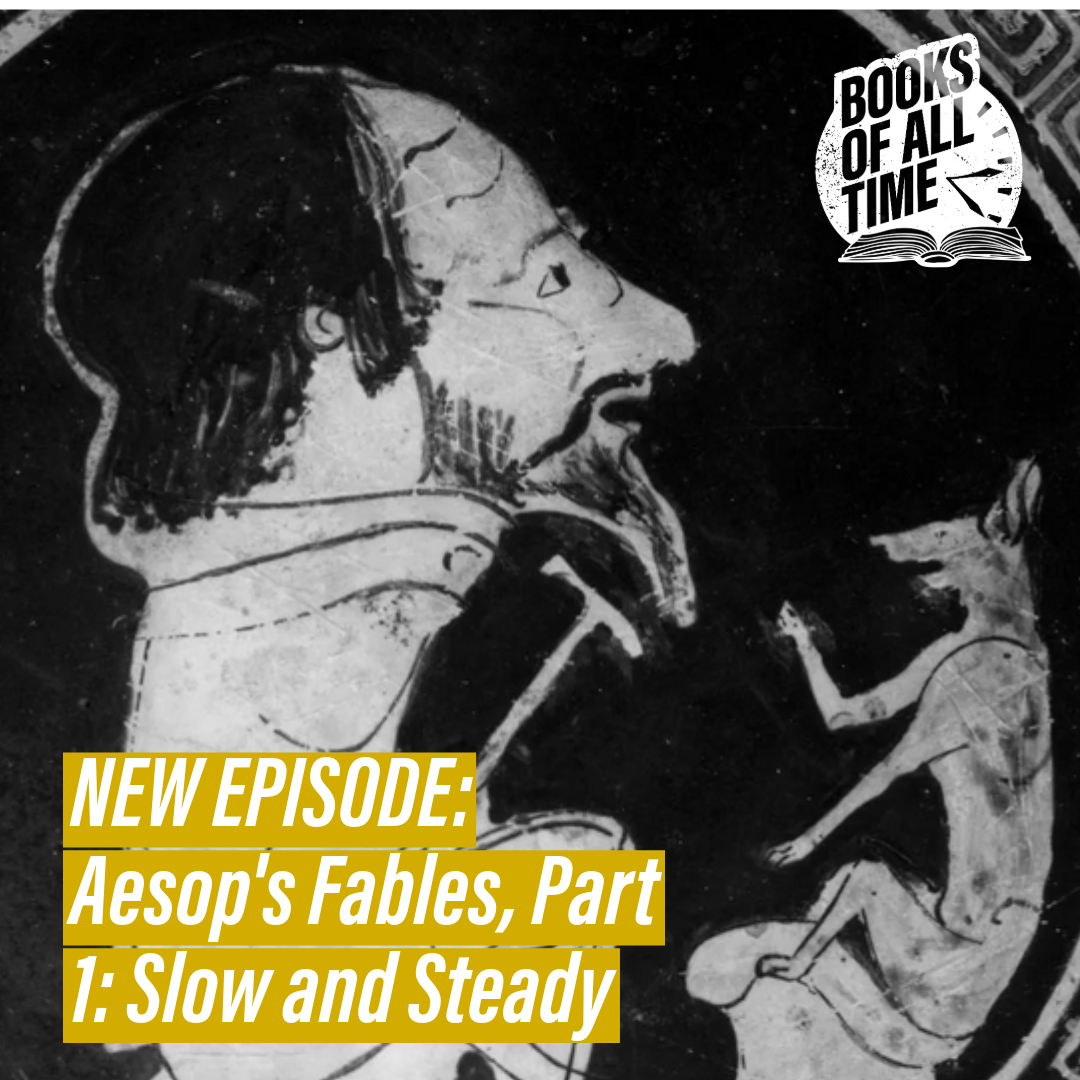
There is a very entertaining depiction of Aesop on some Greek pottery from the 5th century BCE on the Encyclopaedia Britannica website that bears this description out – Aesop has a crooked, feeble-looking little body and an enormous head that resembles, to me at least, a caricature of William Shakespeare. His mouth is open, and he is gazing out of frame, as if he’s in the middle of extemporising one of his weird little stories. His audience is a fox, who appears to be pointing at him and barking with laughter.
Aesop was perceived by his earliest audiences as someone you laughed at. He was a comedian, not a moralist. Moreover, he was a comedian who could be grossly and crudely funny, bitterly and nastily funny, or slyly and subversively funny. “There was a preoccupation of the humour in the fables,” says Robert Temple, “of ‘scoring’ at the expense of someone else’s misfortune.” (Temple 88) He describes the fables as “savage, coarse, brutal, lacking in all mercy or compassion, and lacking also in any political system other than absolute monarchy.” (Temple xvi) But this was wildly popular in its day, and popular very quickly.
Plato tells us that the philosopher Socrates, while in prison awaiting trial, occupied his mind by writing versions of Aesop’s fables in poetic form. Socrates was likely born about a hundred years after Aesop is supposed to have died. Likewise the Greek comedic playwright Aristophanes, who references or quotes Aesop more than once in the plays of his known to us and does so in a casual way which suggests he expected his audience would be in on the joke.
But the stories very soon became about more than mere entertainment. They were handy little allegories that could be deployed to poke fun at, or share unpleasant truths with, your social superiors. They were a jester’s strategy for telling truth to power in a safe way – as long as you didn’t take it too far, as tradition says Aesop did in Delphi. Reading through them, you get the impression of someone who wants to seem devastatingly witty, or who wants to get the biggest laugh at a symposium (in Ancient Greek times, a symposium was a drinking party at which the guests took turns giving speeches). In modern terms, it’s the humour of someone who wants to “own” his opponent in a debate.
Aesop’s Fables – or Aesop-style fables – pop up across the centuries in correspondence and works of history, in public speeches and even in arguments at law courts. Evidently the Roman orator Cicero, whose works we’ll get to sometime in 2026, enjoyed using them to make a point, and, in using humour to make that point, to show up his opponent as ridiculous.
When you read a translation of the ancient fables, you’ll notice that there are in fact little summaries at the end of each one. In many cases they give you the point of the story, though not necessarily its moral, and in others they seem to be broadly categorizing it.
In fact, Temple suggests that is just what the morals started out as: a kind of index entry, a bit like the guide words at the top corners of a dictionary page, if you’re old enough to have used a paper dictionary. If an ancient Greek or Roman orator knew he was going to be giving a speech about someone who was jealous, or boastful, or whatever, he could scan these summaries in the scroll or book he was reading until he found an entry that helped illustrate his topic. Then he could weave it into his speech, maybe adding his own details or spin as you went.
As we’ll see when I start summarizing some of the fables (soon, promise), these tags often don’t seem to help you understand what you just read. Temple, again:
“It will readily appear to most readers that the morals are often silly and inferior in wit . . . some of them are truly appalling, even idiotic.” (Temple xv)
I agree with this: the word “baffling” appears at least 10 times in the notes I made in my copy as I was reading.
As I mentioned earlier, the hundreds of fables collected under Aesop’s name almost certainly weren’t written by him. Audiences were onto this fact as early as Aristotle: a true fanboy, Aristotle carefully catalogued the fables, separating out those he suspected of originating someplace else – usually in Libya, Samos, or Egypt. Robert Temple explains that we ourselves can spot fables borrowed from other cultures by the animals in them: for instance, there are no lions, elephants, hippos, or camels in ancient Greece. These stories would have had to come from elsewhere. Another fun detail also has to do with animals: any fable you remember as featuring a housecat has been edited to make sense to modern readers. While the Ancient Egyptians have had cats as pets for thousands of years, the Greeks didn’t really warm to them until after Alexander the Great. In Aesop’s time, people kept weasels, including ferrets and polecats, instead. And look – I know this is going out on Christmas Eve, but if you feel tempted to make a last-minute purchase for someone you love, please remember that a weasel is for life, not just for Christmas.
So, let’s take a look at some of these fables, eh?
[Music]
The first group of fables I want to look at involve power dynamics. While scholars often like to describe Aesop as someone who speaks truth to power in his stories, I usually find that actually his stories are much more likely to speak the truth about power and warn people not to try to reach above their station. Take fable 153, The Kithara Player, or the Lyre Player. Basically an amateur musician who is, quote, “devoid of talent” (Temple 115) becomes convinced by the acoustics in his room that he’s much better than he actually is. So he goes to a theatre to take part in the Ancient Greek equivalent of an open mic night, and he’s so awful that the audience drives him off the stage with stones.
The moral appended to this is “Thus, certain orators who, at school, seem to have some talent, reveal their incompetence as soon as they enter the political arena.” (Temple 115) And that seems… pretty niche, though you could probably finesse it to be a little more universal – big fish shine in a small pond, but drown at sea, or something. I don’t know, it’s the end of the year and the lance of my wit has grown dull, you know?
Fable 162, The Jackdaw and the Birds, seems to have a similar theme of avoiding trying to be something you’re not. In this fable, Zeus announces that he is going to name a king of the birds, and names a day when all the birds should appear before him to be judged for their beauty. I looked up the jackdaw, and while it is a perfectly fine-looking corvid – a member of the raven and crow family – its black and grey colouring are not going to make it in a world that contains peacocks and cassowaries. Or even pigeons. Have you looked closely at a pigeon recently? They’re actually quite pretty.
Anyway. The jackdaw goes sneaking about in the days leading up to the contest, stealing as many feathers from other birds as he can, and is able to arrange them on himself so convincingly that on the big day, Zeus falls for the ruse and crowns him king. But it’s a short-lived reign, obviously: the other birds descend on the jackdaw and pluck out the purloined feathers, leading Zeus to disqualify him.
The moral of this, you’d think, would be something along the lines of “cheaters never prosper,” but no. Instead it warns against “men who have debts: as long as they possess the wealth of other people, they seem to be somebody. But when they have paid their debts, they find they are once again their old selves.” (Temple 119) Sure, I guess.
Next comes fable 159, The Stomach and the Feet. The feet are trying to convince the stomach that they’re stronger than it is, since they carry it around all day. But the stomach points out that it digests the food which gives the feet the energy they need to carry it, so who’s stronger now, huh? The moralist notes that “thus it is with armies.” (Temple 117) In a 2014 episode of In Our Time about Aesop, the scholar Lucy Grig argues that this is reinforcing the importance of top-down leadership generally. The labourers labour so the king can eat, and vice versa.
Closing out this category is fable 237: The Mice and the House-Ferrets. In a certain house, the mice, hard-pressed by the ferrets, decide to organize. Naturally, some of the mice volunteer as leaders and want some kind of symbol of their status. So they fashion little horns for themselves that they wear into battle. But their battle goes badly: they have to retreat in the face of the ferrets’ ferocity, and when they are escaping into their mouseholes, the leaders wearing horns get stuck, and the ferrets catch and eat them. “Thus,” says the moralist, “vainglory is often a cause of misfortune.” (Temple 175)
True enough, but their entire strategy was misjudged. If they’d just adopted guerilla tactics a la Jerry the cartoon mouse, they’d have prevailed in no time.
Next, I want to look at some of the fables which deal specifically with gods giving people their comeuppance. Temple reckons these are among the oldest fables in the collections – the ones most likely to be “authentically” Aesop’s, if he actually existed.
Fable 55 is one of these. It’s simply called The Cheat. In it, a poor man who’s suffering from a terrible illness promises the gods he’ll sacrifice 100 oxen to them if they restore him to health. When his prayers are heard and he recovers from his illness, he is obviously unable to assemble that many cattle, so he makes 100 little models of cows out of tallow – beef fat – and burns those as a sacrifice instead.
The gods do not think this is cute. They decide to get their revenge: they send him a dream in which he learns that if he goes to the seaside, there will be 1,000 drachmas waiting for him. The man wakes up and rushes down to the beach, where he is immediately captured by pirates and sold – for 1,000 drachmas.
Fable 50 is similar. It’s called The Mischievous Man, and it is about a man who makes a bet with a friend: he can prove the Oracle at Delphi is a fraud. The man visits the temple with a little bird hidden inside his cloak. His plan is to ask the oracle a trick question: is the thing in my hand living or lifeless? If the Oracle says “living”, the man will strangle the bird and show it to her. If she says “lifeless”, he’ll reveal the live bird. Foolproof plan, right?
The man waits his turn. When he’s finally admitted to see the oracle, he asks his question. She fixes him with a look and replies, “It depends on you whether what you are holding is dead or alive.” Haha, owned!
Fable 66 is called The Frogs Who Demanded a King. I was amused by the opening line, which goes, “The frogs, annoyed by the anarchy in which they lived…” (Temple 52) because this brought to mind a British expression I’ve always liked, “mad as a box of frogs.”
Anyway, the frogs are annoyed, and they appeal to Zeus to send them a king to rule over them. Whether because he doesn’t think much of them or because he’s busy planning his next seduction of an unsuspecting mortal, Zeus tosses a log into their pond and goes about his day.
At first the frogs are frightened of this new, large, floating king, but they gradually realize he’s completely inert – gives no orders, arranges no wars, doesn’t cure scrofula with his hands, mainly because he’s a log and hasn’t got any – so they petition Zeus again. This king’s no good; send us a better one. Zeus, irritated with the repeat request, sends a giant water snake, which eats them all up.
“This fable teaches us,” says the moralist, “that it is better to be ruled by passive, worthless men… than by productive but wicked ones.” (Temple 153) Does it, though? Doesn’t it really teach us not to ask Zeus for anything? I realize that this mismatch between moral and fable is not the fault of Aesop, or of the oldest storytellers who contributed to this collection. It’s the fault of the people who were collating and indexing the fables after the time of Alexander the Great – that seems to be when the moral tags were first attached to Aesop’s Fables.
The fault may also lie in the fact that my sense of morality, propriety, and humour is calibrated very differently to that of a man living in Ancient Greece or Rome. Maybe it’s a personality defect, or maybe it’s just a result of my existing where and when I do – I used to live near a piece of public art that featured the inscription, “We resemble our times more than we resemble our parents,” and I’ve thought about that a lot over the past eight months of doing this show.
Whatever the reason for this mismatch, the fact remains that it’s very hard to see the point of many of the fables by themselves, and the moral tags just confuse the issue. Let me take you through a few of the ones I tagged as “baffling” in my notes to illustrate this. Fable 67 is another one about frogs – I can only assume the Ancient Greeks thought frogs were terribly funny, given how often they appear in the fables – and it’s called The Neighbour Frogs.
One frog lives in a pond by the side of a road. Another frog lives in a puddle on the road. The frog in the pond tries to convince the frog in the puddle to move in with her, but the puddle-dwelling frog can’t be bothered. It’d be too much trouble to move, I grew up here, I’d have to redirect all my mail, and that’s a drag – puddle frog stays put. And then one fine day a chariot drives through her puddle, killing her.
That’s it. That’s the fable.
Now, what do you think the moral of this story would be? “Don’t pass up new opportunities in favour of the familiar?” “Get outside your comfort zone?” Something like that? Of course not. The moral tag reads “Those who practice the lowest of trades die before turning to more honourable
employment.” (Temple 54)
What? What on earth? First of all, neither of these frogs seem to have an income, let alone a trade, so I don’t know where the moralist gets that. Second, if you were including this in a collection for children, how would you rewrite it? Once you’d got little Jimmy and Sally past the mental image of a frog squashed on the road, all its guts in the mud, you’d have to impress it on their young minds that this story illustrates the inevitable result of working a quote-unquote “lowly” job like long-haul truck driving or being a nail technician. You’ll die if you don’t get the right kind of job, kiddoes. Wisdom of the ages.
Maybe something gets lost in context over time. Maybe generations of translators have all missed some nuance. Or maybe the person writing the moral tags was making these stories be “about” whatever was on his mind at the time. Another baffling one is fable 172, The Snails. A child is cooking some snails to eat. He hears them bubbling and hissing in their shells as their juices cook off in the heat. “Silly snails,” the child says. “Your houses are on fire and all you can do is sing about it!”
The end. The moral tag says, “This fable shows that everything one does inopportunely is reprehensible.” (Temple 157) Well, obviously.
Incidentally, did you know that eating poorly cooked snails puts a person at risk of developing angiostrongyliasis? This is a condition caused by a parasite common in snails called the rat lungworm, which causes fairly typical food-poisoning symptoms at first, but then, as the worm takes up residence in your brain, progresses to central nervous system deterioration and, on rare occasions, invasion of the vitreous fluid inside the eyes.
I hope that all happened to this child, honestly.
[music]
I am going to summarize a few of the classics for you. But before I do, there are two fables I need to bring to your attention in passing, just so you understand what you’re getting into if you decide to read these for yourself: in addition to the violence and mean-spiritedness of everything we’ve discussed to date, there is also plenty of smuttiness and racism in Aesop, too – smut and racism clearly meant as jokes within the context of the time. Fable 112’s title will give you a hint as to the kinds of things it contains: it’s called The Chariot of Hermes and the Arabs. Fable 118, Zeus and Shame, has a less obvious topic, but the main gist of it is that when Zeus was creating mankind, he had to insert Shame into the body via the rectum.
I really don’t want to repeat racist jokes from any era, even as criticism, and I definitely want to minimise the number of times I use the word “rectum” on this show, so, if you’re morbidly curious, please go to www.bsky.app – that’s the social media site Bluesky – and look up “Books of All Time” in the search bar to see a thread I’ll post about these two gems right after I hit “publish” on the episode.
[Sigh] Should I go back and change “rectum” to “anus”? Or “posterior”? I don’t think there’s much point.
Anyway, let’s try to end on an up note. Here are four of the classic fables. The all-time bangers. The ones we remember from those big picture books many of us had as children – or, if you are of a certain age and had certain media habits, a 1971 TV adaptation starring, as Aesop, the disgraced U.S. comedy legend and convicted serial sexual predator, Bill Cosby. Sorry for bringing him up, but I’ve already said “rectum” multiple times in this episode, so.
Right. Fable 73, The North Wind and the Sun. You know this one: the sun and the wind see a man wearing a cloak walking along a road, and they decide to see which of them can get him to take the cloak off. The north wind howls and rages and batters the man to blow the cloak off, but the man just clutches it more tightly around himself. The sun then shines gently and steadily, warming the man, and he removes the cloak. The moral, for once, matches the obvious meaning: “Persuasion is often more effective than violence.” (Temple 58) Not that you’d know that from reading, oh, any other story in this collection.
Fable 206 is also familiar: The Lion and the Mouse Who Repaid a Kindness. A lion is woken up by a mouse during a nap, grabs it, and is on the point of popping it into his mouth like a festive rum ball when the mouse begs for its life. “I’ll be so grateful if you don’t eat me; I’ll do you a favour in return someday.” The lion thinks this is funny – as if he’d ever need a mouse’s help – but he sets the mouse free.
Some time later, the lion gets caught in a hunter’s snare. He’s in despair of his life when the mouse appears and chews through the ropes holding the lion in place, saving him from his predicament. Again, an obvious moral: “Through the changes of fortune, the strong can come to depend on the weak.” (Temple 154)
This one is interesting not just because it’s familiar to us, but because it clearly travelled throughout the ancient world. The Temples note that there’s an Ancient Indian version of this story with an elephant in place of the lion. “The probability,” they write, “is that the Indian version is an adaptation of the Greek fable done after the time of Alexander the Great.” (Temple 154) If you’re interested in more examples of cultural cross-pollination between Ancient Greece and Ancient India, please see episode 18 of this show, “The Upanishads, Part 2: Dionysus, Son of Indus.”
Fable 243, The Field Mouse and the Town Mouse, is the one I quoted at the top of this episode. It’s got a similar premise to the Mouse and the Frog fable that Aesop tells the Delphians as they’re shoving him towards those cliffs, but thankfully it’s far less violent. A field mouse entertains his cousin from town. The town mouse talks down the country way of living: “Such bad food, and such small portions! You need to come visit me, cousin, and then you’ll eat well.”
On visiting the town mouse, the field mouse is impressed by the dates, cheese, and flour in the pantry of the house where the town mouse lives. But they have to dodge men and house-ferrets in order to snatch a single bite. The field mouse decides he prefers his quiet way of living, even if he only has the odd bit of barley to eat, and the moral “One should live simply and free from passion, instead of luxuriously in fear and dread,” was apparently popular with both the Greeks and the Romans. (Temple 179)
Finally, The Tortoise and the Hare, fable 352. Another classic, with not one but two adaptations starring Bugs Bunny: 1941’s Tortoise Beats Hare and 1943’s Tortoise Wins by a Hare. The hare and the tortoise agree to race; the hare, assuming he has it in the bag, doesn’t take it seriously, and the tortoise wins because he persistently plods along. Instead of the snappy “slow and steady wins the race” that we’ve all become accustomed to, the moral here is instead “Hard work often prevails over natural talents if they are neglected.” True, Aesop, true, and thanks for giving us at least a handful of stories that aren’t completely harsh and appalling.
Phew. Violence, selfishness, celebrating other people’s tragedies – the original Aesop was pretty red in tooth and claw. I guess the silver lining here is that in spite of all the perils and shortcomings of modern life, we are on the whole gentler and more compassionate than the society imagined in these fables. At least, sometimes.
That’s it for this week’s episode. What a ride. I’m not sure I like Aesop’s Fables – I may want to revisit them again and try to ignore the moral tags to see if they make more sense that way. But I do appreciate their longevity, and I do see how that form of story can appeal to speakers and writers as material they can mine to make a point. Little stories are a powerful form of teaching or persuasion – Jesus Christ, to take just one seasonally appropriate example, used them well.
Another reason I appreciate the fables is because they show us a very different side of Greek society than Homer or Sappho or even Hesiod. Professor Simon Goldhill explained it well in that 2014 episode of In Our Time about Aesop. Quote:
“Our standard image of high Greek culture . . . is the body beautiful, standing tall, reading out epic verse. This is the opposite: this is an ugly guy, doing small things in prose.” (BBC, 27:05)
Put another way, Aesop represents the survival of Greek popular culture rather than “prestige” entertainment. Like a lot of popular culture, Aesop’s Fables often pander to the lowest common denominator with coarse and even scatological humour – in fact, I’m just realising I didn’t even mention fable 141, The Camel Who Shat in the River – so sorry, out of time.
Should you read them? Yes, I think it’s worth it. Aside from the dog-eat-dog mentality, the racism and violence and toilet humour, reading the fables does give you glimpses of ordinary life in the ancient world: what food they kept in the house, how they talked to each other, how they worked and got by. And they’re short. The 1998 Penguin Classics edition I read, in spite of having nearly 400 fables, was a quick read – most of the fables take up less than half a page, even with explanatory notes. There’s also a 2002 Oxford World Classics edition that has even more fables, but I haven’t looked at that one closely myself.
Whichever one you choose, copies are widely available in print and digital formats. If you’re lucky enough to have time off over the festive season, you could easily read most of them during a lazy afternoon. There’s no overarching plot to follow, no complex vocabulary involved, and, if the sentimentality of this time of year is getting to you, they will definitely provide a much-needed corrective to that. Or you could just watch Die Hard. Your choice!
Next up, we are going to get to the bottom of how Aesop’s Fables made the leap from after-dinner banter fodder to nursery school morality tales – the fictional equivalent of hiding your dog’s deworming pills in peanut butter. Join me on Thursday, January 2nd for episode 23: “Aesop’s Fables, Part 2 – The Moral of the Story.”
Books of All Time is written and produced by me, Rose Judson. The Disclaimer Voice of Doom is Ed Brown. Lluvia Arras designed our cover art and logo. Special thanks to Yelena Shapiro, Cathy Merli, Matt Brough, John Cole and the Books of All Time Advisory Council: Ed Brown, Beck Collins, Neil Dowling, Caitlin McMullin, Hugh Parker, and Jonathan Skipp. You can support the show by subscribing and leaving a rating or review at Apple Podcasts, Spotify, or wherever you get your podcasts. You can also follow us on social media: we’re on Bluesky, Instagram and Facebook. Thanks for listening! Merry Christmas and/or Happy Hanukkah for tomorrow; I’ll be back next week, in the new year.
References and Works Cited:
Aesop. Aesop: The Complete Fables. Translated by Olivia Temple and Robert Temple, Penguin, 1998.
Aesop. Aesop: The Complete Fables. Translated by Olivia Temple and Robert Temple, Penguin, 1998.
“Aesop.” Encyclopædia Britannica, Encyclopædia Britannica, inc., http://www.britannica.com/biography/Aesop. Accessed 11 Dec. 2024.
“Angiostrongyliasis.” Wikipedia, Wikimedia Foundation, 8 Dec. 2024, en.wikipedia.org/wiki/Angiostrongyliasis.
Anonymous. “Anonymous Life of Aesop.” Translated by Lloyd William Daly, Topostext, Aikaterini Laskaridis Foundation, Piraeus, Greece, topostext.org/work.php?work_id=541. Accessed 11 Dec. 2024.
Bragg, Melvyn, and Simon Tillitson. “Aesop.” In Our Time, BBC Radio 4, 20 Nov. 2014.
https://www.bbc.co.uk/programmes/b04pbq9l
Taylor, Barry. “Aesop’s Fables Are Not Kids’ Stuff.” European Studies Blog, British Library, 21 Mar. 2014, blogs.bl.uk/european/2014/03/aesops-fables-are-not-kids-stuff.html.


 Books Of All Time
Leave a comment