
“Celebrate the holy family of immortals who are forever, those who were born of Earth and Heaven and of black Night, and those whom the briny sea fostered . . . Tell me this from the beginning, Muses of Olympus, and say what thing came first.” Hesiod, Theogony (West 6)
Join me at the breakfast table, won’t you? Not at mine, obviously, but at a breakfast table not quite 100 years in the past, in Oxford, England. It’s March 1930, and Falconer Madan is taking tea with his daughter, a Mrs. Burney, and his granddaughter, Venetia Burney, who is 11 years old. Falconer – I’d call him Mr. Madan, or Professor Madan, but really, you can’t not use a name like “Falconer” as often as possible – is reading an article in The Times to his ladies. Apparently, a team of American astronomers at the Lowell Observatory in Arizona have discovered a ninth planet some three billion miles from the sun. It’s a planet that as yet has no name, and the astronomers have appealed to the public for ideas.
“What about Pluto?” says Venetia. Now, history would show that she was not the only person who came up with this idea. But she happened to be the one to say it to a man with the right connections. In addition to having a fabulous first name, Falconer Madan was also the retired Librarian of the Bodleian – that’s the Bodleian Library, the University of Oxford’s main research library. He immediately passed on his granddaughter’s bright idea to one of his very dear friends, Herbert Hall Turner who happened to be the retired Astronomer Royal.
Turner then immediately wired the Lowell Observatory suggesting that planet X be called Pluto, and explaining the charming circumstances in which the idea had originated. It probably helped that, by a fantastic coincidence, Miss Burney was not the first person in her family to name a celestial body: Falconer’s brother Henry had previously named the two moons of Mars, Phobos and Demios.
The astronomical community agreed. On May 1, 1930, Planet X acquired the Roman name of Hades, the Greek god of the dead – the name of a god who lives in dark and silent halls far beyond the inhabited world; a god whose world is cold and lifeless.
Given what we’ve since learned about the planet—sorry, dwarf planet—Pluto, Venetia Burney really did pick the right name. But she wasn’t some precocious kid thrumming with all the multiple resonances of the name she picked. In a 2006 interview with NASA, she said:
“I was fairly familiar with Greek and Roman legends from various children’s books that I had read, and of course I did know about the solar system and the names the other planets have . . . I just thought this was a name that hadn’t been used. And there it was.”
And there it was. It’s strange to think how powerful the Greek myths are. There hasn’t been any nationally sponsored, serious religious observances on their behalf in countless centuries, but they come up constantly. The other worlds beyond ours are named for them, as are the missions we Americans send out to explore those worlds – Apollo, Artemis. If you speak a romance language, you know that even the days of the week bear the Roman names of these gods: Martes, day of Mars or Ares, is Tuesday in Spanish, and Miercoles, day of Mercury or Hermes, is Wednesday. Sit and think a bit and you’ll come up with more places where they are woven into our lives. Maybe, as the classicist Barbara Graziosi put it in the introduction to her book, The Gods of Olympus: A History: “Thinking about humanity must include some consideration of the Olympian Gods.” (Graziosi ii)
I’m Rose Judson. Welcome to Books of All Time.
Books of All Time is a podcast that’s tackling classic literature in chronological order. This is episode 16: Theogony and Works and Days, Part 2: Immortals Who Are Forever. As always, if you want to read the transcript of this episode or see the references I used to write it, you can visit our website, www.booksofalltime.co.uk. There’s a link in the show notes if you need it. Let’s begin.
This episode is going to be something of a mixed bag. In spite of the focus on Hesiod and the Greek pantheon (and in spite of the intro to this episode), I want to step back to take a broader look at the other cultures we’ve encountered so far in the show. I’d like to do a little comparative religious study, or comparative mythological study, I guess.
To remind you, there are five cultures, or cultural universes, we’ve crossed paths with to date: the Mesopotamians, which includes Sumerians, Babylonians, and Assyrians; the ancient Egyptians; the Vedic people of ancient India; the ancient Greeks, and the people of the ancient Levant: Canaanites, Israelites, and Judahites. We’re going to look at the creation myths, pantheons, and ideas about the afterlife from each of these five groups to draw out some of the interesting parallels among them. First, we’ll start with a little musing about myth and religion.
To begin with, what is myth, and what is religion? It’s worth trying to nail these definitions down, especially if you haven’t thought about them very hard for a while. “Myth” can be an especially fuzzy word. Today, the word “myth” tends to have a pejorative vibe. When modern speakers and writers talk about “myths,” they’re referring to old fairy-stories that primitive people believe, or superstitions or old wives’ tales. Myths exist to be disproven or busted. We also like to use “myth” as a synonym for “lie.”
For this episode, I read Karen Armstrong’s 2005 book A Short History of Myth. It’s a very slender but very dense volume – a bit like Hesiod – and I feel like I’m going to be in conversation with it in many an episode to come. For now, I’ll pull out some ideas from her first chapters, which attempt to explain what myth is and what myth does.
Myths and mythology, according to Armstrong, are intimately connected to our human capacity for imagination and our compulsion to seek meaning. “From the very beginning,” she says:
“…we invented stories that enabled us to place our lives in a larger setting, that revealed an underlying pattern, and gave us a sense that, against all the depressing and chaotic evidence to the contrary, life had meaning and value.” (Armstrong 2)
Myth-making, argues Armstrong, is and always has been an integral part of how humans try to understand the world.
She takes myth very, very seriously: it’s not to be regarded as entertainment, or at least not as mere entertainment. Myth reflects a basic, enduring belief among humans across all the ages she refers to as the “perennial philosophy.” The perennial philosophy basically argues that everything which happens and exists in this world has a parallel in the divine realm, one that is, as Armstrong puts it, “richer, stronger, and more enduring than our own.” (Armstrong 4-5) As a result, myths feature divine characters or events or experiences from the distant past – usually a better, or at least more exciting, past.
This description of the philosophy behind myth seems confirmed by what we’ve just read in Hesiod, right? Everything he talks about in Theogony happened long, long ago. And then there’s Works and Days, in which he wails about the lost Golden Age, when the world used to be full of these perfect forms and beings, created by Zeus himself. We today are their degraded echo, doomed to grow weaker with each successive generation unless we behave correctly, particularly when dividing an inheritance with our brothers.
That, by the way, is another function of myth according to Armstrong: telling us how we should behave. (Armstrong 4) “A myth,” Armstrong explains, “is essentially a guide; it tells us what we must do to live more richly.” I mean, I guess so. Myth absolutely can and does do that. But it’s also possible that myths are not always trying to do that: sometimes myths might just be stories we tell to pass the time. After all, it’s not as if there was anything good on TV until, like, 50 years ago.
I don’t mean to make light of the importance or the influence of myths in our lives – I would not be doing this show if I didn’t believe in the power of stories. I’m also certainly not trying to negate Armstrong’s ideas. I think it’s just important to be open to the possibility that humans in telling myths and other stories don’t always operate out of some deep spiritual yearning, or some angst about the apparent pointlessness of life. Sometimes we’re also just bored and want to entertain each other.
Or sometimes a little fragment, an idea or even a phrase, bounces around our imagination for a while and turns into something else. Think of J.R.R. Tolkien in the 1930s, grading papers while a sentence fragment bounced around his head: “In a hole in the ground there lived a Hobbit.” A whole world grew from that, and it started with a professor who was bored. A myth, you could say, starts as a good yarn and then gets out of hand somehow, whether by being adopted into a religion or into a global media franchise.
So we have myths: long-lived stories about the past involving supernatural beings that often explain some aspect of reality. How does myth differ from religion? For this, I turned to another book, Reza Aslan’s 2017 God: A Human History. This is a controversial book; Aslan connects the evolution of human religion to the physiological evolution of humans – evolutionary psychology, which I’m very skeptical of – and basically, if you don’t mind spoilers, argues that God is made in our image, not the other way around. The very last sentence of the book is “You are God,” which should give you the general flavor of the worldview at work there. (Aslan 171)
Controversy aside, on the way to making this argument, Aslan gives a definition for religion which chimes with the “perennial philosophy” Armstrong talks about in her book: religion, according to Aslan, is human activity that stems from “a universal belief in the existence of the soul [that] led to the concept of an active, engaged, divine presence that underlies all of creation.” (Aslan 47) We then personalized this presence, essentially wrote a bunch of very enduring fan fiction about it, and then began to order society around various practices aimed at worshiping the characters from the fan fiction preferred by our culture. That’s religion: the social behaviors based on the story, the myth.
I’m still not sure how I feel about either of these arguments: Armstrong’s or Aslan’s, but they’ll do as a framework for now. And I recommend Aslan’s book for another reason: he walks through a lot of archaeological evidence about ancient religious practices, and shows how the myths and religious practices of the cultures we’ve been getting to know on this show all developed in similar ways.
Aslan first presents general archaeological findings which support the theory that prehistoric human societies centered their myths and religions around things in nature: animals, trees, phenomena like storms or fire. Then he moves on to the earliest written evidence from the Sumerians to show how these nature-gods gradually became personified and redefined as human-like. (The Sumerians, as you may recall from episodes one and two of this show, are the earliest civilization known to have used writing, and are also our source for the earliest stories about Gilgamesh.) The Sumerian word for a “god”, Aslan explains, is ilu, which roughly translates as “lofty person.” (Aslan 73)
These lofty people can sometimes lose their humanity – the Mesopotamian sun god Shamash, for instance, can be both a supernatural human who controls the sun as well as the actual flaming ball of light, depending on the context. We saw a similar slipperiness with some of the early characters in Hesiod’s Theogony. Gaia and Ouranos, the earth and heaven, sometimes seem to be the physical earth and the physical sky, and at other times they’re very human-shaped – capable, for instance, of having their genitalia sliced off by their children.
But as time progresses, that dual nature recedes. The human form of the god dominates. Aslan ties this in with the development of cities and permanent settlements: the more we walled ourselves off from nature, the more we conceived of and worshiped human-like gods who were distinct from the natural world. (Aslan 65) When you look at creation myths from across the ancient world, you see compelling evidence for this evolution.
The Mesopotamians, Egyptians, Greeks, ancient Levantines, and Vedics all have a creation myth that begins with a void, or maybe endless water. For the Mesopotamians, Egyptians, and Greeks, this void somehow yields powerful beings – the earth and the sky and the sea. For the ancient Israelites, God is already there, ready to get to work improving the void. Either way it all starts in darkness.
So let’s start comparing those creation myths, shall we? We’ll start with the Mesopotamians. Obviously, since recovering the ability to read cuneiform writing, we’ve learned that the various cultures in ancient Iraq had more than one creation myth at different times in their history. But these all seem to share similar beats. One of the best-known creation myths comes from a Babylonian poem (though it draws on Sumerian traditions). It’s called the Enuma Elish, which are the opening words of the poem, meaning “when on high.” I found a public domain translation of the Enuma Elish online – head to the transcript of this show and scroll to the references if you want to read it yourself; it’s not terribly long. I’ll summarize it briskly here.
In the beginning, there was water. Only water, swirling and churning. Then the sweet, fresh water and the salty, bitter water separated from one another. The sweet water became the god Apsu; the salty water became the goddess Tiamat. Apsu and Tiamat had many pairs of children, each more solid than the last: children of slime, of silt, of clay. Chief among their children was Anu, the sky god, and his son Ea or Enki, god of water. (Armstrong 68-69)
Apsu becomes annoyed by these new gods. They make a racket, they interrupt his work. He decides he’ll have to kill them. Fortunately for the younger gods, Tiamat gets wind of this and she warns Ea to do something. Ea puts a spell on Apsu to make him fall asleep, then kills him while he is vulnerable. Ea then builds a home for himself and his wife from and on his father’s carcass, and sets himself up as a king.
Ea’s sons include the warrior-god Marduk, and it’s lucky for Ea that that’s the case. Tiamat was horrified that Ea murdered her husband and then used his corpse as building materials for his dream home. She has nursed a long-simmering grudge, conspiring with her servant Qingu and creating 11 demons to help her get vengeance on the younger (and rapidly multiplying) generations of gods.
Two champions fall in battle with Tiamat and her demons. Marduk defeats her, then takes her hide and stretches it out, using it to permanently separate the sky and water and as a canvas for the constellations. He sets about putting the world in order, establishing the zodiac and the calendar. He cuts up Qingu, his late grandmother’s collaborator, and from the dismembered parts, Marduk creates humankind to assist the gods in their ordering of the world. The end.
So far, so familiar, right? The Enuma Elish shares a lot of elements with Hesiod’s Theogony: watery chaos giving way to proto-gods whose children and grandchildren rebel. That watery void also chimes with the first creation in Genesis, as does the idea of people or beings made from clay. The dismemberment and, uh, recycling of both Apsu and Qingu connects with Purusha from the Rig Veda, the first man to be sacrificed, whose body parts are used to create the various social classes. It also calls to mind the violent castration of Ouranos by Kronos in Theogony.
Turns out that Egyptian myths about creation cover similar ground! Now, Ancient Egyptian society spanned several thousand years, as we’ve discussed in previous episodes, so there are multiple creation myths, just as there were multiple Egyptian Books of the Dead. However, one of the best-known, most complete creation myths comes from the Old Pyramid Texts. I found a version of it in a blog post by a curator at the Glencairn Museum (which, by the way, is not in Scotland, but in suburban Philadelphia.)
This version of creation according to the Egyptians starts with—you guessed it—water and chaos. From the waters emerged Atum, the sun, the first god. He spits out two more gods: Tefnut, goddess of moisture, and Shu, god of Air. Their children are Geb, god of the earth, and Nut, goddess of the sky. They fall in love – Shu, their father is horrified when he finds out, but by the time he manages to separate them, they have already produced Isis, Osiris, Seth, and Nephthys.
Geb is a king, and he passes on his crown to Osiris – peacefully, as far as I can tell, which I guess counts as a plot twist. It’s left to Osiris’s brother, Seth, to do the rebelling. He murders and then dismembers Osiris before taking the throne of Egypt for himself. This puts us back on familiar ground from the Egyptian Book of the Dead covered in episode 5. Isis gathers up Osiris’s body parts from the places where Seth has stashed them – in some versions of the myth, she only grabs one key body part – and uses her reassembled frankenhusband (who is also her brother, as is traditional) to conceive her son, Horus, the god of War.
Horus avenges his father by defeating Seth, then takes his place as king of the gods. Again, many familiar beats, especially with the intergenerational warfare. It calls to mind both Ouranos and his unfortunate mutilation and Zeus asserting himself as the king of gods. If there’s one thing you can say about ancient and classical mythology, it’s that they love a tale of violence and incest. Bonus points if there’s a castration scene. Myths: they teach us to live so intensely, don’t they?
[music]
So who are these gods who have emerged from the void? Who do they tend to be? Again, all the pantheons we’ve crossed paths with so far have very similar hierarchies and character types, rather like our modern sitcoms. Each pantheon has a tiered structure, with a set of very powerful, universal gods at the top. These gods usually include the three “s”es: sky, sun, and sea. On the next level you have potent but not all-powerful gods – often your god of the dead is in this rank, because he or she tends to live at a remove from everyone else. Below that, you might have deities that represent various emotions or abstract qualities, like the Furies or the Muses. At the very bottom, you’re likely to encounter minor local gods – think of the river god Scamander in the Iliad, or the various nymphs of springs and sea-coasts.
The top gods are usually limited in number – the size of a largeish family, say. Hesiod tells us there are 12 Olympians, and that generally holds true over time in Ancient Greece, though the gods in the top 12 spots may vary. The Egyptians’ top tier also varies, again, because of how long ancient Egyptian culture persisted. Generally, you’d have the nine gods from the creation myth plus a handful of others: Anubis, god of Mourners, Hathor, a cattle goddess, Ma’at, the goddess of justice, Nun, the sea god, and so on.
In the Rig Veda, you have many, many gods mentioned, but three are far and away the most important: Indra the thunder- and sky-god, Agni the fire god, and Soma, god of the plant that made the psychedelic ritual drink the Vedic people loved. Canaanite religion followed the same broad strokes: depending on the region, you had a top couple: either El and his wife Asherah or Yahweh and his wife Asherah, followed by Ba’al the lightning god, Moloch, god of Fire, and so on.
As for the Mesopotamians, well. Reza Aslan says that the Sumerians alone had over 3,000 gods and goddesses, and that scribes labored to maintain accurate and up-to-date inventories of them. (Aslan 74). But the main gods across all the Mesopotamian cultures were the Anunnaki, the family of Anu. This included Enlil, the sky god, Shamash, god of the sun, Adad, god of storms, Sin, god of the moon and, of course, Ishtar, goddess of war and of sex – and why don’t more religious traditions combine those two, hmm? They pair very well, to my mind.
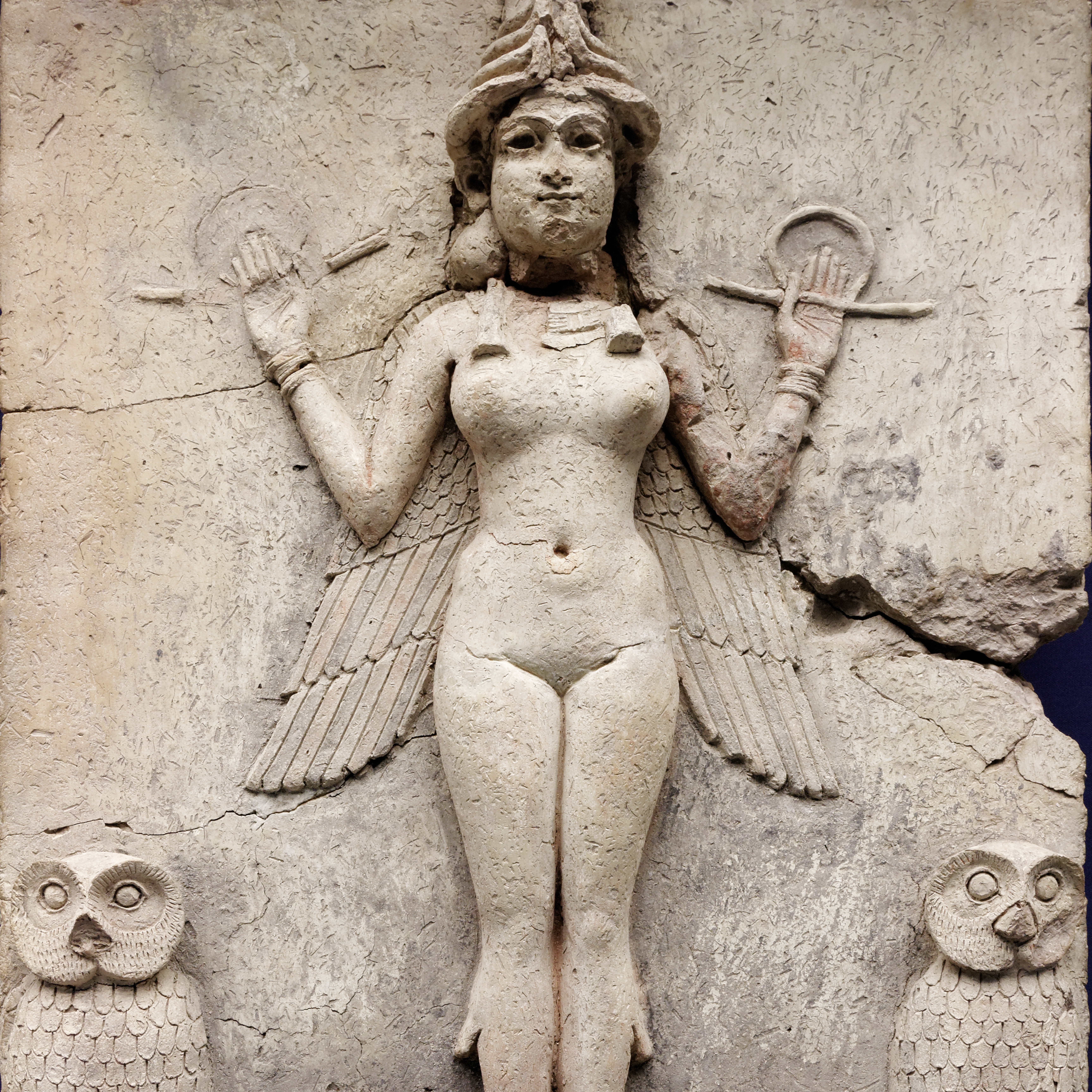
The Mesopotamians held another powerful goddess in reverence, too. This was Ishtar’s sister, the severe and terrifying Ereshkigal, Queen of the Netherworld, mistress of the dead. Shall we go see what she’s up to, hmm? Shall we remind ourselves how these earliest writers pictured the afterlife? Seems as good a time as any.
[music]
Of the five netherworlds we’ve encountered so far, we have one antagonistic realm, one pleasant realm, and three neutral realms. The antagonistic afterlife is the Egyptian one, with its riddles, journeys, ravenous monsters, and legal dramas – again, head back to episode 5 for complete details. For now, I’ll just remind you that the Egyptian netherworld is the only one we’ve encountered so far that includes the idea of judging the soul in any way.
The pleasant afterlife belongs to the Rig Veda, or at least to one of the hymns we encountered, the one translator Wendy Doniger titles “Yama and the Fathers.” In it, the singers invite Yama, god of the dead, to attend the funeral they are holding. They ask him to lead the deceased person’s spirit along safe paths to green pastures. They implore their departed friend or relative to:
“Unite with the fathers, with Yama, with the rewards of your sacrifices and good deeds, in the highest heaven. Leaving behind all imperfections, go back home again, merge with a glorious body.” (Doniger 44)
In addition to green grass, the afterlives elsewhere in the Rig Vedic hymns feature beautiful ladies, lush feasts, and, of course, plenty of Soma. Seems like a good deal.
Then we come to the neutral afterlives. By this I mean two types of neutrality: one, there’s no distinction between “good” and “bad” people, or between social classes. Two, the souls there do not experience torment, nor do they experience bliss: instead, they’re just sort of hanging out in the dark.
These versions of the netherworld are actually more disquieting to me than the idea of an afterlife of eternal torment: endless silence and stillness fills me with dread, makes it hard to breathe if I think about it for too long. Whereas, if I were sent to a medieval-style hell where I’d be punished forever – having my toenails ripped out every few hours while Foreigner’s Juke Box Hero plays on an endless loop, say – that would at least involve something happening to me.
To resume. The first neutral netherworld I’ll describe is Sheol, the netherworld of the Hebrew Bible. Mainly because there’s very little to describe – it’s mentioned infrequently and in the vaguest terms in Exodus and Genesis, and only somewhat better illustrated in later books. Sheol seems for the most part to be a place of stillness and darkness, though in at least one place it’s described as having separate regions for the righteous dead and the wicked dead.
There are a couple of hints that it could be a place of punishment. In Deuteronomy, Moses sings a hymn to Yahweh which mentions that Yahweh’s anger is like a flame burning in Sheol; a flame hot enough to consume the world. In Isaiah, Sheol is used as a threat aimed the unfaithful – but then, as we’ll see when we cover it next year, most things in the book of Isaiah are threats aimed at the unfaithful.
In the first book of Samuel, King Saul summons the Witch of Endor to help him speak to the spirit of the prophet Samuel. Samuel is very annoyed at being called up out of Sheol to talk to the King – while this practice is possible, he makes clear that it’s forbidden. Beyond these clues, however, we don’t really know what the souls in Sheol experienced. There’s no equivalent of Hesiod to tell us how souls journeyed there, what went on when they arrived, or whether they had some sort of supernatural custodian.
For the Mesopotamians, on the other hand, depictions of the netherworld are clear and consistent across centuries. The Assyriologist Irving Finkel, in his book The First Ghosts: Most Ancient of Legacies, quotes a passage that he says was repeated word-for-word in at least three different stories about the netherworld:
“To the House of Darkness, the Seat of Irkalla,
To the house from where no one who enters can leave
To the journey from which there is no going back
To the house whose dwellers are deprived of light
Where dust is their sustenance, clay their food
They see no light, dwelling in darkness
They are clad, like birds, with wings as garments
On door and bolt dust gathers.” (Finkel 35)
Irving goes on to refer to the winged dead in his own words, describing them as “waiting and waiting in unending blackness and despondency like depressed and inscrutable penguins.” (136)
Ruling over all of this is Ereshkigal, the solemn queen. In some stories, her realm includes a fountain of life which she must guard ceaselessly, so as to prevent souls from escaping back to the world of the living. But even in these versions of the story, she is not vengeful: just pitiless and grim. She is rather like Hades, really. And aside from the fact that the souls eat dust and have wings, so is the netherworld she rules.
Hades, for his part, is also the lesser sibling of a flashy god: Zeus is his younger brother. Hades dwells in his dark halls beyond the river Styx, accompanied for half the year by his young wife Persephone. She is also, of course, a close blood relation: in this case, she’s his niece.
Hades is stern, but largely indifferent to the souls in his custody. He usually only gets actively angry if someone tries to escape. There’s also a myth told about him – not in Hesiod, but elsewhere – in which he realizes that Asclepius, a human son of Apollo, has become so skilled as a doctor that fewer people are dying. Hades is enraged by this: it’s his job to harvest souls, after all, and he doesn’t want any mortal cutting in on his trade. He complains to Zeus, who, alarmed that Asclepius will become such an effective medical practitioner as to make human beings immortal, zaps the poor doctor with a thunderbolt.
In spite of this, the Greeks were apparently very frightened of Hades. It became taboo to mention his name directly, so they invented euphemisms or epithets to refer to him when necessary. One of these was derived from his status as the god of wealth as well as of death – corpses may go in the ground to meet Hades, but precious metals and crops come out of it, too.
It turns out that an ancient Greek word for “wealth” is pluton. The Greeks began calling him that, and the Romans later adopted it, too.
Isn’t that nice? I’ve brought us full-circle, tied us right back in to the opening of the show.
That’s this week’s episode. Like I said, reading Theogony for our previous episode illuminated so many connections among the mythologies we’ve encountered to date. I wanted to get them straight in my mind, and I thought you might find that interesting – especially if you’ve been following along with the show since the beginning. This episode was also an excuse to take another look at the ancient Mesopotamians and Egyptians again since we won’t be revisiting their myths. The Greeks, on the other hand: we are going to see so much of them.
But not right away! Next episode, we are heading back to ancient India. We’re going to engage with some of the most important mythological, philosophical, and religious concepts that very fertile subcontinent has produced. Join me on Thursday, October 10th, for Episode 17: “The Upanishads, Part 1: By Wisdom and By Toil.”
Books of All Time is written and produced by me, Rose Judson. The Disclaimer Voice of Doom is Ed Brown. Lluvia Arras designed our cover art and logo. Special thanks to Yelena Shapiro, Cathy Merli, Matt Brough and the Books of All Time Advisory Council: Ed Brown, Beck Collins, Neil Dowling, Caitlin McMullin, Hugh Parker, and Jonathan Skipp. You can support the show by subscribing and leaving a rating or review at Apple Podcasts, Spotify, or wherever you get your podcasts. You can also follow us on social media: we’re on Bluesky, Instagram, Facebook, and also on X, formerly known as Twitter. Thanks for listening! I’ll be back in two weeks.
References and Works Cited:
Altaweel, Mark, and Andrea Squitieri. “The Rise of Shared and Universal Religions.” UCL Press, 2018, pp. 240–252. From Small States to Universalism in the Pre-Islamic Near East, http://www.jstor.org/stable/j.ctt21c4td4.14.
Armstrong, Karen. A Short History of Myth. Canongate, 2018.
Aslan, Reza. God: A Human History of Religion. Corgi Books, 2018.
“A Brief History of the Afterlife.” HistoryExtra, HistoryExtra, 1 July 2020, http://www.historyextra.com/period/ancient-history/history-afterlife-meaning-what-happens-when-we-die/.
Finkel, Irving L. The First Ghosts: Most Ancient of Legacies. Hodder, 2022.
Glenn, Joralyn. “Ancient Egyptian Creation Myths: From Watery Chaos to Cosmic Egg.” Glencairn Museum, Glencairn Museum, 4 Nov. 2022, http://www.glencairnmuseum.org/newsletter/2021/7/13/ancient-egyptian-creation-myths-from-watery-chaos-to-cosmic-egg.
Hesiod. Theogony and Works and Days; Translated with an Introduction and Notes by M.L. West. Oxford University Press, 1988.
Mark, Joshua J. “Enuma Elish – the Babylonian Epic of Creation – Full Text.” World History Encyclopedia, https://www.worldhistory.org#organization, 6 Dec. 2022, http://www.worldhistory.org/article/225/enuma-elish—the-babylonian-epic-of-creation—fu/.
“Pluto – NASA Science.” NASA, NASA, science.nasa.gov/dwarf-planets/pluto/.
Spar, Ira. “Mesopotamian Creation Myths.” The Met’s Heilbrunn Timeline of Art History, Metropolitan Museum of Art, 1 Apr. 2009, http://www.metmuseum.org/toah/hd/epic/hd_epic.htm.
“Venetia Burney Phair (1918-2009) – NASA Science.” NASA, NASA, science.nasa.gov/people/venetia-burney-phair/.


 Books Of All Time
Leave a comment